- [[<span class="smw-highlighter" data-type="4" data-state="inline" data-title="Warning" title="Some use of "|]]
- "
- In your query was not closed by a matching "
- "
- [[.">Some use of "" in your query was not closed by a matching "".|]]
This page will include a discussion on methodological issues related to the translation of the Bodhicaryāvatāra into modern languages. In this discussion, we will identify key points that are particularly relevant for translators of Indian Buddhist treatises.
As an example of these kinds of discussions, below we present the preface to the revised edition of Padmakara's translation of the Bodhicaryāvatāra, The Way of the Bodhisattva, in which Helena Blankleder and Wulstan Fletcher discuss various issues involved in the translation of this classic text.

GREG'S NOTE: This page will include a discussion on methodological issues related to the translation of the Bodhicaryāvatāra into modern languages. In this discussion, we will identify key points that are particularly relevant for translators of Indian Buddhist treatises.
MARCUS NOTES: THIS NEEDS WORK SEE DOC FOR EDITING HERE
"Śāntideva's Bodhicaryāvatāra is one of the most translated Buddhist texts." (Nelson 2016). Not only that, it is one of the most discussed work by translators when speaking about translation methodology, including as a basis of multiple workshops and conferences by academics. In 2005, Nicole Martinez Melis wrote a descriptive analysis of several translations of the text, in part because of "... a significant publishing event...the appearance of seven translations in the space of just five years, between 1992 and 1997" (Melis 2005). Since then, so many translations have appeared in so many languages it is difficult to count, but through our research here, we estimate that there have been no less than 35 publications including a complete translation of the text since 1997. Currently, there are more than 74 complete translations and 33 partial translations of the text in our archive. There may be upwards of 140 translations of Cervantes' Don Quixote, and it may only be a matter of decades before we see that number of translations of Śāntideva.
- Melis, Nicole Martinez. "The Bodhicaryāvatāra: A Buddhist Treatise Translated into Western Languages." In Less Translated Languages, edited by Albert Branchadell and Lovell Margaret West, 207–24. Amsterdam: John Benjamins. 2005.
- Nelson, Barbara. "Śāntideva's Bodhicaryāvatāra in Translation: A Century of Interpretation of a Sanskrit Mahāyāna Text." Journal of Religious History 40, no. 3 (2016): 405–27.
Luis Gomez says: As in other bodies of literature, a few Buddhist works have gained special favor among modern scholars and readers. Some have achieved the exalted status of membership in the modem canon of Buddhist texts. Śāntideva's Bodhicaryāvatāra can claim to be among these select few.[2] Without question it is the most translated among Indian Buddhist works of the śāstra genre. Although it is difficult to keep up to date with, or keep an accurate census of, the many modern language renderings of classical Buddhist texts that appear in contemporary libraries and bookstores, I would venture to say that the Bodhicaryāvatāra most likely now occupies the third position among the most frequently translated Indian Buddhist texts, after the Dhammapada and the "Heart Sutra."[3] (The Way of the Translators (1999))
Topics/Translation and Subtheme Translation methodology.
This page needs work. The top should contextualize this whole situation more. This is one of, if not THE most translated Buddhist text into English and it has been used to discuss translation on many occasions in print and in speeches. Ths page should also highlight this discussion and perhaps others from our translation conferences: https://www.shambhala.com/translating-the-way-of-the-bodhisattva/ - Gomez and others spoke about this in different ways at several events, we just need to identify which videos are relevant. Bonus content, Luis Gomez last public speech could be edited out of this longer video: https://conference.tsadra.org/session/approaches-to-translation-transmission/
"Many translations of Śāntideva's Bodhicaryāvatāra, a Sanskrit Mahāyāna Buddhist text of seventh/eighth-century India, have been published since 1892. Śāntideva's Bodhicaryāvatāra is one of the few Indian Mahāyāna Buddhist texts available in Sanskrit and it was influential in Tibetan Buddhist schools. This article explores how translation of the Bodhicaryāvatāra is no longer the preserve of scholars but has moved to being carried out by Buddhist practitioners influenced by Tibetan schools of Buddhism. It shows how translators' motives for translating the text have reflected changing attitudes to Buddhism and its texts. Śāntideva's Bodhicaryāvatāra has been translated as a source of information, a literary work, an inspirational work and, with the rise of Western interest in Tibetan Buddhism in the late twentieth century, as a vehicle for the transmission of Buddhist teachings. Nevertheless, further scholarly investigation of the Sanskrit text of the Bodhicaryāvatāra remains to be done."
SOURCES: Nelson, Barbara. "Śāntideva's Bodhicaryāvatāra in Translation: A Century of Interpretation of a Sanskrit Mahāyāna Text." Journal of Religious History 40, no. 3 (2016): 405–27. DOI: 10.1111/1467-9809.12307
Collett, Alice. ed. Translating Buddhism: Historical and Contextual Perspectives. Albany, N.Y.: State University of New York Press. 2021.
See Padmakara The Way of the Boddhisattva p.i-xxi
When the first edition of The Way of the Bodhisattva was published in 1997, it was stated that the commentary of the Nyingma master Khenpo Kunzang Pelden (1872-1943) had been consulted for the elucidation of difficult passages. At the time, a translation into English of that long and important work was no more than a pious dream. Now, after a wait of almost ten years and many intervening projects, this task has been completed; and the careful reading and study of the text that it involved prompted us to revisit and overhaul our original version of The Way of the Bodhisattva, correcting errors and, where possible, making it a tauter, more literal, reflection of the Tibetan original. We hope that we have been able to rectify the perhaps undue freedom of expression in the earlier rendering that led some of its readers to question its accuracy, while at the same time maintaining and improving on the stylistic features that others found attractive. It is a rare thing in the publishing business to have the opportunity to amend past work and to remove, or at any rate diminish, its more obvious blemishes; and we are extremely grateful to Emily Bower and the staff at Shambhala Publications for being willing to produce this new edition.
Since 1997, several other translations of the Bodhicharyāvatāra have appeared in English. The first, published just as The Way of the Bodhisattva was going to press, was made by Kate Crosby and Andrew Skilton directly from the surviving Sanskrit text. This was followed shortly afterward by the translation of Vesna and Alan Wallace, made also from the Sanskrit but with reference to the Tibetan, and with the Tibetan variants given in footnotes. Later, in 2003, a version was published by Neil Eliott based in the explanations of Geshe Kelsang Gyatso. Most recently, another rendering (printed and circulated at the time of His Holiness the Dalai Lama's teaching on the Bodhicharyāvatāra in Zurich, 2005) was produced by Alexander Berzin, mainly from the Tibetan but revised and corrected in light of the Sanskrit. Finally, yet another project to translate Shāntideva's root text and the commentary by Kunzang Pelden, accompanied by the inestimable explanations of Khenpo Chöga of Shri Simha College in Kham, was inaugurated in 2002 by Andreas Kretschmar, who, in an act of great and openhanded generosity, has made his as yet uncompleted work freely available on the Internet. All these translations are of the greatest interest, and although, for our interpretation, we have followed Kunzang Pelden in all things, in preparing this revised edition, we have diligently compared our work with the versions just mentioned and gratefully acknowledge the help that they have given us.
The appearance of translations of the Bodhicharyāvatāra made from the Sanskrit, side by side with others made from the Tibetan, calls into question with renewed force the desirability of translating what is itself a translation, when a manuscript of the text still exists in the original language. This is closely connected with another question, which concerns the relative merits of study (and by extension, translation) within the environment of secular Western scholarship as contrasted with the traditional setting of a Tibetan monastic college and a teacher-disciple relationship. These two approaches differ considerably both in method and objective. The Buddhologist of Western academia aims, through the examination of texts, archaeological evidence, and so on, to arrive at a scientifically objective understanding of a religious culture. This is viewed, from outside, as an essentially anthropological phenomenon, the beliefs and practices of which are described and classified within a discipline that consciously distances itself from religious allegiance and practice.[1] Buddhists, on the other hand, study the sacred texts as part of a spiritual discipline, intending or at least aspiring to implement the teachings they contain. And to that end, they attach an equal importance not only to the origins and authorship of the texts, but also to the living tradition of explanation and practice that has preserved them into the present age. These two approaches obviously overlap, in the sense that textual accuracy and correct interpretation are of prime importance for both. Nevertheless, they diverge in important respects; and it is important to recognize the difference between independent, academic scholarship, with its essentially humanistic interest in texts, as compared with the allegiance to a tradition of spiritual training: detached erudition on the one hand, committed involvement on the other.
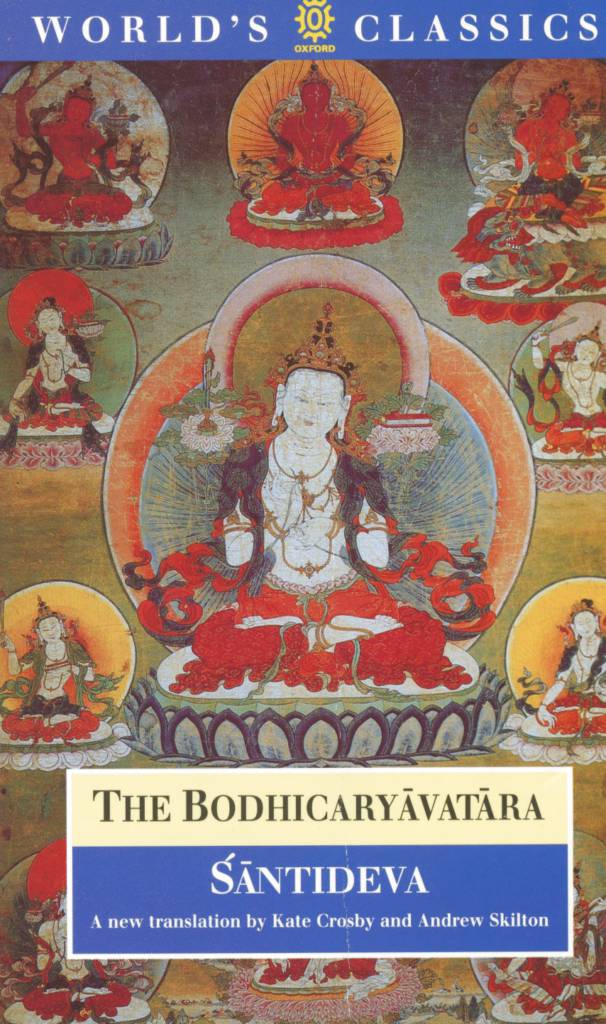
There is no doubt that the findings of Western scholarship in the Buddhological field are important and interesting. The brief but valuable introductory material to the translation by Crosby and Skilton describes the groundbreaking work of Akira Saito on the textual history of the Bodhicharyāvatāra, made possible by the discovery, in the caves of Dun-huang at the beginning of the twentieth century, of three manuscripts of a hitherto unknown Tibetan translation—a rendering that differs notably from the much longer version revised by Ngok Loden Sherab and Sumatikīrti and preserved in the Tengyur. To be sure, tradition records the existence of several versions of the Bodhicharyāvatāra, attributing this fact to the peculiar circumstances in which the poem was first publicized. Shāntideva's biography specifies that a text of one thousand shlokas in ten chapters was produced by the paṇḍitas of Magadha, while their confreres of Kashmir recorded only seven hundred shlokas in nine chapters. Given that the colophon to the Tibetan text we now possess tells us that Kawa Peltsek made the first translation of the Bodhicharyāvatāra using a manuscript from Kashmir (perhaps descended from the work of the very paṇḍitas mentioned by tradition) and given that the translation contained in the Dun-huang manuscripts is indeed a text of nine chapters, the evidence, though not conclusive, tantalizingly suggests that the recension found at Dun-huang is in fact the long-lost translation of Kawa Peltsek.[2] When this text is fully edited and published, a comparison of it with the canonical version will allow us to appreciate how much of Kawa Peltsek's original work (assuming that the Dun-huang translation is his) has survived in the later revisions. But for our understanding of the translation of the Bodhicharyāvatāra into Tibetan and of the history of its various recensions, it is improbable that the discoveries at Dun-huang will simplify the picture. If anything, they are likely to reveal a scenario more complicated than tradition records. On the face of it, and despite the inconvenient fact that the length of the extant Sanskrit and Tibetan texts of the Bodhicharyāvatāra corresponds not at all with the figures quoted in the traditional records, it seems plausible nonetheless that the Sanskrit text and Loden Sherab's revised translation correspond, by and large, to the version authenticated by Shāntideva when he was consulted by the disgraced scholars of Nālandā. But according to Western scholarship, this is far from certain. There are reasons for thinking that, compared with the canonical text, the Dun-huang recension embodies a streamlined and more coherent version of the Bodhicharyāvatāra that could, for that reason, lay claim to being a more faithful reflection of Shāntideva's original work. Conversely, so the argument continues, the problems of the canonical version (its asymmetrical layout, its occasional repetitiousness, the difficulty and obscurity of some of its arguments, and so on) are reasons for thinking that the text we now have is in fact a restructured version of the original work, enlarged in the centuries following Shāntideva’s death by the interpolation of material taken from the commentarial tradition. And in the spirit of such Formkritik, academic erudition will no doubt conclude that the story of Shāntideva's disembodied voice, the limited capacity of recall displayed by the scholars of Kashmir compared with the naturally superior performance of the paṇḍitas of the "central land" of Magadha (with their suspiciously round figure of ten chapters and one thousand shlokas), and the subsequent ratification by the author—is no more than an etiological myth devised, first, to explain the fact that there were at least two known versions of the text, and then to vindicate the authenticity of the longer version preserved in the canon.
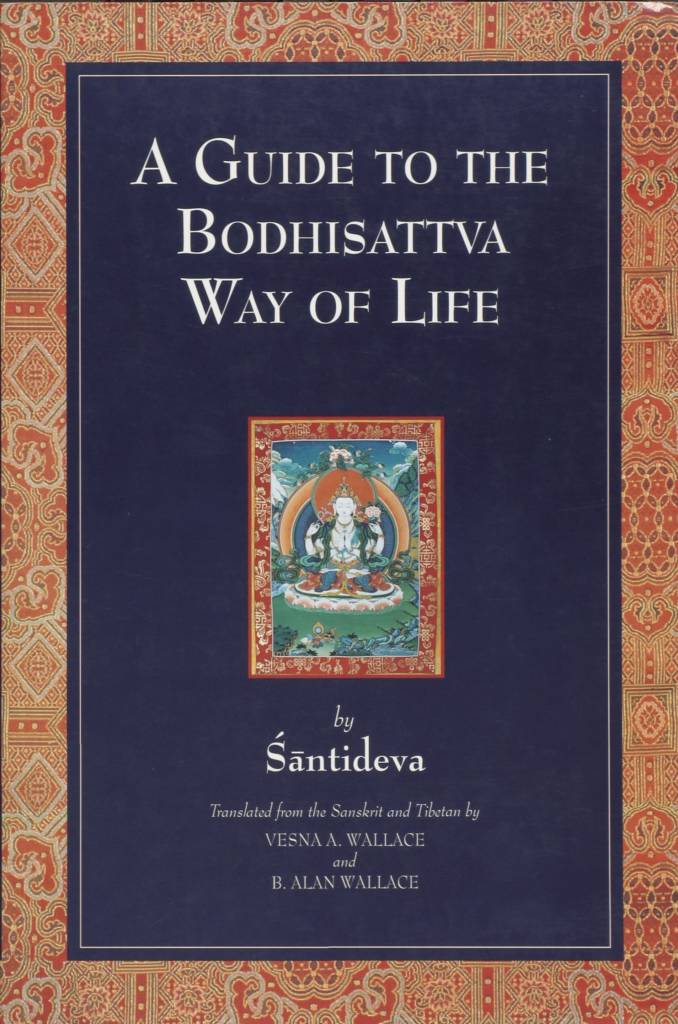
Doubts have also been raised regarding the history and authenticity of the surviving Tibetan translation itself, which is usually assumed to correspond with the Sanskrit text that we still possess. In point of fact, as V. and A. Wallace have made clear, the Tibetan version (that is, the final recension made in the eleventh century) diverges, in some places quite considerably, from its Sanskrit counterpart. Are we to conclude from this that the Tibetan translators were working with a lost Sanskrit version different from the one that still survives? Or are the differences between the Sanskrit and Tibetan versions the result of oral explanations given by the Indian paṇḍitas to the Tibetan translators with whom they worked, which made necessary an interpretative rather than a strictly literal rendering of the Sanskrit original?
Once again, these are questions that Western scholarship, with its resources in archaeology, paleography, and penetrating textual criticism, is best equipped to answer; and the results of such research will be primarily of interest, as we have said, to students of religious and cultural history. By contrast, the needs and expectations of practicing Buddhists, who approach the Bodhicharyāvatāra primarily as a manual for living, are of a quite different order.
The findings of academic study with regard to the textual history of the Bodhicharyāvatāra, and the question whether the Tibetan text we now have corresponds in all respects to Shāntideva's autographed copy are obviously of considerable interest. But for the Buddhist practitioner they are of secondary importance. From a traditional point of view, the authenticity of the Bodhicharyāvatāra depends not just on the historical identity of its author, but also, and perhaps even more importantly, on the generations of practitioners who, by their experience and realization have attested to the truth and effectiveness of Shāntideva's teaching. For the Buddhist, the contribution to a tradition made by the lineage of its accomplished practitioners is just as crucial as that of its source. It is generally thought that the text of the Bodhicharyāvatāra is accompanied by an oral transmission that began with its author[3] and has been passed down for nearly fifteen centuries. It was bequeathed by the Indian paṇḍitas to the Tibetan translators, and they in turn transmitted it to successive generations of meditators and scholars. The Sanskrit transmission of the Bodhicharyāvatāra, presumably existing between Shāntideva's time and that of Sumatikīrti, who collaborated with Ngok Loden Sherab, was interrupted and lost in the calamities that engulfed Indian Buddhism in the twelfth century. By consequence, the oral transmission and explanatory lineage of Shāntideva's teaching exist only in Tibetan and for obvious reasons cannot be resurrected from the Sanskrit relics.
The difference in meaning between a translation made from the Sanskrit and a translation made from the Tibetan may not, in point of fact, be very great. Nevertheless we would argue that for those who are interested in practicing the Bodhisattva path, the Tibetan translation of the Bodhicharyāvatāra occupies a position of greater significance than a modern rendering, be it never so scholarly and accurate, of a Sanskrit manuscript that by chance escaped the destruction of the Buddhist libraries in India. The accidents of history have determined that the textual and commentarial transmission of the Bodhicharyāvatāra stretching back to Shāntideva—the human connection, so to speak—lies in the Tibetan and not in the Sanskrit. Where there are discrepancies between the two renderings, therefore, it by no means follows that a version translated from the Sanskrit is automatically to be preferred.
It has been said that when translating Buddhist texts, it is essential to aim for literalness as a guarantee of accuracy, and that it is unnecessary to be overly concerned for elegance of expression.[4] Whether literal, as distinct from interpretative, rendering is a gauge of fidelity in translation—whether indeed a truly literal rendering between two languages is even possible—is a large question, one that has preoccupied translators and translation theorists for generations.[5] As a general principle, however, we would certainly agree that it is right to prefer the literal to the elegant rendering if by "elegance" is meant a contrived, self-conscious style that uses the original text as a stage on which to display itself. As Dr. Johnson observed, "A translator is to be like his author; it is not his business to excel him." Accurate inelegance, in other words, is preferable to elegant invention. The point is well made, and yet there is something unsatisfactory in setting literal accuracy against elegance of style in such uncompromising opposition. For it is obvious that the character and effectiveness of any composition are profoundly affected by stylistic considerations.
The complete meaning of a statement, in content and nuance, derives not just from what is said, but also from how it is said—and when, and where, and to whom. A perfect translation, were such a thing to exist, would surely be one capable of producing in its readers an exact echo of the intellectual and emotional experience felt by native speakers in their own time and place on encountering the text in the original tongue. No doubt this is a high and probably unattainable goal; but it is one worth striving for. In any case, it is the task of the translator not simply to provide word-for-word cribs—classroom tools devised to help students puzzle their way through the original. The goal, surely, is to produce versions that are completely viable in their own right for those who will never be in a position to read the literature in the source language and who must depend on translations as if they were the texts themselves. In such a case, closeness and fidelity to the original are of vital importance, and by the same token, the obscuring effect of a contrived and artificial "elegance" is something to be avoided at all costs. And yet one would have thought that an accurate rendering, expressive not only of the content but also of the style of the original, which consists of plain, clear, well-balanced sentences that are pleasing both to eye and ear, and can be understood in a single reading all this is elegant and effective translation. Alas, this kind of writing is a comparative rarity nowadays in Buddhist literature in English. How often it happens that correct renderings are ruined by stylistic ineptitude.
To say, as some have done, that the translation of Tibetan texts need not be elegant because the originals are not elegant begs an important question.[6] Aesthetic standards vary from culture to culture and from language to language, and it is far from clear that we are in a position to judge what the speakers of the source language find, or found, pleasing. We ourselves have heard a Tibetan teacher enthusiastically praising the grace of Patsap's translation of the Madhyamakāvatāra; and it is recorded that Tsongkhapa was moved to tears by the beauty of the Pramāṇavārttika. This represents a considerable challenge for the translator, for it is surely insufficient to render texts that, however difficult they may be, are considered fine and beautiful in the original, by translations that are dull and sometimes so opaque and turgid as to be unreadable.
The translation of the Bodhicharyāvatāra into verse, or rather rhythmic prose, is an attempt to come to terms with this difficulty. The result is a kind of blank verse (sometimes very blank) that can rarely claim the status of poetry and might best be described as a literary experiment. Its purpose is to provide a vehicle that, by being not altogether unpleasant, might contribute positively to the expression and propagation of Shāntideva's teaching.

Source: Wikipedia
We have tried to follow the wise principle of King Alfred (849-899), perhaps the first of English translators ("sometimes word for word, sometimes meaning for meaning"), by which he meant that translation should be literal where possible, free and interpretative where necessary, and at all times accurate. In translating the Bodhicharyāvatāra, it is perhaps not possible, or even desirable, to achieve the equivalent of Luther's declared intention in his translation of the Old Testament: "to make Moses sound so German that no one would ever suspect he was a Jew." Nevertheless, it has been our aim to convey Shāntideva's meaning as clearly as we could, and to give him a voice that might fall on the ears of English speakers as pleasantly as it seems to do for Tibetans. Of course, there is no accounting for taste, and it is hardly to be expected that our goal has been wholly, or even mostly, successful. But it is our hope that, by adhering to the explanations of Kunzang Pelden, the translation is as faithful and close as meager talent and English idiom will allow, and that whatever is found to be "poetic" will not be thought to derogate from its accuracy as a rendering.
Our hoped-for goal has been to throw a bridge across the barrier of language so that English readers may hear Shāntideva speaking to them persuasively and in familiar accents, enabling them to discover wisdom and a way of life easily and accessibly in their own tongue. As the translators of the King James Version of the Bible observed in the preface to their own unsurpassed achievement,
Translation it is that openeth the window, to let in the light; that breaketh the shell, that we may eat of the kernel; that putteth aside the curtain, that we may look into the most Holy place; that removeth the cover of the well, that we may come by the water.[7]
Notes
- ↑ Consider the remark of Paul Griffiths: "The Buddhologist qua Buddhologist cannot be a religious enthusiast, proselytiser, or even, one might go so far as to say, Buddhist." See "Buddhist Hybrid English," pp. 17-33. The same sentiments are expressed by Crosby and Skilton: "We hope the reader will appreciate that all of this material is offered by way of explanation for the general reader, rather than as the exegesis of scripture for the purposes of religious practice." See The Bodhicaryāvatāra, p. xxvii.
- ↑ For more details, see Kretschmar (Vol. 1, pp. 13-18), who is categorically in favor of Kawa Peltsek's authorship of the Dun-huang translation and who notes Saito's belief that there were two and perhaps three different Sanskrit versions of the Bodhicharyāvatāra in existence during the period when the text was translated into Tibetan. See www.kunpal.com/bcaicomm.pdf
- ↑ See appendix 1 for Shāntideva's encounter with the paṇḍitas who were sent from Nālandā to find him.
- ↑ See the remarks of Elizabeth Napper in "Styles and Principles of Translation." In Buddhist Translations: Problems and Perspectives, p. 36.
- ↑ See George Steiner's interesting reflections on this matter in After Babel, p. 324.
- ↑ See Elizabeth Napper, p. 40.
- ↑ Taken from the "Translators' Preface" to the King James Version of the Bible.
The titles listed in the bibliography below are useful sources to develop this page. Even if their main focus appears to be on different subject, they have been selected because they include valuable information on the topic of this page.
