- [[<span class="smw-highlighter" data-type="4" data-state="inline" data-title="Warning" title="Some use of "|]]
- "
- In your query was not closed by a matching "
- "
- [[.">Some use of "" in your query was not closed by a matching "".|]]
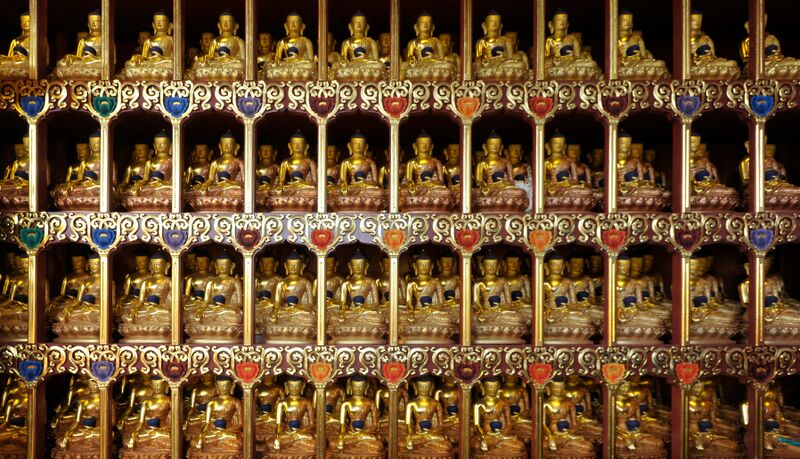
Chapters 16–19 cover the fourth major topic of The Compendium of Training—namely, enhancement of the body, possessions, and merit. According to Śāntideva, true fulfillment is only achieved by the attainment of buddhahood. Therefore, a bodhisattva's body, possessions, and virtue must be enhanced through various practices, including the culitvation of right effort and enthusiasm, charitable giving, making offerings and prostrations, recollecting the Three Jewels, and putting other sentient beings at the center of all of one's activities.
Chapter 19: Enhancing Merit
The final chapter on enhancement of merit brings us back to the discussion of how to increase merit by thinking of sentient beings in all situations. Śāntideva quotes The Jewel Cloud Sūtra, which gives the advice that when one offers flowers, incense, or perfumes to the image of the Buddha, one must wish that the ordinary foul smell of sentient beings is eradicated and that they attain the fragrance of the discipline of the Buddha. Similarly, the sūtra states that if one is cleaning or plastering an image of the Buddha, one must wish that the ugly behaviors of sentient beings are eliminated and that they possess beautiful wholesome behavior. In the same way, the sūtra states, if one enters a temple, one must think that all sentient beings are being led to the city of nirvana, if coming out, think that all sentient beings are being taken out of samsara, if opening a door, think the door of the happy realm of transcendental wisdom is being opened, if closing the door, think the door of unhappy realms is being closed, and so forth. Likewise, every activity is to be used as a way to think of benefitting sentient beings.
Śāntideva also cites The Perfection of Wisdom Sūtra, although he does not mention which version, wherein the Buddha addresses Śāriputra to say that a bodhisattva should not be scared of going to a wilderness filled with terrifying beasts but to take it as an opportunity to cherish such beings and to think that even if he is eaten by the beasts, he will be achieving the perfection of giving and coming closer to perfect enlightenment. He should pray that the realm in which he becomes a buddha is free of such beasts. Likewise, for thieves and for all other troubles, one must think of the opportunity such a situation provides to benefit sentient beings and practice the path and get closer to buddhahood.
A bodhisattva should also give Dharma that involves no entanglement and serves as a cause of enhancing merits. The Sūtra Encouraging Superior Intention (Skt. Adhyaśayasaṃcodanasūtra) states that teaching Dharma without expecting material gain or service leads to twenty benefits, including possession of mindfulness, awareness, intelligence, interest, wisdom, supramundane realization, low attachment, low aversion, low ignorance, becoming invincible by the evil force, living up to the ideals of buddhas, being protected by nonhuman spirits, being shown light by the gods, being unaffected by the unfriendly, being inseparable from the friendly, being listened to, attaining fearlessness, having plenty of mental peace, being praised by the wise, and recollecting the giving of Dharma. Among the teachings, the Buddha tells Ānanda that teaching the doctrine containing the perfection of wisdom for a session is more meritorious than teaching the doctrine of the hearers to all sentient beings in the trichiliocosm, which leads all of them to the state of an arhat.
In order to present details on how to give teachings on Dharma, Śāntideva cites The Sacred Dharma of White Lotus Sūtra (Skt. Saddharmapuṇḍarīkasūtra). According to this sūtra, one must enter a room, close the door to properly study the topic, and then teach with a fearless mind. The wise one should be at ease and teach in a clean and pleasant venue, sitting on a wide seat with a foot pedestal, wearing clean and well-dyed robes, having washed one's feet properly, and with the face smooth and lustrous. He should deliver various discourses to different audiences in pleasant words with single-pointed concentration and loving-kindness but without laziness, jealousy, and weariness. He should have no desire for food, drinks, clothes, bedding, robes, and medicine, and should accept nothing from the students. Rather, he should wish that oneself and other beings become buddhas and should think that teaching to benefit others is the provision for happiness.
The Moon Lamp Sūtra (Skt. Candrapradīpasūtra, aka Samādhirājasūtra) mentions how a bodhisattva must express modesty when asked to teach by first saying "I have not learned in detail. You are knowledgeable and learned. How can I teach in the presence of a great person?"[1] One should not rush to speak without studying the audience. Only if one knows the audience, one can teach without being asked. The sūtra also advises the teacher to be sensitive to the situation of the audience. For instance, if some among the audience are poor, one should not teach them to reduce possessions but instead praise giving. However, if the audience has very little desire, one can encourage them by speaking about reducing possessions.
Śāntideva also presents a mantra from The Questions of Sāgaramati (Skt. Sāgaramatiparipṛcchāsūtra) that the teacher should chant along with loving-kindness for the disciples before teaching so that evil forces cannot cause havoc to the sermon. The teacher must think of himself as a doctor, the teaching as medicine, the audience as patients, the Buddha as a sublime being, and he should wish for the Dharma to remain for a long period. With this, Śantideva concludes the discussion of teaching Dharma, which is one of two main ways to enhance merit he recommends, the other being the cultivation of bodhicitta, to which Śāntideva turns next.
Bodhicitta, later commentators would argue, is the central theme of Śāntideva's two works. Although Śāntideva does not explicitly define bodhicitta in either of his two works, there is no doubt he understood bodhicitta to be the altruistic thought to seek the perfect enlightenment of the Buddha for the sake of all sentient beings, as it is generally understood in Mahāyāna literature. It is the wish to take all sentient beings to perfect enlightenment, the ultimate state of lasting happiness. In chapter 1 of The Compendium of Training and in his Way of the Bodhisattva, he mentions the two types of bodhicitta, aspiring and applied, and extensively discusses their merits. To highlight the power of bodhicitta in generating merit, he cites here The Basket of Jewels Sūtra (Skt. Ratnakāraṇḍasūtra), in which the Buddha tells Mañjuśrī that the virtuous actions of a bodhisattva will grow vigorously if dedicated to the state of omniscient buddhahood, just as a sal tree grows when the four elements are present. The full understanding of how bodhicitta enhances merit can be grasped only by a buddha, and what is mentioned here through analogies is to encourage beginners to engage in the practice of bodhicitta and observe the associated precepts through vigilance, mindfulness, and awareness.
To promote merit through bodhicitta, Śāntideva frames the yang dag spong bzhi, or four right efforts, in the context of three last activities of protection, purification, and enhancement presented in this work. Śāntideva states that to strive to stop sinful actions which have not yet come about is protection, to strive to abandon sinful actions which have arisen is purification, and to strive to bring about virtuous actions which have not arisen and to enhance those which have arisen is enhancement. These are achieved by having vigilance, which is the root of virtues. Śāntideva cites several sūtras which highlight the importance of vigilance, define what it is, and praise its virtues. In The Sūtra on the Buddha's Secrets, the Buddha addresses Guhyapati, or Vajrapāṇi: "O Guhyapati! One who has faith, vigilance, enthusiasm, mindfulness, and awareness must strive for implementation. Guhyapati! A bodhisattva who strives properly will know what exists to exist and what does not exist to not exist."[2]Thus, vigilance, mindfulness, and awareness are taught to be critical for the proper practice of bodhicitta and the understanding of things as they are.
Śāntideva then explains the cultivation of bodhicitta through the equality between oneself and others and through the exchange between oneself and others. Just like ideas such as "here" and "there" are relative, he argues that self and others are relative creations and that one cannot distinguish oneself and others in reality. Thus, it is not rational to only dispel one's own suffering and seek one's own happiness. "I must clear the suffering of others because they are suffering, like my own suffering. I must benefit others because they are sentient beings, like my own body," Śāntideva argues in his Way of the Bodhisattva.[3]
If the justification were that one need not dispel the suffering of others because one does not directly experience the suffering, then, he argues, one need not even avoid one's suffering in the future, as one does not experience it directly now. He refutes the existence of a continuous entity, such as the prakṛti nature postulated by the Sāṃkhya school and the absolute atom of the Vaiśeṣikas, and argues that even notions of continuum and aggregates lack real existence and are false. Śāntideva presents the various arguments he used in his Way of the Bodhisattva and also reproduces verbatim some verses from that text to argue that there is no real self or enduring entity that distinguishes oneself from others. Thus, there is no basis for working for oneself and not for others. One must see the world as one without difference and work for the equality of self and others. All endeavors, including the practices to generate merit, must be undertaken for the sake of both oneself and others. Eventually, with practice, one can happily take up the task of dispelling the misery of others, like swans diving into a lotus pond. With the joy in serving others, one would have no expectation for return or reward, would not develop pride and conceit for doing it, and would not harbor any jealousy toward others. One would be truly joining the bodhisattvas on their vehicle as an heir of the Buddha.
According to Śāntideva, one who is seized by craving cannot eliminate his or her own suffering, for attachment to oneself is the root of all sufferings. Thus, in order to seek the elimination of suffering for both oneself and others, one must let go of the self and engage in bringing benefit to others. Just as the body cannot experience bliss while being burned, a bodhisattva cannot enjoy happiness while the world is burning with suffering. A bodhisattva must deploy his wisdom to serve other sentient beings, the majority, dispel the greater misery of others, and attain the greater happiness for others. Such an altruistic endeavor like bodhicitta, combining wisdom and compassion, will lead to the accumulation of extensive merit. If bodhicitta, the field of merit, Śāntideva concludes, is good, the resultant harvest will be bountiful to satisfy the world, which is suffering from the famine of happiness.
Śāntideva ends his exhortation to enhance bodhicitta with a reminder that a bodhisattva has pledged to give away material possessions, services, and his body to miserable beings. He asks, "How could one then be distraught in helping others? Is the pledge a lie? Where is compassion if one hates someone causing harm?"[4] Highlighting the same messages as some verses in his Way of the Bodhisattva, Śāntideva writes the following:
These are known as five elements: Earth, water, fire, air and space. Just as long as sentient beings exist, They serve to benefit the sentient beings.
No wrongdoing can stop them From benefiting sentient beings. In the same way, I shall not waste The six elements I possess.
As far as the end of space So far as the end of the universe. May I endure that far To benefit the world guided by wisdom.[5]
Whereas in The Way of the Bodhisattva Śāntideva prays to serve the world to the furthest extent of time, here he seems to pray to serve the world to the furthest limits of space. His two works thus highlight the highest of human ideals to benefit others and serve the world to the extent of both the temporal and spatial limits of existence.
In one's endeavor to benefit the world, Śāntideva remarks that one is one's own best teacher and one is one's own student, as one's problems, abilities, strengths, and weaknesses are obvious to oneself. Just as the Buddha has taught that one is one's own master and one is one's own enemy, Śāntideva points out the responsibility of the individual. Thus, he indicates that the bodhisattva path is a personal journey of internal transformation. However, as the task of a bodhisattva to rescue the world is great and the challenges of overcoming all flaws are huge, it is important to seek help and take counsel from others and become a pupil of others. This is in the same spirit as what he teaches in The Way of the Bodhisattva. There, he teaches that one must become a student of all and learn all sciences and trades, which a bodhisattva can turn into an opportunity for merit-making.
Śāntideva ends his work in the same fashion as The Way of the Bodhisattva by paying respects to his tutelary deity, Mañjuśri, although eight stanzas of this homage found in Sanskrit are missing in the Tibetan. Only the following final stanza is preserved in both Tibetan and Sanskrit:
A doctor for all forms of suffering, Bestower of a great feast of happiness, Sustainer of many forms of life, To you, Mañjuśrī, I pay homage.[6]
This is followed by two stanzas of final benedictory words of dedication, praying that all sentient beings attain the boundless happiness of the state of buddhahood through the merit that has been accrued by the work of compiling the marvelous ways and practices of bodhisattvas. The Tibetan translation ends with the colophon mentioning the full title of the text, the name of the author, the names of the scholar and translator who initially translated the work from Sanskrit to Tibetan, and the scholars and translators who improved the translation at later times.
Additional resources
Here we need to think about what would be particularly useful to the student/reader at this point. Link to key terms found in chapter one? Any thoughts?
The Way of the Bodhisattva
Notes
- ↑ citation
- ↑ Derge Tanjur, Khi, f. 192a: གསང་བ་པའི་བདག་པོ་སུ་དད་པ་དང་བག་ཡོད་པ་དང་། བརྩོན་འགྲུས་དང་དྲན་པ་དང་ཤེས་བཞིན་དང་ལྡན་པ་དེས་ཚུལ་བཞིན་དུ་སྦྱོར་བ་ལ་བརྩོན་པར་བྱའོ། །གསང་བ་པའི་བདག་པོ་ཚུལ་བཞིན་ལ་བརྩོན་པའི་བྱང་ཆུབ་སེམས་དཔའ་ནི་གང་ཡོད་པ་དེ་ཡང་ཡོད་པར་རབ་ཏུ་ཤེས་སོ། །གང་མེད་པ་དེ་ཡང་མེད་པར་རབ་ཏུ་ཤེས་་་།
- ↑ BCA, 8.94
- ↑ Derge Tanjur, Khi, f.193b: ཅི་ཕྱིར་ད་དུང་འཁྲུག་པར་བྱེད། །བདག་གིས་བརྫུན་དུ་དེ་སྨྲས་སམ། །རང་དོན་གནོད་བྱེད་ལ་སྡང་ན། །འོ་ན་སྙིང་རྗེ་གང་དུ་འབྱུང་། །
- ↑ Derge Tanjur, Khi, f. 194a: ས་དང་ཆུ་དང་མེ་དང་རླུང་། །ནམ་མཁའ་ཞེས་བྱ་ཁམས་ལྔ་པོ། །སེམས་ཅན་ཇི་སྲིད་གནས་སྲིད་དུ། །ཀུན་གྱི་དོན་ནི་བྱེད་པ་སྟེ། །ཉེས་སྤྱོད་ཀུན་གྱིས་དེ་དག་ནི། །སེམས་ཅན་དོན་ལས་མི་ལྡོག་གོ། །དེ་བཞིན་བདག་གིས་ཁམས་དྲུག་པོ། །འདི་དག་དོན་མེད་མི་བྱའོ། །ནམ་མཁའི་མཐའ་ནི་ཇི་ཙམ་པར། །འཇིག་རྟེན་མཐའ་ནི་སྲིད་གྱུར་པ། །དེ་སྲིད་འཇིག་རྟེན་དོན་བྱེད་པས། །ཡེ་ཤེས་སྔོན་བཏང་གནས་པར་བགྱི། །
- ↑ Derge Tanjur, Khi, f. 194b: སྡུག་བསྔལ་ཀུན་གྱི་སྨན་པ་མཆོག །བདེ་བའི་དགའ་སྟོན་རབ་ཚོགས་ཞིང་། །རྣམ་པ་ཀུན་དུ་ཉེར་འཚོ་བ། །འཇམ་དབྱངས་ཁྱོད་ལ་ཕྱག་འཚལ་ལོ། །
