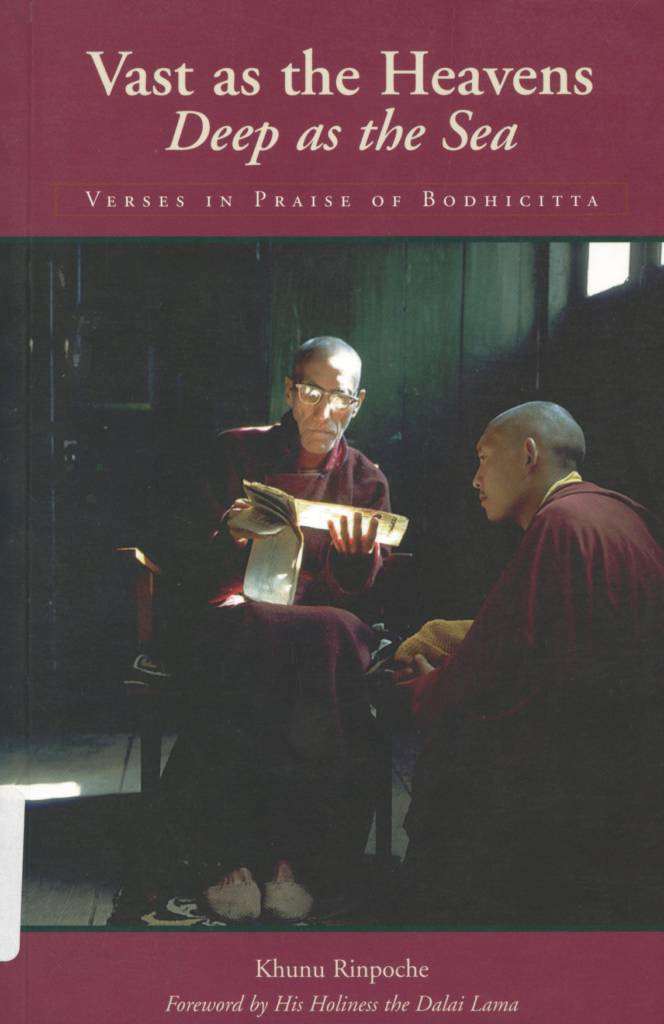
Vast as the Heavens Deep as the Sea
From Bodhicitta
< BooksBooks/Vast as the Heavens Deep as the Sea
| 🤓 Admin Zone 🛠️ hidden to non-admins | |
Vast as the Heavens Deep as the Sea: Verses in Praise of Bodhicitta
Book
Please note that many items in our library are simply pages that represent a detailed library catalog entry and citation of someone else's work, presentation, or performance. Read our General Disclaimer for more information.

Description
Revered by many—especially His Holiness the Dalai Lama—as the very embodiment of altruism, the late Khunu Rinpoche Tenzin Gyaltsen devoted his life to the development of bodhicitta—the aspiration to achieve enlightenment for the sake of all sentient beings. Presented in both English and the original Tibetan, this modern classic is a collection of Khunu Rinpoche's inspirational verse. (Source: Wisdom Publications)
Citation
Khunu Rinpoche. Vast as the Heavens Deep as the Sea: Verses in Praise of Bodhicitta. Translated by Gareth Sparham. Boston: Wisdom Publications, 1999.
Table of contents
- Publisher's Acknowledgmentvi
- Translator's Acknowledgmentsvii
- Translator's Introduction1
- Foreword to the 1966 Edition by the Dalai Lama (Tibetan and English)20
- The Jewel Lamp: A Praise of Bodhicitta (Tibetan and English)23
- Translator's Dedication146
- Notes147
Interconnections
1 Full translation of

The Jewel Lamp: A Praise of Bodhicitta is a text by Khunu Rinpoche (Khunu Lama Tenzin Gyaltsen, 1894–1977) composed in classical Tibetan verse. The work was written in 1959 and consists of 356 verses that Khunu Rinpoche wrote in a diary, composing one verse a day for approximately a year. The text extols bodhicitta—the altruistic intention to attain enlightenment for the benefit of all sentient beings, which is considered the heart of Mahāyāna Buddhist practice.
The text presents bodhicitta as the most precious quality one can develop, using extensive poetic imagery and metaphors to describe its benefits and supreme importance. Khunu Rinpoche draws on traditional Buddhist sources while offering his own devotional perspective on this central concept.
His Holiness the Dalai Lama, who was a student of Khunu Rinpoche, has been particularly devoted to this text. He received the oral transmission directly from Khunu Rinpoche himself, noting it was "the first teaching I received from him." The Dalai Lama has taught from The Jewel Lamp on multiple occasions, including extended teachings in Sydney, Australia in 2013. The work is valued for its clarity, inspirational quality, and its role in preserving the emphasis on compassion and altruism in Tibetan Buddhist practice. It has been translated into English and is studied within Tibetan Buddhist communities as both a teaching text and a source of contemplation on compassionate motivation.1 Related

Khunu Lama Tenzin Gyaltsen (1895–1977) composed The Jewel Lamp: In Praise of Bodhicitta (Byang chub sems kyi bstod pa rin chen sgron ma) in 1959–60 during the Tibetan refugee crisis, creating a 356-verse masterwork that demonstrates his mastery of both Sanskrit and Tibetan poetic traditions. The text emerged from his deep study of Śāntideva's Bodhicaryāvatāra under Khenpo Shenga and his extensive training in classical Indian poetics, employing sophisticated literary devices and traditional metaphorical imagery to convey profound spiritual teachings. Dedicated to the Dalai Lama's sister and endorsed by the Dalai Lama himself, who wrote the foreword and frequently references the work in his teachings, The Jewel Lamp presents bodhicitta not as abstract philosophy but as transformative daily practice.
The work shows intimate connection with Śāntideva's Bodhicaryāvatāra, particularly in its emphasis on self-other exchange and the practical application of compassion in adverse circumstances—themes especially resonant for Tibetan refugees facing exile. Verse 355 directly echoes BCA 1.2 in stating the author's motivation to "familiarize my mind" with bodhicitta through composition, while verses 348-349 parallel Śāntideva's teachings on equalizing and exchanging self and others. The Jewel Lamp serves as both spiritual instruction and literary achievement, bridging traditional Indo-Tibetan contemplative poetry with contemporary needs, and continues to function as a primary meditation text in mind training practices across Tibetan Buddhist traditions.