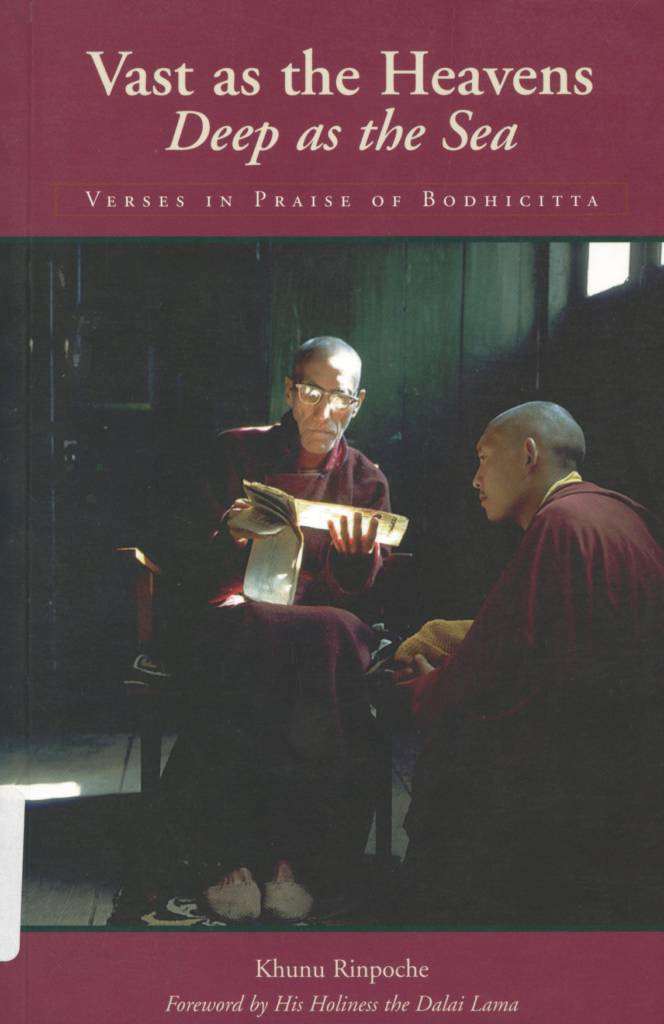
Living Bodhicitta: Khunu Lama's Transmission of the Bodhicaryāvatāra
| 🤓 Admin Zone 🛠️ hidden to non-admins | |
Khunu Lama Tenzin Gyaltsen (1895–1977) composed The Jewel Lamp: In Praise of Bodhicitta (Byang chub sems kyi bstod pa rin chen sgron ma) in 1959–60 during the Tibetan refugee crisis, creating a 356-verse masterwork that demonstrates his mastery of both Sanskrit and Tibetan poetic traditions. The text emerged from his deep study of Śāntideva's Bodhicaryāvatāra under Khenpo Shenga and his extensive training in classical Indian poetics, employing sophisticated literary devices and traditional metaphorical imagery to convey profound spiritual teachings. Dedicated to the Dalai Lama's sister and endorsed by the Dalai Lama himself, who wrote the foreword and frequently references the work in his teachings, The Jewel Lamp presents bodhicitta not as abstract philosophy but as transformative daily practice.
The work shows intimate connection with Śāntideva's Bodhicaryāvatāra, particularly in its emphasis on self-other exchange and the practical application of compassion in adverse circumstances—themes especially resonant for Tibetan refugees facing exile. Verse 355 directly echoes BCA 1.2 in stating the author's motivation to "familiarize my mind" with bodhicitta through composition, while verses 348-349 parallel Śāntideva's teachings on equalizing and exchanging self and others. The Jewel Lamp serves as both spiritual instruction and literary achievement, bridging traditional Indo-Tibetan contemplative poetry with contemporary needs, and continues to function as a primary meditation text in mind training practices across Tibetan Buddhist traditions.Featured on
Early Life and Cultural Context
Birth and Family Heritage
Khunu Lama Tenzin Gyaltsen (Khu nu bla ma Bstan 'dzin rgyal mtshan, 1895–1977), also known as Khunu Rinpoche or Negi Lama, emerged as one of the most influential Buddhist teachers of the twentieth century. Born in 1895 in the village of Shunam in the Kinnaur (Khunu) Valley, his life would come to embody the convergence of Tibetan and Indian Buddhist traditions. His family heritage was deeply rooted in Buddhist practice, with significant connections to major Tibetan Buddhist lineages: his father's lineage traced back to the renowned fifteenth-century Nyingma treasure revealer Pema Lingpa, while his mother's family maintained practice traditions within the Drukpa Kagyu lineage.[1]
The Indo-Tibetan Borderlands
The Kinnaur Valley, situated along the Indo-Tibetan border at an elevation of 2,000 to 2,500 meters above sea level, provided a unique cultural environment for Khunu Lama's early development. The region was characterized by its mountain pine forests transitioning to orchards of apple and apricot trees and fields of mountain barley. This borderland geography fostered a distinctive spiritual atmosphere where Tibetan Buddhism intermingled with the syncretic traditions of the North Indian plains, creating a rich local tradition of religious practice.[2]
Early Religious Education
Under the guidance of his maternal uncle, Lama Rasvir Das, who resided in an adjoining village, Khunu Lama began his formal religious education at the age of seven. This early training focused on foundational skills and texts crucial to Buddhist scholarship. His uncle taught him to read and write Tibetan and guided him through the study of seminal Buddhist texts, particularly the Diamond Cutter Sūtra (Vajracchedikāūtra) and the Verse Summary of Perfect Wisdom (Ratnaguṇasaṃcayagāthā).[3]
The Journey to Deeper Buddhist Studies
Following the traditions of the Drukpa Kagyu sect, at age thirteen, Khunu Lama traveled to Libpa, a region north of Kinnaur, where the southern school of Drukpa Kagyu flourished. There he studied under Sonam Gyaltsen (Bsod nams rgyal mtshan, d.u.), a direct student of the renowned Khampa master Togden Śākya Śrī (Rtogs ldan shAkya shrI, 1853–1919). This early exposure to advanced Buddhist teachings culminated in his decision at age nineteen to leave his homeland in pursuit of deeper Buddhist studies. Unable to afford even a new pair of shoes, he initially traveled through the Kullu Valley, where he collected some outstanding loans made by his older brother to fund his spiritual journey.[4]
Of particular significance in his early formation was his deep connection to Śāntideva's Bodhicaryāvatāra, a text that would profoundly influence his later teachings and writings. This foundational exposure to Śāntideva's work would later manifest in his own composition of The Jewel Lamp: In Praise of Bodhicitta (Byang chub sems kyi bstod pa rin chen sgron ma), written amid the turbulent events of 1959.[5]
Period of Intensive Study (1914–1940s)
Initial Studies in Sikkim (1914–1916)
In 1914, at age nineteen, Khunu Rinpoche embarked on a transformative journey that would shape his unique synthesis of Buddhist scholarship. After gathering travel funds by collecting on his brother's loans near Manali, he made his way to Sikkim, where he spent approximately three years (1914–1917) studying Tibetan grammar, poetry, and philosophy. During this period, he formed a particularly significant relationship with the Sikkimese polymath and Dzogchen master Khangsarwa Ogyen Tenzin Rinpoche (Khang gsar ba o rgyan kun bzang bstan 'dzin rin po che, 1863–1936), who would deeply influence both his literary studies and his later nonsectarian (ris med) approach.[6]
Years at Tashi Lhunpo and Derge
Between 1916 and 1917, Khunu Rinpoche traveled to Tibet, establishing himself first at the Tashi Lhunpo Monastery in Shigatse, the seat of the Panchen Lama. Rather than following the traditional monastic curriculum of philosophical debate, he focused on advanced studies in grammar, poetry, and composition. His scholarly reputation soon drew the attention of the Ninth Panchen Lama Chökyi Nyima (PaN chen bla ma thub bstan chos kyi nyi ma, 1883–1937), who requested him to return to Shigatse to teach Tibetan aristocrats and students from the Tsang region at a specialized school for Tibetan grammar and poetry.[7]
Following his time at Tashi Lhunpo, Khunu Rinpoche traveled to Derge in Kham, eastern Tibet. During his five-year stay there, he undertook an intensive study of the thirteen volumes of essential Buddhist scriptures. It was during this period that he encountered some of his most influential teachers, including Khenpo Shenga (Mkhan po gzhan dga', or Gzhan phan chos kyi snang ba, 1871–1927), who was a primary custodian of the Bodhicaryāvatāra lineage. This connection profoundly influenced Khunu Rinpoche's understanding of Śāntideva's text and its emphasis on ethical cultivation and compassionate action.[8]
Khenpo Zhenga's lineage traced back through Zhenga's root guru Orgyen Tenzin Norbu (O rgyan bstan 'dzin nor bu, 1841/51-1900?) to the renowned Dza Patrul Rinpoche (Dpal sprul rin po che, 1808–1887), who was famous for teaching Śāntideva's text widely, including to poor rural people. The Bodhicaryāvatāra was included among the Thirteen Great Texts (gzhung chen bcu gsum) that Zhenga transmitted to Khunu Lama in their entirety, along with the accompanying pith instructions (man ngag). This transmission proved especially significant, as Khunu Lama would later become the Fourteenth Dalai Lama's primary teacher for this text, creating a direct link between the nineteenth-century eastern Tibetan renaissance of Buddhist learning and the post-1959 preservation of these teachings in exile.[9]
Sanskrit Studies in Varanasi
Khunu Lama's engagement with Sanskrit scholarship occurred in multiple phases. His initial exposure came through his studies in Sikkim with Ogyen Tenzin. After extensive travels and studies in Tibet, he undertook focused Sanskrit studies for five years in Varanasi in the 1940s under Pandit Dev Narayan Tripathi, mastering the Pāṇinian grammatical tradition largely absent from Tibet. This training proved crucial both for his later teaching activities and his composition of The Jewel Lamp. His knowledge of Sanskrit enabled him to engage meaningfully with non-Buddhist Indian scholars and to approach Buddhist texts with unique insight into their original linguistic and cultural context.
Teaching and Scholarship
Upon returning to Kham in the mid-1930s, Khunu Rinpoche entered a period of intensive teaching and scholarly production. His most significant work from this period was his widely used commentary on the Tibetan lexicon of the translator Palkhang, titled The Lamp for Learned Speech (Ngag sgron). This text was composed while teaching grammar and poetry to the children of the Derge royal family. His deep engagement with both Tibetan and Sanskrit literary traditions during this period would later influence his composition of The Jewel Lamp: In Praise of Bodhicitta, particularly in its sophisticated use of Sanskrit poetics and metaphorical imagery.[10]
By the mid-1940s, Khunu Rinpoche had returned to Lhasa where, at the request of the Tibetan government, he taught at the main astrological and medical institute known as the Mentsi Khang (Sman rtsis khang) for three years. His decision to resign from this prestigious position to return to India for further Sanskrit studies illustrates his lifelong commitment to scholarship and his profound indifference to worldly status.[11]
Khunu Lama's literary scholarship served multiple purposes; while opening doors and garnering admiration, it sometimes also functioned as a form of self-concealment. For certain Buddhist audiences, his literary erudition made him appear to be "merely" a literature scholar, concealing his identity as a realized Buddhist master. The prominent teacher Chökyi Nyima Rinpoche (Chos kyi nyi ma rin po che, b. 1951), abbot of Ka-Nying Shedrub Ling Monastery in Kathmandu, suggested this was intentional—part of Khunu Lama's practice as a "hidden yogin" (sbas pa'i rnal 'byor pa).[12]
Years of Teaching and Renunciation (Late 1940s–1959)
Return to Kinnaur
After spending thirty-four years traveling and studying throughout Tibet and India, Khunu Rinpoche returned to his native Kinnaur shortly after India's independence in 1947. Though he had initially planned only a brief stay before returning to Varanasi, the earnest requests of his relatives and fellow Kinnauris led to an extended period of teaching lasting nearly eight years. During this time, he composed several works to help the local mountain people learn the Tibetan alphabet, demonstrating his commitment to making Buddhist education accessible to his homeland community.[13]
Life of Renunciation in Varanasi
Toward the end of the 1950s, Khunu Rinpoche returned to Varanasi, where he established a pattern of living that exemplified the Buddhist ideal of renunciation. Despite holding a teaching position at the Sanskrit University, he declined the accompanying salary, choosing instead to live in an unassuming part of the city with his old friend from the 1930s, Jobo Ganga-gire. His residence was a simple room atop his friend's temple in Lakasa, which became his base between periods of teaching in Bodh Gaya and visits to Sikkim, where he served as a personal guru to the royal family.[14]
Khunu Lama's renunciation manifested in ways that profoundly impressed his students. He truly embodied the spirit of the jadralwa (bya bral ba), or "person who is free from 'doing' anything," through his complete detachment from worldly concerns. His room at Tekra Math became emblematic of his renunciatory practice—unbearably hot, full of mosquitoes, with windows and doors lacking glass. During rains, water would collect on the floor. His lifestyle was characterized by radical simplicity: he owned no furniture, ritual objects, or even personal dishes, and he would routinely give away any donations he received to the next visitor or to those in need. When asked why he didn't even keep a water pitcher, Khunu Lama reportedly replied: "First you get one cup and a pitcher. Then you need another cup in case you have a visitor. Then you need a third cup in case someone else comes. And that's how possessions accumulate." Unsurprisingly, he ate sparingly, often only once per day, and he consistently turned down honors, prominent positions, and financial support.[15]
Teaching Activities
During this period, Khunu Rinpoche's teaching activities were marked by a remarkable nonsectarian approach that extended equal care to students from all traditions. His teaching style was deeply influenced by his study of Śāntideva's Bodhicaryāvatāra, particularly its emphasis on the practical application of bodhicitta in daily life. He encouraged practitioners to view each interaction as an opportunity to practice kindness and selflessness, reflecting the text's call to embrace all beings with an unbiased mind.
A distinctive feature of his teaching method was his emphasis on the imaginative and poetic aspects of Buddhist practice, drawing from his extensive knowledge of Tibetan and Sanskrit poetics. This approach would later find full expression in his composition of The Jewel Lamp: In Praise of Bodhicitta, where he employed rich imagery and metaphor to convey the transformative power of bodhicitta.[16]
A particularly significant aspect of Khunu Lama's teaching career was his transmission of Śāntideva's Bodhicaryāvatāra. He became renowned as the Dalai Lama's primary teacher for this text, earning recognition as "His Holiness's favorite teacher of [Śāntideva's] Guide." His deep familiarity with both Sanskrit and Tibetan traditions informed his teaching of this seminal work, drawing on transmissions he had received from Khenpo Zhenga and other masters in eastern Tibet. His teaching of the Bodhicaryāvatāra was considered so significant that the Dalai Lama continues to reference it in his own teachings.[17]
The Dalai Lama recalled that after receiving the oral transmission of Khunu Lama's own Jewel Lamp verses in his small room at Tekra Math, the next transmission Khunu Lama offered was Śāntideva's Way of the Bodhisattva (Bodhicaryāvatāra). The Dalai Lama was deeply moved during both transmissions. The Dalai Lama has frequently referenced Khunu Lama's teachings on bodhicitta, particularly his teachings on The Way of the Bodhisattva, and has also given teachings commenting directly on Khunu Lama's Jewel Lamp—an unusual honor, as figures like the Dalai Lama rarely teach or refer to works by contemporary authors.[18]
Approach to Buddhist Practice
Khunu Rinpoche's approach to Buddhist practice during this period was characterized by a unique synthesis of scholarly erudition and practical implementation. His understanding of bodhicitta was not merely theoretical but was grounded in the practice of seeing hardships as opportunities to deepen compassion. This concept reflects Śāntideva's advice in the Bodhicaryāvatāra to view suffering as a tool for spiritual growth, an idea that Khunu Rinpoche would later elaborate in his Jewel Lamp. His teaching emphasized that bodhicitta should be woven into the fabric of everyday life, not confined to formal meditation sessions. One of his primary instructions was the daily remembrance of the bodhisattva intention to work for the welfare of all beings. His own instructions, deeply influenced by Śāntideva’s teaching, aim at internalizing bodhicitta to the extent that it shaped one's thoughts, words, and actions, as one begins to view others' successes and joys as one's own.
Crisis and Continuity (1959–1977)
According to Lamchen Gyalpo (Lam chen rgyal po, 1939–2017), Khunu Lama served as "the re-connector of the lifeforce of the nonsectarian tradition of the Teachings at the moment of its death." During this critical period when Tibetan Buddhism faced unprecedented challenges, he transmitted teachings across sectarian lines, including both New (Sarma) and Old (Nyingma) traditions, arts and sciences, sūtras, and tantras to Tibetan refugees in India.[19]
His relationship with the Fourteenth Dalai Lama developed through his former student Ling Rinpoche (1903–1983),[20] who had studied literary topics with Khunu Lama in Lhasa during the 1930s. As the Dalai Lama's Senior Tutor, Ling Rinpoche facilitated their connection in Mussoorie in 1959. The Dalai Lama went on to receive extensive teachings from Khunu Lama, including eleven major works from Khenpo Zhenga's Thirteen Great Texts.[21]
In 1965, at the Dalai Lama's request, Khunu Lama served as lead teacher for an intensive six-month teacher-training program in Mussoorie. This program prepared sixty prominent Tibetan scholars who would later establish and staff key exile institutions, including the Central Institute for Higher Tibetan Studies in Sarnath. The lecture notes from his classes were later published in Dharamsala with funding from the newly established Department of Religious Affairs.[22]
His final major teaching was a significant Dzogchen transmission at Tso Pema in 1976, where he also composed his only known supplication prayer (gsol 'debs) at his students' request. Even in this formal teaching context, he maintained his characteristic renunciant approach, discouraging elaborate ceremonies and redistributing monetary offerings back to the assembly.[23]
In early 1977, Khunu Lama gave his last teachings at Shashur Monastery in Lahaul. He passed away on February 20th while teaching the Perfection of Wisdom chapter from Gampopa's Jewel Ornament of Liberation. The events surrounding his death and funeral revealed the complex network of devotees and communities connected to him, from Kinnauri relatives to Lahauli disciples and his close circle of nun attendants.[24]
The Composition of The Jewel Lamp
Historical Context and Circumstances
The composition of The Jewel Lamp in 1959–60 occurred at a crucial historical juncture. While living simply at Tekra Math, Khunu Lama witnessed the devastating events unfolding in Tibet—the March 1959 uprising in Lhasa, the flight of the Dalai Lama, and the beginning of the mass exodus of Tibetan refugees to India. His diary from this period interweaves daily verses on bodhicitta with notes about these events, particularly the Dalai Lama's journey to exile. The text thus emerged from the intersection of his personal practice, his mastery of Indo-Tibetan literary traditions, and his response to a moment of profound crisis for Tibetan Buddhism. This historical context adds deeper resonance to the text's emphasis on transforming adversity through bodhicitta practice.[25]
When the first printed edition of The Jewel Lamp was published in 1966, it was dedicated to the Dalai Lama's eldest sister Takla Tsering Dolma (Stag lha Tshe ring sgrol ma, 1919–1964), who had recently passed away. The Dalai Lama himself wrote a short forward praising Khunu Lama as a hidden and nonsectarian bodhisattva, someone who had spent a long time studying and reflecting on Śāntideva's Way of the Bodhisattva and its core message of bodhicitta "'that cherishes others more than self.'"[26]
Structure and Literary Features
Consisting of 356 verses, The Jewel Lamp showcases Khunu Rinpoche's mastery of both Tibetan and Sanskrit poetic traditions. The work demonstrates his deep engagement with classical Sanskrit poetry (kāvya) and Tibetan poetics (snyan ngag), reflecting decades of immersion in both traditions. His verses employ sophisticated literary devices, including rich metaphorical imagery drawing from nature, precious substances, and celestial bodies to convey the qualities of bodhicitta.[27]
The text's literary sophistication is particularly evident in its use of traditional Sanskrit poetic imagery. For example, Khunu Rinpoche employs classical motifs such as the cuckoo as the "messenger of spring" and the relationship between moonlight and water lilies, demonstrating his command of the kāvya aesthetic tradition. These poetic elements serve not merely as ornamental features but as vehicles for conveying profound spiritual teachings.[28]
Philosophical Content and Bodhicitta Teachings
The philosophical content of The Jewel Lamp shows a profound influence from Śāntideva's Bodhicaryāvatāra while presenting bodhicitta teachings in a distinctively practical manner. Like Śāntideva, Khunu Rinpoche frames his verses as a form of self-cultivation, stating in verse 355 that he composed them "in order to meditatively cultivate it in my own mind." This approach echoes Śāntideva's famous statement about writing to "perfume" his own mind, suggesting a deep connection between literary composition and spiritual practice.[29]
The text presents bodhicitta not merely as an abstract ideal but as a transformative force in daily life. Khunu Rinpoche emphasizes its practical application in various circumstances, from dealing with enemies to facing personal hardships. His verses frequently address how bodhicitta can transform adverse conditions into opportunities for spiritual growth, a theme that could have resonated particularly strongly with the Tibetan refugee community dealing with the trauma of exile.
Students and biographers often viewed Khunu Lama as a virtual reincarnation of Śāntideva, drawing substantive parallels between their renunciant lifestyles, emphasis on bodhicitta, and practices of self-concealment. As Khen Rinpoche Lobsang Delek (Mkhan rin po che blo bzang bde legs, b. 1939) observed: "I thought the yogis of ancient India must be like this [like Khunu Lama]. . . He practiced bodhicitta all the time . . . It is said that Śāntideva [also] always practiced only bodhicitta."[30]
Influence and Legacy
The Jewel Lamp gained significant prominence through its endorsement by the Fourteenth Dalai Lama, who wrote the foreword to its first publication in 1966. The text was dedicated to the memory of the Dalai Lama's sister, Tsering Dolma, and has since been reprinted numerous times in various editions and translations. The Dalai Lama frequently references the text in his teachings on bodhicitta to both Tibetan and international audiences, contributing significantly to its widespread influence.[31]
The work's impact extends beyond its immediate historical context, serving as a bridge between traditional Tibetan Buddhist poetic and philosophical forms and contemporary spiritual needs. Its verses continue to be used as meditation focuses and teaching tools, particularly in the context of mind training (lojong) practices. The text exemplifies Khunu Rinpoche's unique ability to present profound Buddhist concepts through accessible yet sophisticated literary forms, making it a significant contribution to both Tibetan Buddhist literature and practical spiritual instruction.
The Jewel Lamp — Selected Verses for Practice (trsl. by Gareth Sparham)
The Jewel Lamp's intimate connection with Śāntideva's Bodhicaryāvatāra (BCA) reflects Khunu Rinpoche's deep engagement with this classical text. The most striking parallel appears in verse 355 of The Jewel Lamp ("I have explained this practice of bodhicitta in order to familiarize my mind with it"), which directly echoes BCA 1.2, where Śāntideva states his identical motivation for composition. Verse 115 of The Jewel Lamp ("Application of the seven-limbed practice of offering and so forth produces and builds up bodhicitta, just as the application of water, fertilizer, and so forth produces and builds up a seedling") mirrors BCA 1.25–26's comparison of bodhicitta's transformative power to other virtues. The protective quality of bodhicitta described in verse 134 ("Since there never has been, never will be, and there is not now any enlightened being independent of bodhicitta, it is proper to always respectfully attend to it") corresponds to BCA 1.30's depiction of bodhicitta as a guardian. Two verses in The Jewel Lamp explore the fundamental Mahāyāna practice of exchanging self and others: verse 348 ("Having seen that I myself and all wandering beings equal to space want happiness and do not want suffering, with the awareness that self and other are equal one should meditate on bodhicitta continually") and verse 349 ("Ignoring the accomplishment of one's own selfish aims and enthusiastically taking on the accomplishment of the aims of others, make an effort to unite with your mindstream the bodhicitta that cherishes others more than one's self"), which closely parallel BCA 8.90–91 and 8.120–124 respectively, where Śāntideva elaborates these meditative techniques in detail.
Actively Cultivating the Causes of Bodhicitta
Bodhicitta comes from knowing that [all] have served as one's mother, From recollecting and repaying their kindness, from love, From compassion, and from surpassing intention; It is the source of happiness and benefit for oneself and others. (48)
Those who wish to follow the spiritual practice Of the bodhisattvas, the Victor's children, At the very outset strive to produce Bodhicitta since it is the foundation of that practice. (101)
Application of the seven-limbed practice Of offering and so forth produces and builds up bodhicitta, Just as the application of water, fertilizer, and so forth Produces and builds up a seedling. (115)
If you want to produce bodhicitta, you need faith. If you want to produce bodhicitta, you need to want it. If you want to produce bodhicitta, you need compassion. If you want to produce bodhicitta, meditate on these. (195)
By relying on remembrance and introspection, Give up doing things that are in opposition to bodhicitta. If you do such a thing, immediately repair it Through making a confession and so on. (202)
Unless and until bodhicitta becomes As rock-solid as Mount Meru, Who will taste the nectar of entrance Into the vast and profound stages [of the path]? (217)
Even if one cannot, by what one does, help a person Who is threatening or harming one's life, One should still not give up the thought to benefit [that person]; Otherwise one will go against bodhicitta. (263)
If one is without the vital juice of bodhicitta, One cannot even enter the Mahāyāna. If such is the case, how will one get To the supreme stage of buddhahood? (298)
Maintaining Constant Mindfulness of Bodhicitta
Remember bodhicitta when you feel down, Remember bodhicitta when you are scared, Remember bodhicitta when you suffer, Remember bodhicitta when you feel joy. (89)
Whatever you meet with, never ever give up bodhicitta. If one mentally gives up supreme bodhicitta, There is no force for attaining buddhahood, There is no way to fulfill one's purpose. (194)
Remember bodhicitta if you are going somewhere, Remember bodhicitta if you are sitting down, Remember bodhicitta if you are lying down, Remember bodhicitta if you are standing up. (201)
In the morning when you get up, generate A heartfelt intention to be in accord with bodhicitta. In the evening when going to bed, investigate whether What you did was in accord with or in opposition to bodhicitta. (205)
Whatever work one engages in, one should Do it after connecting it with bodhicitta. Going from happiness to the culmination of happiness, One reaches great bliss that never degenerates. (227)
With bodhicitta one transforms Even afflictions into a branch of enlightenment. The medicinal shoots are born From the medicinal root that cures diseases. (250)
When you walk, walk with bodhicitta, When you sit, sit with bodhicitta, When you stand, stand with bodhicitta, When you sleep, sleep with bodhicitta. (338)
When you look, look with bodhicitta, When you eat, eat with bodhicitta, When you speak, speak with bodhicitta, When you think, think with bodhicitta. (339)
Having seen that I myself and all wandering beings equal to space Want happiness and do not want suffering, With the awareness that self and other are equal One should meditate on bodhicitta continually. (348)
Ignoring the accomplishment of one's own selfish aims and Enthusiastically taking on the accomplishment of the aims of others, Make an effort to unite with your mindstream the bodhicitta That cherishes others more than one's self. (349)
Thinking with bodhicitta that [living beings] Are like one's father or mother, relatives or friends, Wife or child, in every case become absorbed In the notion of joyfully helping [them]. (350)
Integrating Conventional and Ultimate Bodhicitta
There are two Mahāyāna bodhicittas: The conventional and the ultimate. The conventional is the wishing and setting-out bodhicittas. The ultimate is the nonconceptual, free from elaboration. (150)
Thinking "I am a bodhisattva," do not despise even a bug. It is taught that the supreme ultimate bodhicitta pervades every wandering being. (189)
The practices for the supreme conventional bodhicitta are exchanging self for others and so on. The practice for the supreme ultimate bodhicitta is meditation on emptiness. (337)
Meditate on the supreme conventional bodhicitta By means of exchanging self for others and so on. Meditate on the supreme ultimate bodhicitta By means of the wisdom free from extremes and so on. (352)
Notes
- ↑ Annabella Pitkin, "'Like Pouring Water into Water:' Buddhist Lineages, Modernity, and the Continuity of Memory in the Twentieth-Century History of Tibetan Buddhism" (PhD diss., Columbia University, 2009), 97.
- ↑ Gareth Sparham, trans., Vast as the Heavens Deep as the Sea: Verses in Praise of Bodhicitta, by Khunu Rinpoche (Boston: Wisdom Publications, 1999), 1.
- ↑ Sparham, Vast as the Heavens, 1–2.
- ↑ Sparham, Vast as the Heavens, 2.
- ↑ Annabella Pitkin, "All the Wealth of Poets: The Bodhicitta Verses of Khunu Lama Tenzin Gyaltsen," Journal of Tibetan Literature 3, no. 1 (2024): 118, https://doi.org/10.58371/jtl.2024.79.
- ↑ Pitkin, "All the Wealth of Poets," 122.
- ↑ Sparham, Vast as the Heavens, 2.
- ↑ Pitkin, "Like Pouring Water," 145–46.
- ↑ On Khunu Lama's Sanskrit knowledge, see Annabella Pitkin, Renunciation and Longing: The Life of a Twentieth-Century Himalayan Buddhist Saint (Chicago: University of Chicago Press, 2022), 40–41 and 97ff.
- ↑ Pitkin, "All the Wealth of Poets," 122.
- ↑ Sparham, Vast as the Heavens, 3.
- ↑ Pitkin, Renunciation and Longing, 97.
- ↑ Sparham, Vast as the Heavens, 3.
- ↑ Sparham, Vast as the Heavens, 3.
- ↑ See Pitkin, Renunciation and Longing, 84, and "All the Wealth of Poets," 126.
- ↑ Pitkin, "All the Wealth of Poets," 128–30.
- ↑ Pitkin, Renunciation and Longing, 109–10.
- ↑ Pitkin, Renunciation and Longing, 130–1.
- ↑ Pitkin, Renunciation and Longing, 112–14.
- ↑ Thub bstan lung rtogs rnam rgyal 'phrin las.
- ↑ On the relationship between the Dalai Lama and Khunu Lama, see Pitkin, Renunciation and Longing, 125–29.
- ↑ Pitkin, Renunciation and Longing, 128–29.
- ↑ Pitkin, Renunciation and Longing, 137–43.
- ↑ Pitkin, Renunciation and Longing, 169–73.
- ↑ See Pitkin, "All the Wealth of Poets," 118–19, and Renunciation and Longing, 81 and 114–15.
- ↑ Pitkin, Renunciation and Longing, 130.
- ↑ Pitkin, "All the Wealth of Poets," 119–20.
- ↑ Pitkin, "All the Wealth of Poets," 130.
- ↑ Pitkin, "All the Wealth of Poets," 124.
- ↑ Pitkin, Renunciation and Longing, 109.
- ↑ Pitkin, "All the Wealth of Poets," 118.

The text presents bodhicitta as the most precious quality one can develop, using extensive poetic imagery and metaphors to describe its benefits and supreme importance. Khunu Rinpoche draws on traditional Buddhist sources while offering his own devotional perspective on this central concept.
His Holiness the Dalai Lama, who was a student of Khunu Rinpoche, has been particularly devoted to this text. He received the oral transmission directly from Khunu Rinpoche himself, noting it was "the first teaching I received from him." The Dalai Lama has taught from The Jewel Lamp on multiple occasions, including extended teachings in Sydney, Australia in 2013. The work is valued for its clarity, inspirational quality, and its role in preserving the emphasis on compassion and altruism in Tibetan Buddhist practice. It has been translated into English and is studied within Tibetan Buddhist communities as both a teaching text and a source of contemplation on compassionate motivation.