| 🤓 Admin Zone 🛠️ hidden to non-admins | |
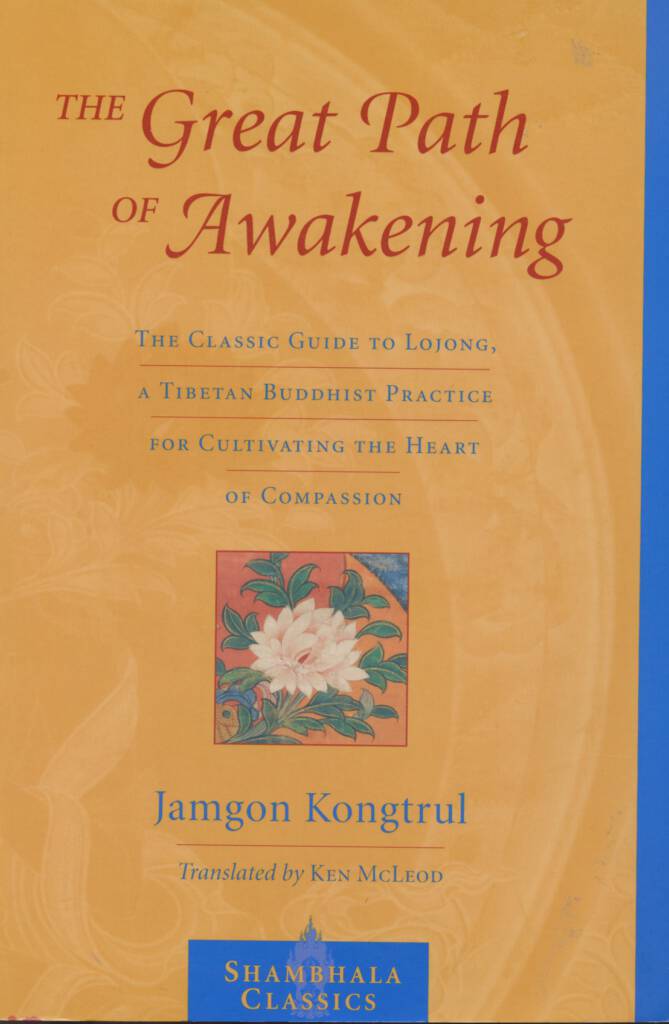
The Great Path of Awakening: The Classic Guide to Lojong, a Tibetan Buddhist Practice for Cultivating the Heart of Compassion (2005)
Book
Please note that many items in our library are simply pages that represent a detailed library catalog entry and citation of someone else's work, presentation, or performance. Read our General Disclaimer for more information.

Description
Here is a practical Buddhist guidebook that offers techniques for developing a truly compassionate heart in the midst of everyday life. For centuries, Tibetans have used fifty-nine pithy slogans—such as "A joyous state of mind is a constant support" and "Don't talk about others' shortcomings"—as a means to awaken kindness, gentleness, and compassion. While Tibetan Buddhists have long valued these slogans, recently they have become popular in the West.
This edition of The Great Path of Awakening contains an accessible, newly revised translation of the slogans from the famous text The Seven Points of Mind Training. It also includes illuminating commentary from Jamgon Kongtrul that provides further instruction on how to meet every situation with intelligence and an open heart. (Source: Shambhala Publications)
Citation
McLeod, Ken, trans. The Great Path of Awakening: The Classic Guide to Lojong, a Tibetan Buddhist Practice for Cultivating the Heart of Compassion. By Jamgön Kongtrul. Boston: Shambhala Publications, 2005.
Table of contents
- Prefaceix
- Translator's Introductionxiii
- The Great Path of Awakening1
- The Source of the Transmission3
- The Need for Mind Training5
- The Actual Instructions7
- The Explanation of the Seven Points of Mind Training7
- The Groundwork: Instruction on What Supports Dharma8
- The Actual Practice: Training in Bodhicitta10
- The Transformation of Adversity into the Path of Awakening17
- The Utilization of the Practice in One's Whole Life25
- The Extent of Proficiency in Mind Training29
- Commitments of Mind Training30
- Guidelines for Mind Training37
- Concluding Verses45
- The Explanation of the Seven Points of Mind Training7
- Additional Instructions from the Transmission Lineage46
- Conclusion53
- Notes55
- Appendices87
- The Seven Points of Mind Training (McLeod)89
- The Root Text of the Seven Points of Training the Mind (Nalanda Translation Committee)93
- Soothing the Pain of Faith: A Prayer to the Mind-Training Lineage99
- The Seven-Branch Prayer105
Interconnections
2 Full translation of

Blo sbyong don bdun ma. (Lojong Döndünma). In Tibetan, "Seven Points of Mind Training"; an influential Tibetan work in the blo sbyong ("mind training") genre. The work was composed by the Bka' gdams scholar 'Chad ka ba ye shes rdo rje, often known as Dge bshes Mchad kha ba, based on the tradition of generating bodhicitta known as "mind training" transmitted by the Bengali master Atiśa Dīpaṃkaraśrījñāna. It also follows the system laid out previously by Glang ri thang pa (Langri Tangpa) in his Blo sbyong tshig brgyad ma ("Eight Verses on Mind Training"). Comprised of a series of pithy instructions and meditative techniques, the Blo sbyong don bdun ma became influential in Tibet, with scholars from numerous traditions writing commentaries to it. According to the commentary of the nineteenth-century Tibetan polymath 'Jam mgon kong sprul, the seven points covered in the treatise are: (1) the preliminaries to mind training, which include the contemplations on the preciousness of human rebirth, the reality of death and impermanence, the shortcomings of saṃsāra, and the effects of karman; (2) the actual practice of training in bodhicitta; (3) transforming adverse conditions into the path of awakening; (4) utilizing the practice in one's entire life; (5) the evaluation of mind training; (6) the commitments of mind training; and (7) guidelines for mind training. (Source: "Blo sbyong don bdun ma." In The Princeton Dictionary of Buddhism, 126–27. Princeton University Press, 2014. http://www.jstor.org/stable/j.ctt46n41q.27.)

A commentary on the Seven Points of Mind Training by Jamgon Kongtrul. This text is included in Jamgon Kongtrul's Dam Ngag Dzo collection.
1 Other editions
-front.jpg)
Here is a practical Buddhist guidebook that offers techniques for developing a truly compassionate heart in the midst of everyday life. For centuries, Tibetans have used fifty-nine pithy slogans—such as "A joyous state of mind is a constant support" and "Don't talk about others' shortcomings"—as a means to awaken kindness, gentleness, and compassion. While Tibetan Buddhists have long valued these slogans, recently they have become popular in the West. (Source: Shambhala Publications)
1 Teaching on
Blo sbyong don bdun ma. (Lojong Döndünma). In Tibetan, "Seven Points of Mind Training"; an influential Tibetan work in the blo sbyong ("mind training") genre. The work was composed by the Bka' gdams scholar 'Chad ka ba ye shes rdo rje, often known as Dge bshes Mchad kha ba, based on the tradition of generating bodhicitta known as "mind training" transmitted by the Bengali master Atiśa Dīpaṃkaraśrījñāna. It also follows the system laid out previously by Glang ri thang pa (Langri Tangpa) in his Blo sbyong tshig brgyad ma ("Eight Verses on Mind Training"). Comprised of a series of pithy instructions and meditative techniques, the Blo sbyong don bdun ma became influential in Tibet, with scholars from numerous traditions writing commentaries to it. According to the commentary of the nineteenth-century Tibetan polymath 'Jam mgon kong sprul, the seven points covered in the treatise are: (1) the preliminaries to mind training, which include the contemplations on the preciousness of human rebirth, the reality of death and impermanence, the shortcomings of saṃsāra, and the effects of karman; (2) the actual practice of training in bodhicitta; (3) transforming adverse conditions into the path of awakening; (4) utilizing the practice in one's entire life; (5) the evaluation of mind training; (6) the commitments of mind training; and (7) guidelines for mind training. (Source: "Blo sbyong don bdun ma." In The Princeton Dictionary of Buddhism, 126–27. Princeton University Press, 2014. http://www.jstor.org/stable/j.ctt46n41q.27.)