| 🤓 Admin Zone 🛠️ hidden to non-admins | |
The Art of Transforming the Mind: A Meditator's Guide to the Tibetan Practice of Lojong
Book
Please note that many items in our library are simply pages that represent a detailed library catalog entry and citation of someone else's work, presentation, or performance. Read our General Disclaimer for more information.

Description
This second edition of the commentary on the aphorisms of Atisha's Seven-Point Mind-Training, includes three additional concise texts.
The first if these, Pith Instructions on a Single Mindfulness could be viewed as a commentary on on the aphorism in the Seven-Point Mind Training "Guard the two at the cost of your life".
The second translation is of Atisha's Pith Instructions on the Middle Way, presenting the Madhyamaka view expounded by Nagarjuna. This corresponds to the first aphorism on the cultivation of ultimate bodhichitta, namley, "Regard phenomena as if they were dreams".
The third additional translation is Atisha's Essential, Synthesized Practical Instructions on Connate Union. These practical instructions may be seen as a commentary on the aphorism " Examine the unborn nature of awareness".
Citation
Wallace, B. Alan. The Art of Transforming the Mind: A Meditator's Guide to the Tibetan Practice of Lojong. Boulder: Shambhala Publications, 2022.
Table of contents
- Preface to the 2022 editionvii
- Preface to the 2001 editionix
- The First Point: The Preliminaries1
- The Second Point: Cultivating Ultimate and Relative Bodhicitta46
- The Third Point: Transforming Adversity into an Aid to Spiritual Awakening159
- The Fourth Point: A Synthesis of Practice for One Life183
- The Fifth Point: The Criterion of Proficiency in the Mind-Training193
- The Sixth Point: The Pledges of the Mind-Training200
- The Seventh Point: The Precepts of the Mind-Training253
- Conclusion236
- Meditation Instructions239
- The Aphorisms of the Seven-Point Mind Training243
- Appendix 1. Pith Instructions on a Single Mindfulness247
- Appendix 2. Pith Instructions on the Middle Way251
- Appendix 3. Essential, Synthesized Practical Instructions on Connate Union255
- Notes261
- Bibliography267
Interconnections
1 Modern commentary of

Blo sbyong don bdun ma. (Lojong Döndünma). In Tibetan, "Seven Points of Mind Training"; an influential Tibetan work in the blo sbyong ("mind training") genre. The work was composed by the Bka' gdams scholar 'Chad ka ba ye shes rdo rje, often known as Dge bshes Mchad kha ba, based on the tradition of generating bodhicitta known as "mind training" transmitted by the Bengali master Atiśa Dīpaṃkaraśrījñāna. It also follows the system laid out previously by Glang ri thang pa (Langri Tangpa) in his Blo sbyong tshig brgyad ma ("Eight Verses on Mind Training"). Comprised of a series of pithy instructions and meditative techniques, the Blo sbyong don bdun ma became influential in Tibet, with scholars from numerous traditions writing commentaries to it. According to the commentary of the nineteenth-century Tibetan polymath 'Jam mgon kong sprul, the seven points covered in the treatise are: (1) the preliminaries to mind training, which include the contemplations on the preciousness of human rebirth, the reality of death and impermanence, the shortcomings of saṃsāra, and the effects of karman; (2) the actual practice of training in bodhicitta; (3) transforming adverse conditions into the path of awakening; (4) utilizing the practice in one's entire life; (5) the evaluation of mind training; (6) the commitments of mind training; and (7) guidelines for mind training. (Source: "Blo sbyong don bdun ma." In The Princeton Dictionary of Buddhism, 126–27. Princeton University Press, 2014. http://www.jstor.org/stable/j.ctt46n41q.27.)
1 Other editions

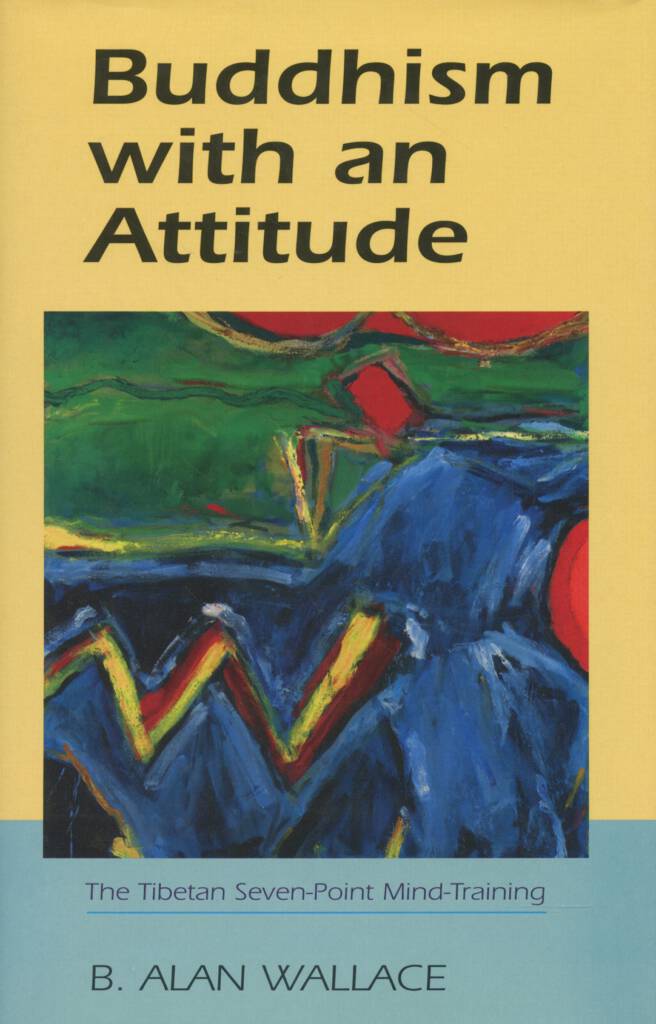
All of us have attitudes. Some of them accord with reality and serve us well throughout the course of our lives. Others are out of alignment with reality, and cause us problems. Tibetan Buddhist practice isn't just sitting in silent meditation, it's developing fresh attitudes that align our minds with reality. Attitudes need adjusting, just like a spinal column that has been knocked out of alignment. B. Alan Wallace explains a fundamental type of Buddhist mental training called lojong, which can literally be translated as attitudinal training. It is designed to shift our attitudes so that our minds become pure well-springs of joy instead of murky pools of problems, anxieties, fleeting pleasures, hopes and frustrations. Wallace brings this centuries-old practice into the twenty-first century. (Source Accessed Jan 22, 2025)