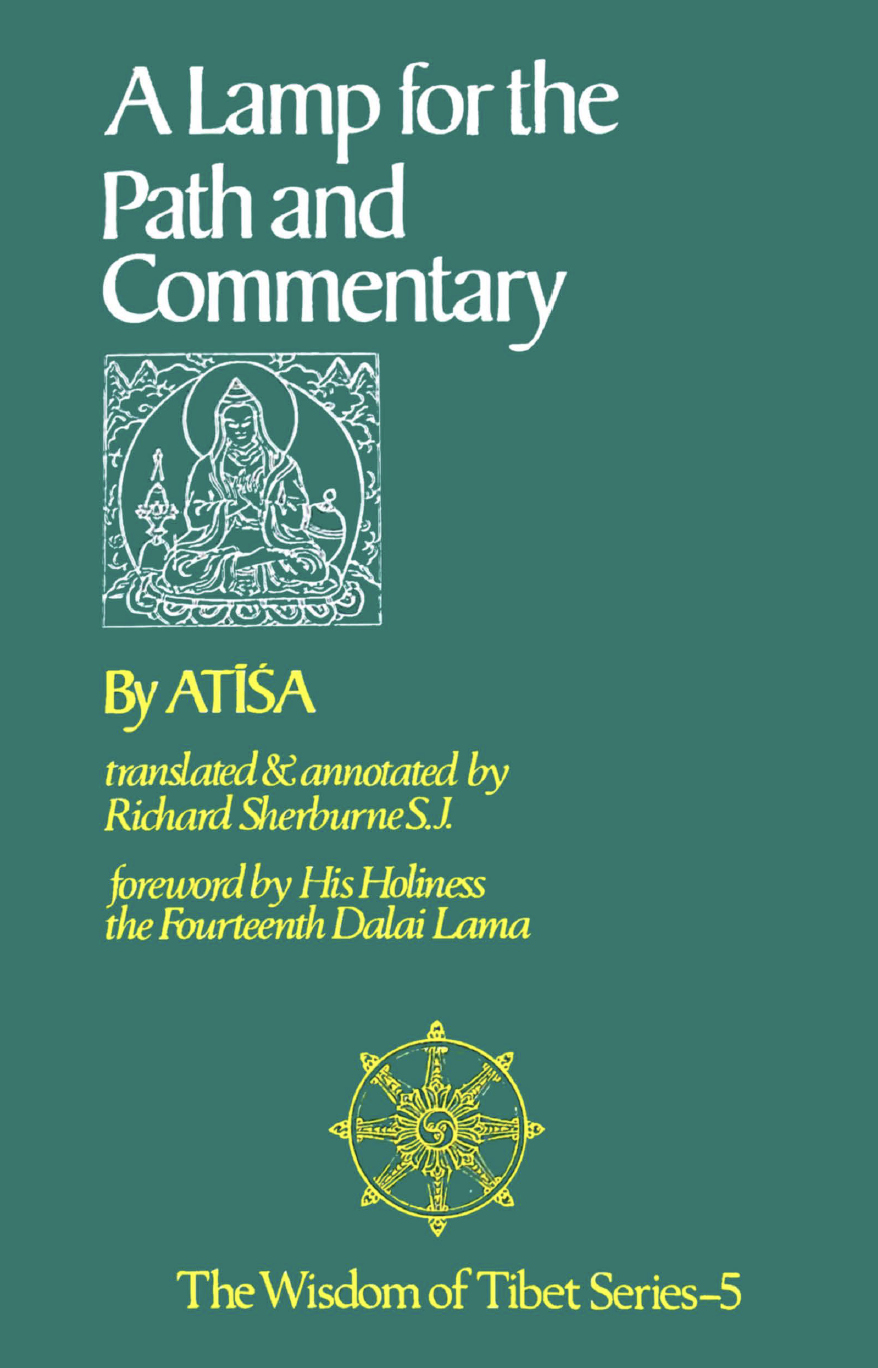
A Lamp for the Path and Commentary
Book
Please note that many items in our library are simply pages that represent a detailed library catalog entry and citation of someone else's work, presentation, or performance. Read our General Disclaimer for more information.
Description
The Lamp for the Enlightenment Path and its Commentary are eleventh-century Buddhist texts which were written at Tho-ling ("High-flying") Monastery in the central Himalayas near Mount Kailas. Although little known to "outsiders", these texts have been used and cherished by the Buddhist communities within Tibet and inner Asia for well over nine centuries. The monk who composed them wrote originally in Sanskrit (now lost) while simultaneously translating them into Tibetan, and they were included as authentic commentary in the earliest canon of Mahāyāna scripture. (Sherburne, introduction, x)
Citation
Sherburne, Richard, trans. A Lamp for the Path and Commentary. By Atiśa. The Wisdom of Tibet Series 5. London: George Allen & Unwin, 1983.
Texts Translated
- Atiśa (jo bo rje a ti sha). Bodhipathapradīpa, (Byang chub lam gyi sgron ma). (D 3947) mdo 'grel (dbu ma), khi 238a6-241a4. In Vol. 111: 475-481. Delhi: Delhi Karmapae Choedhey, Gyalwae Sungrab Partun Khang, 1982-1985. - Go to the corresponding Classical Work page by clicking on the above text title for a full list of available recensions.
- Atiśa (jo bo rje a ti sha). Bodhimārgapradīpapañjikā, (Byang chub lam gyi sgron ma'i dka' 'grel). (D 3948) mdo 'grel (dbu ma), khi 241a4-293a4. In Vol. 111: 481–585. Delhi: Delhi Karmapae Choedhey, Gyalwae Sungrab Partun Khang, 1982-1985. - Go to the corresponding Classical Work page by clicking on the above text title for a full list of available recensions.
Bodhipathapradīpa. (T. Byang chub lam gyi sgron ma). In Sanskrit, "Lamp for the Path to Enlightenment"; a work composed by the Indian scholar Atiśa Dīpamkaraśrījñāna at Tho ling gtsug lag khang shortly after he arrived in Tibet in 1042. Tibetan histories often note that Atiśa wrote this text in order to clarify problematic points of Buddhist practice, especially tantra, which were thought to have degenerated and become distorted, and to show that tantra did not render basic Buddhist practice irrelevant. The Bodhipathapradīpa emphasizes a gradual training in the practices of the Mahāyāna and vajrayāna and became a prototype and textual basis first for the bstan rim, or "stages of the teaching" genre, and then for the genre of Tibetan
religious literature known as lam rim, or "stages of the path." It is also an early source for the instructions and practice of blo sbyong, or "mind training." Atiśa wrote his own commentary (pańjikā) (Commentary on the Difficult Points of the Lamp for the Path to Enlightenment) to the text. The text says bodhisattvas must first follow one of the sets of prātimokṣa disciplinary rules; based on those precepts, they practice the six perfections (pāramitā); with those perfections as a solid foundation, they finally practice Buddhist tantra. (Source: "Bodhipathapradīpa." In The Princeton Dictionary of Buddhism, 133. Princeton University Press, 2014. http://www.jstor.org/stable/j.ctt46n41q.27.)
Text

Atiśa's commentary on the difficult points of his Lamp for the Path to Enlightenment. The text says bodhisattvas must first follow one of the sets of prātim okṣa disciplinary rules; based on those precepts, they practice the six perfections
(pāramitā); with those perfections as a solid foundation, they finally practice Buddhist tantra. (Source: "Bodhimārgapradīpa." In The Princeton Dictionary of Buddhism, 133. Princeton University Press, 2014. http://www.jstor.org/stable/j.ctt46n41q.27.)
Text

- Forewordvii
- Introductionx
- Abbreviationsxiv
- A Lamp for the Enlightenment Path [Poem]1
- Commentary on the Lamp for the Path
- DEDICATION AND THEME — Stanzas 1-615
- Part One: Higher Conduct
- CHAPTER 1 THE TRIPLE REFUGE — Stanzas 7-923
- CHAPTER 2 THE ENLIGHTENMENT THOUGHT — Stanzas 10-1941
- CHAPTER 3 THE MONASTIC LIFE — Stanzas 20-2165
- CHAPTER 4 THE BODHISATTVA VOW — Stanzas 22-3387
- Part Two: Higher Meditation
- CHAPTER 5 THE SUPERKNOWLEDGES — Stanzas 34-40113
- Part Three: Higher Insight
- CHAPTER 6 INSIGHT AND MEANS — Stanzas 41–59129
- CHAPTER 7 TANTRA — Stanzas 60–67165
- COLOPHONS — Stanza 68181
- Appendices
- Chart I: The Five Paths190
- Chart II: Tantric Initiations191
- Glossary192
- Bibliography204
- Index221

