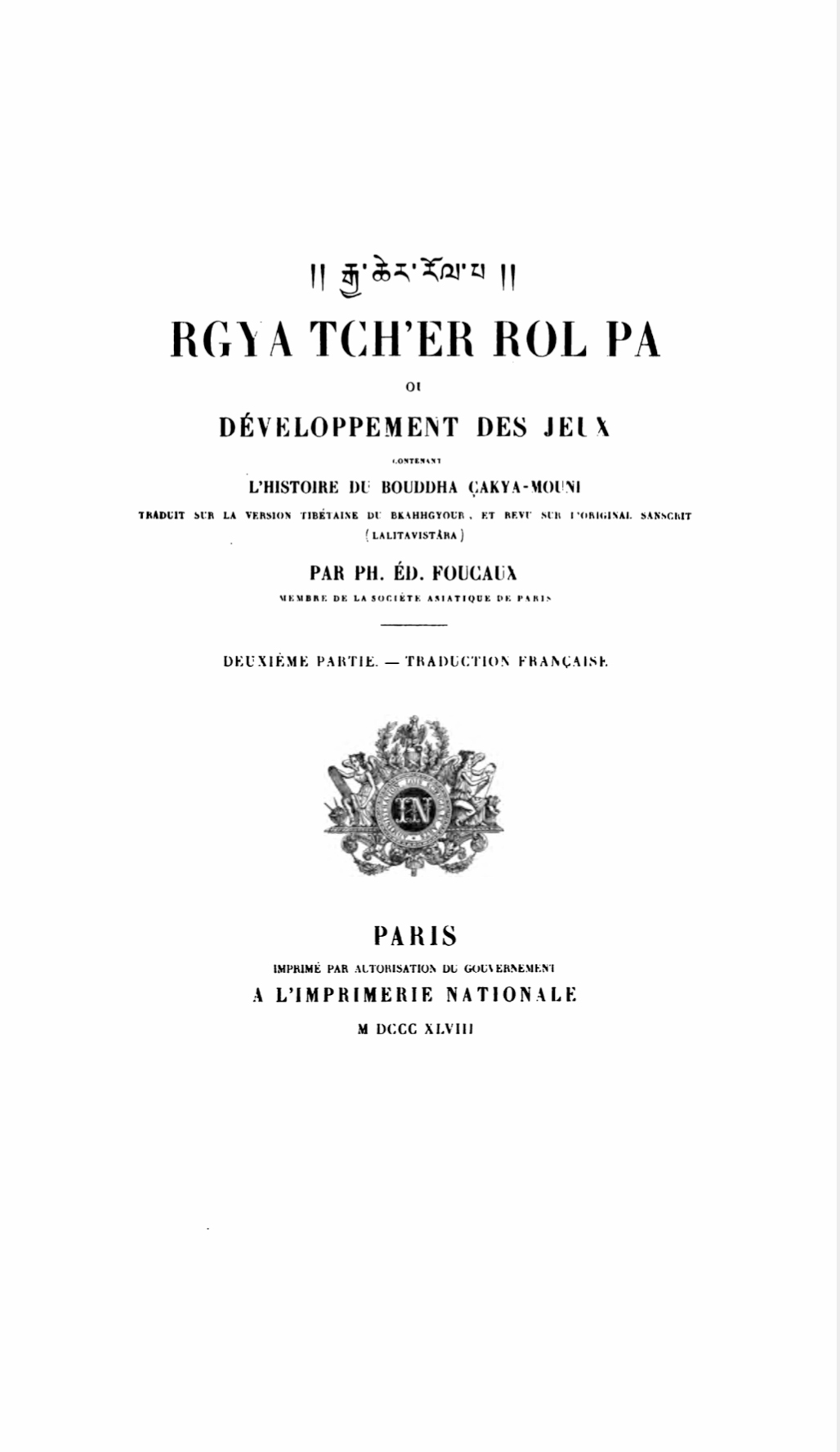
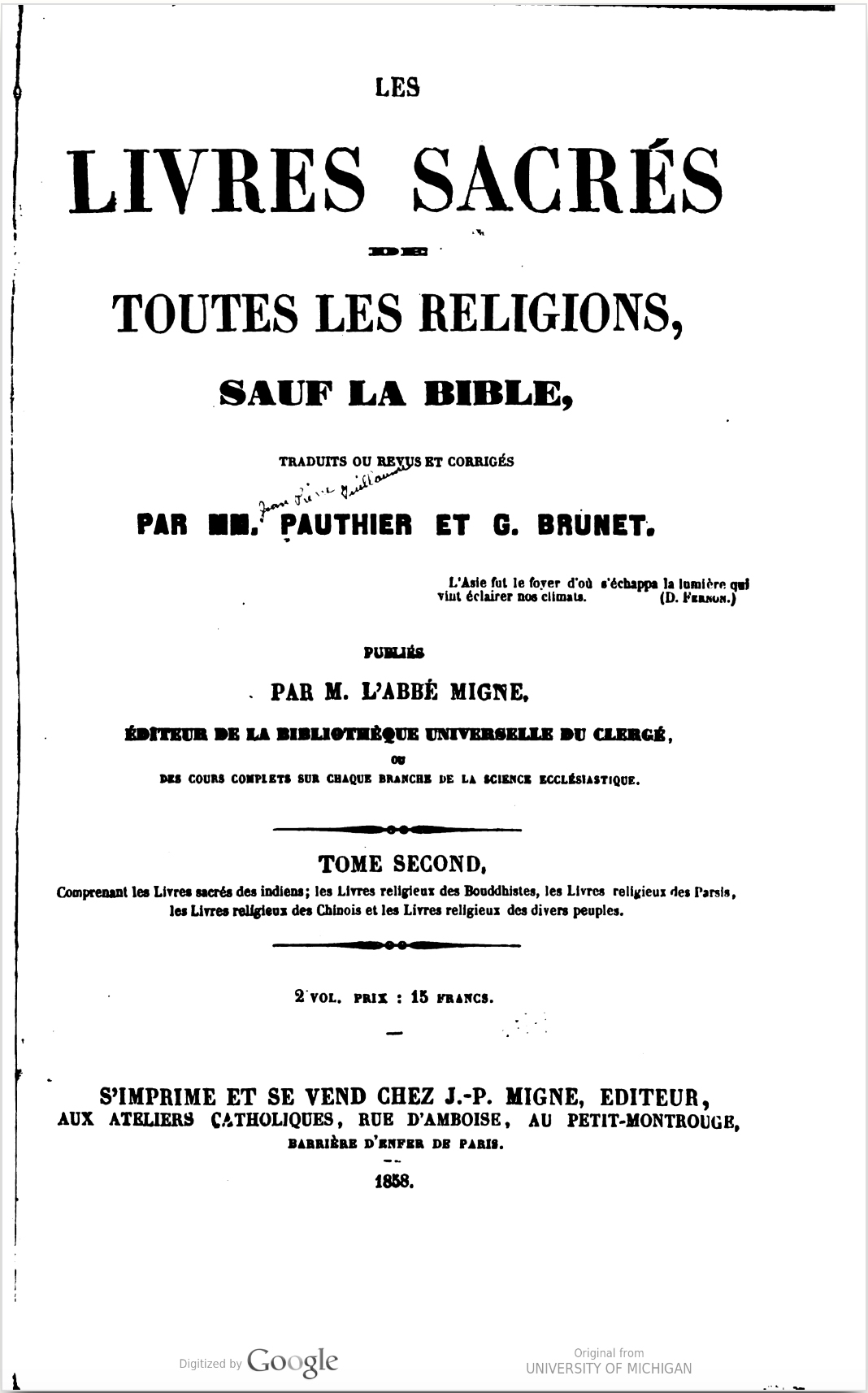
Rgya tch'er rol pa (Lalitavistara), ou développement de jeux
From Bodhicitta
< Articles
Articles/Rgya tch'er rol pa (Lalitavistara), ou développement de jeux| 🤓 Admin Zone 🛠️ hidden to non-admins | |
Rgya tch'er rol pa (Lalitavistara), ou développement de jeux, contentant l'histoire du Bouddha Çakya-Mouni
Article
Please note that many items in our library are simply pages that represent a detailed library catalog entry and citation of someone else's work, presentation, or performance. Read our General Disclaimer for more information.
Description
This French translation of the Lalitavistara by Philippe Édouard Foucaux (1811–1894), professor of Tibetan at the Collège de France and one of the pioneers of Tibetan studies in France, was published as a contribution to Les livres sacrés de toutes les religions, sauf la bible ("The Sacred Books of All Religions, Except the Bible"), a two-volume encyclopedic anthology edited by Jean-Pierre Guillaume Pauthier and Pierre Gustave Brunet and published by J. P. Migne in Paris in 1858 as part of his broader project of comprehensive reference publishing. The translation, occupying pages 574–714 of Volume 2, is based on the Tibetan version of the text (Rgya tch'er rol pa, "Development of Plays"), rather than the Sanskrit, and represents one of the earliest French renderings of this celebrated biography of the Buddha. Foucaux later published a fuller translation of the Lalitavistara in two separate volumes (1847–1848 and 1884–1892).
Citation
Foucaux, Philippe Édouard, trans. "Rgya tch'er rol pa (Lalitavistara), ou développement de jeux." In Vol. 2 of Les livres sacrés de toutes les religions, sauf la bible, edited by Jean-Pierre Guillaume Pauthier and Pierre Gustave Brunet, 574–714. Paris: J. P. Migne, 1858. https://babel.hathitrust.org/cgi/pt?id=mdp.39015082032312&view=1up&seq=578&skin=2021.
Interconnections
1 Full translation of

The Play in Full tells the story of how the Buddha manifested in this world and attained awakening, as perceived from the perspective of the Great Vehicle. The sūtra, which is structured in twenty-seven chapters, first presents the events surrounding the Buddha’s birth, childhood, and adolescence in the royal palace of his father, king of the Śākya nation. It then recounts his escape from the palace and the years of hardship he faced in his quest for spiritual awakening. Finally the sūtra reveals his complete victory over the demon Māra, his attainment of awakening under the Bodhi tree, his first turning of the wheel of Dharma, and the formation of the very early saṅgha. (Source: 84000)
1 Other editions

This volume is the French translation portion of the first published European rendering of the Lalitavistara—the Mahāyāna narrative of the Buddha's life from his descent from Tuṣita heaven through his first sermon at Sarnath, known in Tibetan as the Rgya cher rol pa ("The Play in Full"). It was produced by Philippe Édouard Foucaux (1811–1894), a student of Eugène Burnouf who took up Tibetan studies under the influence of Csoma de Kőrös and went on to become the first professor of Tibetan in Europe, holding a newly created chair at the École des langues orientales in Paris.
Foucaux based his translation on the Tibetan Kangyur text but cross-checked it against the Sanskrit original, making this an early example of comparative Tibetan-Sanskrit philological method applied to a Buddhist scripture in the West. The work was issued in two parts: the Tibetan text itself appeared first (Paris: Imprimerie Royale, 1847), followed by this French translation volume (Paris: Imprimerie Nationale, 1848). Foucaux would later return to the Lalitavistara directly from the Sanskrit, producing a second, Sanskrit-based French translation decades later (Le Lalita Vistara, Annales du Musée Guimet, 1884–1892)—making this 1847–48 edition his earlier, Tibetan-based pass at the same text.
1 Chapter or part of

This is the second volume of a two-volume anthology assembled by Jean-Pierre Guillaume Pauthier and Pierre Gustave Brunet for the prolific Catholic publisher Abbé Jacques-Paul Migne, as part of his broader project of producing encyclopedic reference collections for the French clergy. True to its title — "The Sacred Books of All Religions, Except the Bible"—the volume surveys non-Christian scripture across several traditions, organized into five sections: the sacred books of the Indians (p. 7), the religious books of the Buddhists (p. 473), the religious books of the Parsis/Zoroastrians (p. 714), the religious books of the Chinese (p. 781), and the religious books of various other peoples (p. 796).
The Buddhist section is of particular note for Tibetan and Buddhist studies: it reprints Philippe Édouard Foucaux's pioneering 1847–48 French translation of the Lalitavistara (Tib. Rgya tch'er rol pa), including Foucaux's own original preface, in which he identifies himself as the first person to translate the Lalitavistara into a European language. Rather than presenting an independent Pauthier–Brunet rendering, this section functions as a republication of Foucaux's translation within Migne's larger comparative-religion compendium—making the volume a secondary vehicle for Foucaux's work rather than a fresh scholarly translation in its own right.