Achieving Bodhichitta
From Bodhicitta
| 🤓 Admin Zone 🛠️ hidden to non-admins | |
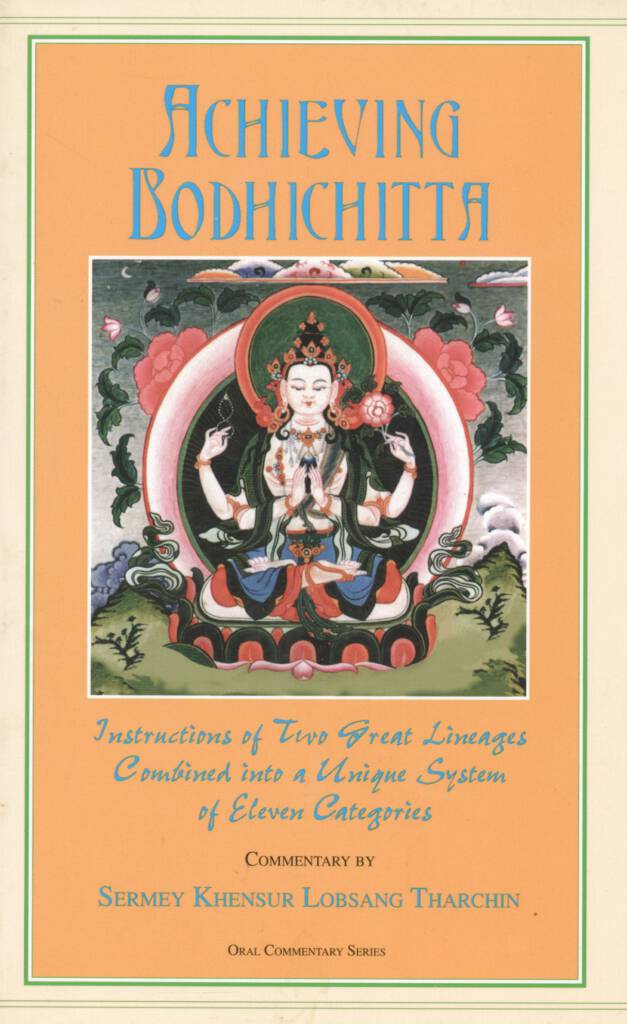
Achieving Bodhichitta: Instructions of Two Great Lineages Combined into a Unique System of Eleven Categories
Book
Please note that many items in our library are simply pages that represent a detailed library catalog entry and citation of someone else's work, presentation, or performance. Read our General Disclaimer for more information.

Description
Achieving Bodhichitta is a compilation of oral teachings given in the 1980s by Sermey Khensur Lobsang Tharchin on the two methods of achieving bodhichitta—the Sevenfold Instruction on Cause and Effect and Equality and Exchange Between Self and Others. These two instructions are presented according to the unique system established by Je Tsongkapa, which combines them into an eleven-step method of practice. This book includes a concise yet thorough presentation of the instruction for achieving calm abiding (shamatha) based on the explanations found in Je Tsongkapa's Great Exposition on the Stages of the Path to Enlightenment (Lamrim Chenmo). (Source Accessed Jan 7, 2025)
Citation
Tharchin, Lobsang. Achieving Bodhichitta: Instructions of Two Great Lineages Combined into a Unique System of Eleven Categories. Translated by Artemus Engle. Oral Commentary Series. Howell, NJ: Mahayana Sutra and Tantra Press, 1999.
Table of contents
- Forewordviii
- Acknowledgmentsix
- Editors' Notex
- INTRODUCTION3
- Lojong, or Mind Training5
- The Lojong Lineage Tradition6
- The Importance of Right Motivation6
- The Power of Bodhichitta9
- The Ten Benefits of Achieving Bodhichitta11
- The Two Instructions for Achieving Bodhichitta14
- PART ONE:
- SEVENFOLD CAUSE AND EFFECT INSTRUCTION
- Equanimity19
- Step One:
- Recognizing That All Beings Have Been My Mother24
- Step Two:
- Recalling the Kindness of All Mother Beings33
- A Special Form of Recalling the Kindness of Beings34
- Step Three:
- Repaying the Kindness of All Mother Beings37
- Step Four:
- Loving-Kindness for All Beings46
- The Eight Benefits of Loving-Kindness48
- Step Five:
- Great Compassion for All Beings50
- Step Six:
- Extraordinary Compassion for All Beings53
- Step Seven:
- The Result: Bodhichitta55
- Maintaining Bodhichitta in This Life57
- Maintaining Bodhichitta in Future Lives58
- PART TWO:
- COMMENTARY TO LAMA CHEKAWA'S SEVEN POINT MIND TRAINING 63
- First Point:
- Preliminaries66
- Leisure and Fortune66
- Impermanence67
- Taking Refuge68
- Karma68
- Second Point:
- The Main Instruction on How to Practice Bodhichitta70
- Recognizing That Self and Others Are the Same71
- Thinking in Many Ways about the Faults of Self-Cherishing Mind73
- Thinking in Many Ways about the Benefits of Cherishing Others79
- The Three Levels of Motivation80
- The Actual Practice of Exchanging Self and Others84
- The Practice of Tonglen, or Giving and Taking86
- The Three Kinds of Suffering87
- How to Do the Visualization of Taking Suffering88
- The Seven Pure Practices for Accumulating Good Karma89
- How to Do the Visualization of Giving Happiness93
- Giving and Taking with the Breath96
- Combining the Two Rivers of Instruction into Eleven Categories99
- Third Point:
- The Method of Turning Bad Experiences into Causes for Enlightenment105
- Turning Bad Experiences into Good Causes by the Power of Mind106
- Turning Bad Causes into Good Causes through Right View110
- Turning Bad Experiences into Good Causes through Taking Action by Body and Speech113
- Fourth Point:
- A Summary of how to Practice throughout Your Life117
- The Five Strengths117
- The Five Strengths as Practiced at the Time of Death129
- Assuming the Proper Physical Position at the Time of Death138
- Fifth Point:
- Signs of Having Mastered the Lojong Instruction141
- Sixth Point:
- The Eighteen Lojong Pledges154
- Seventh Point:
- The Twenty-two Lojong Precepts194
- Right View233
- SEVEN POINT MIND TRAINING
- Root Text in Tibetan241
- Root Text in English Translation249
- APPENDIX:
- Meditation259
- Meditation Posture259
- Types of Meditation261
- Five Enemies of Meditation262
- Breathing Meditation268
- The Nine Levels of Achieving Quiescence270
- Placement270
- Continuous Placement271
- Renewed Placement274
- Close Placement275
- Subduing276
- Pacification277
- Heightened Pacification277
- Single-Pointedness278
- Equipoise278
- Agility279
- Agility of Mind280
- Agility of Body280
- About the Author285
- BIBLIOGRAPHY287
- INDEX293
Interconnections
1 Recension of

Blo sbyong don bdun ma. (Lojong Döndünma). In Tibetan, "Seven Points of Mind Training"; an influential Tibetan work in the blo sbyong ("mind training") genre. The work was composed by the Bka' gdams scholar 'Chad ka ba ye shes rdo rje, often known as Dge bshes Mchad kha ba, based on the tradition of generating bodhicitta known as "mind training" transmitted by the Bengali master Atiśa Dīpaṃkaraśrījñāna. It also follows the system laid out previously by Glang ri thang pa (Langri Tangpa) in his Blo sbyong tshig brgyad ma ("Eight Verses on Mind Training"). Comprised of a series of pithy instructions and meditative techniques, the Blo sbyong don bdun ma became influential in Tibet, with scholars from numerous traditions writing commentaries to it. According to the commentary of the nineteenth-century Tibetan polymath 'Jam mgon kong sprul, the seven points covered in the treatise are: (1) the preliminaries to mind training, which include the contemplations on the preciousness of human rebirth, the reality of death and impermanence, the shortcomings of saṃsāra, and the effects of karman; (2) the actual practice of training in bodhicitta; (3) transforming adverse conditions into the path of awakening; (4) utilizing the practice in one's entire life; (5) the evaluation of mind training; (6) the commitments of mind training; and (7) guidelines for mind training. (Source: "Blo sbyong don bdun ma." In The Princeton Dictionary of Buddhism, 126–27. Princeton University Press, 2014. http://www.jstor.org/stable/j.ctt46n41q.27.)
1 Full translation of
Blo sbyong don bdun ma. (Lojong Döndünma). In Tibetan, "Seven Points of Mind Training"; an influential Tibetan work in the blo sbyong ("mind training") genre. The work was composed by the Bka' gdams scholar 'Chad ka ba ye shes rdo rje, often known as Dge bshes Mchad kha ba, based on the tradition of generating bodhicitta known as "mind training" transmitted by the Bengali master Atiśa Dīpaṃkaraśrījñāna. It also follows the system laid out previously by Glang ri thang pa (Langri Tangpa) in his Blo sbyong tshig brgyad ma ("Eight Verses on Mind Training"). Comprised of a series of pithy instructions and meditative techniques, the Blo sbyong don bdun ma became influential in Tibet, with scholars from numerous traditions writing commentaries to it. According to the commentary of the nineteenth-century Tibetan polymath 'Jam mgon kong sprul, the seven points covered in the treatise are: (1) the preliminaries to mind training, which include the contemplations on the preciousness of human rebirth, the reality of death and impermanence, the shortcomings of saṃsāra, and the effects of karman; (2) the actual practice of training in bodhicitta; (3) transforming adverse conditions into the path of awakening; (4) utilizing the practice in one's entire life; (5) the evaluation of mind training; (6) the commitments of mind training; and (7) guidelines for mind training. (Source: "Blo sbyong don bdun ma." In The Princeton Dictionary of Buddhism, 126–27. Princeton University Press, 2014. http://www.jstor.org/stable/j.ctt46n41q.27.)
2 Teaching on
Blo sbyong don bdun ma. (Lojong Döndünma). In Tibetan, "Seven Points of Mind Training"; an influential Tibetan work in the blo sbyong ("mind training") genre. The work was composed by the Bka' gdams scholar 'Chad ka ba ye shes rdo rje, often known as Dge bshes Mchad kha ba, based on the tradition of generating bodhicitta known as "mind training" transmitted by the Bengali master Atiśa Dīpaṃkaraśrījñāna. It also follows the system laid out previously by Glang ri thang pa (Langri Tangpa) in his Blo sbyong tshig brgyad ma ("Eight Verses on Mind Training"). Comprised of a series of pithy instructions and meditative techniques, the Blo sbyong don bdun ma became influential in Tibet, with scholars from numerous traditions writing commentaries to it. According to the commentary of the nineteenth-century Tibetan polymath 'Jam mgon kong sprul, the seven points covered in the treatise are: (1) the preliminaries to mind training, which include the contemplations on the preciousness of human rebirth, the reality of death and impermanence, the shortcomings of saṃsāra, and the effects of karman; (2) the actual practice of training in bodhicitta; (3) transforming adverse conditions into the path of awakening; (4) utilizing the practice in one's entire life; (5) the evaluation of mind training; (6) the commitments of mind training; and (7) guidelines for mind training. (Source: "Blo sbyong don bdun ma." In The Princeton Dictionary of Buddhism, 126–27. Princeton University Press, 2014. http://www.jstor.org/stable/j.ctt46n41q.27.)
.jpg)
Lam rim chen mo. In Tibetan, "Great Treatise on the Stages of the Path"; the abbreviated title for one of the best-known works on Buddhist thought and practice in Tibet, composed by the Tibetan luminary Tsong khapa Blo bzang Grags pa in 1402 at the central Tibetan monastery of Rwa sgreng. A lengthy treatise belonging to the lam rim, or stages of the path, genre of Tibetan Buddhist literature, the Lam rim chen mo takes its inspiration from numerous earlier writings, most notably the Bodhipathapradīpa ("Lamp for the Path to Enlightenment") by the eleventh-century Bengali master Atiśa Dīpaṃkaraśrījñāna. It is the most extensive treatment of three principal stages that Tsong kha pa composed. The others include (1) the Lam rim chung ba ("Short Treatise on the Stages of the Path"), also called the Lam rim 'bring ba ('"Intermediate Treatise on the States of the Path") and (2) the Lam rim bsdus don ("Concise Meaning of the Stages of the Path"), occasionally also referred to as the Lam rim chung ngu ("Brief Stages of the Path"). The latter text, which records Tsong kha pa's own realization of the path in verse form, is also referred to as the Lam rim nyams mgur ma ("Song of Experience of the Stages of the Path"). The Lam rim chen mo is a highly detailed and often technical treatise presenting a comprehensive and synthetic overview of the path to buddhahood. It draws, often at length, upon a wide range of scriptural sources including the Sūtra and śāstra literature of both the hīnayāna and Mahāyāna; Tsong kha pa treats tantric practice in a separate work. The text is organized under the rubric of the three levels of spiritual predilection, personified as "the three individuals" (skyes bu gsum): the beings of small capacity, who engage in religious practice in order to gain a favorable rebirth in their next lifetime; the beings of intermediate capacity, who seek liberation from rebirth for themselves as an arhat; and the beings of great capacity, who seek to liberate all beings in the universe from suffering and thus follow the bodhisattva path to buddhahood. Tsong kha pa's text does not lay out all the practices of these three types of persons but rather those practices essential to the bodhisattva path that are held in common by persons of small and intermediate capacity, such as the practice of refuge (śaraṇa) and contemplation of the uncertainty of the time of death. The text includes extended discussions of topics such as relying on a spiritual master, the development of bodhicitta, and the six perfections (pāramitā). The last section of the text, sometimes regarded as a separate work, deals at length with the nature of serenity (śamatha) and insight (vipaśyanā); Tsong kha pa's discussion of insight here represents one of his most important expositions of emptiness (śūnyatā). Primarily devoted to exoteric Mahāyāna doctrine, the text concludes with a brief reference to Vajrayāna and the practice of tantra, a subject discussed at length by Tsong kha pa in a separate work, the Sngags rim chen mo ("Stages of the Path of Mantra"). The Lam rim chen mo's full title is Skyes bu gsum gyi rnyams su blang ba'i rim pa thams cad tshang bar ston pa'i byang chub lam gyi rim pa. (Source: "Lam rim chen mo." In The Princeton Dictionary of Buddhism, 465-66. Princeton University Press, 2014. http://www.jstor.org/stable/j.ctt46n41q.27.)