Study/Tibetan Lineages of Teachers of the Bodhicaryāvatāra
- [[<span class="smw-highlighter" data-type="4" data-state="inline" data-title="Warning" title="Some use of "|]]
- "
- In your query was not closed by a matching "
- "
- [[.">Some use of "" in your query was not closed by a matching "".|]]

Andreas Kretschmar, in his translation of Khenpo Kunpal's Drops of Nectar, a commentary on the Bodhicaryāvatāra that is widely used in traditional curricula and among lay Buddhists, lists the various teaching lineages associated with the Bodhicaryāvatāra that developed in Tibet.
Giving evidence of an unbroken, oral explanation lineage for a treatise such as the Bodhisattva-caryāvatāra is of utmost importance for a teacher, since it proves his authority and the validity of his interpretation. That is why Butön lists, in the colophon of his commentary on the Bodhisattva-caryāvatāra,[1] the oral explanation lineage[2] of the masters through whom the Bodhisattva-caryāvatāra was handed down to him:
When this Bodhisattva-caryāvatāra, composed by the great master Śāntideva, who practiced one-pointedly the conduct of a bodhisattva, was spoken as a recitation, those who had achieved perfect recall and who were present in his entourage at that time successively handed down the direct oral explanation lineage through Jetāri,[3] Candrakīrti the lesser,[4] Kunayaśrī,[5] the Nepalese Kanakaśrī,[6] Sumatikīrti,[7] Ngok Loden Sherab,[8] Khyung Rinchen Trak,[9] Tölung Gyamar,[10] and Chawa Chö Seng[11] (1109-1169).
It is said that Chawa Chö Seng also received it from Trolungpa.[12] (From Chawa Chö Seng the lineage continues with) Tsangkar[13] to Trophu Lotsawa Jampe Pal[14] (1172-1225).
Again, Trophu Lotsawa Jampe Pal received the explanation from the three: Khache Panchen Śākyaśrī,[15] Paṇḍita Buddhaśrījñāna,[16] and the Nepalese Paṇḍita Devaśrī.[17]
(Trophu Lotsawa Jampe Pal gave it) to both Lama Sönam Gyalwa[18] and Khenpo Zhönu Dorje[19] (1207-1263). I (Butön) received it from my great teacher Tseme Kyebu.[20]
The Lineage of Teachers of the Bodhisattva-caryāvatāra in the Lam Rim Tradition
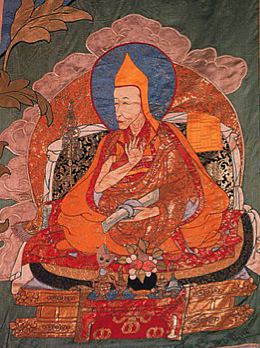
In 1787, the great Gelukpa author Tsechok Ling Yongdzin Yeshe Gyaltsen (1713-1793) compiled two volumes with the biographies[21] of all the lineage masters of the Lam Rim tradition, the 'graded stages to enlightenment'.[22] The tradition of the graded stages to enlightenment describes the development of bodhicitta and the application of the six transcendental perfections, the entire sūtra Mahāyāna path to enlightenment. The graded stages tradition is the most essential teaching of the Gelukpa School that arose out of the Old Kadampa School[23] as founded by the Indian master Atiśa.[24]
Atiśa received the complete teachings and instructions on the graded stages to enlightenment through three lineages:[25] the two afore-mentioned great lineages, i.e., the 'lineage of the profound view' and the 'lineage of vast activities', as well as the 'practice lineage of great blessings'.
The 'practice lineage of great blessings' is said to begin with the Bodhisattva Mañjughoṣa and was recorded by Śāntideva in his texts the Bodhisattva-caryāvatāra, the Śikṣā-samuccaya, and, according to the Tibetan view, the Sūtra-samuccaya. The 'practice lineage of great blessings' is said to run through Mañjughoṣa, Akṣayamati,[26] master Eladhari,[27] master Śuravajra,[28] the Mahā Śrī Ratna Bodhisattva,[29] Atiśa's root guru Lord (Dharmakīrti of) Suvarṇadvīpa,[30] and Atiśa. From Atiśa the lineage runs in an unbroken succession of masters through the Old and New Kadampa schools[31] up to the present day.
Terdag Lingpa's reading transmission of the Bodhisattva-caryāvatāra
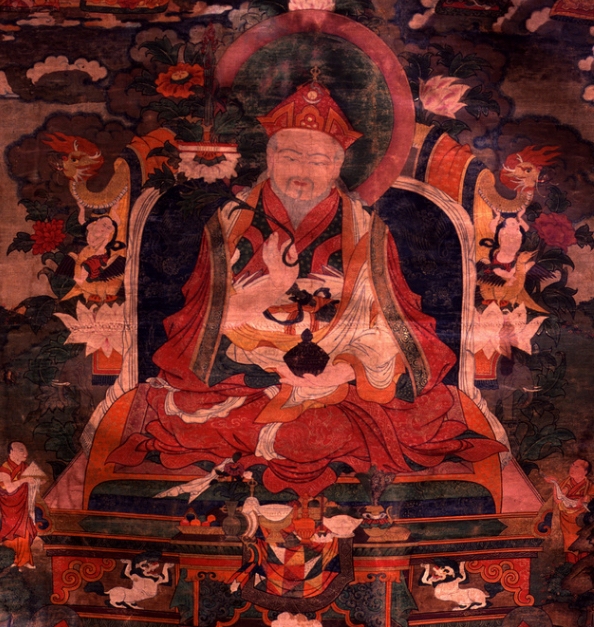
Terdag Lingpa Gyurme Dorje's 'manual of received teachings'[32] provides us with another lineage of the reading transmission[33] of the Bodhisattva-caryāvatāra[34] and the Śikṣā-samuccaya[35] that was passed on through the masters of the New Translation Period before it became exclusively Nyingma:
Śāntideva, Eladhari, Jetāri,[36] Candrakīrti the lesser,[37] Puṇyaśrī, the Nepalese Kanakapa,[38] Sumatikīrti,[39] Ngok Loden Sherab[40] (1059-1109), Zhangtshe Pongwa[41] (1059-1109), and Tsang Nagpa[42] (1109-1169).
From Ngok Loden Sherab the lineage also comes down to Tsang Nagpa through Trolungpa[43] and Chawa Chö Seng[44] (1109-1169). From Tsang Nagpa the lineage continues with:
Palden Tro,[45] Chim Chenpo[46] (1290-1285), Zeu Traktsön,[47] and Chim Lobzang Trakpa[48] (1299-1375).
From Chim Lobzang Trakpa the lineage comes down to Kangyurwa Śākya Gyaltshen[49] and continues with:
Dorje Denpa Kunga Namgyal,[50] Sönam Chogden,[51] Lodro Thogme,[52] Palden Dondrup,[53] Wangchug Gyaltshen,[54] Ngagwang Namgyal,[55] Tsültrim Trashi,[56] Rinchen Gyamtsho,[57] Kunga Tendar,[58] Domtsön Kunga Dargye,[59] and Terdag Lingpa Gyurme Dorje.[60]
The Lineage of Teachers of the Bodhisattva-caryāvatāra at Dzogchen Monastery
Paltrül Rinpoche composed a 'Supplication to the Lineage Masters of the Bodhisattvacaryāvatāra',[61] which begins with Buddha Śākyamuni and continues all the way down to himself. This lineage supplication also presents the lineage maintained at Śrī Siṃha Shedra. The lineage is not always historically connected in a teacher-student relationship but at times skips a generation or two. The lineage is as follows:
Buddha Śākyamuni, Mañjughoṣa, Śāntideva, Jetāri,[62] Candrakīrti the lesser,[63] Guṇa Śrī,[64] Kanakaśrī,[65] Sumatikīrti,[66] Ngok Loden Sherab[67] (1051), Master Jetsünpa,[68] Butön Rinchen Drup[69] (1290-1364), Thukse Lotsawa,[70] Yagtruk Sangye Pal[71] (1350-1414), Sangye Phel[72] (1348-1414), Trinle Mikyöpa[73] (1507-1554), Könchok Jungne,[74] Karma Chagme[75] (1613-1678), Pema Rigdzin[76] (1625-1697), Pönlob Namkha Özer,[77] Thekchog Tendzin,[78] Trashi Gyamtso,[79] Rigdzin Zangpo,[80] Pema Trashi,[81] Gyalse Zhenphen Thaye,[82] Jigme Ngotshar,[83] and Paltrül Rinpoche.[84]
It is striking that Paltrül Rinpoche, a great Nyingma scholar, traces his explanation lineage of the Bodhisattva-caryāvatāra back to masters of the New Translation Period, such as Ngok Loden Sherab, Butön and others. This lineage supplication again suggests that an independent Nyingma explanation lineage tracing itself back to Kawa Paltsek and his first translation of the Bodhisattva-caryāvatāra no longer exists.
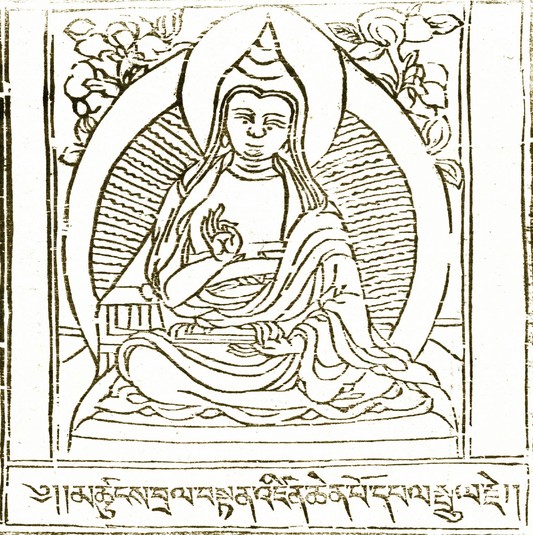
Paltrül Rinpoche's explanation lineage originates from the great masters of the New Translation Period and becomes an exclusively Nyingma lineage only in the 17th century with masters such as Pema Rigdzin and others. This refutes the commonly held belief that all sūtra lineages of the Nyingma School can be traced back to the First Translation Period through an exclusively Nyingma lineage. Nevertheless, Tibetan scholars believe that the reading transmission[85] and explanation lineage[86] of Kawa Paltsek's first translation and Rinchen Zangpo's second translation of the Bodhisattvacaryāvatāra were all absorbed by Ngok Loden Sherab in his third and final translation of the root text from the Sanskrit.
According to the tradition of Śrī Siṃha Shedra, Paltrül Rinpoche's lineage continues with his famous students such as Ön Urgyen Tendzin Norbu,[87] Thubten Chökyi Drakpa,[88] Khenpo Kunpal,[89] Khenpo Yönga,[90] Dzogchen Khenpo Pema Dorje,[91] and Mipham Rinpoche.[92] Ön Urgyen Tendzin Norbu's main student was Khenpo Zhenga, who taught the Bodhisattva-caryāvatāra extensively to Batur Khenpo Thubga.[93] Batur Khenpo Thubga taught the Bodhisattva-caryāvatāra according to Khenpo Kunpal's commentary to Khenpo Pentse (1931-2002).[94]
Khenpo Pentse received Khenpo Zhenga’s annotation commentary[95] on the Bodhisattva-caryāvatāra from Dzogchen Khenpo Thubnor.[96] He also received Ngülchu Thogme's commentary[97] on the Bodhisattva-caryāvatāra from Dzogchen Khenpo Tsering Nyima.[98] Furthermore, he received teachings on the Bodhisattvacaryāvatāra from Khenpo Thubga's student Khenpo Chödor.[99] During the latter part of his life, until his death in 2001, Khenpo Pentse was considered the main khenpo at Dzogchen Śrī Siṃha Shedra, although his main residence was Phugkhung Gompa[100] in the district of Arik Dza.[101]
Khenpo Chöga[102] received teachings on the Bodhisattva-caryāvatāra from many masters, and studied and practiced the Bodhisattva-caryāvatāra for many years. He received numerous commentaries on the root text of the Bodhisattva-caryāvatāra from his main teacher Khenpo Pentse, including Khenpo Kunpal's commentary twice, and Khenpo Zhenga's annotation commentary once. Khenpo Chöga also received a commentary on Khenpo Zhenga's annotation commentary from Khenpo Thubnor. He received teachings on Ngülchu Thogme's commentary from Khenpo Tsering Nyima and from Serta Khenpo Sori.[103] He received a very extensive commentary on the Bodhisattva-caryāvatāra root text over a period of two years from Khenpo Kunub Özer,[104] who had received his transmission from Khenpo Thubnyen,[105] who in turn was a direct student of Khenpo Zhenga. Furthermore, Khenpo Chöga received detailed teachings on the Bodhisattva-caryāvatāra root text from Khenpo Akhu Dolo.[106] He also received Khenpo Kunpal's commentary as well as another commentary on the Bodhisattva-caryāvatāra root text from his classmate Khenpo Urgyen Rigdzin.[107]
These days, scholars at Dzogchen Monastery first give new students a commentary on the Bodhisattva-caryāvatāra root text, which they must memorize. The students next study Ngülchu Thogme's commentary on the Bodhisattva-caryāvatāra. At the same time, the students learn the interpretations of other schools on the Bodhisattvacaryāvatāra. Later, they study Khenpo Zhenga's annotation commentary. Finally, they learn Khenpo Kunpal's commentary in conjunction with an oral commentary on the root text. All these commentaries on the Bodhisattva-caryāvatāra are taught in the practice-oriented tradition of Paltrül Rinpoche, in which all scholastic knowedge must be meditated upon and thereby applied to one's mind.
Notes
- ↑ See bu ston 'grel chen, pages 600-602. This colophon has been discussed and analysed by Akira Saito in Bu ston and the sPyod 'jug, pages 79-85.
- ↑ man ngag gi legs bshad brgyud pa
- ↑ dze ta ri
- ↑ zla grags chung ba
- ↑ ku na ya śrī
- ↑ bal po ka na ka śrī
- ↑ su ma ti kirti
- ↑ rngog blo ldan shes rab
- ↑ khyung rin chen grags
- ↑ stod lung rgya dmar
- ↑ phyva ba chos seng / phyva ba chos kyi seng ge
- ↑ gro lung pa
- ↑ gtsang dkar
- ↑ Trophu Lotsawa Jampe Pal [khro phu lo tsā ba byams pa'i dpal] was a direct student of Tsangkarpa [gtsang dkar pa].
- ↑ kha che paṇ chen śākya śrī
- ↑ paṇḍita buddha śri jñāna
- ↑ bal po’i paṇḍita deva śrī
- ↑ bla ma bsod nams rgyal ba
- ↑ mkhan po gzhon nu rdo rje
- ↑ tshad ma’i skyes bu
- ↑ See lam rim bla brgyud
- ↑ byang chub lam gyi rim pa
- ↑ Gene Smith mentions in Among Tibetan Texts, page 228, that the early Kadampa masters included the Bodhisattva-caryāvatāra among the 'six basic texts of the Kadampa School' [bka' gdams gzhung drug], which are: 1) the Sūtrālaṃkāra [mdo sde rgyan] of Maitreya, 2) the Bodhisattva-bhūmi [byang chub sems dpa'i sa] of Asaṅga, 3) the Śikṣā-samuccaya [bslab btus] of Śāntideva, 4) the Bodhisattva-caryāvatāra [spyod 'jug] of Śāntideva, 5) the Jātakamālā [skyes pa'i rabs kyi rgyud] of Āryaśūra, and 6) the Udāna-varga [ched du brjod pa'i tshoms].
- ↑ Dīpaṃkaraśrī [dpal mar me mdzad] or Dīpaṃkaraśrījñāna [dpal mar med mdzad ye shes] or Jobo Je Palden Atiśa [jo bo rje dpal ldan a ti śa] are names of Atiśa (982-1054).
- ↑ See lam rim bla brgyud, page 290.
- ↑ blo gros mi zad pa, an epithet for Śāntideva.
- ↑ slob dpon e la dha ri (ti)
- ↑ slob dpon dpa' bo rdo rje
- ↑ byang chub sems dpa' chen po rin chen dpal
- ↑ mgon po gser gling pa
- ↑ The Old Kadampa School [bka' gdams rnying ma] began with Atiśa and the New Kadampa School [bka' gdams gsar pa] with Tsongkhapa. The New Kadampa school is also called the Gendenpa [dge ldan pa] or Gelukpa School. The Old Kadampa School has again two lineages: the lineage of textbooks of the Kadampas [bka' gdams gzhung pa], lam rim bla brgyud, pages 475-576; and the lineage of oral instructions of the Kadampas [bka' gdams gdams ngag pa], lam rim bla brgyud, 576-end. There is also the lineage of upadeśa of Kadampa [bka' gdams man ngag pa], which is sometimes given as the third lineage.
- ↑ thob yig, pages 20-21.
- ↑ Reading transmission [lung]: From the earliest periods of instruction in Buddhism, teachings were transmitted orally from teacher to student. When the teachings were eventually written down, this tradition persisted. Before a student can study a sacred text, he must first hear it orally from his teacher. Every text that is read or studied must first be read aloud to the student before he is even allowed to look at it. After this oral recitation, the teacher begins giving the explanation [bshad pa] of the text.
- ↑ byang chub sems dpa'i spyod pa la 'jug pa'i lung brgyud
- ↑ bslab btus / bslab pa kun las btus pa
- ↑ dze tā ri
- ↑ zla grags chung ba
- ↑ bal po ka na ka pa
- ↑ su ma ti kīrti
- ↑ rngog blo ldan shes rab
- ↑ Zhangtshe Pongwa Chökyi Lama [zhang tshe spong ba chos kyi bla ma] was a direct student of Ngok Loden Sherab.
- ↑ Tsang Nagpa Tsöndrü Senge [gtsang nag pa brtson 'grus seng ge] was a direct student of Chawa Chö Seng [phyva ba chos seng].
- ↑ Trolungpa Lodro Jungne [gro lung pa blo gros ’byung gnas] was a direct student of Atiśa, Dromtön Gyalwe Jungne ['brom ston rgyal ba'i 'byung gnas] (1005-1064) and Ngok Loden Sherab.
- ↑ Chawa Chö Seng [phyva ba chos seng / phyva ba chos kyi seng ge] was the teacher of Sönam Tsemo [bsod nams rtse mo] (1142-1182).
- ↑ dpal ldan gro
- ↑ Chim Chenpo [mchims chen po] or Chim Namkha Dragpa [mchims nam mkha' grags pa] was a direct student of Palden Tro.
- ↑ ze'u grags brtson
- ↑ Lobzang Trakpa [mchims blo bzang grags pa]
- ↑ bka' 'gyur ba śākya rgyal mtshan
- ↑ rdo rje gdan pa kun dga' rnam rgyal
- ↑ bsod nams mchog ldan
- ↑ blo gros thogs med
- ↑ dpal ldan don grub
- ↑ dbang phyug rgyal mtshan
- ↑ ngag dbang rnam rgyal, only mentioned in the lineage of the Śikṣā-samuccaya.
- ↑ tshul khrims bkra shis
- ↑ rin chen rgya mtsho
- ↑ kun dga' bstan dar
- ↑ sdom brtson kun dga' dar rgyas
- ↑ gter bdag gling pa 'gyur med rdo rje
- ↑ spyod 'jug brgyud 'debs
- ↑ dze ta ri, an Indian scholar who studied in Śāntideva's tradition.
- ↑ zla ba grags pa chung ba, a student of Jetāri.
- ↑ gu ṇa śrī [yon tan dpal], a student of Chandrakīrti.
- ↑ ka na ka śrī (or kāṇakaśrī), a student of Guṇa Śrī.
- ↑ A student of Kanakaśrī.
- ↑ rngog blo ldan shes rab
- ↑ slob dpon rje btsun pa who might be identical with Trolungpa [gro lung pa].
- ↑ bu ston rin chen grub
- ↑ thugs sras lo tsā ba, a direct student of Butön
- ↑ g.yag phrug sangs rgyas dpal, a great scholar of the Sakya school, who wrote a detailed commentary on the Prajñāpāramitā [sher phyin]. His most famous students were Rongtön Mawe Senge [rong ston smra ba'i seng ge chen mo] (1367-1449) and Rendaba Zhönu Lodro [red mda' ba gzhon nu blo gros] (1349-1412). He is also known under the name g.yag ston or g.yag phrug pa. See also Blue Annals, page 339. See gangs can mkhas grub rim byon ming mdzod, pages 1573-1573
- ↑ sangs rgyas 'phel, a great Sakya Lama whose teacher was Rongtön Mawe Senge [rong ston smra ba'i seng ge chen mo] (1367-1449), also known as Rongtön Sheja Kunrig Shakya Gyaltshen [rong ston shes bya kun rig shākya rgyal mtshan]. See Blue Annals, pages 339-340.
- ↑ phrin las mi bskyod pa, the eighth Karmapa, Mikyö Dorje [mi bskyod rdo rje].
- ↑ dkon mchog ’byung gnas, the ninth Shamarpa (???).
- ↑ karma chags med.
- ↑ pad ma rig 'dzin, the first Dzogchen Rinpoche.
- ↑ dpon slob nam mkha' 'od zer
- ↑ theg mchog bstan 'dzin, the second Dzogchen Pema Rigdzin.
- ↑ bkra shis rgya mtsho
- ↑ rig 'dzin bzang po
- ↑ Khenchen Sengtruk Pema Trashi [seng phrug pad ma bkra shis].
- ↑ rgyal sras gzhan phan mtha' yas.
- ↑ 'jigs med ngo mtshar was a direct student of Jigme Lingpa (1730-1798) as well as a student of Gyalse Zhenphen Thaye.
- ↑ Paltrül Rinpoche [dpal sprul 'jigs med chos kyi dbang po].
- ↑ lung brgyud
- ↑ bshad brgyud
- ↑ Ön Urgyen Tendzin Norbu [dbon u rgyan bstan 'dzin nor bu], also known as Urgyen Tenga [u rgyan bstan dga'], was a cousin [tsha bo] of Gyalse Zhenphen Thaye. He studied with Paltrül Rinpoche and also with Gyalse Zhenphen Thaye.
- ↑ Khenpo Thubten Chökyi Drakpa [thub bstan chos kyi grags pa] was also known as Minyag Kunzang Sönam [mi nyag kun bzang bsod nams].
- ↑ Khenpo Kunpal (1862-1943) had several names, including Gegong Khenpo Kunpal [dge gong mkhan po kun dpal], Kunzang Palden [kun bzang dpal ldan], and also Thubten Kunzang Chödrak [thub bstan kun bzang chos grags].
- ↑ Khenpo Yönga [mkhan po yon dga' / mkhan po yon tan rgya mtsho] studied with Paltrül Rinpoche and with Ön Urgyen Tendzin Norbu.
- ↑ Dzogchen Khenpo Pema Dorje [rdzogs chen mkhan po pad ma rdo rje] was a 19th century master who studied with Gyalse Zhenpen Thaye, the fourth Dzogchen Rinpoche, and Khenchen Sengtruk Pema Trashi [mkhan chen seng sprugs padma bkra shis]. He was a classmate of Paltrül Rinpoche and one of the foremost khenpos of Dzogchen Monastery. For biographical notes see Masters of Meditation, page 200.
- ↑ Mipham Rinpoche [mi pham rin po che] (1846-1912), also known as Ju Mipham Jamyang Namgyal ['ju mi pham 'jam dbyangs rnam rgyal], received teachings from Paltrül Rinpoche on the chapter concerning transcendental knowledge and shortly thereafter, in 1878, wrote a commentary to this chapter. See nor bu ke ta ka.
- ↑ Batur Khenpo Thubga [ba thur mkhan po thub dga'] was also known as Khenpo Thubten Chöphel [mkhan po thub bstan chos 'phel]. Along with a group of about one thousand Mongolians, his family had migrated from Mongolia to East Tibet following the visit to Mongolia of the third Dzogchen Pema Rigdzin. In addition to Khenpo Zhenga, Batur Khenpo Thubga also received teachings on the Bodhisattva-caryāvatāra from Khenpo Yönga. As he had studied at Paltrül Rinpoche's hermitage called Changma Ritrö [lcang ma ri khrod], he was also known as Changmay Khenchen Thubga Yibzhin Norbu [lcang ma'i mkhan chen thub dga' yid bzhin nor bu].
- ↑ Regarding Khenpo Pentse's [mkhan po pad ma tshe dbang] education in sūtrayāna, his main root guru [thun mong ma yin pa'i rtsa ba'i bla ma] was Batur Khenpo Thubga. For his education in the teachings of the Great Perfection according to the Longchen Nyingthig tradition, his main root guru was Adzom Drugpa's son Gyalse Gyurme Dorje [rgyal sras 'gyur med rdo rje / sras 'gyur dga']. In 1958 he received from Gyalse Gyurme Dorje the extraordinary oral transmission [thun mong ma yin pa'i snyan brgyud] of the Longchen Nyingthig tradition. During the time when the Chinese suppressed the practice of Buddhism in East Tibet, from the late 1950s until the mid 1970s, Khenpo Pentse was unable to wear robes; pretending to be a lay person, he remained in retreat in his native village, Arik Deba [a rig sde ba], in the district of Arik Dza [a rig rdza] in East Tibet. When the Chinese stopped the persecution of Buddhist practitioners toward the end of the 1970s, Khenpo Pentse again began teaching and was free to wear his robes. Upon the recommendation of Khenpo Thubnor [mkhan po thug nor], Khenpo Pentse was invited in 1982 by Alag Zenkar Rinpoche [a lag gzen dkar rin po che] to teach khenpos at a newly-founded (1980) school for Tibetan studies called Pöyig Lobdra Chenmo [bod yid slob grva chen mo], next to Dzogchen monastery. At the time, this was the only place of study at Dzogchen monastery, since the Śrī Siṃha Shedra had been completely destroyed by the Chinese around 1959. Khenpo Pentse stayed for three years at the Pöyig Lobdra and taught extensively. He then returned to his native village and founded a shedra called Ngedön Shedrub Dargye Ling [nges don bshad sgrub dar rgyas gling] at Phugkhung Monastery [phug khungs bde chen chos 'khor lhun po], his childhood monastery, a sub-monastery [dgon lag] of Zhechen. This shedra became his main residence. At present, 200 monks are studying at this shedra, which has produced many khenpos. Every year Khenpo Pentse used to go for a short period of time to teach both at the Śrī Siṃha Shedra and at Zhechen, where he had also started a shedra. In 2002 Khenpo Pentse passed away at the age of 70/71 at Samye Chimphu [bsam yas mchims phu].
- ↑ gzhan dga' mchan 'grel
- ↑ rdzogs chen mkhan po thub nor
- ↑ dngul chu thogs med 'grel pa
- ↑ rdzogs chen mkhan po tshe ring nyi ma
- ↑ mkhan po chos rdor
- ↑ phug khungs bde chen chos 'khor lhun po
- ↑ a rig rdza
- ↑ rdzogs chen mkhan po chos dga'
- ↑ mkhan po gso rig
- ↑ sku gnubs 'od zer
- ↑ mkhan po thub bstan snyan grags
- ↑ a khu rdo lo / a khu rdo rje
- ↑ mkhan po u rgyan rig 'dzin
