Sarvapuṇyasamuccayasamādhisūtra

From Bodhicitta
< TextsTexts/Sarvapuṇyasamuccayasamādhisūtra

🤓 Admin Zone 🛠️ hidden to non-admins
सर्वपुण्यसमुच्चयसमाधिसूत्र
Sarvapuṇyasamuccayasamādhisūtra
འཕགས་པ་བསོད་ནམས་ཐམས་ཅད་བསྡུས་པའི་ཏིང་ངེ་འཛིན་ཞེས་བྱ་བ་ཐེག་པ་ཆེན་པོའི་མདོ།
'phags pa bsod nams thams cad bsdus pa'i ting nge 'dzin zhes bya ba theg pa chen po'i mdo
The Noble Mahāyāna Sūtra "The Absorption That Encapsulates All Merit" (84000)
Text


Please note that many items in our library are simply pages that represent a detailed library catalog entry and citation of someone else's work, presentation, or performance. Read our General Disclaimer for more information.

Description

The Absorption That Encapsulates All Merit tells the story of Vimalatejā, a strongman renowned for his physical prowess, who visits the Buddha in order to compare abilities and prove that he is the mightier of the two. He receives an unexpected, humbling riposte in the form of a teaching by the Buddha on the inconceivable magnitude of the powers of awakened beings, going well beyond mere physical strength. The discussions that then unfold—largely between the Buddha, Vimalatejā, and the bodhisattva Nārāyaṇa—touch on topics including the importance of creating merit, the centrality of learning and insight, and the question of whether renunciation entails monasticism. Above all, however, Vimalatejā is led to see that the entirety of the Great Vehicle path hinges on the practice that forms the name of the sūtra, which is nothing other than the mind of awakening (bodhicitta). (Source: 84000)

Śāntideva quotes this sūtra four times in the Śikṣāsamuccaya, citing it as the Nārāyaṇaparipṛcchā (The Inquiry of Nārāyaṇa; Tib. Sred med kyi bus zhus pa), after the bodhisattva Nārāyaṇa, one of its principal interlocutors: once in chapter 1, on giving away one’s possessions and body; once in chapter 7, on the motivation and benefits of moral discipline; and twice in chapter 10, on the value of learning and on respect for the Dharma, the second addressed to Vimalatejas. All four correspond closely to passages in the Derge Kangyur translation of this text (vol. 56, ff. 83b–85a, 87b–89b, and 92b–96b), in the same order in which Śāntideva cites them.

The quotations are not found in the Kangyur text that bears the title Nārāyaṇaparipṛcchā (Toh 684), a dhāraṇī for victory in battle in which Nārāyaṇa, defeated by the asuras, asks the Buddha for protection. According to its colophon, that dhāraṇī had not previously been translated into Tibetan and was rendered from a Sanskrit manuscript obtained from Nepal by Situ Paṇchen Chökyi Jungne in the eighteenth century, long after the Śikṣāsamuccaya was translated. The work Śāntideva cites as the Nārāyaṇaparipṛcchā therefore corresponds, at least in the passages he quotes, to this sūtra, the Sarvapuṇyasamuccayasamādhi.

Kamalaśīla likewise quotes this sūtra under the title Nārāyaṇaparipṛcchā in the second Bhāvanākrama, citing the passage on learning and wisdom that Śāntideva quotes in chapter 10 of the Śikṣāsamuccaya.


Quoted in the aligned translations
Interconnections
1 Recensions
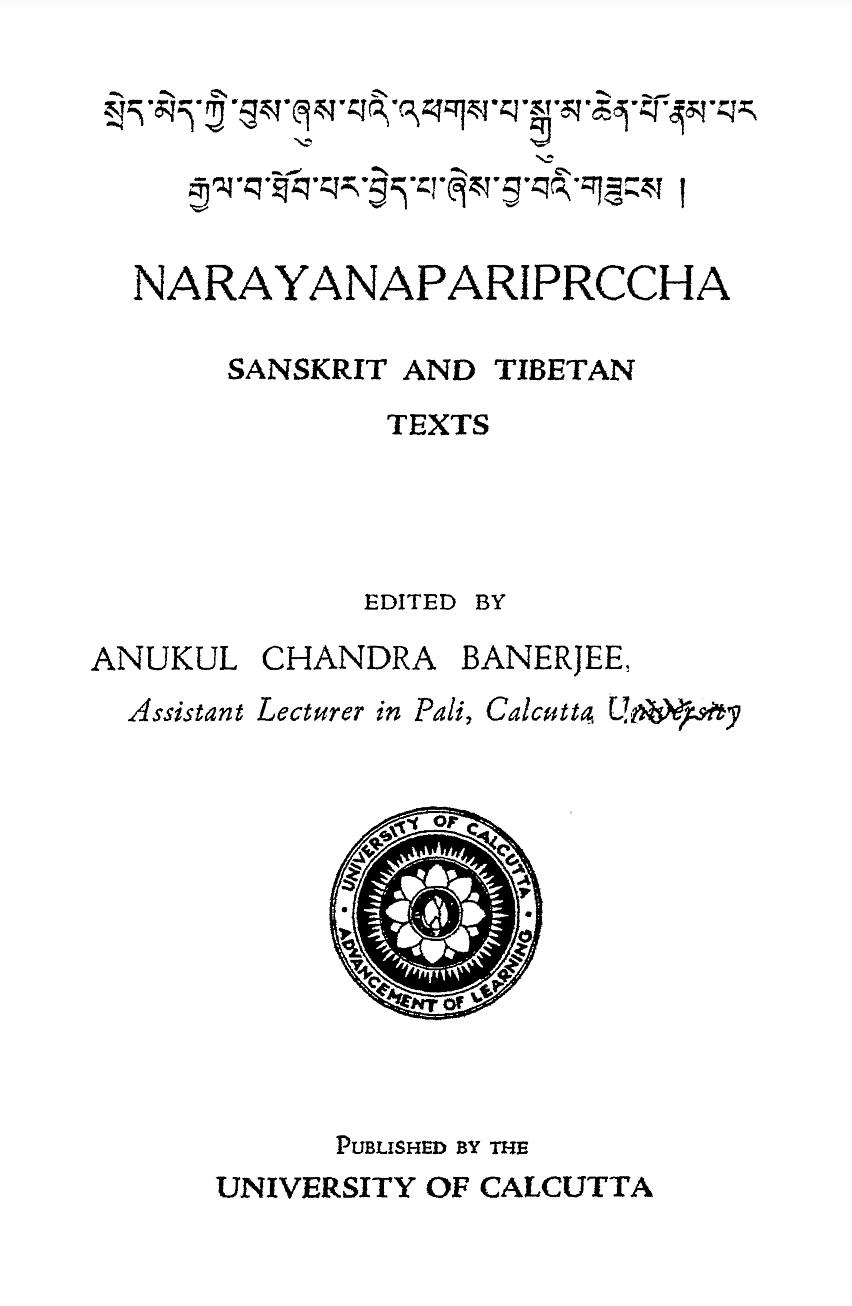
Narayanapariprccha Sanskrit and Tibetan Texts-front.jpg
Books1941About this item
Sanskrit text of the Nārāyaṇaparipṛcchādhāraṇī with Tibetan translation and an English introduction. Edited by Anukul Chandra Banerjee.
1 Scholarship
Narayanapariprccha Sanskrit and Tibetan Texts-front.jpg
Books1941About this item
Sanskrit text of the Nārāyaṇaparipṛcchādhāraṇī with Tibetan translation and an English introduction. Edited by Anukul Chandra Banerjee.