Kāśyapaparivartasūtra
From Bodhicitta
| 🤓 Admin Zone 🛠️ hidden to non-admins | |
काश्यपपरिवर्तसूत्र
Kāśyapaparivartasūtra
འཕགས་པ་འོད་སྲུང་གི་ལེའུ་ཞེས་བྱ་བ་ཐེག་པ་ཆེན་པོའི་མདོ།
'phags pa 'od srung gi le'u zhes bya ba theg pa chen po'i mdo
The Discourse for Kāśyapa (84000)
Text
Please note that many items in our library are simply pages that represent a detailed library catalog entry and citation of someone else's work, presentation, or performance. Read our General Disclaimer for more information.


Description
Kāśyapaparivarta. (T. 'Od srung gi le'u; C. Yiri monibao jing; J. Yuinichi manihōkyō; K. Yuil manibo kyǒng 遺日摩尼寶經). In Sanskrit, "The Kāśyapa Chapter"; a sūtra from one of the earliest strata of Indian Mahāyāna Buddhism, probably dating from sometime in the first Century CE. The sūtra offers an overview of practices emblematic of bodhisattvas, which are arranged in several groups of four practices apiece. The text cites a "bodhisattva canon" (bodhisattvapiṭaka) as the source for the teaching on the six perfections (pāramitā) and offers one of the earliest mentions of the "thought of enlightenment" (bodhicitta) in its Mahāyāna interpretation as the aspiration to achieve buddhahood. A bodhisattva who generates this thought even for the first time is said to be superior to the solitary buddhas (pratyekabuddha) and disciples (śrāvaka). Disciples are also censured as not being true sons of the Buddha, an early expression of the later Mahāyāna school's more explicit denunciations of the so-called hīnayāna. The sūtra also refers to bodhisattva precepts (see bodhisattvaśīla), which will subsequently be elaborated upon in such texts as Maitreya/Asaṅga's Bodhisattvabhūmi and in such Chinese apocrypha as the Fanwang jing. The Kāśyapaparivarta was one of the first sūtras translated into Chinese, by the Indo-Scythian monk *Lokakṣema (c. 178-198 CE) in 179 CE; a later recension is also included in the massive Ratnakūṭa collection of sūtras. The Kāśyapaparivarta is one of a substantial number of scriptures in the Ratnakūṭa collection for which Sanskrit recensions have been rediscovered and edited. Its Sanskrit manuscript was first discovered in Khotan in the 1890s and was more than one thousand years old; other Sanskrit fragments have subsequently been recovered. (Source: "Kāśyapaparivarta." In The Princeton Dictionary of Buddhism, 426. Princeton University Press, 2014. http://www.jstor.org/stable/j.ctt46n41q.27.)
Quoted in the aligned translations
Reference
Kāśyapaparivartasūtra [काश्यपपरिवर्तसूत्र]. 'phags pa 'od srung gi le'u zhes bya ba theg pa chen po'i mdo [འཕགས་པ་འོད་སྲུང་གི་ལེའུ་ཞེས་བྱ་བ་ཐེག་པ་ཆེན་པོའི་མདོ།]. [The Discourse for Kāśyapa (84000)]. Kangyur, RKTSK 87 http://www.rkts.org/cat.php?id=87&typ=1.
Interconnections
All 41Books 21Articles 18Classical Works 2
4 Recensions

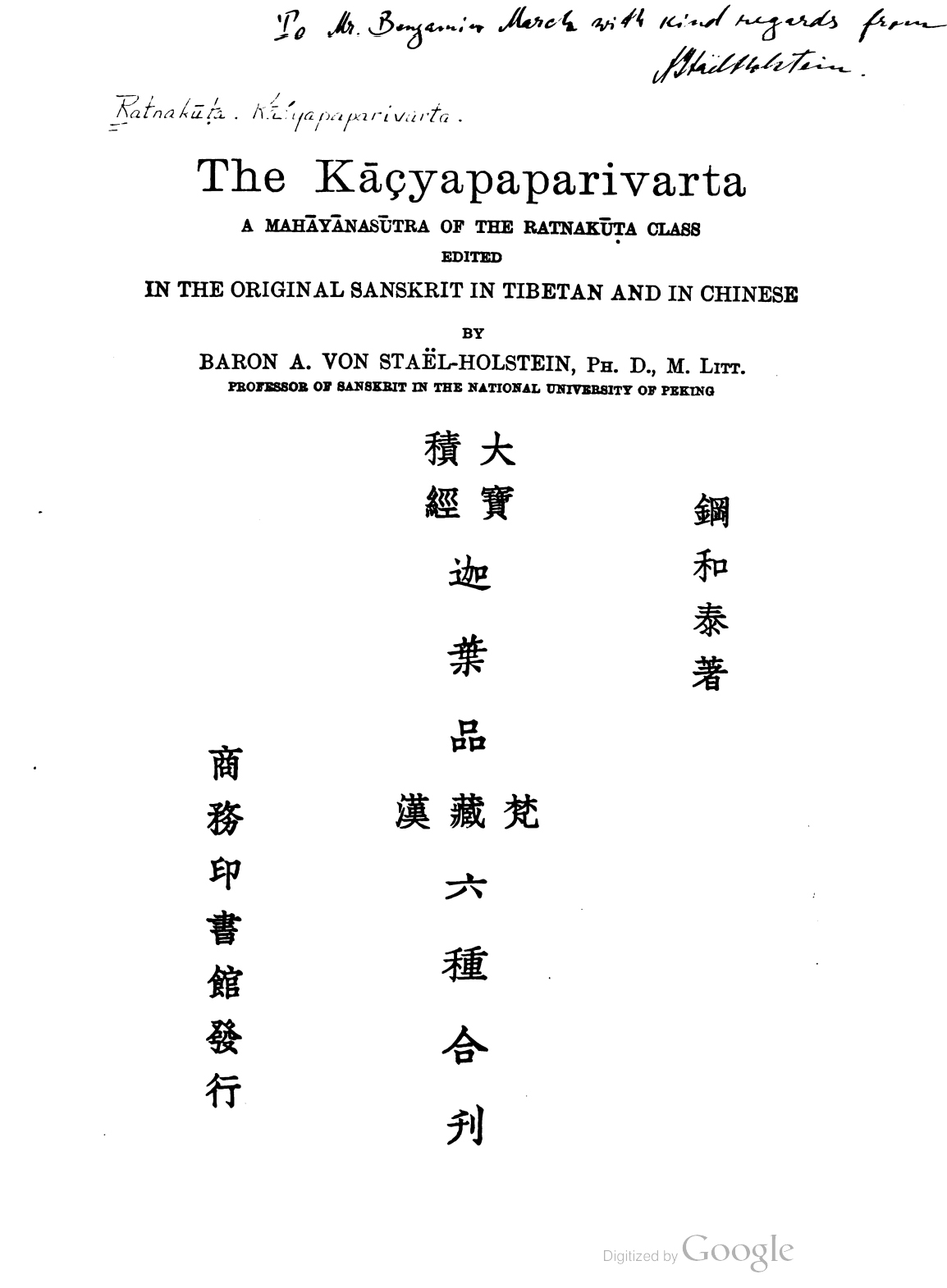
This is Baron Alexander von Staël-Holstein's editio princeps of the Kāśyapaparivarta, presenting the Sanskrit text alongside its Tibetan translation and four Chinese translations. In his preface, Staël-Holstein argues the sūtra belongs to a small group of Mahāyāna works datable before 200 CE, highlights its exposition of the "middle path" (chapters 52–63) and its polemic against self-interested Śrāvakas, and traces the history of the title "Kāśyapaparivarta" as a later designation for a text more anciently known simply as Ratnakūṭa. He also describes the sole surviving Sanskrit manuscript (found near Khotan, missing 8 of 81 leaves), and argues from a comparison of the four Chinese translations (Han, Djin, Ch'in, Sung) that they represent successive, evolving textual states, with the 2nd-century Han translation by Lokakṣema preserving the earliest recoverable form. The volume also includes a Chinese preface by Liang Qichao.

The Kāśyapaparivarta: Facsimile Edition with a New Transliteration
M. I. Vorobyova-Desyatovskaya, Bibliotheca Philologica et Philosophica Buddhica V (Tokyo: IRIAB, Soka University, 2002)
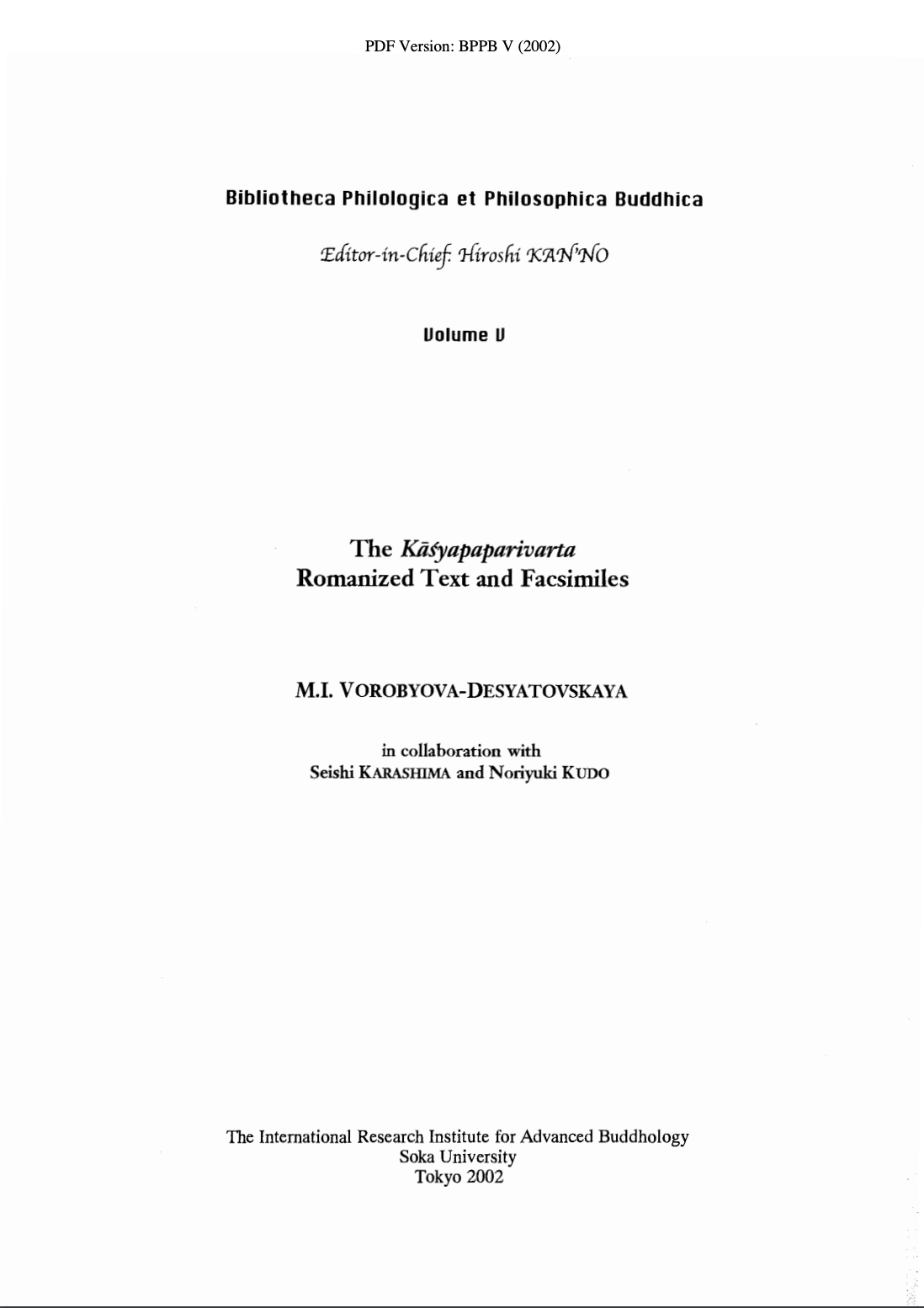
This volume presents the first facsimile edition of the St. Petersburg Sanskrit manuscript (SI P/2) of the Kāśyapaparivarta, one of the oldest and most important texts of the Mahāyāna Buddhist tradition, accompanied by a new transliteration. The manuscript, brought from Eastern Turkestan in the nineteenth century and held at the St. Petersburg Branch of the Institute of Oriental Studies, was first transliterated by Alexander von Staël-Holstein in 1926 alongside Tibetan and Chinese versions. Comparison of SI P/2 with Central Asian Sanskrit fragments from British, Finnish, German, and Russian collections reveals that at least two versions of the text circulated in Eastern Turkestan — a briefer, earlier prose version and an extended version that adds verse summaries after the prose passages. The introduction surveys the significance of the Kāśyapaparivarta for Mahāyāna Buddhism, noting that it was regarded as a foundational text by both Madhyamaka and Yogācāra schools, that it contains the first full formulation of the bodhisattva moral code, and that it was widely quoted in works including Śāntideva's Śikṣāsamuccaya and Prajñākaramati's commentary on the Bodhicaryāvatāra.
This book contains a) the first Devanagari edition of the Kaśyapaparivarta, the unique Sanskrit manuscript of which (supposedly written sometime in the 7th or 8th century ce in Khotan) was discovered more than a hundred years ago in Eastern Turkestan, and b) an English translation of this text. It highly esteemed, for there exist several Chinese versions and one Tibetan translation of it. It can be argued with good reason that, together with the oldest textual strata of the Aṣṭasāhasrikā-Prajñāpāramitā, those of the Kaśyapaparivarta constitute a specimen of the earliest Mahāyāna literature. A study of the present text reveals that it must have inspired the compilers of further Mahāyāna discourses and, moreover, become one of the basic sources for the chief Madhyamika and Yogācāra masters who both rather substantially quote from and often allude to it. The main themes of the text are the bodhisattva ideal and the teaching of śūnyatā, "emptiness," both being the key features of the Great Vehicle. (Source Accessed Aug 10, 2026)

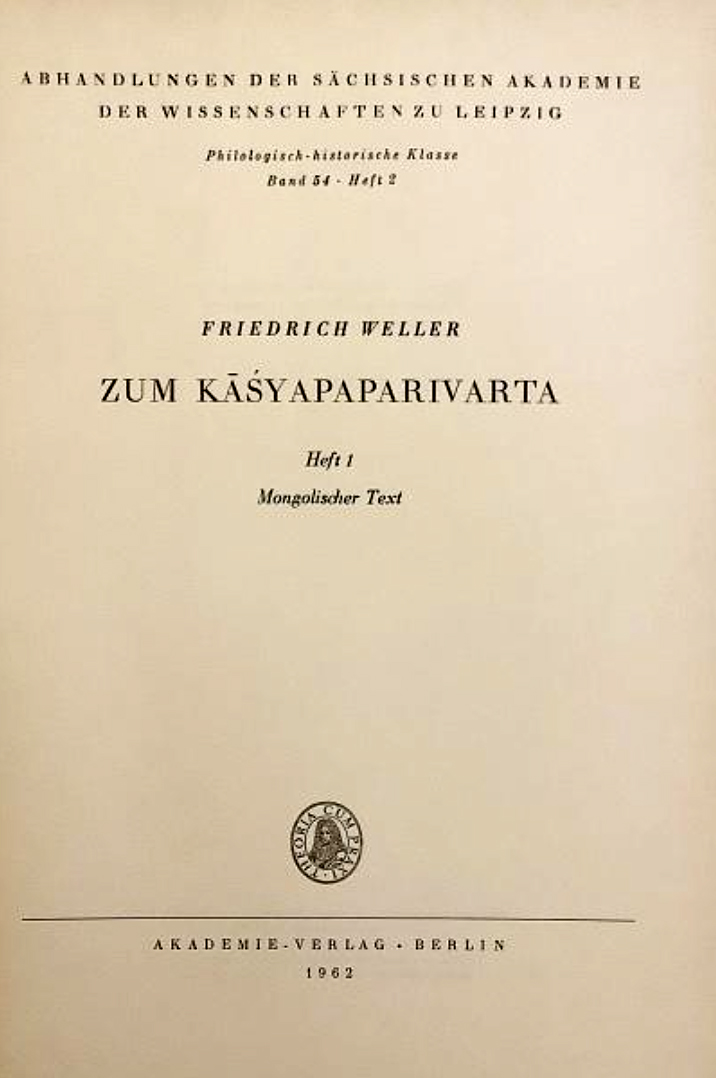
This volume presents Friedrich Weller's edition of the Mongolian text of the Kāśyapaparivarta, part of his broader philological work on the sūtra's transmission across multiple linguistic traditions (alongside his earlier indices to the Tibetan and Sanskrit texts). Published in the Abhandlungen der Sächsischen Akademie der Wissenschaften zu Leipzig (Philologisch-historische Klasse), Bd. 54, Heft 2, the work forms part of Weller's decades-long study of the KP, which also included detailed linguistic studies of specific Mongolian terms in the translation.
7 Full translations


Pāsādika, Bhikkhu. "Discourse of the Kāśyapa-Section." In Wisdom Gone Beyond: An Anthology of Buddhist Texts, 107–123. Bangkok: Social Science Association Press of Thailand, 1966.
This is Bhikkhu Pāsādika's English translation of the Kāśyapaparivarta, including his reconstruction of the Sanskrit portions missing from the manuscript. The translation was serialized across nine consecutive issues of Linh-Sơn publication d'études bouddhologiques between 1977 and 1979, with one installment appearing in each issue.
The Kāśyapaparivarta: Facsimile Edition with a New Transliteration
M. I. Vorobyova-Desyatovskaya, Bibliotheca Philologica et Philosophica Buddhica V (Tokyo: IRIAB, Soka University, 2002)
This volume presents the first facsimile edition of the St. Petersburg Sanskrit manuscript (SI P/2) of the Kāśyapaparivarta, one of the oldest and most important texts of the Mahāyāna Buddhist tradition, accompanied by a new transliteration. The manuscript, brought from Eastern Turkestan in the nineteenth century and held at the St. Petersburg Branch of the Institute of Oriental Studies, was first transliterated by Alexander von Staël-Holstein in 1926 alongside Tibetan and Chinese versions. Comparison of SI P/2 with Central Asian Sanskrit fragments from British, Finnish, German, and Russian collections reveals that at least two versions of the text circulated in Eastern Turkestan — a briefer, earlier prose version and an extended version that adds verse summaries after the prose passages. The introduction surveys the significance of the Kāśyapaparivarta for Mahāyāna Buddhism, noting that it was regarded as a foundational text by both Madhyamaka and Yogācāra schools, that it contains the first full formulation of the bodhisattva moral code, and that it was widely quoted in works including Śāntideva's Śikṣāsamuccaya and Prajñākaramati's commentary on the Bodhicaryāvatāra.This book contains a) the first Devanagari edition of the Kaśyapaparivarta, the unique Sanskrit manuscript of which (supposedly written sometime in the 7th or 8th century ce in Khotan) was discovered more than a hundred years ago in Eastern Turkestan, and b) an English translation of this text. It highly esteemed, for there exist several Chinese versions and one Tibetan translation of it. It can be argued with good reason that, together with the oldest textual strata of the Aṣṭasāhasrikā-Prajñāpāramitā, those of the Kaśyapaparivarta constitute a specimen of the earliest Mahāyāna literature. A study of the present text reveals that it must have inspired the compilers of further Mahāyāna discourses and, moreover, become one of the basic sources for the chief Madhyamika and Yogācāra masters who both rather substantially quote from and often allude to it. The main themes of the text are the bodhisattva ideal and the teaching of śūnyatā, "emptiness," both being the key features of the Great Vehicle. (Source Accessed Aug 10, 2026)

The Sūtra of Assembled Treasures is the original Ratnakūṭa Sūtra. It gives various admonishments to the followers of Mahāyāna, expounds on the right observation of the Middle Way, and discusses the various kinds of śramaṇas. (A Treasury of Mahāyāna Sutras, xv)

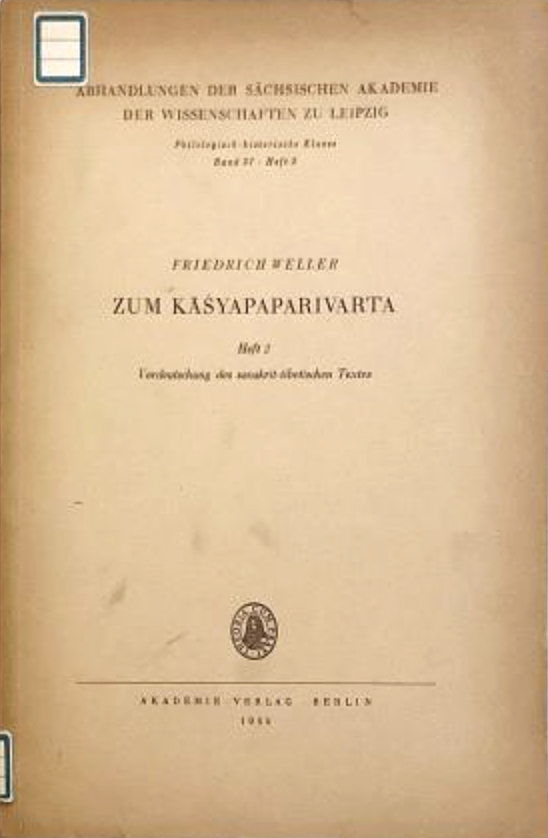
This companion volume offers Weller's German rendering ("Verdeutschung") of the Sanskrit-Tibetan text of the Kāśyapaparivarta, continuing the multipart Zum Kāśyapaparivarta series. Published in the same Leipzig academy series (Bd. 57, Heft 3), it complements Weller's other German translations of the sūtra's various versions from this period, including his renderings based on the Chin (Jin) and Sung Chinese translations.
1 Classical commentaries

This commentary, attributed to Sthiramati (slob dpon blo brtan), offers an extensive explanation of the Kāśyapaparivarta. It is preserved in Tibetan translation (Tengyur, RKTST 3349) and in a Chinese translation, Da Baoji jinglun 大寶積經論, attributed to Bodhiruci (I) of the Later Wei dynasty (508–535 CE); the commentary's own Indic title is not securely known. The work combines two distinct modes of exegesis: a close, word-by-word gloss on the sūtra's terminology, followed by a more discursive, philosophical treatment that closely parallels the wording of the Viniścayasaṃgrahaṇī section of the Yogācārabhūmi.
See Resource: Silk, Jonathan A. "Remarks on the Kāśyapaparivarta Commentary." In Pāsādikadānaṃ: Festschrift für Bhikkhu Pāsādika, edited by M. Straube, R. Steiner, J. Soni, M. Hahn, and M. Demoto, 381–97. Marburg: Indica et Tibetica Verlag, 2009.
11 Scholarship

In addition to previously known sources, newly identified materials preserving portions of Tibetan versions of the *Kāśyapaparivarta are here introduced, chiefly from Dunhuang manuscripts Pelliot tibétain 678 and IOL Tib J 57. Part II of this paper continues with another new source, IOL Tib J 57, and a reconsideration of the previously noted IOL Tib J 152, Pelliot tibétain 671 and 672.
Following on Part I of this paper, which introduced newly identified materials preserving portions of Tibetan versions of the *Kāśyapaparivarta, namely the Dunhuang manuscripts Pelliot tibétain 678 and IOL Tib J 57, Part II here continues with another new source, IOL Tib J 57, and a reconsideration of the previously noted IOL Tib J 152, Pelliot tibétain 671 and 672.

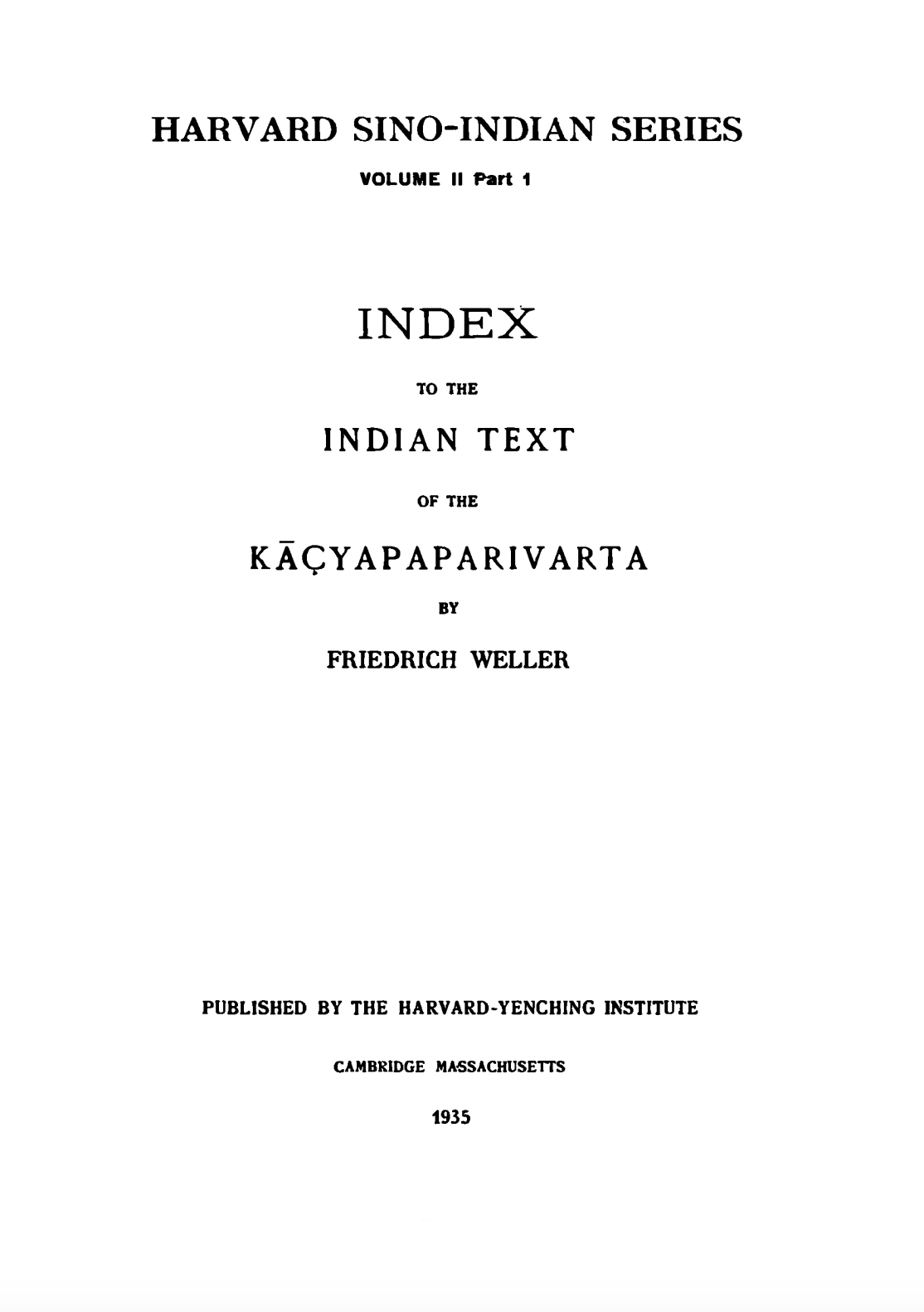
This is the second installment of Friedrich Weller's index to Baron A. von Staël-Holstein's edition of the Kāśyapaparivarta, covering the index to the Indian (Sanskrit) text–a companion to his earlier index of the Tibetan translation. Weller compiled the index concisely, in the alphabetical style of the Petersburg (Böhtlingk–Roth) dictionaries, deliberately omitting grammatical forms; homophones are distinguished by the numbering used in the smaller Petersburg dictionary. Word locations are cited by Staël-Holstein's paragraph numbers, with a "v." appended to indicate a heading occurring only in the verse portions of a section (an unmarked number indicates the heading may appear in either the prose or verse). A few particles and pronouns of little significance were excluded. In his preface, dated Leipzig, October 1, 1934, Weller frames the index as groundwork for a future systematic grammar of the text's language, which he hoped would eventually allow comparison with related texts and help trace the linguistic origins of such works—with their characteristically mixed grammatical forms—to specific regions of India via vernacular inscriptions and dialects.

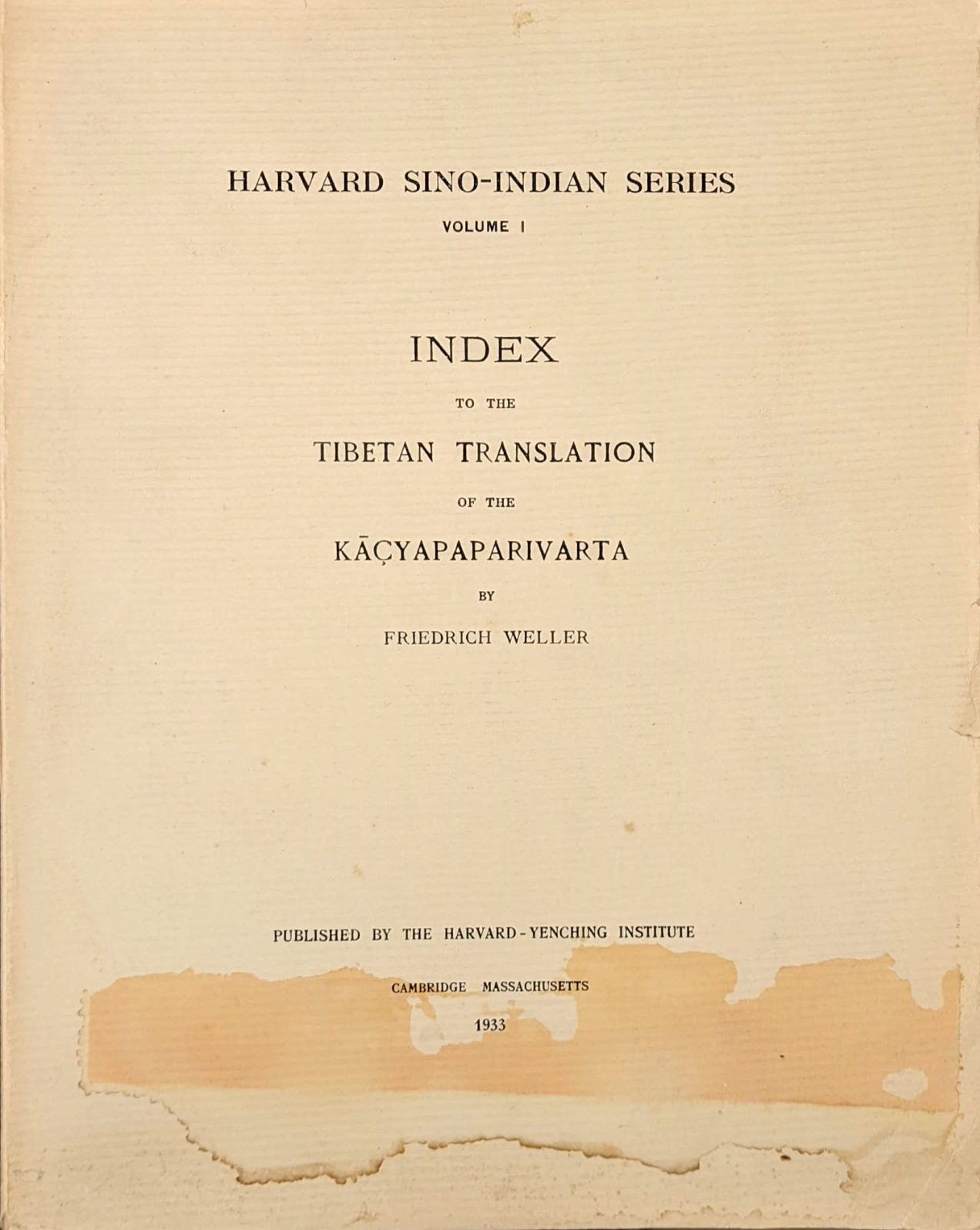
The first part of the indices to Baron A. v. Staël-Holstein's edition of the Kāçyapaparivarta, the Tibetan-Sanskrit index. (Source Accessed Jan 31, 2024)
The *Kāśyapaparivarta, an early Mahāyāna sūtra, has a complex history. Sanskrit and Tibetan versions, and some of its Chinese translations, have been available to scholars for almost a century, thanks to Staël-Holstein’s 1926 editio princeps. Yet no comprehensive survey of available sources, or critical appraisal of their antecedants, has been published, and most importantly, essential Chinese materials have long been overlooked. The present contribution focuses most centrally on the Chinese translations of the scripture. In addition, the relation of the sūtra to the Mahāratnakūṭa collection of forty-nine texts and the possible Indic origins of the latter are explored.
This is Baron Alexander von Staël-Holstein's editio princeps of the Kāśyapaparivarta, presenting the Sanskrit text alongside its Tibetan translation and four Chinese translations. In his preface, Staël-Holstein argues the sūtra belongs to a small group of Mahāyāna works datable before 200 CE, highlights its exposition of the "middle path" (chapters 52–63) and its polemic against self-interested Śrāvakas, and traces the history of the title "Kāśyapaparivarta" as a later designation for a text more anciently known simply as Ratnakūṭa. He also describes the sole surviving Sanskrit manuscript (found near Khotan, missing 8 of 81 leaves), and argues from a comparison of the four Chinese translations (Han, Djin, Ch'in, Sung) that they represent successive, evolving textual states, with the 2nd-century Han translation by Lokakṣema preserving the earliest recoverable form. The volume also includes a Chinese preface by Liang Qichao.
This article serves as prolegomena to Bhikkhu Pāsādika's English translation of the Kāśyapaparivarta (Tib. 'Od-srung-gi le'u), an early Mahāyāna sūtra preserved in the Ratnakūṭa class. After surveying prior scholarship—including von Staël-Holstein's 1926 Sanskrit edition, Weller's Tibetan index, and translations and studies by Edgerton, de Jong, Conze, and Bendall/Rouse—Pāsādika situates the text's antiquity relative to the Aṣṭasāhasrikāprajñāpāramitā, arguing on linguistic and textual grounds (following de Jong, Lin Li-Kouang, and others) that the KP's prose likely dates to around the first century B.C., with its verses composed later in Buddhist Hybrid Sanskrit. The article traces citations of the KP in later Mahāyāna and Madhyamaka literature (Candrakīrti, the Sūtrasamuccaya, the Śikṣāsamuccaya) and situates the text as a "New Wisdom School" root text for later Mādhyamika treatises.
The core of the article is a section-by-section synopsis of the KP's contents based on von Staël-Holstein's Sanskrit edition, covering its structure from the introductory setting on Vulture Peak through 166 sections addressing bodhisattva ethics, emptiness, the qualities of true versus false ascetics, and the concluding praise of the discourse's merit. A final section on "Some Doctrinal Points" reconsiders von Staël-Holstein's characterization of the text as harshly denunciatory of Śrāvakas, arguing instead that KP's criticism targets specific failings (escapist quietism, narrow-mindedness) rather than the śrāvakayāna as such, and that the text exemplifies a "peaceful coexistence" of śrāvaka, pratyekabuddha, and bodhisattva ideals consistent with later Tibetan monastic practice.

It is a Buddhist view that the highest level of attainment (pratipatti) that one can gain by practicing the dharma in a proper way is the middle path (madhyamapratipad). It is known as the middle path because, in accomplishing it, one goes beyond all extreme views (anta). This paper will attempt to elucidate this central concern of Buddhism in the light of the discussion on the middle path found in the Kāśyapaparivarta-sūtra, a Mahāyāna-sūtra of the Ratnakūṭa class. (Kawamura, introductory remarks, 221)

This paper identifies for the first time the Old Tibetan version of the Kāśyapaparivarta preserved in fragments from Dunhuang. The currently known extant versions of the Kāśyapaparivarta are in Sanskrit in two Central Asian manuscripts, five Chinese versions, Khotanese fragments, and a ninth century Tibetan version preserved among Tibetan Kanjur collections. The following comparative collation identifies for the first time seven Old Tibetan fragments of the Kāśyapaparivarta found among the Stein and Pelliot collections from the ancient city-state of Dunhuang. Jonathan Silk previously identified an eighth Tibetan fragment, Pelliot tibétain 676. These fragments comprise a version of the Kāśyapaparivarta preserved in Old Tibetan that was previously unknown. This article, Part 1, examines and collates the Old Tibetan fragments that correspond to sections §00–63 of the Staël-Holstein (1926) edition. Part 2 consists of the fragments that correspond to sections §98–135.
This volume presents Friedrich Weller's edition of the Mongolian text of the Kāśyapaparivarta, part of his broader philological work on the sūtra's transmission across multiple linguistic traditions (alongside his earlier indices to the Tibetan and Sanskrit texts). Published in the Abhandlungen der Sächsischen Akademie der Wissenschaften zu Leipzig (Philologisch-historische Klasse), Bd. 54, Heft 2, the work forms part of Weller's decades-long study of the KP, which also included detailed linguistic studies of specific Mongolian terms in the translation.
This companion volume offers Weller's German rendering ("Verdeutschung") of the Sanskrit-Tibetan text of the Kāśyapaparivarta, continuing the multipart Zum Kāśyapaparivarta series. Published in the same Leipzig academy series (Bd. 57, Heft 3), it complements Weller's other German translations of the sūtra's various versions from this period, including his renderings based on the Chin (Jin) and Sung Chinese translations.
18 A topic of
Contains 22 of the 49 Sūtras of the Mahāratnakūṭa (or "Treasury") Sūtra, many translated for the first time in a Western language
Pāsādika, Bhikkhu. "Discourse of the Kāśyapa-Section." In Wisdom Gone Beyond: An Anthology of Buddhist Texts, 107–123. Bangkok: Social Science Association Press of Thailand, 1966.
In addition to previously known sources, newly identified materials preserving portions of Tibetan versions of the *Kāśyapaparivarta are here introduced, chiefly from Dunhuang manuscripts Pelliot tibétain 678 and IOL Tib J 57. Part II of this paper continues with another new source, IOL Tib J 57, and a reconsideration of the previously noted IOL Tib J 152, Pelliot tibétain 671 and 672.
Following on Part I of this paper, which introduced newly identified materials preserving portions of Tibetan versions of the *Kāśyapaparivarta, namely the Dunhuang manuscripts Pelliot tibétain 678 and IOL Tib J 57, Part II here continues with another new source, IOL Tib J 57, and a reconsideration of the previously noted IOL Tib J 152, Pelliot tibétain 671 and 672.
This is the second installment of Friedrich Weller's index to Baron A. von Staël-Holstein's edition of the Kāśyapaparivarta, covering the index to the Indian (Sanskrit) text–a companion to his earlier index of the Tibetan translation. Weller compiled the index concisely, in the alphabetical style of the Petersburg (Böhtlingk–Roth) dictionaries, deliberately omitting grammatical forms; homophones are distinguished by the numbering used in the smaller Petersburg dictionary. Word locations are cited by Staël-Holstein's paragraph numbers, with a "v." appended to indicate a heading occurring only in the verse portions of a section (an unmarked number indicates the heading may appear in either the prose or verse). A few particles and pronouns of little significance were excluded. In his preface, dated Leipzig, October 1, 1934, Weller frames the index as groundwork for a future systematic grammar of the text's language, which he hoped would eventually allow comparison with related texts and help trace the linguistic origins of such works—with their characteristically mixed grammatical forms—to specific regions of India via vernacular inscriptions and dialects.
The first part of the indices to Baron A. v. Staël-Holstein's edition of the Kāçyapaparivarta, the Tibetan-Sanskrit index. (Source Accessed Jan 31, 2024)
This commentary, attributed to Sthiramati (slob dpon blo brtan), offers an extensive explanation of the Kāśyapaparivarta. It is preserved in Tibetan translation (Tengyur, RKTST 3349) and in a Chinese translation, Da Baoji jinglun 大寶積經論, attributed to Bodhiruci (I) of the Later Wei dynasty (508–535 CE); the commentary's own Indic title is not securely known. The work combines two distinct modes of exegesis: a close, word-by-word gloss on the sūtra's terminology, followed by a more discursive, philosophical treatment that closely parallels the wording of the Viniścayasaṃgrahaṇī section of the Yogācārabhūmi.
See Resource: Silk, Jonathan A. "Remarks on the Kāśyapaparivarta Commentary." In Pāsādikadānaṃ: Festschrift für Bhikkhu Pāsādika, edited by M. Straube, R. Steiner, J. Soni, M. Hahn, and M. Demoto, 381–97. Marburg: Indica et Tibetica Verlag, 2009.
This is Bhikkhu Pāsādika's English translation of the Kāśyapaparivarta, including his reconstruction of the Sanskrit portions missing from the manuscript. The translation was serialized across nine consecutive issues of Linh-Sơn publication d'études bouddhologiques between 1977 and 1979, with one installment appearing in each issue.
The *Kāśyapaparivarta, an early Mahāyāna sūtra, has a complex history. Sanskrit and Tibetan versions, and some of its Chinese translations, have been available to scholars for almost a century, thanks to Staël-Holstein’s 1926 editio princeps. Yet no comprehensive survey of available sources, or critical appraisal of their antecedants, has been published, and most importantly, essential Chinese materials have long been overlooked. The present contribution focuses most centrally on the Chinese translations of the scripture. In addition, the relation of the sūtra to the Mahāratnakūṭa collection of forty-nine texts and the possible Indic origins of the latter are explored.
This is Baron Alexander von Staël-Holstein's editio princeps of the Kāśyapaparivarta, presenting the Sanskrit text alongside its Tibetan translation and four Chinese translations. In his preface, Staël-Holstein argues the sūtra belongs to a small group of Mahāyāna works datable before 200 CE, highlights its exposition of the "middle path" (chapters 52–63) and its polemic against self-interested Śrāvakas, and traces the history of the title "Kāśyapaparivarta" as a later designation for a text more anciently known simply as Ratnakūṭa. He also describes the sole surviving Sanskrit manuscript (found near Khotan, missing 8 of 81 leaves), and argues from a comparison of the four Chinese translations (Han, Djin, Ch'in, Sung) that they represent successive, evolving textual states, with the 2nd-century Han translation by Lokakṣema preserving the earliest recoverable form. The volume also includes a Chinese preface by Liang Qichao.
The Kāśyapaparivarta: Facsimile Edition with a New Transliteration
M. I. Vorobyova-Desyatovskaya, Bibliotheca Philologica et Philosophica Buddhica V (Tokyo: IRIAB, Soka University, 2002)
This volume presents the first facsimile edition of the St. Petersburg Sanskrit manuscript (SI P/2) of the Kāśyapaparivarta, one of the oldest and most important texts of the Mahāyāna Buddhist tradition, accompanied by a new transliteration. The manuscript, brought from Eastern Turkestan in the nineteenth century and held at the St. Petersburg Branch of the Institute of Oriental Studies, was first transliterated by Alexander von Staël-Holstein in 1926 alongside Tibetan and Chinese versions. Comparison of SI P/2 with Central Asian Sanskrit fragments from British, Finnish, German, and Russian collections reveals that at least two versions of the text circulated in Eastern Turkestan — a briefer, earlier prose version and an extended version that adds verse summaries after the prose passages. The introduction surveys the significance of the Kāśyapaparivarta for Mahāyāna Buddhism, noting that it was regarded as a foundational text by both Madhyamaka and Yogācāra schools, that it contains the first full formulation of the bodhisattva moral code, and that it was widely quoted in works including Śāntideva's Śikṣāsamuccaya and Prajñākaramati's commentary on the Bodhicaryāvatāra.This article serves as prolegomena to Bhikkhu Pāsādika's English translation of the Kāśyapaparivarta (Tib. 'Od-srung-gi le'u), an early Mahāyāna sūtra preserved in the Ratnakūṭa class. After surveying prior scholarship—including von Staël-Holstein's 1926 Sanskrit edition, Weller's Tibetan index, and translations and studies by Edgerton, de Jong, Conze, and Bendall/Rouse—Pāsādika situates the text's antiquity relative to the Aṣṭasāhasrikāprajñāpāramitā, arguing on linguistic and textual grounds (following de Jong, Lin Li-Kouang, and others) that the KP's prose likely dates to around the first century B.C., with its verses composed later in Buddhist Hybrid Sanskrit. The article traces citations of the KP in later Mahāyāna and Madhyamaka literature (Candrakīrti, the Sūtrasamuccaya, the Śikṣāsamuccaya) and situates the text as a "New Wisdom School" root text for later Mādhyamika treatises.
The core of the article is a section-by-section synopsis of the KP's contents based on von Staël-Holstein's Sanskrit edition, covering its structure from the introductory setting on Vulture Peak through 166 sections addressing bodhisattva ethics, emptiness, the qualities of true versus false ascetics, and the concluding praise of the discourse's merit. A final section on "Some Doctrinal Points" reconsiders von Staël-Holstein's characterization of the text as harshly denunciatory of Śrāvakas, arguing instead that KP's criticism targets specific failings (escapist quietism, narrow-mindedness) rather than the śrāvakayāna as such, and that the text exemplifies a "peaceful coexistence" of śrāvaka, pratyekabuddha, and bodhisattva ideals consistent with later Tibetan monastic practice.
This book contains a) the first Devanagari edition of the Kaśyapaparivarta, the unique Sanskrit manuscript of which (supposedly written sometime in the 7th or 8th century ce in Khotan) was discovered more than a hundred years ago in Eastern Turkestan, and b) an English translation of this text. It highly esteemed, for there exist several Chinese versions and one Tibetan translation of it. It can be argued with good reason that, together with the oldest textual strata of the Aṣṭasāhasrikā-Prajñāpāramitā, those of the Kaśyapaparivarta constitute a specimen of the earliest Mahāyāna literature. A study of the present text reveals that it must have inspired the compilers of further Mahāyāna discourses and, moreover, become one of the basic sources for the chief Madhyamika and Yogācāra masters who both rather substantially quote from and often allude to it. The main themes of the text are the bodhisattva ideal and the teaching of śūnyatā, "emptiness," both being the key features of the Great Vehicle. (Source Accessed Aug 10, 2026)
It is a Buddhist view that the highest level of attainment (pratipatti) that one can gain by practicing the dharma in a proper way is the middle path (madhyamapratipad). It is known as the middle path because, in accomplishing it, one goes beyond all extreme views (anta). This paper will attempt to elucidate this central concern of Buddhism in the light of the discussion on the middle path found in the Kāśyapaparivarta-sūtra, a Mahāyāna-sūtra of the Ratnakūṭa class. (Kawamura, introductory remarks, 221)
This paper identifies for the first time the Old Tibetan version of the Kāśyapaparivarta preserved in fragments from Dunhuang. The currently known extant versions of the Kāśyapaparivarta are in Sanskrit in two Central Asian manuscripts, five Chinese versions, Khotanese fragments, and a ninth century Tibetan version preserved among Tibetan Kanjur collections. The following comparative collation identifies for the first time seven Old Tibetan fragments of the Kāśyapaparivarta found among the Stein and Pelliot collections from the ancient city-state of Dunhuang. Jonathan Silk previously identified an eighth Tibetan fragment, Pelliot tibétain 676. These fragments comprise a version of the Kāśyapaparivarta preserved in Old Tibetan that was previously unknown. This article, Part 1, examines and collates the Old Tibetan fragments that correspond to sections §00–63 of the Staël-Holstein (1926) edition. Part 2 consists of the fragments that correspond to sections §98–135.
The Sūtra of Assembled Treasures is the original Ratnakūṭa Sūtra. It gives various admonishments to the followers of Mahāyāna, expounds on the right observation of the Middle Way, and discusses the various kinds of śramaṇas. (A Treasury of Mahāyāna Sutras, xv)
This volume presents Friedrich Weller's edition of the Mongolian text of the Kāśyapaparivarta, part of his broader philological work on the sūtra's transmission across multiple linguistic traditions (alongside his earlier indices to the Tibetan and Sanskrit texts). Published in the Abhandlungen der Sächsischen Akademie der Wissenschaften zu Leipzig (Philologisch-historische Klasse), Bd. 54, Heft 2, the work forms part of Weller's decades-long study of the KP, which also included detailed linguistic studies of specific Mongolian terms in the translation.
This companion volume offers Weller's German rendering ("Verdeutschung") of the Sanskrit-Tibetan text of the Kāśyapaparivarta, continuing the multipart Zum Kāśyapaparivarta series. Published in the same Leipzig academy series (Bd. 57, Heft 3), it complements Weller's other German translations of the sūtra's various versions from this period, including his renderings based on the Chin (Jin) and Sung Chinese translations.