Index to the Indian Text of the Kāçyapaparivarta (Weller 1935)
From Bodhicitta
< Books
Books/Index to the Indian Text of the Kāçyapaparivarta (Weller 1935)| 🤓 Admin Zone 🛠️ hidden to non-admins | |
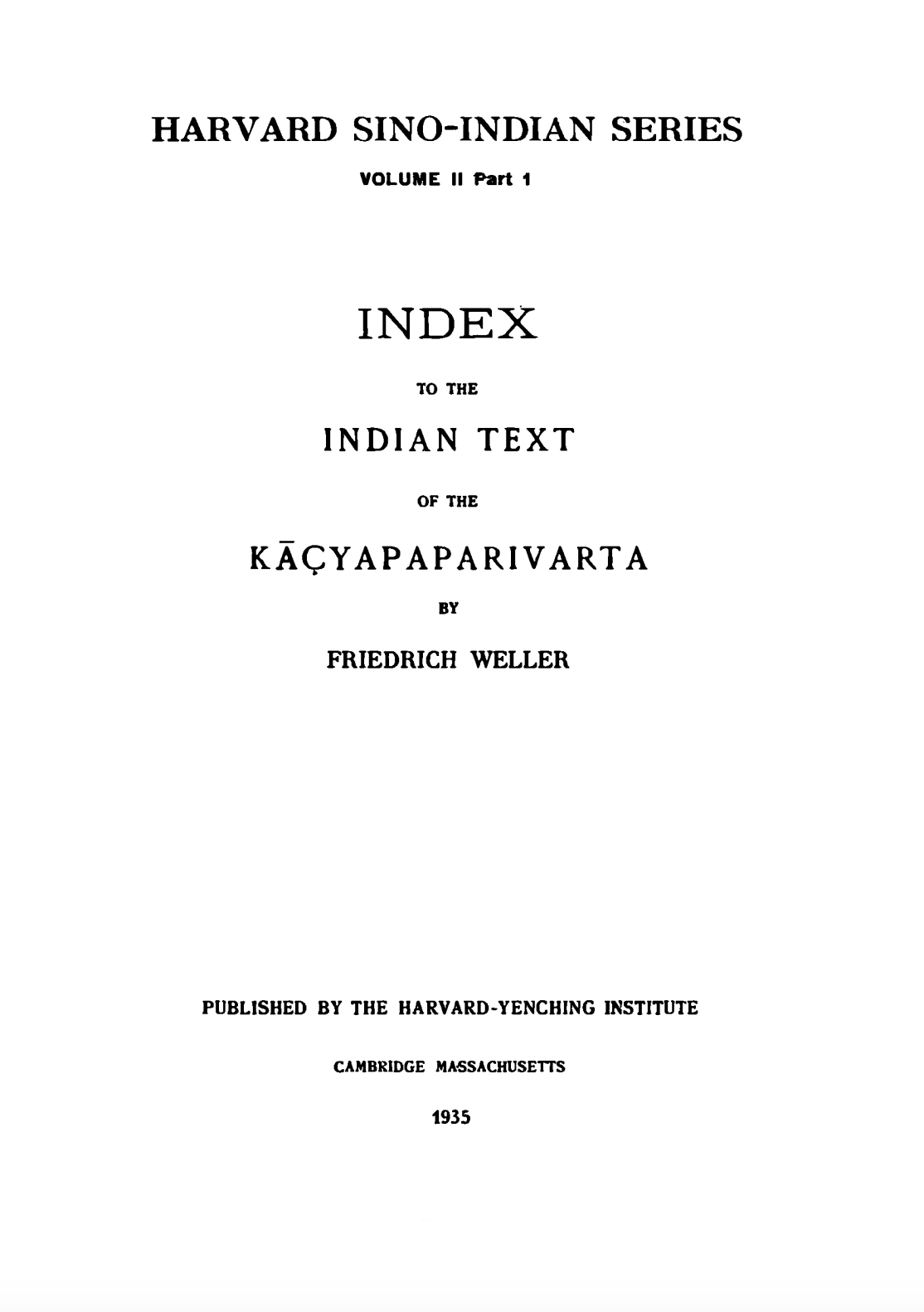
Index to the Indian Text of the Kāçyapaparivarta
Book
Please note that many items in our library are simply pages that represent a detailed library catalog entry and citation of someone else's work, presentation, or performance. Read our General Disclaimer for more information.

Description
This is the second installment of Friedrich Weller's index to Baron A. von Staël-Holstein's edition of the Kāśyapaparivarta, covering the index to the Indian (Sanskrit) text–a companion to his earlier index of the Tibetan translation. Weller compiled the index concisely, in the alphabetical style of the Petersburg (Böhtlingk–Roth) dictionaries, deliberately omitting grammatical forms; homophones are distinguished by the numbering used in the smaller Petersburg dictionary. Word locations are cited by Staël-Holstein's paragraph numbers, with a "v." appended to indicate a heading occurring only in the verse portions of a section (an unmarked number indicates the heading may appear in either the prose or verse). A few particles and pronouns of little significance were excluded. In his preface, dated Leipzig, October 1, 1934, Weller frames the index as groundwork for a future systematic grammar of the text's language, which he hoped would eventually allow comparison with related texts and help trace the linguistic origins of such works—with their characteristically mixed grammatical forms—to specific regions of India via vernacular inscriptions and dialects.
Citation
Weller, Friedrich. Index to the Indian Text of the Kāçyapaparivarta. Harvard Sino-Indian Series 2, pt. 1. Cambridge: Harvard University Press, 1935.
Interconnections
1 Scholarship on

Kāśyapaparivarta. (T. 'Od srung gi le'u; C. Yiri monibao jing; J. Yuinichi manihōkyō; K. Yuil manibo kyǒng 遺日摩尼寶經). In Sanskrit, "The Kāśyapa Chapter"; a sūtra from one of the earliest strata of Indian Mahāyāna Buddhism, probably dating from sometime in the first Century CE. The sūtra offers an overview of practices emblematic of bodhisattvas, which are arranged in several groups of four practices apiece. The text cites a "bodhisattva canon" (bodhisattvapiṭaka) as the source for the teaching on the six perfections (pāramitā) and offers one of the earliest mentions of the "thought of enlightenment" (bodhicitta) in its Mahāyāna interpretation as the aspiration to achieve buddhahood. A bodhisattva who generates this thought even for the first time is said to be superior to the solitary buddhas (pratyekabuddha) and disciples (śrāvaka). Disciples are also censured as not being true sons of the Buddha, an early expression of the later Mahāyāna school's more explicit denunciations of the so-called hīnayāna. The sūtra also refers to bodhisattva precepts (see bodhisattvaśīla), which will subsequently be elaborated upon in such texts as Maitreya/Asaṅga's Bodhisattvabhūmi and in such Chinese apocrypha as the Fanwang jing. The Kāśyapaparivarta was one of the first sūtras translated into Chinese, by the Indo-Scythian monk *Lokakṣema (c. 178-198 CE) in 179 CE; a later recension is also included in the massive Ratnakūṭa collection of sūtras. The Kāśyapaparivarta is one of a substantial number of scriptures in the Ratnakūṭa collection for which Sanskrit recensions have been rediscovered and edited. Its Sanskrit manuscript was first discovered in Khotan in the 1890s and was more than one thousand years old; other Sanskrit fragments have subsequently been recovered. (Source: "Kāśyapaparivarta." In The Princeton Dictionary of Buddhism, 426. Princeton University Press, 2014. http://www.jstor.org/stable/j.ctt46n41q.27.)
1 Related

The first part of the indices to Baron A. v. Staël-Holstein's edition of the Kāçyapaparivarta, the Tibetan-Sanskrit index. (Source Accessed Jan 31, 2024)