Bodhicaryāvatārapañjikā
From Bodhicitta
| 🤓 Admin Zone 🛠️ hidden to non-admins | |
बोधिचर्यावतारपञ्जिका
Bodhicaryāvatārapañjikā
བྱང་ཆུབ་ཀྱི་སྤྱོད་པ་ལ་འཇུག་པའི་དཀའ་འགྲེལ།
byang chub kyi spyod pa la 'jug pa'i dka' 'grel
A Commentary on the Difficult Points of (Śāntideva’s) "Entering into the Deeds of a Bodhisattva" (84000)
Text
Please note that many items in our library are simply pages that represent a detailed library catalog entry and citation of someone else's work, presentation, or performance. Read our General Disclaimer for more information.


Description
Written by Prajñākaramati (950–1030), the Bodhicaryāvatārapañjikā is considered to be the most important Indian commentary on the Bodhicaryāvatāra by Śāntideva. This commentary explains the words in the verses (tshig 'grel), with additional commentaries on difficult points. Excluding The Dedication Chapter, it has only nine chapters.
Type of Commentary: an extensive commentary on difficult points
Length: 494
Length: 494
Quoted in the aligned translations
Reference
Prajñākaramati (ཤེས་རབ་འབྱུང་གནས་བློ་གྲོས་). Bodhicaryāvatārapañjikā [बोधिचर्यावतारपञ्जिका]. byang chub kyi spyod pa la 'jug pa'i dka' 'grel [བྱང་ཆུབ་ཀྱི་སྤྱོད་པ་ལ་འཇུག་པའི་དཀའ་འགྲེལ།]. [A Commentary on the Difficult Points of (Śāntideva’s) "Entering into the Deeds of a Bodhisattva" (84000)]. Translated by Gnyan lo tsA ba, Sumatikīrti, Mar pa do pa chos kyi dbang phyug. Tengyur, RKTST 3217 http://www.rkts.org/cat.php?id=3217&typ=2.
Interconnections
All 67Books 21Articles 25Classical Works 1Dissertations 16Tibetan Publications 2Sanskrit Publications 2
5 Recensions

Critical edition of the Bodhicaryāvatāra and Prajñākaramati's Pañjikā edited by P. L. Vaidya, with introductions in English and Hindi.

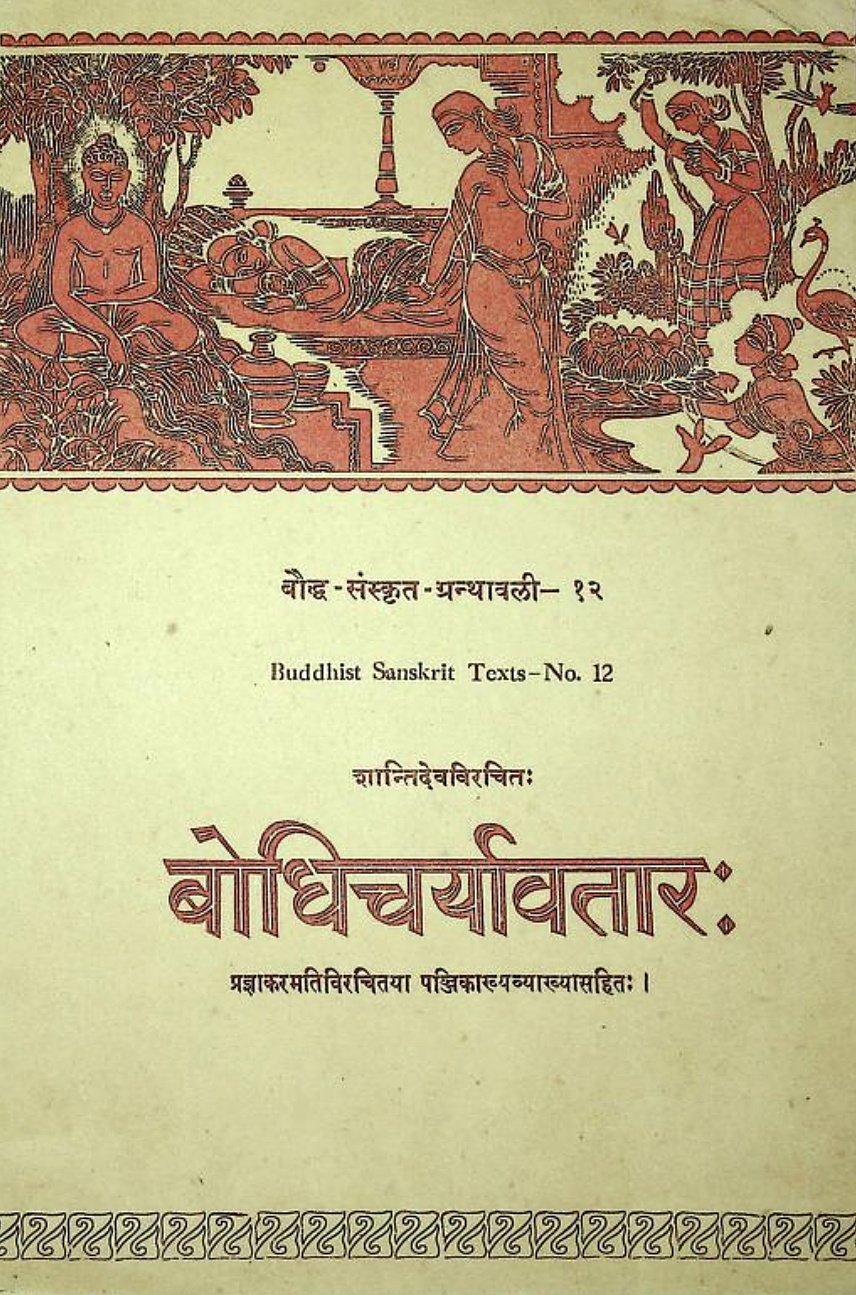
This is the second edition (1988) of P. L. Vaidya's critical edition of the Bodhicaryāvatāra and Prajñākaramati's Pañjikā published in 1960. This edition is edited by Sridhar Tripathi.

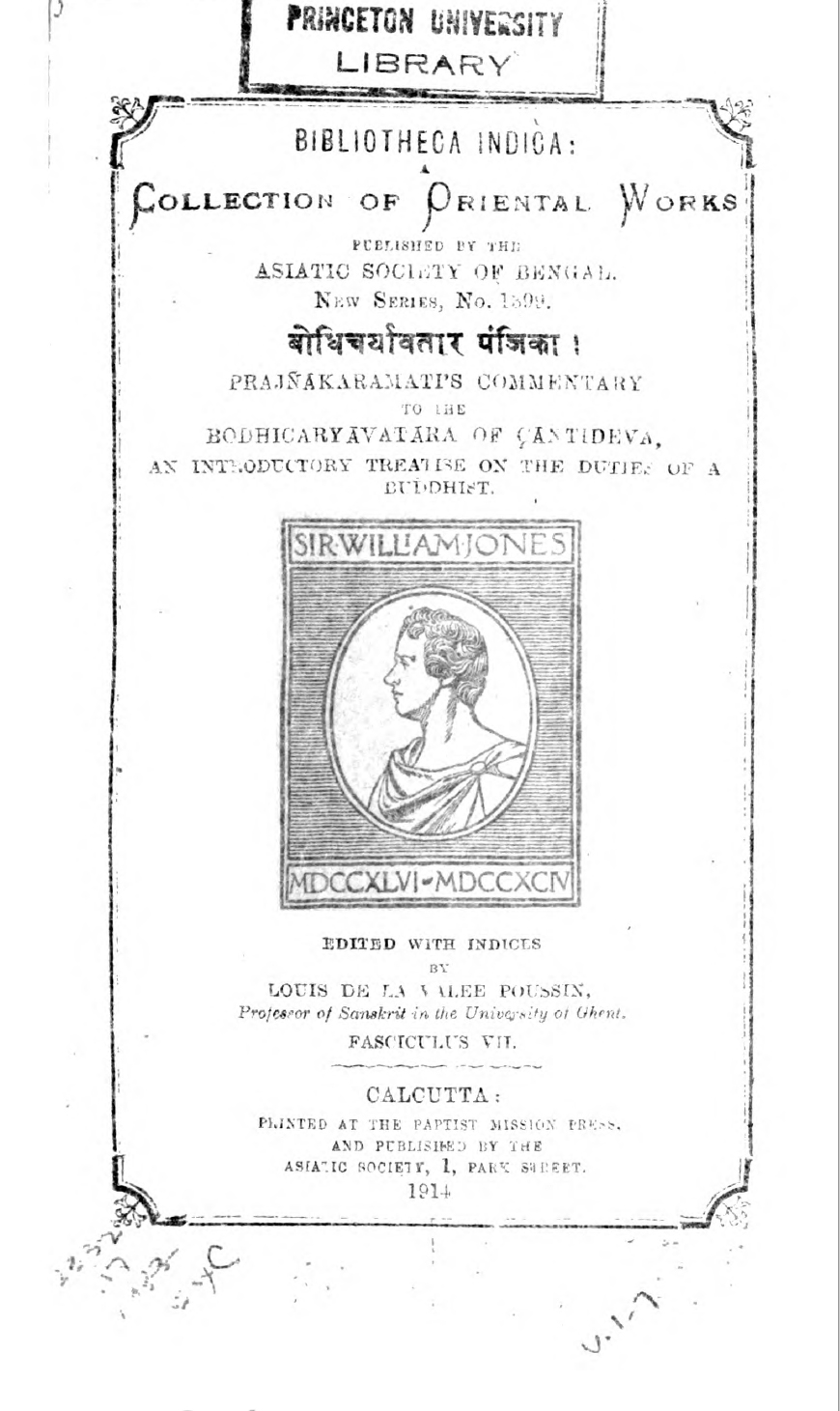
A critical Sanskrit edition of Prajñākaramati's commentary to the Bodhicaryāvatāra entitled the Bodhicaryāvatārapañjikā, edited by Louis de La Vallée Poussin

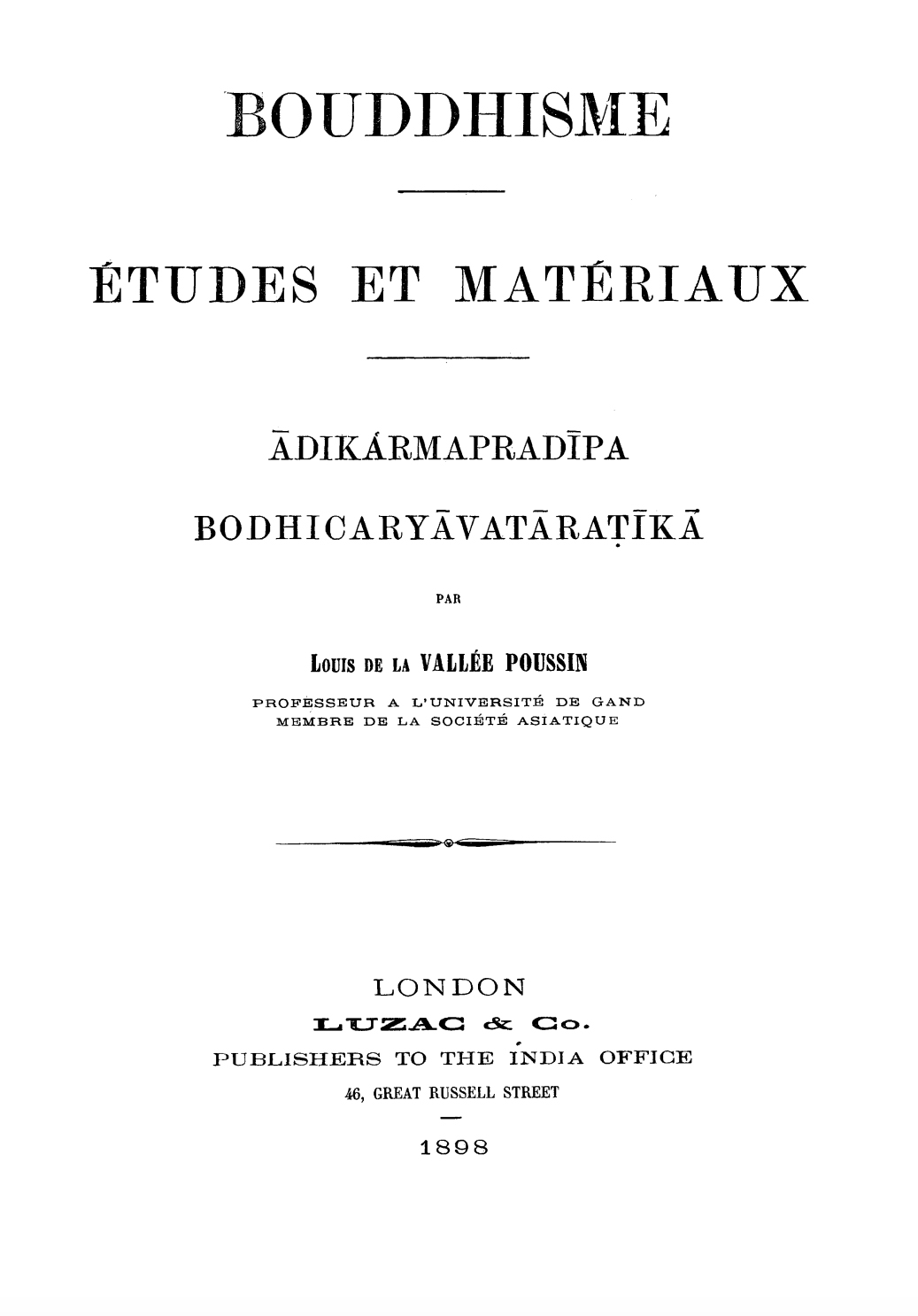
Contains an essay on the history of Buddhism and on tantric literature, the text of the Ādikarmapradīpa, and an edition of the commentary on the ninth chapter of the Bodhicaryāvatāra
-front.jpg)
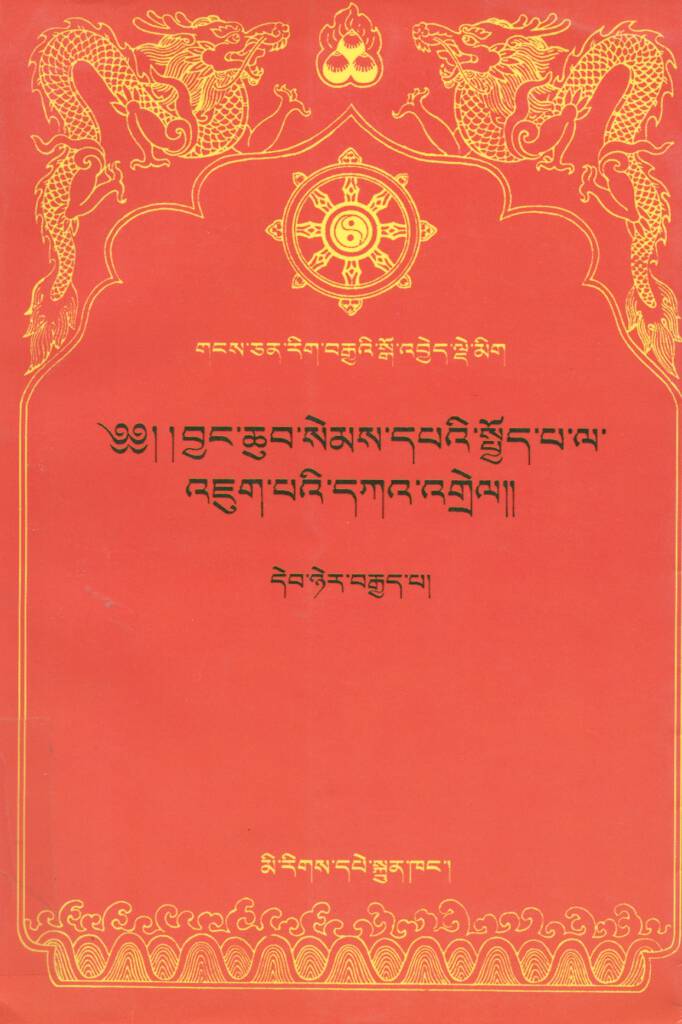
Commentary on difficult points of the Bodhicaryāvatāra. Published by Mi rigs dpe skrun khang, 2000.
2 Full translations
Hindi translation of Śāntideva's Bodhicaryāvatāra and Prajñākaramati's Pañjikā by Swami Dvārikādāsa Śāstrī, with text and commentary in Sanskrit.
A Sanskrit edition with Newari translations of the BCA and the BCAP.
1 Classical commentary of
An "Introduction to Bodhisattva Practice," the Bodhisattvacaryāvatāra is a poem about the path of a bodhisattva, in ten chapters, written by the Indian Buddhist Śāntideva (fl. c. 685–763). One of the masterpieces of world literature, it is a core text of Mahāyāna Buddhism and continues to be taught, studied, and commented upon in many languages and by many traditions around the world. The main subject of the text is bodhicitta, the altruistic aspiration for enlightenment, and the path and practices of the bodhisattva, the six perfections (pāramitās). The text forms the basis of many contemporary discussions of Buddhist ethics and philosophy.
8 Partial translations

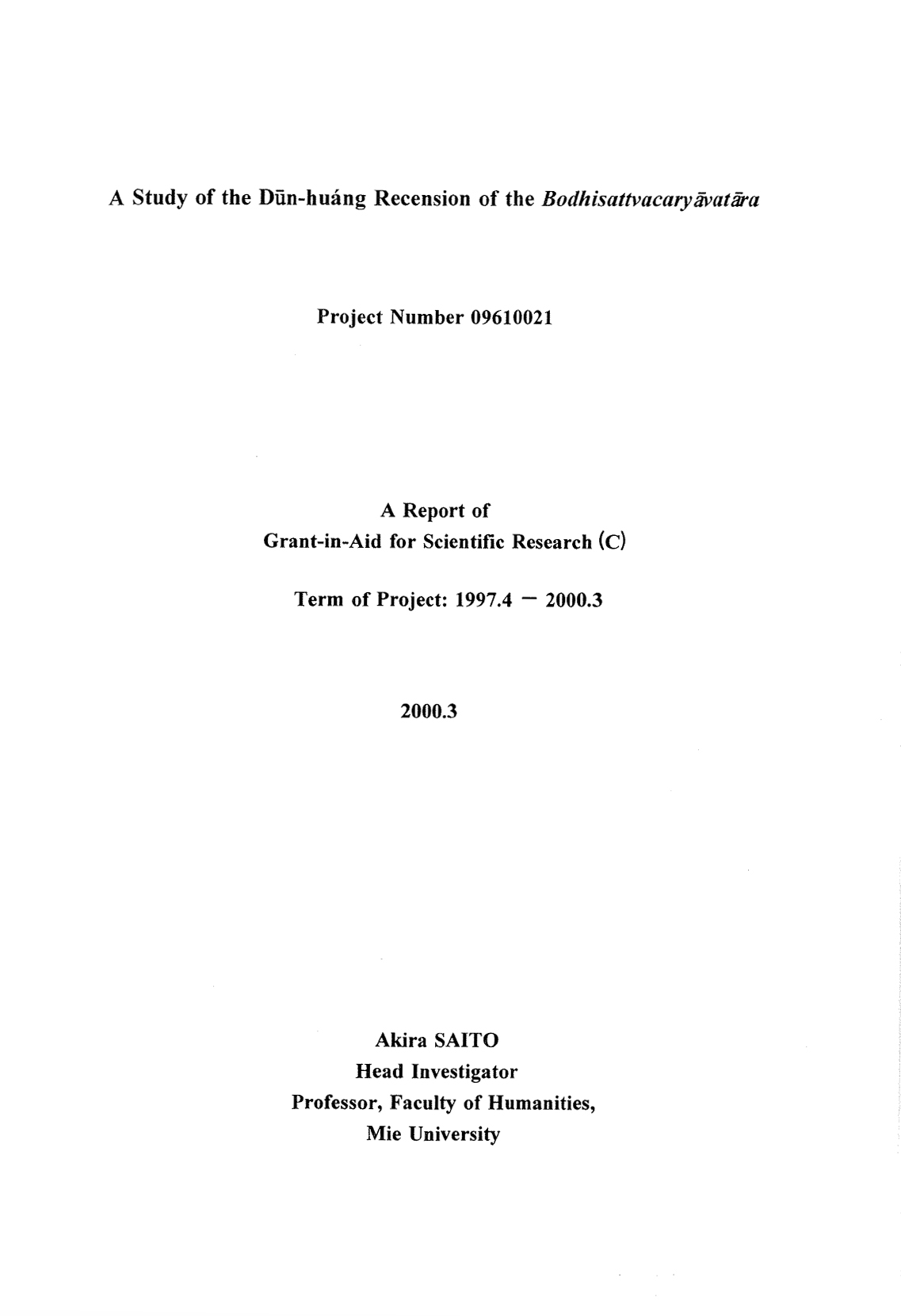
Transliterated text of the Bodhicaryāvatāra of A. Stein No. 628 (Chaps 1, 2, 6, 7, 8) and a Japanese translation of Chap 8 of BCA-1 and Bodhisattvacaryāvatāravyākhyāna
_of_the_Bodhicary%C4%81vat%C4%81rapa%C3%B1jik%C4%81_of_Praj%C3%B1%C4%81karamati-front.jpg)
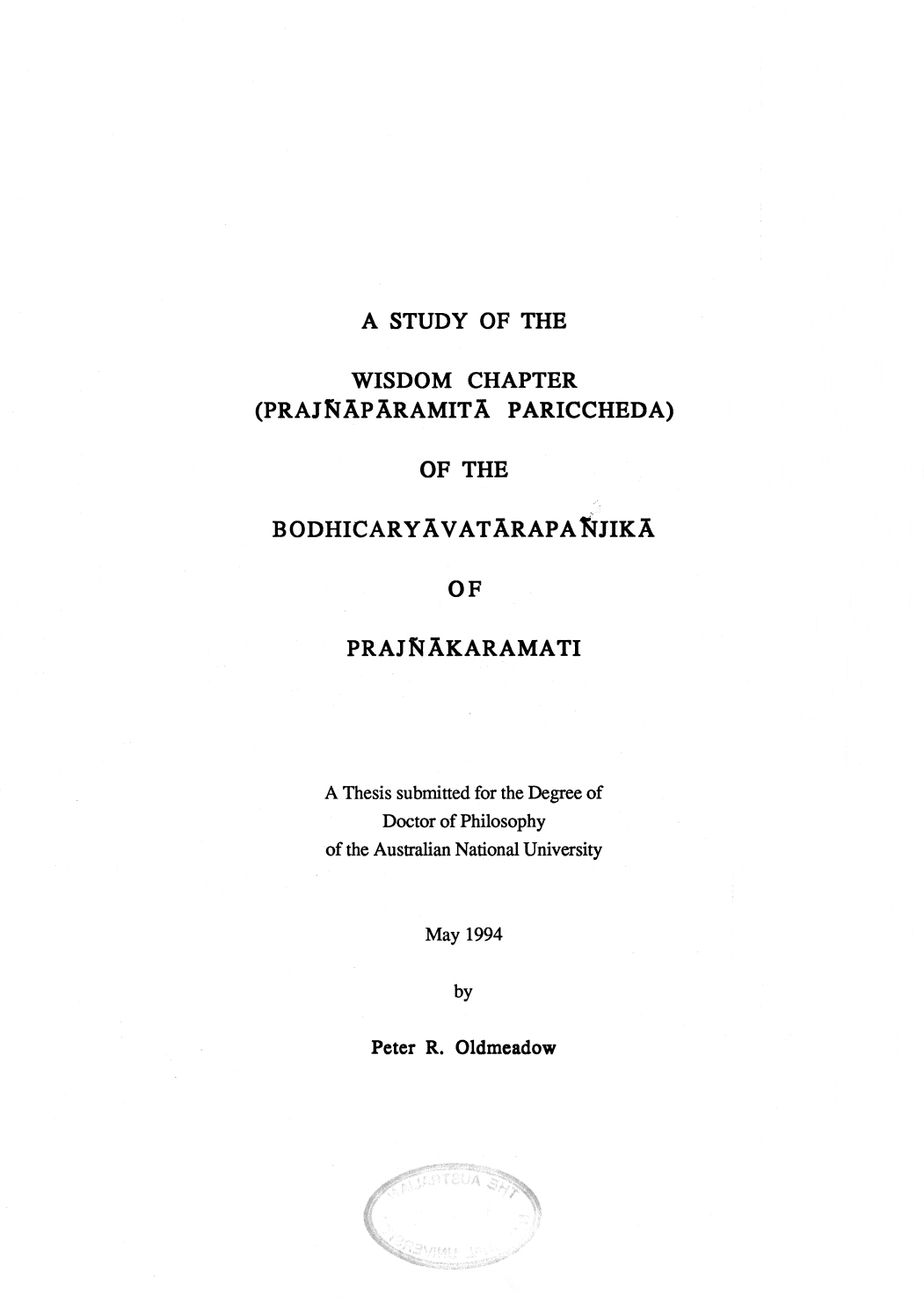
This PhD thesis by Peter Oldmeadow is an annotated translation of the Prajñāpāramitā Pariccheda (Wisdom Chapter) of the Bodhicaryāvatārapañjikā by Prajñākaramati.
This is a translation by Mark Siderits and Charles Goodman of Prajñākaramati's Bodhicaryāvatārapañjikā Chapter 8 verses 90-103, which is an appendix to Moonpaths: Ethics and Emptiness.

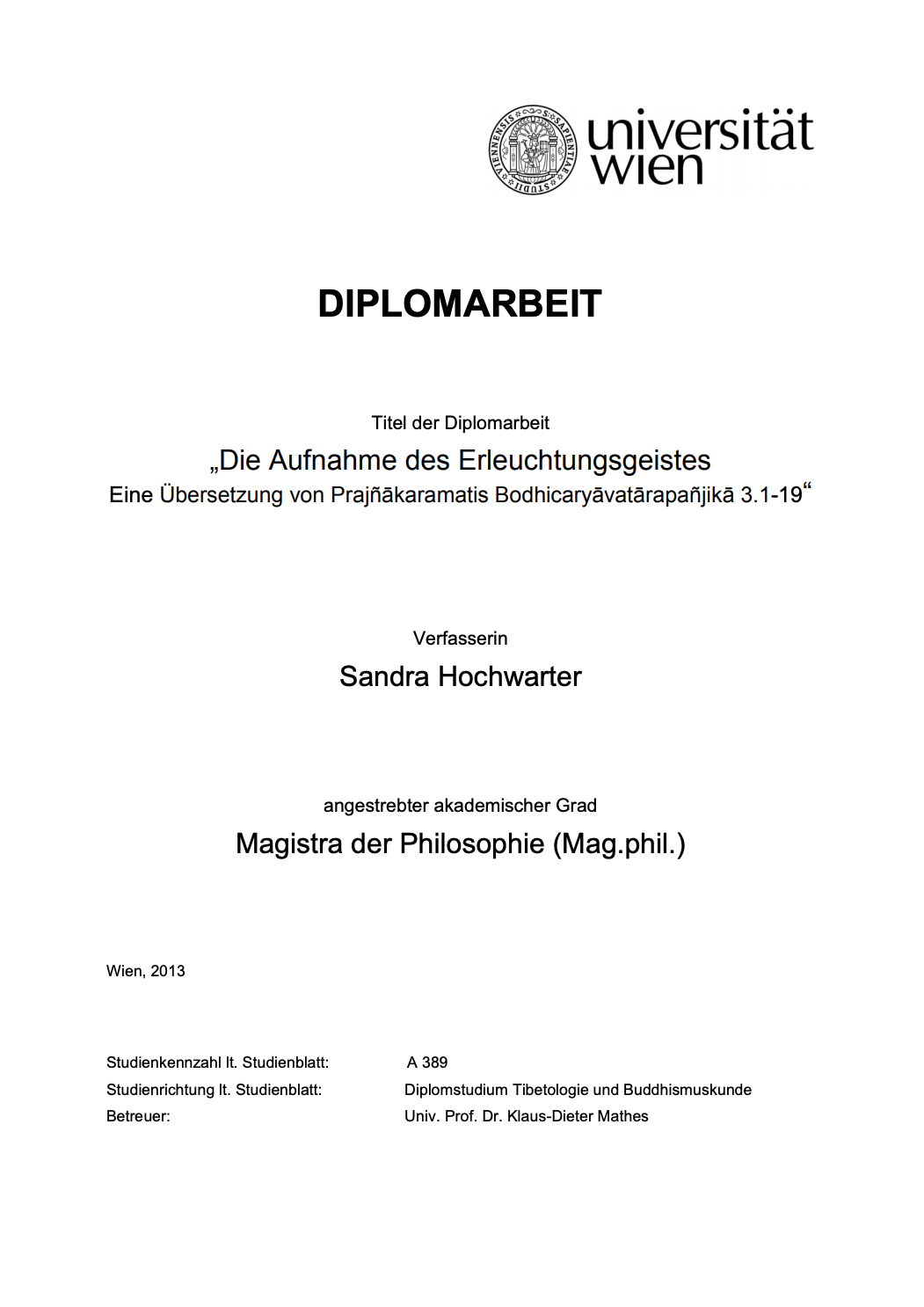
This dissertation by Sandra Hochwarter contains a German translation of Prajñākaramati's commentary on verses 1–19 of the third chapter of the Bodhicaryāvatāra.

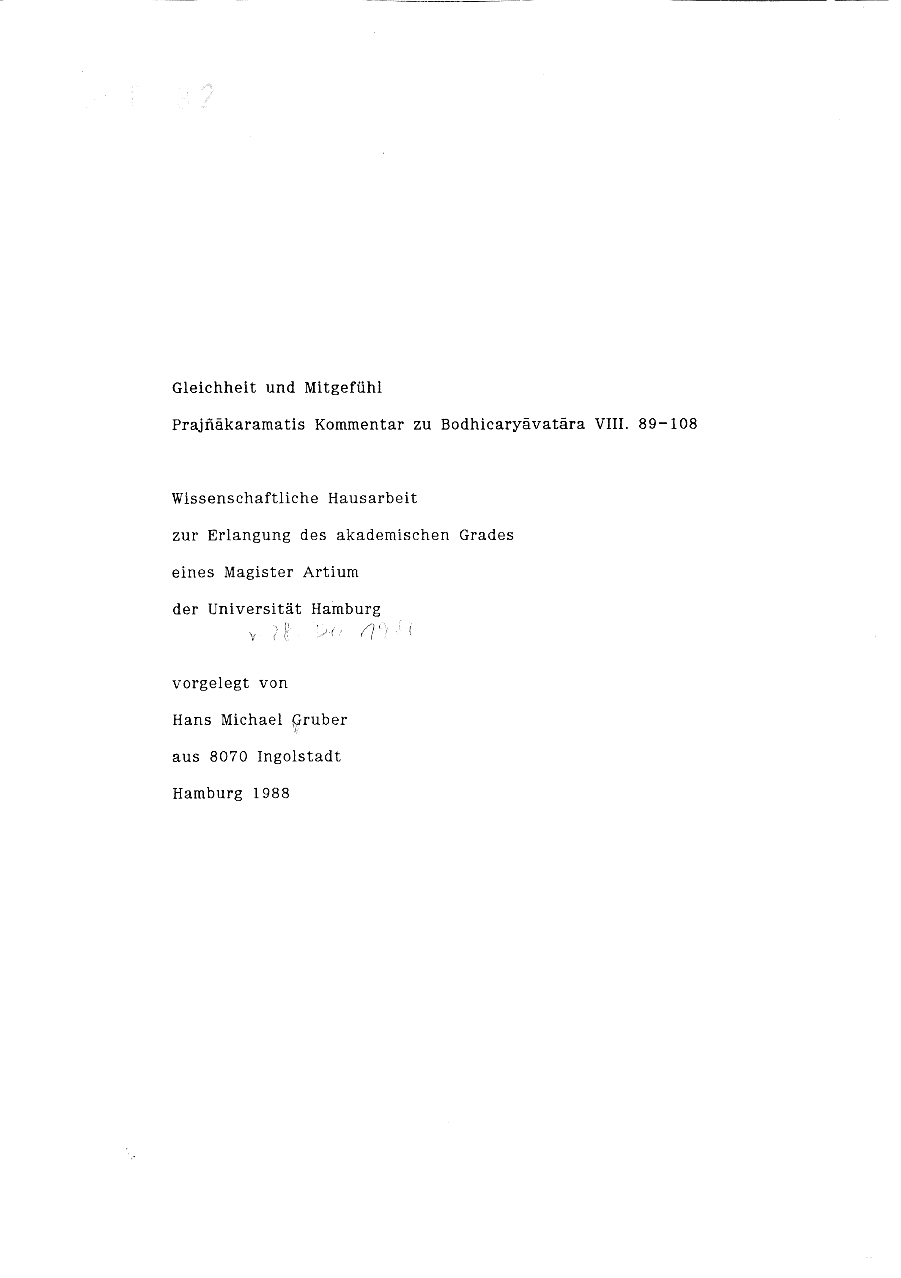
Hans Michael Gruber's MA thesis from the University of Hamburg titled "Equality and Compassion: Prajñākaramati's Commentary on Bodhicaryāvatāra VIII. 89–108"

A translation by Charles Goodman and Aaron Schultz of a major part of Prajñākaramati’s canonical commentary on chapter 6 of Śāntideva's Bodhicaryāvatāra.

Paul Thomas examines the genre of stotra with particular focus on the Bodhicittānuśaṃsapariccheda and provides an English translation of the first chapter Prajñākaramati's Pañjikā.

This thesis presents a German translation of Prajñakaramati's Bodhicaryāvatārapañjikā, a ninth-century Sanskrit commentary on Śāntideva's Bodhicaryāvatāra, covering the first 39 verses of Chapter 8. The Bodhicaryāvatāra ("The Way of the Bodhisattva") is a Sanskrit work composed in eighth-century India by the Buddhist monk Śāntideva, who studied at the monastic university of Nālandā. Chapter 8 treats various forms of Buddhist meditation; the selected verses address not the meditative practices themselves but their prerequisites—specifically, withdrawal from social life and the adoption of a solitary existence as conditions for successful meditation. The translation is based on Louis de la Vallée Poussin's 1901–1914 edition of the Bodhicaryāvatārapañjikā, supplemented by the Tibetan translation where gaps occur in that edition. The thesis also includes a text edition drawing on three Sanskrit manuscripts, two Tengyur versions (Derge and Peking), and the Dunhuang manuscript texts published in Saito (2000).
1 Works containing teachings

A translation of Śāntidēva's Bodhicharyāvatāra by Parmananda Sharma. Contains the original Sanskrit text with English translation and exposition based on Prajñākarmati's Pañjikā.
19 Scholarship

In recent years, a Sanskrit palm-leaf manuscript of Prajñākaramati's Bodhicaryāvatārapañjikā (ZX0617-ZB20, BCAP hereafter) has been identified among the facsimiles of the palm-leaf manuscripts preserved in the Tibetan Autonomous Region. Initial investigations (Wang et al. 2021; 2022) have explored various aspects of the manuscript, including its preservation status, the disarray of its leaves, the interpolation of one leaf of the Saṃghāṭasūtra and the distinct handwriting of at least two scribes. These studies have also supplemented the lacunae in Louis de La Vallée Poussin's (1901-1914) critical edition by providing the BCAP commentaries on the BCA 1.1, 3.28-33, and 4.1-14. This paper extends these initial studies by offering the following BCAP commentaries on the BCA 4.15-48, thereby rendering the fourth chapter of the BCAP a complete Sanskrit text. (Wang et al., introduction, 81)
In recent years, a palm-leaf manuscript (ZX0617-ZB20) version of Prajñākaramati’s (c. 10–11th century) Bodhicaryāvatārapañjikā (BCAP) preserved in the TAR became available to scholars worldwide. While it has since received considerable attention, this newly discovered palm-leaf manuscript remains something of a mystery. We have, for instance, considered issues such as manuscript’s unorthodox pagination, the seemingly arbitrary insertion within manuscript ZX0617-ZB20 of a leaf taken from the Saṃghāṭasūtra. We are also interested in the fact that the script seems to not have been written by one hand, but by various scribes. This paper concentrates on the latter issue, concentrating on the paleographic features of the manuscript to conduct an examination of the varied characteristics of the handwriting. Using these paleographic methods, this piece seeks to attribute these ascribed script variations to their respective sources so as to extrapolate some further conclusions on the processes involved in the manuscript’s transcription. (Source Accessed July 23, 2026)
The Bodhicaryāvatārapañjikā (BCAP) composed by Prajñākaramati (c. 10–11th century) is the only officially published Sanskrit commentary on Śāntideva’s renown Bodhicaryāvatāra (BCA). Since the critical edition of BCAP was published in the early 20th century by Louis de La Vallée Poussin (1914), it has been carefully studied by many scholars. However, this early critical edition of BCAP is far from perfect. According to de La Vallée Poussin's "Introduction," the critical edition is based on two Sanskrit manuscripts, noting that: "The first is in the Nepalese character and contains (with several large lacunae) the whole of the work; the second, in the Maithili character, contains only the commentary on the ninth chapter." This means that the first eight chapters of his edition of the BCAP are based only on a problematic Nepalese manuscript. There are therefore significant lacunae in the commentaries to the BCA's verses: 1.1, 3.22–33, 4.1–45, 8.18–22, 8.24–25, 8.40–47, and 8.108–186, as well as many smaller textual lacunae and unreadable passages scattered throughout the whole text which ultimately have hindered the exhaustive study of the text as a whole.
With the recent discovery of a BCAP Sanskrit palm-leaf manuscript in the Tibetan Autonomous Region, further study of the BCAP has become possible.[1] This newly discovered palm-leaf manuscript measures around 32.1*6.2cm in size and is catalogued as ZX0617–ZB20 in the facsimile edition. Each page generally contains six or seven lines in black ink with space for a string hole slightly left of the center. Its scripts are mainly written in the Proto-Bengali style. Even considering that the same scribe would write in a different hand depending on circumstances—e.g., the script would change if he was in a hurry to finish the day’s transcription, etc.— we can identify the handwriting of at least three scribes in this palm-leaf manuscript. One of them would have copied the leaf of a Saṃghāṭasūtra manuscript (folio 71ab) that was inserted—probably by accident—into the BCAP. The other two scribes who copied the BCAP differ not only in the neatness of their writing as well as in the embellishment of akṣaras, but also in their unique choice of fonts. For example, Scribe A who copied the majority of the manuscript tends to use la in the typical Proto-Bengali style, although sometimes with a transitional form, while Scribe B tends to write la (91A1) in the Nāgarī style. The ca of the former is in the Nāgarī style, while the ca (92A1) of the latter is generally in the Proto-Bengali style. A closer study of their paleographical features will be done in the future. (Wang, et al., introduction, 97-98)
Transliterated text of the Bodhicaryāvatāra of A. Stein No. 628 (Chaps 1, 2, 6, 7, 8) and a Japanese translation of Chap 8 of BCA-1 and Bodhisattvacaryāvatāravyākhyāna
This PhD thesis by Peter Oldmeadow is an annotated translation of the Prajñāpāramitā Pariccheda (Wisdom Chapter) of the Bodhicaryāvatārapañjikā by Prajñākaramati.
In Wang et al. (2022), we presented a philological analysis and introduction of a newly-identified palm-leaf manuscript (ZX0617-ZB20) containing Prajñākaramati's Bodhicaryāvatārapañjikā (hereafter BCAP). Through systematic collation with the standard edition established by de la Vallée Poussin (1901-1914), we reconstructed BCAP’s commentaries on Bodhicaryāvatāra (BCA) 1.1, 3.28-33, and 4.1-14 passages conspicuously absent from the aforementioned critical edition. Building upon this foundation, Wang et al. (2023) extended this reconstruction to encompass the commentary on BCA 4.15-48, similarly omitted from de la Vallée Poussin (1901-1914). These successive publications have rendered publicly accessible all lacunae in the standard edition that our manuscript evidence permits to supplement. Given that these reconstructed passages constitute the manuscript's principal scholarly contribution, our initial research prioritization focused on their transliteration and analysis. Consequently, even though our team had nearly completed transliterating the entire BCAP manuscript, we temporarily deferred further verification and comparative work (involving the Tibetan translation of BCAP and various cited works) on the remaining, less critical portions. Subsequent to disseminating these findings, however, we received communications from several scholars engaged in producing the first complete modern-language translation of BCAP. This development is particularly significant, as BCAP, despite its century-long status as a critically edited text, has only been partially translated and remains without a full translation to this day. Recognizing that our ongoing transliteration and textual comparisons might benefit this translation effort, we have decided to present here a transliteration of the remaining portion of Chapter 1 of our BCAP manuscript, along with a comparative analysis against the Tibetan version of BCAP, relevant cited works, the Bhāvanākrama, and the Śikṣāsamuccaya.

The index is in two romanized parts, Sanskrit-Tibetan and Tibetan-Sanskrit. Only the preface is in English.
Contains an essay on the history of Buddhism and on tantric literature, the text of the Ādikarmapradīpa, and an edition of the commentary on the ninth chapter of the Bodhicaryāvatāra
This dissertation by Sandra Hochwarter contains a German translation of Prajñākaramati's commentary on verses 1–19 of the third chapter of the Bodhicaryāvatāra.

N. Aiyaswami Sastri discusses chapter 9 of the Bodhicaryāvatāra along with its commentary Pañjikā. Published in Brahmavidyā: The Adyar Library Bulletin 17, no. 2 (1953).
Hans Michael Gruber's MA thesis from the University of Hamburg titled "Equality and Compassion: Prajñākaramati's Commentary on Bodhicaryāvatāra VIII. 89–108"
Paul Thomas examines the genre of stotra with particular focus on the Bodhicittānuśaṃsapariccheda and provides an English translation of the first chapter Prajñākaramati's Pañjikā.

This is a study of compassion in the non-tantric literature of Indian Buddhism focused on whether it is correctly characterized as self-abnegating altruism.
This article (in Japanese) by Taeko Ono explores the meaning of the word sugata in the Bodhicaryāvatārapañjikā, the commentary on the Bodhicaryāvatāra by Prajñākaramati.

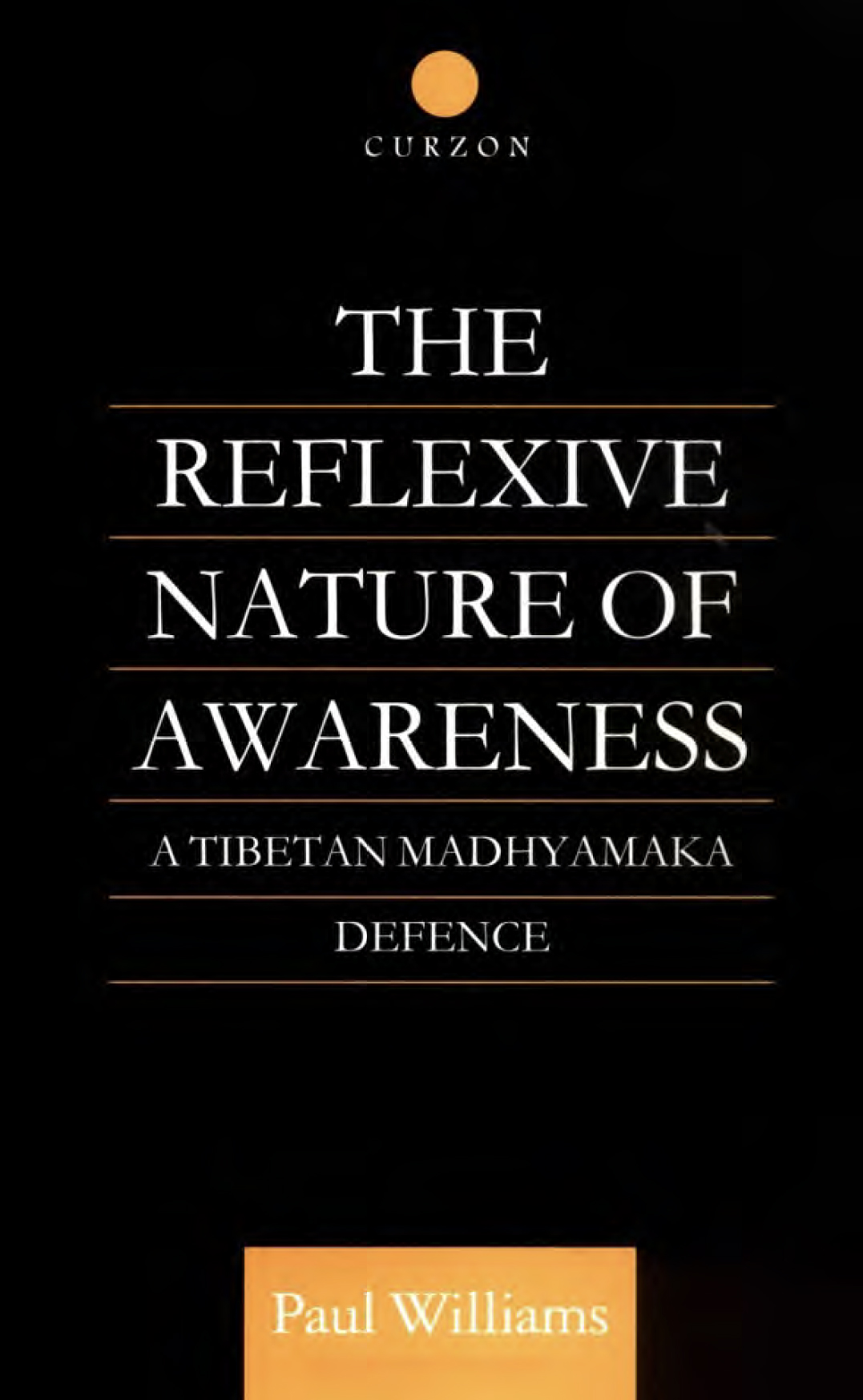
Paul Williams places the controversy over the nature of awareness in its Indian and Tibetan context, tracing in detail Mi pham's position in his commentary on the Bodhicaryāvatāra.

According to the Tibetan Tsong Kha pa one of the eight difficult points in understanding Madhyamaka philosophy is the way in which Prāsaṅgika Madhyamaka does not accept even conventionally that reflexivity is an essential part of awareness — that in being aware there is also an awareness of being aware (rang rig). One of the most sysyematic and detailed refutations of Tsong kha pa's approach to this issue can be found in the commentary to the ninth chapter of the Bodhicaryaāvatāra by the rNyingma lama Mi pham (1846–1912), together with Mi pham's own replies to his subsequent critics. In the course of this Mi pham reveals a vision of what is going on in the Madhyamaka which is rather different from the more familiar Tibetan approach of Tsong kha pa.
Paul Williams places this controversy in its Indian and Tibetan context. He traces in detail Mi pham's position in his commentary on the Bodhicaryaāvatāra, the attack of one of his opponents, and his response, as well as indicating ways in which this controversy over the nature of awareness may be important within the context of Mi pham's rNyingma heritage of rDzogs chen thought and practice.
This book is the first book length study of its subject, and also includes a reprint of a previous paper by Williams on the reflexive nature of awareness, as well as the relevant Tibetan texts from Mi pham. The book will be of interest to all students of Indian and Tibetan Madhyamaka, as well as associated areas of Buddhist thought such as Yogācāra and the philosophy of Dharmakīrti. It will also be of value to those concerned with the intelectual foundations of rDzogs chen. (Source: Back cover of Routledge 2013 edition)
Paul Williams places this controversy in its Indian and Tibetan context. He traces in detail Mi pham's position in his commentary on the Bodhicaryaāvatāra, the attack of one of his opponents, and his response, as well as indicating ways in which this controversy over the nature of awareness may be important within the context of Mi pham's rNyingma heritage of rDzogs chen thought and practice.
This book is the first book length study of its subject, and also includes a reprint of a previous paper by Williams on the reflexive nature of awareness, as well as the relevant Tibetan texts from Mi pham. The book will be of interest to all students of Indian and Tibetan Madhyamaka, as well as associated areas of Buddhist thought such as Yogācāra and the philosophy of Dharmakīrti. It will also be of value to those concerned with the intelectual foundations of rDzogs chen. (Source: Back cover of Routledge 2013 edition)
In this article (in Japanese) Jenhong Shih discusses two kinds of saṃvṛtis (relative truths) in the Bodhicaryāvatārapañjikā 9:3-8. Published in the Journal of Indian and Buddhist Studies.
This thesis presents a German translation of Prajñakaramati's Bodhicaryāvatārapañjikā, a ninth-century Sanskrit commentary on Śāntideva's Bodhicaryāvatāra, covering the first 39 verses of Chapter 8. The Bodhicaryāvatāra ("The Way of the Bodhisattva") is a Sanskrit work composed in eighth-century India by the Buddhist monk Śāntideva, who studied at the monastic university of Nālandā. Chapter 8 treats various forms of Buddhist meditation; the selected verses address not the meditative practices themselves but their prerequisites—specifically, withdrawal from social life and the adoption of a solitary existence as conditions for successful meditation. The translation is based on Louis de la Vallée Poussin's 1901–1914 edition of the Bodhicaryāvatārapañjikā, supplemented by the Tibetan translation where gaps occur in that edition. The thesis also includes a text edition drawing on three Sanskrit manuscripts, two Tengyur versions (Derge and Peking), and the Dunhuang manuscript texts published in Saito (2000).

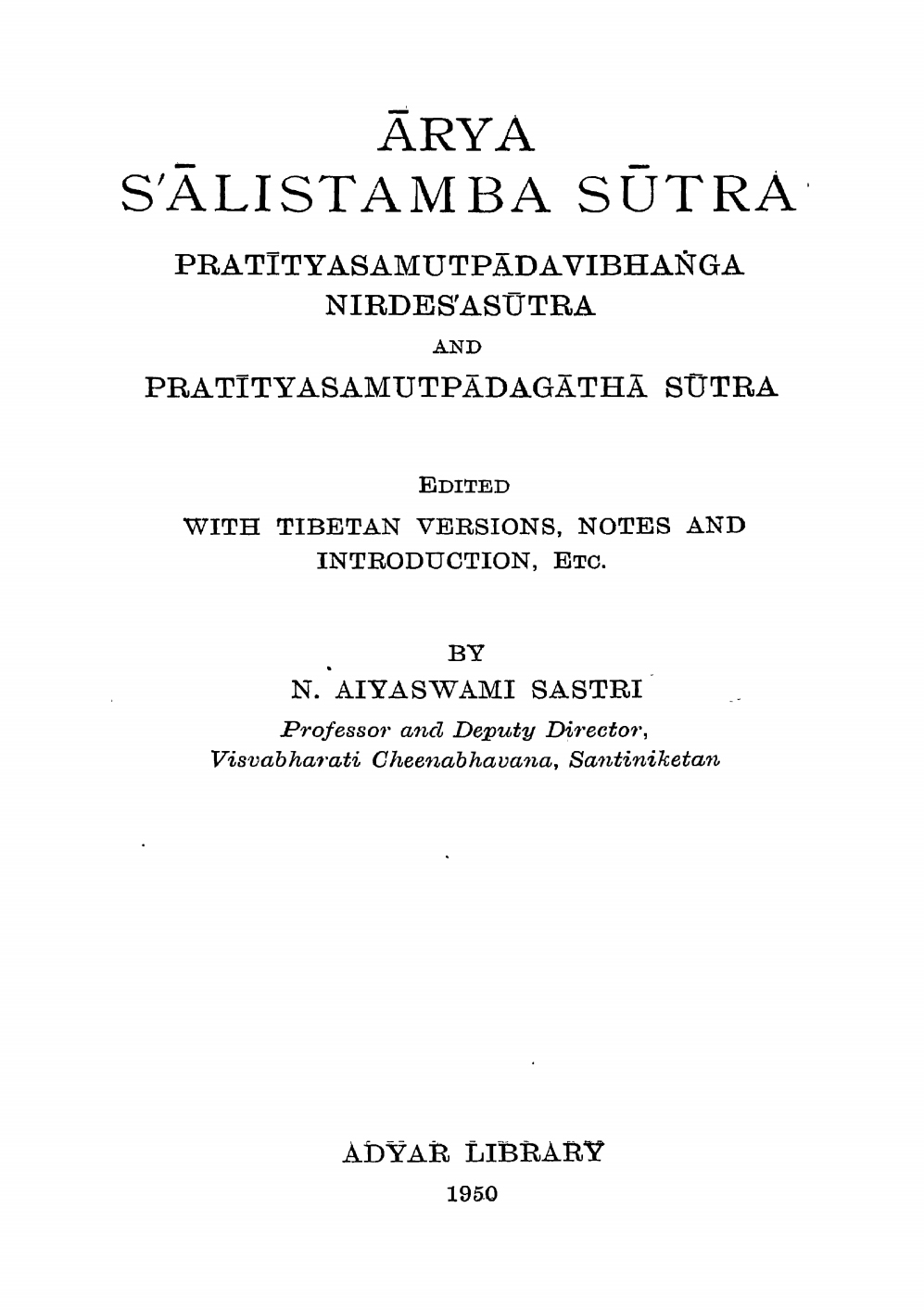
The publication of the Śālistamba Sūtra along with other two Sūtras was planned long ago and commenced in October 1943 through the Bulletin and continued to
appear through the issues of the Bulletin till May 1949. The acute paper shortage at the time of commencement, in 1943 did not allow the printing of sufficient number of copies to issue the work as a separate volume, though the entire body of the book, omitting of course the Introduction, etc., appeared in the Bulletin. In pursuance of the plan to issue the book separately, the whole matter had to be reprinted. In so reprinting, the main change I have introduced is the replacement of the reconstructed text of the Vibhaṅga Sūtra by the original one which escaped my notice at that time. I must apologize to my readers that no attempt was made to translate into English any of the texts, although I have given in the Introduction a short summary of the contents of the Śālistamba Sūtra. I have discussed there in full all such topics that would interest the scholars in the present context. Some information from epigraphical records in regard to the Buddha's worship and image are also culled in the Additional Notes (pp, 31-33). The Tibetan text which is presented in this volume is reproduced from the xylograph copy of the Kanjur collection in Narthang Edition preserved in the Adyar Library. Since no Peking Edition of the collection was available to me, I was not able to consult that edition in preparing my Tibetan text. Full particulars about the Chinese translations are supplied in the Introduction, IV. Index of the Tibetan-Sanskrit words is intended to cover only the authentic terms thus the terms from the last Sūtra are left unrecorded in the Index. I have likewise also prepared a Chinese Index of such technical terms, Since the facility for printing Chinese characters is not available at present, I have deferred it for a future occasion. (N. A. Sastri, preface, v–vi)
31 A topic of
In recent years, a Sanskrit palm-leaf manuscript of Prajñākaramati's Bodhicaryāvatārapañjikā (ZX0617-ZB20, BCAP hereafter) has been identified among the facsimiles of the palm-leaf manuscripts preserved in the Tibetan Autonomous Region. Initial investigations (Wang et al. 2021; 2022) have explored various aspects of the manuscript, including its preservation status, the disarray of its leaves, the interpolation of one leaf of the Saṃghāṭasūtra and the distinct handwriting of at least two scribes. These studies have also supplemented the lacunae in Louis de La Vallée Poussin's (1901-1914) critical edition by providing the BCAP commentaries on the BCA 1.1, 3.28-33, and 4.1-14. This paper extends these initial studies by offering the following BCAP commentaries on the BCA 4.15-48, thereby rendering the fourth chapter of the BCAP a complete Sanskrit text. (Wang et al., introduction, 81)

A selection from a classical Mahāyāna liturgy from the first four chapters in the Bodhicaryāvatāra meant to be performed once as a rite of passage and repeatedly as a rite of affirmation.
In recent years, a palm-leaf manuscript (ZX0617-ZB20) version of Prajñākaramati’s (c. 10–11th century) Bodhicaryāvatārapañjikā (BCAP) preserved in the TAR became available to scholars worldwide. While it has since received considerable attention, this newly discovered palm-leaf manuscript remains something of a mystery. We have, for instance, considered issues such as manuscript’s unorthodox pagination, the seemingly arbitrary insertion within manuscript ZX0617-ZB20 of a leaf taken from the Saṃghāṭasūtra. We are also interested in the fact that the script seems to not have been written by one hand, but by various scribes. This paper concentrates on the latter issue, concentrating on the paleographic features of the manuscript to conduct an examination of the varied characteristics of the handwriting. Using these paleographic methods, this piece seeks to attribute these ascribed script variations to their respective sources so as to extrapolate some further conclusions on the processes involved in the manuscript’s transcription. (Source Accessed July 23, 2026)
The Bodhicaryāvatārapañjikā (BCAP) composed by Prajñākaramati (c. 10–11th century) is the only officially published Sanskrit commentary on Śāntideva’s renown Bodhicaryāvatāra (BCA). Since the critical edition of BCAP was published in the early 20th century by Louis de La Vallée Poussin (1914), it has been carefully studied by many scholars. However, this early critical edition of BCAP is far from perfect. According to de La Vallée Poussin's "Introduction," the critical edition is based on two Sanskrit manuscripts, noting that: "The first is in the Nepalese character and contains (with several large lacunae) the whole of the work; the second, in the Maithili character, contains only the commentary on the ninth chapter." This means that the first eight chapters of his edition of the BCAP are based only on a problematic Nepalese manuscript. There are therefore significant lacunae in the commentaries to the BCA's verses: 1.1, 3.22–33, 4.1–45, 8.18–22, 8.24–25, 8.40–47, and 8.108–186, as well as many smaller textual lacunae and unreadable passages scattered throughout the whole text which ultimately have hindered the exhaustive study of the text as a whole.
With the recent discovery of a BCAP Sanskrit palm-leaf manuscript in the Tibetan Autonomous Region, further study of the BCAP has become possible.[1] This newly discovered palm-leaf manuscript measures around 32.1*6.2cm in size and is catalogued as ZX0617–ZB20 in the facsimile edition. Each page generally contains six or seven lines in black ink with space for a string hole slightly left of the center. Its scripts are mainly written in the Proto-Bengali style. Even considering that the same scribe would write in a different hand depending on circumstances—e.g., the script would change if he was in a hurry to finish the day’s transcription, etc.— we can identify the handwriting of at least three scribes in this palm-leaf manuscript. One of them would have copied the leaf of a Saṃghāṭasūtra manuscript (folio 71ab) that was inserted—probably by accident—into the BCAP. The other two scribes who copied the BCAP differ not only in the neatness of their writing as well as in the embellishment of akṣaras, but also in their unique choice of fonts. For example, Scribe A who copied the majority of the manuscript tends to use la in the typical Proto-Bengali style, although sometimes with a transitional form, while Scribe B tends to write la (91A1) in the Nāgarī style. The ca of the former is in the Nāgarī style, while the ca (92A1) of the latter is generally in the Proto-Bengali style. A closer study of their paleographical features will be done in the future. (Wang, et al., introduction, 97-98)
This PhD thesis by Peter Oldmeadow is an annotated translation of the Prajñāpāramitā Pariccheda (Wisdom Chapter) of the Bodhicaryāvatārapañjikā by Prajñākaramati.
In Wang et al. (2022), we presented a philological analysis and introduction of a newly-identified palm-leaf manuscript (ZX0617-ZB20) containing Prajñākaramati's Bodhicaryāvatārapañjikā (hereafter BCAP). Through systematic collation with the standard edition established by de la Vallée Poussin (1901-1914), we reconstructed BCAP’s commentaries on Bodhicaryāvatāra (BCA) 1.1, 3.28-33, and 4.1-14 passages conspicuously absent from the aforementioned critical edition. Building upon this foundation, Wang et al. (2023) extended this reconstruction to encompass the commentary on BCA 4.15-48, similarly omitted from de la Vallée Poussin (1901-1914). These successive publications have rendered publicly accessible all lacunae in the standard edition that our manuscript evidence permits to supplement. Given that these reconstructed passages constitute the manuscript's principal scholarly contribution, our initial research prioritization focused on their transliteration and analysis. Consequently, even though our team had nearly completed transliterating the entire BCAP manuscript, we temporarily deferred further verification and comparative work (involving the Tibetan translation of BCAP and various cited works) on the remaining, less critical portions. Subsequent to disseminating these findings, however, we received communications from several scholars engaged in producing the first complete modern-language translation of BCAP. This development is particularly significant, as BCAP, despite its century-long status as a critically edited text, has only been partially translated and remains without a full translation to this day. Recognizing that our ongoing transliteration and textual comparisons might benefit this translation effort, we have decided to present here a transliteration of the remaining portion of Chapter 1 of our BCAP manuscript, along with a comparative analysis against the Tibetan version of BCAP, relevant cited works, the Bhāvanākrama, and the Śikṣāsamuccaya.
The index is in two romanized parts, Sanskrit-Tibetan and Tibetan-Sanskrit. Only the preface is in English.

An essay related to the doctrine of the Two Truths, including a full translation of Prajñākaramati's commentary on Śāntideva's verse 2 of chapter 9.

This is an encyclopedia entry for "Bodhicaryāvatāra" and "Bodhicaryāvatāra-Pañjikā" in Encyclopaedia of Buddhism, vol. 3, fasc. 2, published by the Government of Sri Lanka, 1972.
Critical edition of the Bodhicaryāvatāra and Prajñākaramati's Pañjikā edited by P. L. Vaidya, with introductions in English and Hindi.
This is the second edition (1988) of P. L. Vaidya's critical edition of the Bodhicaryāvatāra and Prajñākaramati's Pañjikā published in 1960. This edition is edited by Sridhar Tripathi.
This is a translation by Mark Siderits and Charles Goodman of Prajñākaramati's Bodhicaryāvatārapañjikā Chapter 8 verses 90-103, which is an appendix to Moonpaths: Ethics and Emptiness.
Hindi translation of Śāntideva's Bodhicaryāvatāra and Prajñākaramati's Pañjikā by Swami Dvārikādāsa Śāstrī, with text and commentary in Sanskrit.
A critical Sanskrit edition of Prajñākaramati's commentary to the Bodhicaryāvatāra entitled the Bodhicaryāvatārapañjikā, edited by Louis de La Vallée Poussin
Contains an essay on the history of Buddhism and on tantric literature, the text of the Ādikarmapradīpa, and an edition of the commentary on the ninth chapter of the Bodhicaryāvatāra
Commentary on difficult points of the Bodhicaryāvatāra. Published by Mi rigs dpe skrun khang, 2000.
This dissertation by Sandra Hochwarter contains a German translation of Prajñākaramati's commentary on verses 1–19 of the third chapter of the Bodhicaryāvatāra.

Mark Siderits inqires into the question of what a Madhyamaka Buddhist ethics might look like, given that Madhyamaka denies there is much that can be said to be ultimately true.

German translation of the Bodhicaryāvatāra and the Bodhicaryāvatārapañjikā by Ernst Steinkellner
N. Aiyaswami Sastri discusses chapter 9 of the Bodhicaryāvatāra along with its commentary Pañjikā. Published in Brahmavidyā: The Adyar Library Bulletin 17, no. 2 (1953).
Hans Michael Gruber's MA thesis from the University of Hamburg titled "Equality and Compassion: Prajñākaramati's Commentary on Bodhicaryāvatāra VIII. 89–108"

In this lecture transcript, Lambert Schmithausen discusses no-self, emptiness, and altruistic ethics in Śāntideva's Bodhicaryāvatāra, touching on verses from chaps. 9, 8, and 6.
In this chapter, Lambert Schmithausen discusses no-self, emptiness, and altruistic ethics in Śāntideva's Bodhicaryāvatāra, touching on verses from chaps. 9, 8, and 6.
A translation by Charles Goodman and Aaron Schultz of a major part of Prajñākaramati’s canonical commentary on chapter 6 of Śāntideva's Bodhicaryāvatāra.
Paul Thomas examines the genre of stotra with particular focus on the Bodhicittānuśaṃsapariccheda and provides an English translation of the first chapter Prajñākaramati's Pañjikā.
This article (in Japanese) by Taeko Ono explores the meaning of the word sugata in the Bodhicaryāvatārapañjikā, the commentary on the Bodhicaryāvatāra by Prajñākaramati.
In this article (in Japanese) Jenhong Shih discusses two kinds of saṃvṛtis (relative truths) in the Bodhicaryāvatārapañjikā 9:3-8. Published in the Journal of Indian and Buddhist Studies.

This chapter addresses the problem of compassion for sentient beings who are ultimately empty and then investigates how compassion made sense to three Mādhyamika thinkers.
This thesis presents a German translation of Prajñakaramati's Bodhicaryāvatārapañjikā, a ninth-century Sanskrit commentary on Śāntideva's Bodhicaryāvatāra, covering the first 39 verses of Chapter 8. The Bodhicaryāvatāra ("The Way of the Bodhisattva") is a Sanskrit work composed in eighth-century India by the Buddhist monk Śāntideva, who studied at the monastic university of Nālandā. Chapter 8 treats various forms of Buddhist meditation; the selected verses address not the meditative practices themselves but their prerequisites—specifically, withdrawal from social life and the adoption of a solitary existence as conditions for successful meditation. The translation is based on Louis de la Vallée Poussin's 1901–1914 edition of the Bodhicaryāvatārapañjikā, supplemented by the Tibetan translation where gaps occur in that edition. The thesis also includes a text edition drawing on three Sanskrit manuscripts, two Tengyur versions (Derge and Peking), and the Dunhuang manuscript texts published in Saito (2000).
A Sanskrit edition with Newari translations of the BCA and the BCAP.
The publication of the Śālistamba Sūtra along with other two Sūtras was planned long ago and commenced in October 1943 through the Bulletin and continued to
appear through the issues of the Bulletin till May 1949. The acute paper shortage at the time of commencement, in 1943 did not allow the printing of sufficient number of copies to issue the work as a separate volume, though the entire body of the book, omitting of course the Introduction, etc., appeared in the Bulletin. In pursuance of the plan to issue the book separately, the whole matter had to be reprinted. In so reprinting, the main change I have introduced is the replacement of the reconstructed text of the Vibhaṅga Sūtra by the original one which escaped my notice at that time. I must apologize to my readers that no attempt was made to translate into English any of the texts, although I have given in the Introduction a short summary of the contents of the Śālistamba Sūtra. I have discussed there in full all such topics that would interest the scholars in the present context. Some information from epigraphical records in regard to the Buddha's worship and image are also culled in the Additional Notes (pp, 31-33). The Tibetan text which is presented in this volume is reproduced from the xylograph copy of the Kanjur collection in Narthang Edition preserved in the Adyar Library. Since no Peking Edition of the collection was available to me, I was not able to consult that edition in preparing my Tibetan text. Full particulars about the Chinese translations are supplied in the Introduction, IV. Index of the Tibetan-Sanskrit words is intended to cover only the authentic terms thus the terms from the last Sūtra are left unrecorded in the Index. I have likewise also prepared a Chinese Index of such technical terms, Since the facility for printing Chinese characters is not available at present, I have deferred it for a future occasion. (N. A. Sastri, preface, v–vi)