| 🤓 Admin Zone 🛠️ hidden to non-admins | |
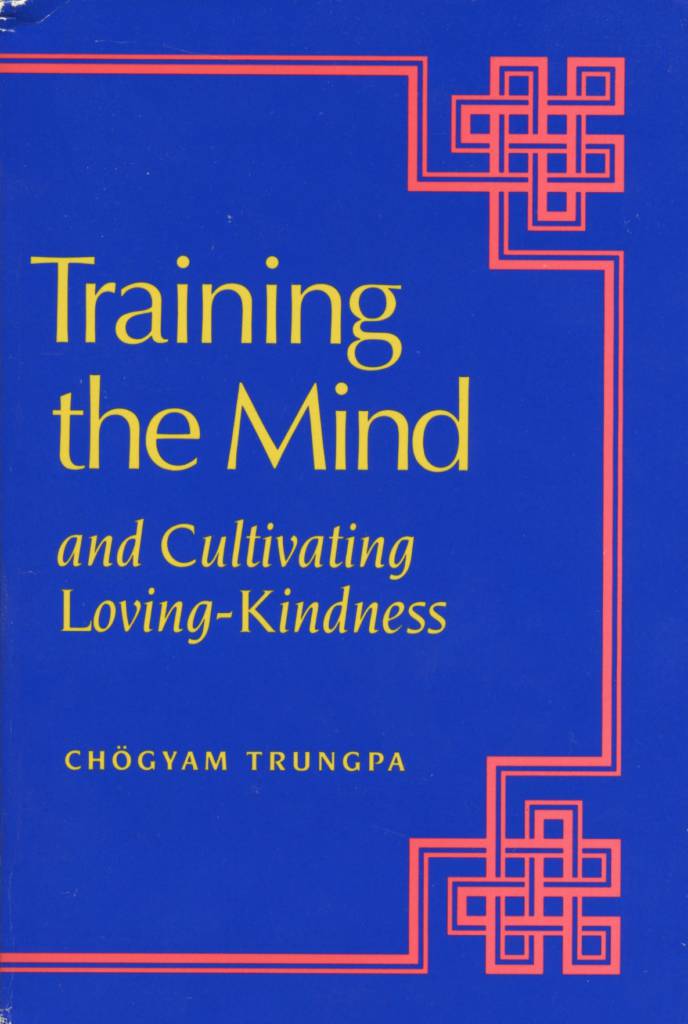
Training the Mind and Cultivating Loving-Kindness
Book
Please note that many items in our library are simply pages that represent a detailed library catalog entry and citation of someone else's work, presentation, or performance. Read our General Disclaimer for more information.
-front.jpg)
Description
Warning: Using this book could be hazardous to your ego! The slogans it contains are designed to awaken the heart and cultivate love and kindness toward others. They are revolutionary in that practicing them fosters abandonment of personal territory in relating to others and in understanding the world as it is.
The fifty-nine provocative slogans presented here—each with a commentary by the Tibetan meditation master Chögyam Trungpa—have been used by Tibetan Buddhists for eight centuries to help meditation students remember and focus on important principles and practices of mind training. They emphasize meeting the ordinary situations of life with intelligence and compassion under all circumstances. Slogans include, "Don't be swayed by external circumstances," "Be grateful to everyone," and "Always maintain only a joyful mind." (Source Accessed April 22, 2025)
Citation
Trungpa, Chögyam. Training the Mind and Cultivating Loving-Kindness. Edited by Judith Lief. Boston: Shambhala Publications, 1993.
Table of contents
- Acknowledgmentsxi
- Editor's Forewordxiii
- Introduction1
- POINT ONE
- The Preliminaries, Which Are a Basis for Dharma Practice9
- 1. First, train in the preliminaries9
- POINT TWO
- The Main Practice, Which Is Training in Bodhichitta11
- Ultimate and Relative Bodhichitta11
- Ultimate Bodhichitta Slogans29
- 2. Regard all dharmas as dreams29
- 3. Examine the nature of unborn awareness31
- 4. Self-liberate even the antidote33
- 5. Rest in the nature of alaya, the essence36
- 6. In postmeditation, be a child of illusion42
- Relative Bodhichitta Slogans46
- 7. Sending and taking should be practiced alternately. These two should ride the breath46
- 8. Three objects, three poisons, and three seeds of virtue64
- 9. In all activities, train with slogans67
- 10. Begin the sequence of sending and taking with yourself69
- POINT THREE
- Transformation of Bad Circumstances into the Path of Enlightenment71
- [Point Three and the Paramita of Patience]71
- 11. When the world is filled with evil, Transform all mishaps into the path of bodhi72
- 12. Drive all blames into one76
- 13. Be grateful to everyone88
- 14. Seeing confusion as the four kayas Is unsurpassable shunyata protection96
- 15. Four practices are the best of methods102
- 16. Whatever you meet unexpectedly, join with meditation125
- POINT FOUR
- Showing the Utilization of Practice in One's Whole Life131
- [Point Four and the Paramita of Exertion]131
- 17. Practice the five strengths, The condensed heart instructions133
- 18. The mahayana instruction for ejection of consciousness at death is the five strengths: how you conduct yourself is
important140
- POINT FIVE
- Evaluation of Mind Training147
- [Point Five and the Paramita of Meditation]147
- 19. All dharma agrees at one point148
- 20. Of the two witnesses, hold the principal one152
- 21. Always maintain only a joyful mind155
- 22. If you can practice even when distracted, you are well trained160
- POINT SIX
- Disciplines of Mind Training167
- [Point Six and Prajnaparamita]167
- 23. Always abide by the three basic principles168
- 24. Change your attitude, but remain natural171
- 25. Don't talk about injured limbs173
- 26. Don't ponder others174
- 27. Work with the greatest defilements first175
- 28. Abandon any hope of fruition176
- 29. Abandon poisonous food178
- 30. Don't be so predictable179
- 31. Don't malign others181
- 32. Don't wait in ambush182
- 33. Don't bring things to a painful point183
- 34. Don't transfer the ox's load to the cow183
- 35. Don't try to be the fastest185
- 36. Don't act with a twist186
- 37. Don't make gods into demons187
- 38. Don't seek others' pain as the limbs of your own happiness188
- POINT SEVEN
- Guidelines of Mind Training189
- [Point Seven and Postmeditation]189
- 39. All activities should be done with one intention189
- 40. Correct all wrongs with one intention190
- 41. Two activities: one at the beginning, one at the end191
- 42. Whichever of the two occurs, be patient192
- 43. Observe these two, even at the risk of your life194
- 44. Train in the three difficulties194
- 45. Take on the three principal causes196
- 46. Pay heed that the three never wane198
- 47. Keep the three inseparable199
- 48. Train without bias in all areas. It is crucial always to do this pervasively and wholeheartedly199
- 49. Always meditate on whatever provokes resentment200
- 50. Don't be swayed by external circumstances200
- 51. This time, practice the main points201
- 52. Don't misinterpret201
- 53. Don't vacillate202
- 54. Train wholeheartedly203
- 55. Liberate yourself by examining and analyzing203
- 56. Don't wallow in self-pity204
- 57. Don't be jealous204
- 58. Don't be frivolous204
- 59. Don't expect applause205
- CONCLUDING VERSES206
- Appendix: The Forty-six Ways in Which a Bodhisattva Fails207
- Notes211
- Glossary214
- Transliterations of Tibetan Names and Terms226
- Bibliography228
- About the Slogan Cards230
- About the Author231
- Meditation Center Information239
- Index241
Interconnections
1 Full translation of

Blo sbyong don bdun ma. (Lojong Döndünma). In Tibetan, "Seven Points of Mind Training"; an influential Tibetan work in the blo sbyong ("mind training") genre. The work was composed by the Bka' gdams scholar 'Chad ka ba ye shes rdo rje, often known as Dge bshes Mchad kha ba, based on the tradition of generating bodhicitta known as "mind training" transmitted by the Bengali master Atiśa Dīpaṃkaraśrījñāna. It also follows the system laid out previously by Glang ri thang pa (Langri Tangpa) in his Blo sbyong tshig brgyad ma ("Eight Verses on Mind Training"). Comprised of a series of pithy instructions and meditative techniques, the Blo sbyong don bdun ma became influential in Tibet, with scholars from numerous traditions writing commentaries to it. According to the commentary of the nineteenth-century Tibetan polymath 'Jam mgon kong sprul, the seven points covered in the treatise are: (1) the preliminaries to mind training, which include the contemplations on the preciousness of human rebirth, the reality of death and impermanence, the shortcomings of saṃsāra, and the effects of karman; (2) the actual practice of training in bodhicitta; (3) transforming adverse conditions into the path of awakening; (4) utilizing the practice in one's entire life; (5) the evaluation of mind training; (6) the commitments of mind training; and (7) guidelines for mind training. (Source: "Blo sbyong don bdun ma." In The Princeton Dictionary of Buddhism, 126–27. Princeton University Press, 2014. http://www.jstor.org/stable/j.ctt46n41q.27.)
1 Other editions

Warning: Using this book could be hazardous to your ego! The slogans it contains are designed to awaken the heart and cultivate love and kindness toward others. They are revolutionary in that practicing them fosters abandonment of personal territory in relating to others and in understanding the world as it is.
The fifty-nine provocative slogans presented here—each with a commentary by the Tibetan meditation master Chögyam Trungpa—have been used by Tibetan Buddhists for eight centuries to help meditation students remember and focus on important principles and practices of mind training. They emphasize meeting the ordinary situations of life with intelligence and compassion under all circumstances. Slogans include, "Don't be swayed by external circumstances," "Be grateful to everyone," and "Always maintain only a joyful mind." (Source: Shambhala Publications.)