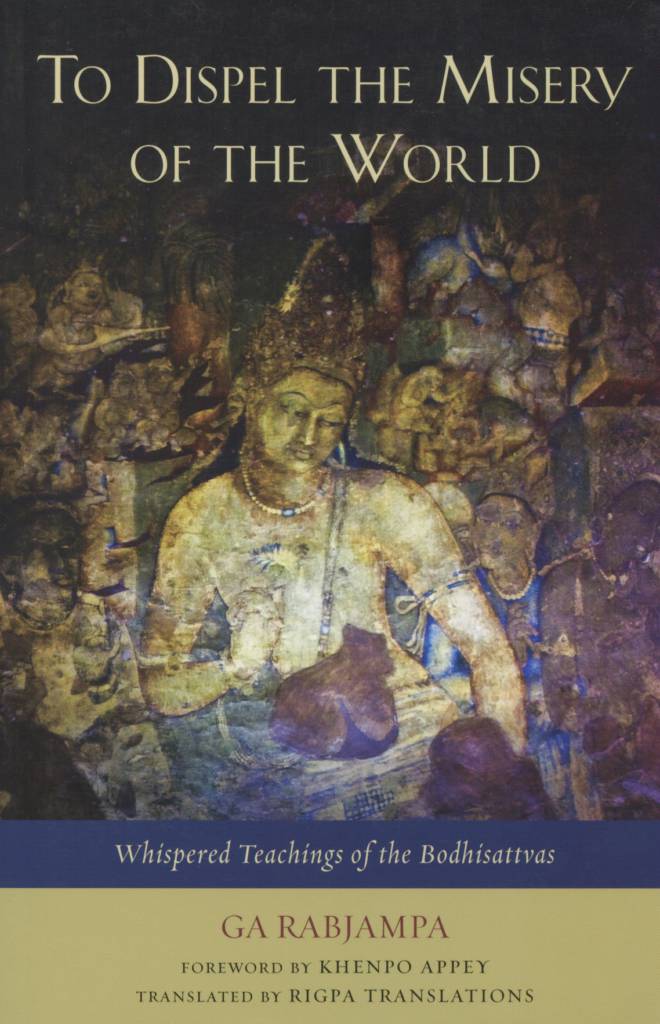
To Dispel the Misery of the World

From Bodhicitta
LibraryBooksTo Dispel the Misery of the World
< Books
Books/To Dispel the Misery of the World

To Dispel the Misery of the World
Book


Please note that many items in our library are simply pages that represent a detailed library catalog entry and citation of someone else's work, presentation, or performance. Read our General Disclaimer for more information. You can find more information about this item on the publisher website.
To Dispel the Misery of the World-front.jpg

Description

“Offered here is the pith advice on mind training according to the great vehicle. This is the path followed by all the buddhas and their children of the past, present, and future, the most profound instruction of the oral lineage, and the quintessence of the ocean of all the excellent teachings.”—Ga Rabjampa

This short book contains a wealth of advice for those wanting to become more fully human. When we are disconnected from others we flounder; only by recognizing the profound interdependence of all beings do we flourish and grow. The famous Seven-Point Mind Training, in just a few pages of one-line instructions, provides direct and powerful advice for breaking through the chronic barriers that separate us from those around us. It is easy to see why it is one of the most cherished texts in all of Tibetan Buddhism.

Ga Rabjampa, an influential master of the fifteenth century, here uses the Seven-Point Mind Training as the basis for illuminating the essential teachings on Buddhism, giving special attention to the practices of giving and taking (tonglen) and of transforming adversity into opportunities for spiritual growth. (Source: Wisdom Publications)

Citation
Rigpa Translations, trans. To Dispel the Misery of the World: Whispered Teachings of the Bodhisattvas. By Ga Rabjampa. Boston: Wisdom Publications, 2012.
Publisher Link
Texts Translated


Translation of

 
Blo sbyong don bdun ma
Blo sbyong don bdun ma. (Lojong Döndünma). In Tibetan, "Seven Points of Mind Training"; an influential Tibetan work in the blo sbyong ("mind training") genre. The work was composed by the Bka' gdams scholar 'Chad ka ba ye shes rdo rje, often known as Dge bshes Mchad kha ba, based on the tradition of generating bodhicitta known as "mind training" transmitted by the Bengali master Atiśa Dīpaṃkaraśrījñāna. It also follows the system laid out previously by Glang ri thang pa (Langri Tangpa) in his Blo sbyong tshig brgyad ma ("Eight Verses on Mind Training"). Comprised of a series of pithy instructions and meditative techniques, the Blo sbyong don bdun ma became influential in Tibet, with scholars from numerous traditions writing commentaries to it. According to the commentary of the nineteenth-century Tibetan polymath 'Jam mgon kong sprul, the seven points covered in the treatise are: (1) the preliminaries to mind training, which include the contemplations on the preciousness of human rebirth, the reality of death and impermanence, the shortcomings of saṃsāra, and the effects of karman; (2) the actual practice of training in bodhicitta; (3) transforming adverse conditions into the path of awakening; (4) utilizing the practice in one's entire life; (5) the evaluation of mind training; (6) the commitments of mind training; and (7) guidelines for mind training. (Source: "Blo sbyong don bdun ma." In The Princeton Dictionary of Buddhism, 126–27. Princeton University Press, 2014. http://www.jstor.org/stable/j.ctt46n41q.27.)
Text
 
Byang chub kyi sems gnyis bsgom pa'i man ngag bdud rtsi'i chu rgyun
Ga Rabjampa Kunga Yeshe's commentary on Chekawa Yeshe Dorje's Seven Points of Mind Training. The commentary is concerned primarily with explaining relative and absolute bodhicitta.
Text
 
Theg pa chen po'i blo sbyong gi smon lam byang chub lam bzang
theg pa chen po'i blo sbyong gi smon lam byang chub lam bzang [ཐེག་པ་ཆེན་པོའི་བློ་སྦྱོང་གི་སྨོན་ལམ་བྱང་ཆུབ་ལམ་བཟང་།]. [The Excellent Path to Enlightenment: An Aspiration Prayer for Mahāyāna Mind Training].
Text

  • Foreword by Khenpo Appey Rinpoche ix
  • Preface xi
  • Introduction 1
  • Seven Points of Mind Training 13
The Stream of Nectar
Pith Instructions for Cultivating Relative and Absolute Bodhicitta
  • 1. The Lineage of Practice 23
  • 2. Following a Spiritual Teacher 33
  • 3. The Freedoms and Advantages 41
  • 4. Death and Impermanence 49
  • 5. Actions and Their Effects 61
  • 6. The Trials of Saṃsāra 75
  • 7. Relative Bodhicitta: The Holy Secret 99
  • 8. Absolute Bodhicitta: Śamatha and Vipaśyanā 139
  • 9. Subsequent Points 153
  • 10. Conclusion 175
  • Appendix
    • The Excellent Path to Enlightenment: An Aspiration Prayer for Mahāyāna Mind Training 179
  • Notes 187
  • Bibliography 195
  • Index 201