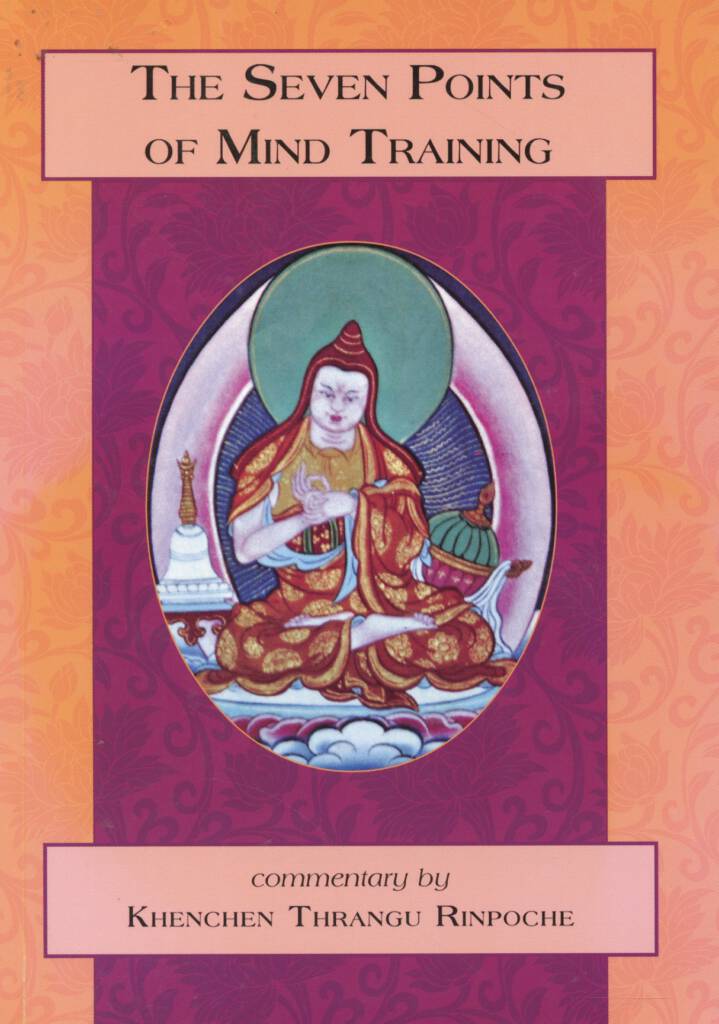
The Seven Points of Mind Training (Thrangu Rinpoche 2004)
| 🤓 Admin Zone 🛠️ hidden to non-admins | |
-front.jpg)
Description
These 59 instructions on Mind Training are short, easily memorized and then will pop into our mind in the many situations of our daily life helping us to make decisions that will produce positive karma for us and others.
The Seven Points of Mind Training is a method of developing a relative universal compassion for all sentient beings or bodhichitta practice which was brought to Tibet by the great Atisha. This practice is very effective in working with emotions. One usually learns a number of instructions and every time the situation where the solution is one of these instructions, one thinks of the instruction and changes one's behavior.
These short instructions are sometimes a little cryptic and Thrangu Rinpoche clearly explains these Seven Points which are presented in Jamgon Kongtrul Lodrö Thaye’s classic text, The Great Path of Awakening. In Rinpoche’s view, the combination of Mahamudra and Mind Training is an excellent balance of ultimate and relative bodhichitta practice that together offer a swift path to full realization. (Source: Namo Buddha Publications)
- Foreword 11
- Preface 13
- Chapter 1
- An Introduction to Mind Training 17
- Chapter 2
- I. The Preliminaries 25
- A. The Visualization for Mind Training Lineage 25
- B. The Four Ordinary Foundations 28
- 1. The Difficulty of Finding a Human Birth 28
- 2. Death and Impermanence 29
- 3. The Infallible Law of cause and Effect 29
- 4. The Inherent Tragedies of Samsara 30
- Chapter 3
- II. The Main Practice 35
- A. Ultimate Bodhicitta 36
- 1. Analytical Meditation 36
- 2. Placement Meditation 41
- 3. Post- meditation 42
- B. Relative Bodhicitta 43
- 1. The Preliminary Practice 46
- 2. The Main Practice 47
- 3. The Post- meditation Practice 49
- A. Ultimate Bodhicitta 36
- Chapter 4
- III. How to Carry the Practice onto the Path 55
- A. The General Practice 55
- 1. Relying on Relative Bodhicitta 56
- 2. Relying on Ultimate Bodhicitta 60
- a. Accumulating Merit 61
- b. The Confession of Negative Deeds 62
- c. Making Offerings to Gods and Demons 62
- d. Making Offerings to Dakinis and Protectors 63
- A. The General Practice 55
- Chapter 5
- IV. Practicing Mind Training in Daily Life 71
- A. Practicing Mind Training in this Lifetime 71
- 1. The Power of Goodwill 74
- 2. The Power of Familiarization 75
- 3. The Power of Virtuous Actions 76
- 4. The Power of Remorse 77
- 5. The Power of Aspiration 79
- B. Practicing Mind Training at the Time of Death 80
- 1. The Power of Virtuous Seeds 80
- 2. The Power of Aspiration 81
- 3. The Power of Remorse 81
- 4. The Power of Goodwill 82
- 5. The Power of Familiarization 83
- A. Practicing Mind Training in this Lifetime 71
- Chapter 6
- V. The Evaluation of Mind Training 87
- A. Clinging to self as a measure 87
- B. Relying on yourself as a measure 90
- C. State of mind as a measure 91
- D. Staying on Guard 92
- Chapter 7
- VI. Commitments of Mind Training 95
- A. Three General Principles 96
- B. Specific Principles 98
- Chapter 8
- VII. Guidelines of Mind Training 109
- A. What to Reject 109
- B. What to Adopt 112
- Conclusion 119
- The Root Text of Seven Points of Mind Training 123
- Notes 127
- Glossary of Terms 131
- Glossary of Tibetan Terms 139
- Bibliography 141
- Index 143
- About the Author 145