| 🤓 Admin Zone 🛠️ hidden to non-admins | |
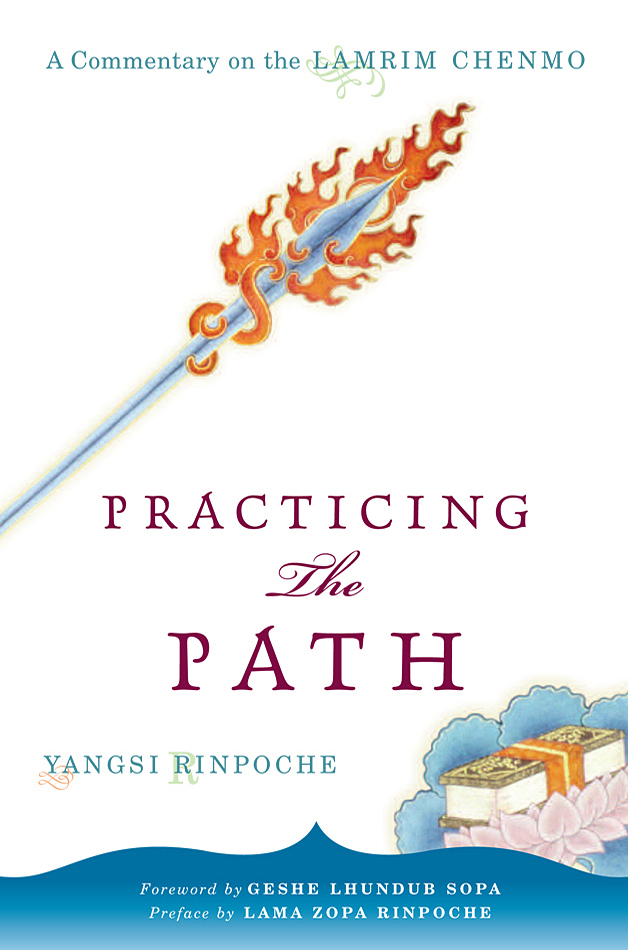
Practicing the Path: A Commentary on the Lamrim Chenmo
Book
Please note that many items in our library are simply pages that represent a detailed library catalog entry and citation of someone else's work, presentation, or performance. Read our General Disclaimer for more information. You can find more information about this item on the publisher website.

Description
The Lamrim Chenmo, or Great Treatise on the Steps of the Path, by Je Tsongkhapa is a comprehensive overview of the process of individual enlightenment. Meditation on these steps has been a core practice of Tibetan Buddhists for centuries. The Lamrim Chenmo presents the Buddha’s teachings along a continuum of three spiritual attitudes: the person who worries about rebirth, the person who wants to escape rebirth, and finally the person who strives for buddhahood in order to relieve the suffering of all beings—this is the supreme aspiration of the bodhisattva.
This book is composed of teachings from Yangsi Rinpoche's commentary on Lama Tsongkhapa's Lamrin Chenmo given Feburary-April, 2000 at Tushita Meditation Center in Dharamsala, India. (Source: Wisdom Publications)
Citation
Yangsi Rinpoche. Practicing the Path: A Commentary on the Lamrim Chenmo. Translated by Tsering Tuladhar. Edited by Miranda Adams. Boston: Wisdom Publications, 2003.
Publisher Link
Table of contents
- Foreword by Geshe Lhundub Sopavii
- Editor's Preface vi
- Preface by Lama Zopa Rinpochexiii
- Part 1: Introduction to the Lamrim
- Introduction to the Text3
- The Excellent Qualities of the Author15
- The Greatness of the Dharma23
- How to Teach and Listen to the Dharma29
- Part 2: The Foundation of Practicing the Lamrim
- Relying on the Spiritual Teacher 41
- The Meditation Practice 63
- Precious Human Rebirth81
- Part 3: The Small Scope
- Remembering Death and Impermanence103
- Contemplating the Suffering and Happiness of Future Lives 117
- The Method to Attain Happiness in Future Lives 125
- The Law of Cause and Effect155
- Part 4: The Medium Scope
- Recognizing and Generating the Wish for Liberation 195
- The Nature of the Path to Liberation247
- Part 5: The Great Scope
- How Bodhichitta is the Doorway to Practicing the Great Vehicle 273
- The Manner of Generating Bodhichitta Mind289
- After Generating Bodhichitta, the Manner of Training in the Conduct of a Bodhisattva 353
- Calming the Mind395
- The Final Perfection419
- Part 6: Conclusion
- Dedication by Lama Zopa Rinpoche 486
- Appendix: Outline of the Text489
- Notes499
- Glossary of Tibetan Names and Terms 503
- Bibliography of Principal Sources 511
- Index521
- Note: A comprehensive outline of the commentary with page references can be found on pages 489–97.
Interconnections
1 Teaching based on
.jpg)
Lam rim chen mo. In Tibetan, "Great Treatise on the Stages of the Path"; the abbreviated title for one of the best-known works on Buddhist thought and practice in Tibet, composed by the Tibetan luminary Tsong khapa Blo bzang Grags pa in 1402 at the central Tibetan monastery of Rwa sgreng. A lengthy treatise belonging to the lam rim, or stages of the path, genre of Tibetan Buddhist literature, the Lam rim chen mo takes its inspiration from numerous earlier writings, most notably the Bodhipathapradīpa ("Lamp for the Path to Enlightenment") by the eleventh-century Bengali master Atiśa Dīpaṃkaraśrījñāna. It is the most extensive treatment of three principal stages that Tsong kha pa composed. The others include (1) the Lam rim chung ba ("Short Treatise on the Stages of the Path"), also called the Lam rim 'bring ba ('"Intermediate Treatise on the States of the Path") and (2) the Lam rim bsdus don ("Concise Meaning of the Stages of the Path"), occasionally also referred to as the Lam rim chung ngu ("Brief Stages of the Path"). The latter text, which records Tsong kha pa's own realization of the path in verse form, is also referred to as the Lam rim nyams mgur ma ("Song of Experience of the Stages of the Path"). The Lam rim chen mo is a highly detailed and often technical treatise presenting a comprehensive and synthetic overview of the path to buddhahood. It draws, often at length, upon a wide range of scriptural sources including the Sūtra and śāstra literature of both the hīnayāna and Mahāyāna; Tsong kha pa treats tantric practice in a separate work. The text is organized under the rubric of the three levels of spiritual predilection, personified as "the three individuals" (skyes bu gsum): the beings of small capacity, who engage in religious practice in order to gain a favorable rebirth in their next lifetime; the beings of intermediate capacity, who seek liberation from rebirth for themselves as an arhat; and the beings of great capacity, who seek to liberate all beings in the universe from suffering and thus follow the bodhisattva path to buddhahood. Tsong kha pa's text does not lay out all the practices of these three types of persons but rather those practices essential to the bodhisattva path that are held in common by persons of small and intermediate capacity, such as the practice of refuge (śaraṇa) and contemplation of the uncertainty of the time of death. The text includes extended discussions of topics such as relying on a spiritual master, the development of bodhicitta, and the six perfections (pāramitā). The last section of the text, sometimes regarded as a separate work, deals at length with the nature of serenity (śamatha) and insight (vipaśyanā); Tsong kha pa's discussion of insight here represents one of his most important expositions of emptiness (śūnyatā). Primarily devoted to exoteric Mahāyāna doctrine, the text concludes with a brief reference to Vajrayāna and the practice of tantra, a subject discussed at length by Tsong kha pa in a separate work, the Sngags rim chen mo ("Stages of the Path of Mantra"). The Lam rim chen mo's full title is Skyes bu gsum gyi rnyams su blang ba'i rim pa thams cad tshang bar ston pa'i byang chub lam gyi rim pa. (Source: "Lam rim chen mo." In The Princeton Dictionary of Buddhism, 465-66. Princeton University Press, 2014. http://www.jstor.org/stable/j.ctt46n41q.27.)