| 🤓 Admin Zone 🛠️ hidden to non-admins | |
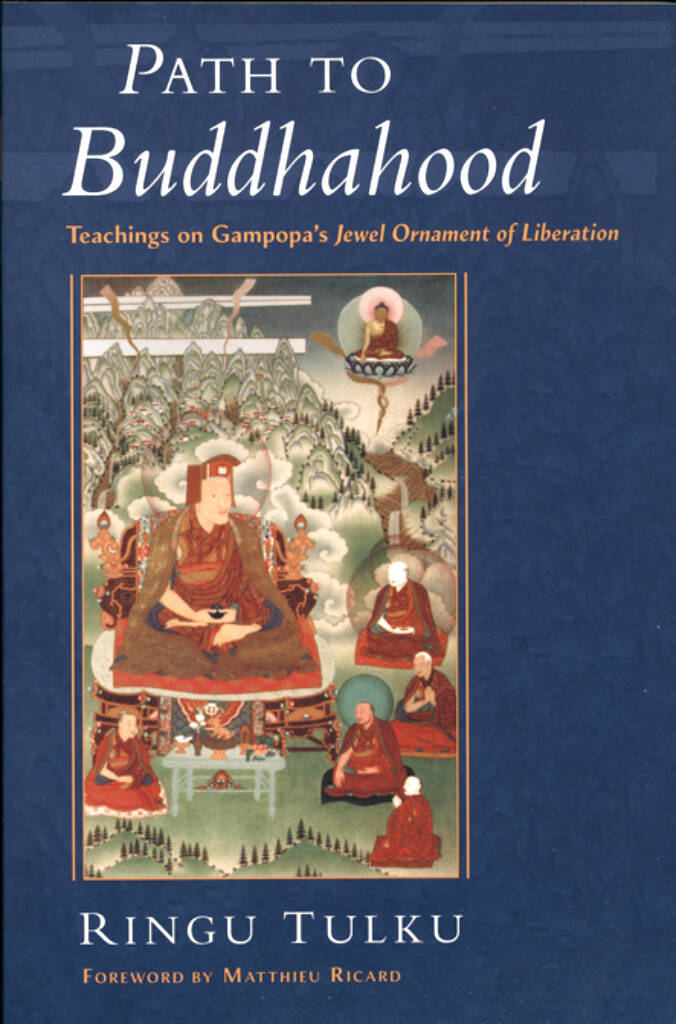
Path to Buddhahood: Teachings on Gampopa's Jewel Ornament of Liberation
Book
Please note that many items in our library are simply pages that represent a detailed library catalog entry and citation of someone else's work, presentation, or performance. Read our General Disclaimer for more information. You can find more information about this item on the publisher website.

Description
The Jewel Ornament of Liberation is regarded by all Tibetan Buddhist schools as one of the most inspiring and comprehensive works of the tradition. Written by Gampopa (born 1079 CE), the main spiritual son of the great hermit Milarepa, this important text lays out the stages of the Buddhist path and explains how an enlightened attitude is strengthened by practicing the six perfections of generosity, discipline, patience, exertion, meditation, and knowledge. (Source: Shambhala Publications)
Citation
Ringu Tulku Rinpoche. Path to Buddhahood: Teachings on Gampopa's Jewel Ornament of Liberation. Edited by Maggy Jones, Briona Nic Dhiarmada, and Corinne Segers. Boston: Shambhala Publications, 2003. Originally published in French as Et si vous m'expliquiez le bouddhisme? Paris: Nil Editions, 2001.
Publisher Link
Table of contents
- Forewordxi
- Prefacexv
- Acknowledgmentsxix
- Homage to Manjushrixxi
- Introduction1
- 1. The Cause: Buddha Nature7
- 2. The Basis: A Precious Human Life15
- 3. The Condition: The Spiritual Friend23
- Why We Need a Spiritual Friend24
- The Different Categories of Spiritual Friends25
- The Qualities of Ordinary Spiritual Friends26
- The Master-Disciple Relationship27
- Receiving the Teachings in the Right Way29
- 4. The Method: The Instructions of the spiritual Friend37
- First Antidote: Contemplating Impermanence32
- Second Antidote37
- Contemplating the Misery of Samsara37
- Understanding Karma44
- Third Antidote: Love and Compassion50
- The Development of Loving-Kindness51
- The Development of Compassion60
- Fourth Antidote: Bodhichitta64
- The Bodhichitta of Aspiration67
- Refuge67
- Taking Refuge in the Buddha68
- Taking Refuge in the Dharma70
- Taking Refuge in the Sangha70
- The Three Kayas72
- The Refuge Ceremony74
- The Bodhichitta of Commitment76
- The Bodhisattva Vows76
- Instructions for Developing the Bodhichitta of Commitment: The Six Paramitas80
- First Paramita: Generosity82
- Second Paramita: Ethics or Right Conduct87
- Third Paramita: Forbearance88
- Fourth Paramita: Diligence93
- Fifth Paramita: Meditation99
- Sixth Paramita: Wisdom108
- The Five Levels of the Bodhisattva Path138
- Accumulation139
- Integration140
- Insight141
- Meditation142
- Complete Accomplishment142
- The Ten Bodhisattva Levels143
- 5. The Result: perfect Buddhahood149
- 6. The Activities of a Buddha163
- Conclusion169
- Dedication of Merit171
- Notes173
- Index179
Interconnections
1 Teaching based on

One of Gampopa's (b. 1079–d. 1153) most enduring works. It was one of the first "stages of the path" (lam rim) texts to be written by a Tibetan after the genre was introduced by Atiśa through his famous composition Bodhipathapradīpa, The Lamp for the Path to Enlightenment. Sometimes called the Dakpo Targyen (དྭགས་པོ་ཐར་རྒྱན།), Tharpa Rinpoche Gyen (ཐར་པ་རིན་པོ་ཆེའི་རྒྱན།) or simply Targyen (ཐར་རྒྱན། ) for short, it is one of the core Lamrim treatises of the Kagyu school by one of the early founders of the Kagyu tradition. The text presents a graduated path to enlightenment, synthesizing the Kadam teachings of Atiśa and the Mahāmudrā teachings of Milarepa and Marpa.