Minor Buddhist Texts Part III (Tucci 1971)
From Bodhicitta
< BooksBooks/Minor Buddhist Texts Part III (Tucci 1971)
| 🤓 Admin Zone 🛠️ hidden to non-admins | |
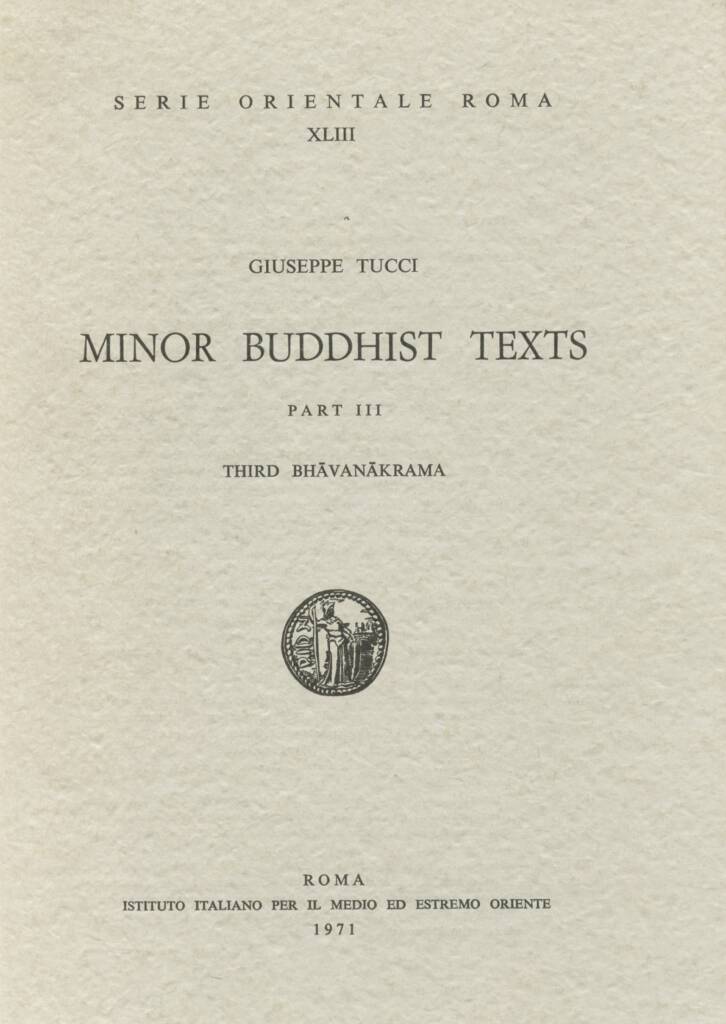
Minor Buddhist Texts, Part 3: Third Bhāvanākrama
Book
Please note that many items in our library are simply pages that represent a detailed library catalog entry and citation of someone else's work, presentation, or performance. Read our General Disclaimer for more information.

Citation
Tucci, Giuseppe, ed. Minor Buddhist Texts, Part 3: Third Bhāvanākrama. Serie Orientale Roma 43. Rome: Istituto Italiano per il Medio ed Estremo Oriente, 1971.
Table of contents
- Prefaceix
- § 1. - Śamatha and vipaśyanā1
- § 2. - How to practise śamatha and vipaśyanā3
- § 3. - Distractions to be avoided: how to be counteracted9
- § 4. - How to get up from samādhi11
- § 5. - Thesis of the Hva šaṅ13
- § 6. - Refutation14
- a) General implications of such a thesis14
- b) Inconsistency of the objection that one can reach nirvikalpa by means of mere asmṛti and amanasikāra15
- c) Necessity of bhūtaprathyavekṣā17
- d) Confirmation by Buddhavacana17
- e) Mukti is not caused only by destruction of karma but by elimination of kleśas20
- § 7. - Conclusion27
- References to the volume and page of the Sūtras and other canonical texts quoted in the third Bhk33
Interconnections
1 Recension of

The third and briefest of the Bhāvanākrama is devoted especially to the topics of śamatha and vipaśyanā, how each is cultivated, and how they are ultimately unified. Kamalaśīla argues that analysis (vicāra) into the lack of self (ātman) in both persons (pudgala) and phenomena (dharma) is required to arrive at a nonconceptual state of awareness. The three texts are widely cited in later Tibetan Buddhist literature, especially on the process for developing śamatha and vipaśyanā. (Source: "Bhāvanākrama." In The Princeton Dictionary of Buddhism, 112–13. Princeton University Press, 2014. http://www.jstor.org/stable/j.ctt46n41q.27.)
3 Other volumes

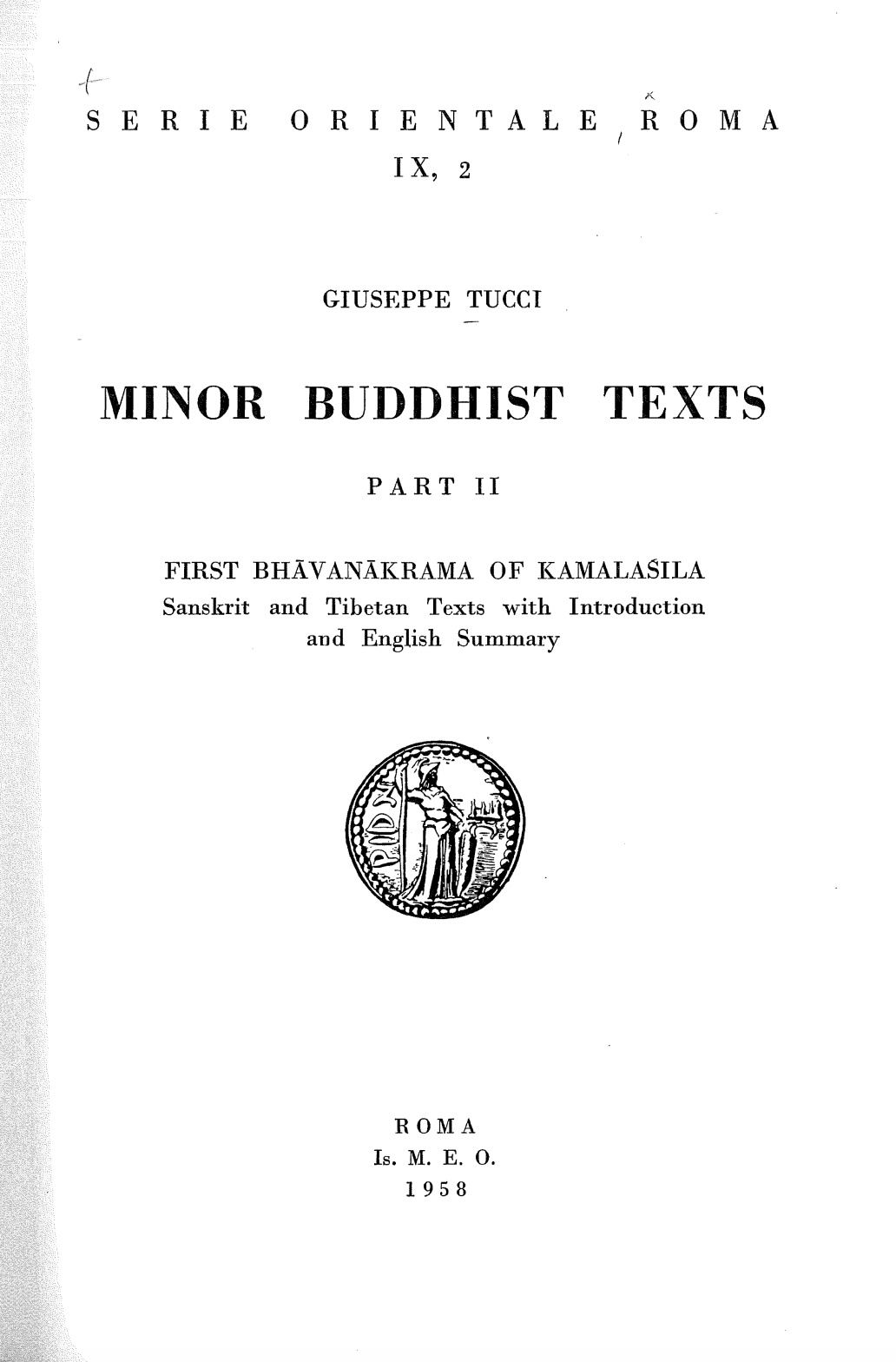
Contains the First Bhāvanākrama of Kamalaśīla, with Sanskrit and Tibetan texts and an English summary.
Contains that Third Bhāvanākrama of Kamalaśīla (Sanskrit)

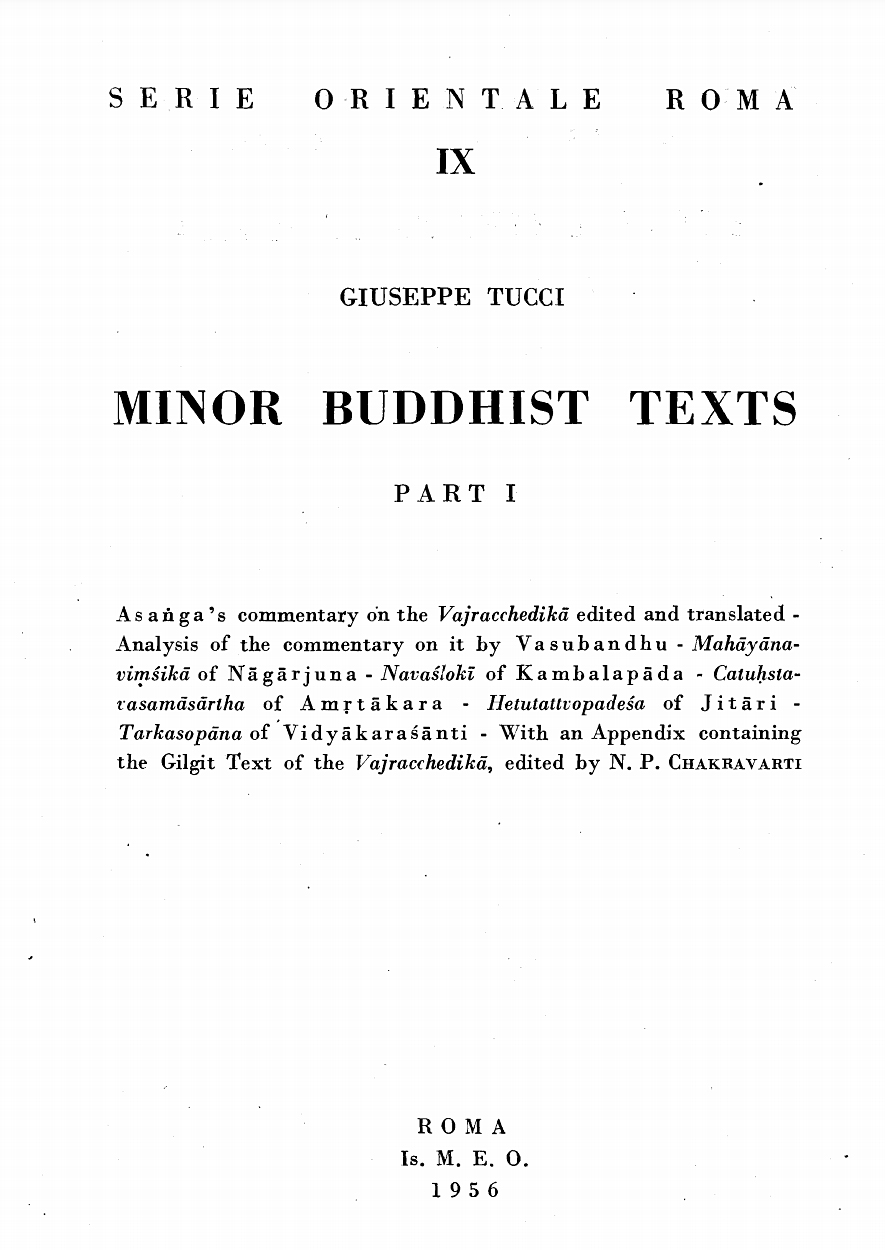
Contents of pt. 1 includes: Triśatikāyāḥ prajñāpāramitāyāḥ kārikāsaptatiḥ / Asaṅga--Mahāyānaviṁśikā / Nāgārjuna--Navaślokī / Kambalapāda--Catuḥstavasamāsārtha / Amr̥tākara--Hetutattvopadeśa / Jitāri--Tarkasopāna / Vidyākaraśānti / Vajracchedikā (Gilgit text).
1 Reviews

Akira Yuyama's review of Tucci's edition offers important scholarly observations about both the strengths and limitations of this long-awaited publication. While welcoming Tucci's critical edition of the Third Bhāvanākrama based on the Leningrad manuscript, Yuyama raises concerns about unclear editorial practices, particularly Tucci's mysterious reference to a possible second manuscript that is never identified or used in the apparatus. The reviewer criticizes Tucci's failure to provide complete textual variants between the Sanskrit and Tibetan versions, and suggests that including pagination from the more widely accessible Peking edition (in addition to the Derge) would have made the work more useful to scholars. Yuyama also questions the value of reconstructing entire lost Sanskrit texts from Tibetan translations, arguing that it is more philologically sound to simply note technical terms attested in other Indic sources. Despite these methodological critiques, Yuyama demonstrates the edition's scholarly value by providing detailed philological corrections and emphasizing the importance of identifying the numerous canonical quotations that appear throughout Kamalaśīla's text, a task requiring collaborative effort from specialists in various fields.