| 🤓 Admin Zone 🛠️ hidden to non-admins | |

Description
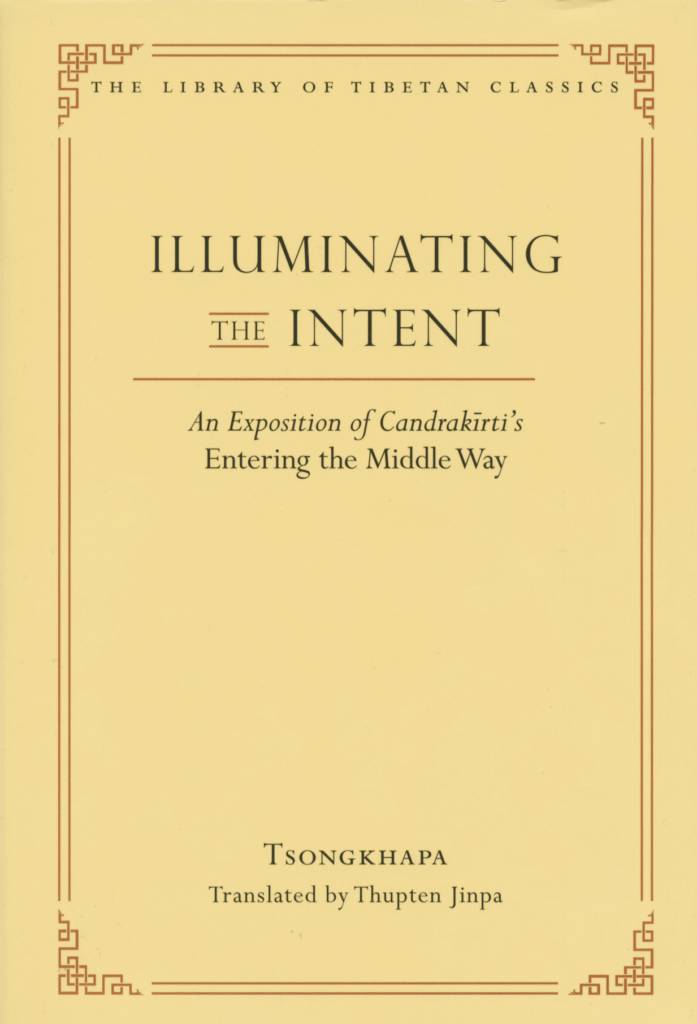
Written as a supplement to Nagarjuna's Fundamental Verses on the Middle Way, Candrakirti's text integrates the central insight of Nagarjuna's thought—the rejection of any metaphysical notion of intrinsic existence—with the well-known Mahayana framework of the ten levels of the bodhisattva, and it became the most studied presentation of Madhyamaka thought in Tibet.
Completed the year before the author's death, Tsongkhapa's exposition of Candrakirti's text is recognized by the Tibetan tradition as the final standpoint of Tsongkhapa on many philosophical questions, particularly the clear distinctions it draws between the standpoints of the Madhyamaka and Cittamatra schools.
Written in exemplary Tibetan, Tsongkhapa's work presents a wonderful marriage of rigorous Madhyamaka philosophical analysis with a detailed and subtle account of the progressively advancing mental states and spiritual maturity realized by sincere Madhyamaka practitioners.
The work remains the principal textbook for the study of Indian Madhyamaka philosophy in many Tibetan monastic colleges, and it is a principal source for many Tibetan teachers seeking to convey the intricacies of Madhyamaka philosophy to non-Tibetan audiences.
Though it is often cited and well known, this is the first full translation of this key work in a Western language. (Source: Wisdom Publications)
- Contents
- Prefacexiii
- Introduction1
- Technical Note27
- 1. Preliminaries31
- Part I. The First Five Grounds
- 2. General Presentation of the Grounds59
- 3. The First Ground, Perfect Joy69
- 4. The Second Ground, The Stainless117
- 5. The Third Ground, The Luminous129
- 6. The Fourth Ground, The Radiant147
- 7. The Fifth Ground, Hard to Conquer151
- Part II. The Sixth Ground, The Manifest
- 8. Introducing the Sixth Ground157
- 9. Identifying the Object of Negation171
- 10. Refuting Arising from Self and Other191
- 11. The Two Truths221
- 12. The Merits of Negation259
- 13. Refuting the Cittamātra Standpoint301
- 14. Refuting the Proof of Intrinsic Existence of Dependent Nature337
- 15. How to Read the Sutras369
- 16. Refuting Arising from Both and from No Cause395
- 17. The Selflessness of Persons419
- 18. Extending the Analysis471
- 19. Enumerations of Emptiness485
- Part III. The Final Grounds
- 20. The Seventh Ground, Gone Afar515
- 21. The Eighth Ground, The Immovable517
- 22. The Ninth Ground, Perfect Intellect523
- 23. The Tenth Ground, Cloud of Dharma525
- 24. Qualities of the Ten Grounds527
- 25. The Resultant Ground531
- Appendix 1. A Complete Outline of the Text569
- Appendix 2. Table of Tibetan Transliteration593
- Notes595
- Glossary653
- Bibliography665
- Index679
- About the Translator697
.jpg)
Written as a supplement to Nagarjuna’s Fundamental Verses on the Middle Way, Candrakīrti’s text integrates the central insight of Nagarjuna’s thought—the rejection of any metaphysical notion of intrinsic existence—with the well-known Mahayana framework of the ten levels of the bodhisattva, and it became the most studied presentation of Madhyamaka thought in Tibet.
Completed the year before the author’s death, Tsongkhapa’s exposition of Candrakīrti's text is recognized by the Tibetan tradition as the final standpoint of Tsongkhapa on many philosophical questions, particularly the clear distinctions it draws between the standpoints of the Madhyamaka and Cittamatra schools.
Written in exemplary Tibetan, Tsongkhapa’s work presents a wonderful marriage of rigorous Madhyamaka philosophical analysis with a detailed and subtle account of the progressively advancing mental states and spiritual maturity realized by sincere Madhyamaka practitioners. (Source: Thupten Jinpa, Illuminating the Intent, 2021)