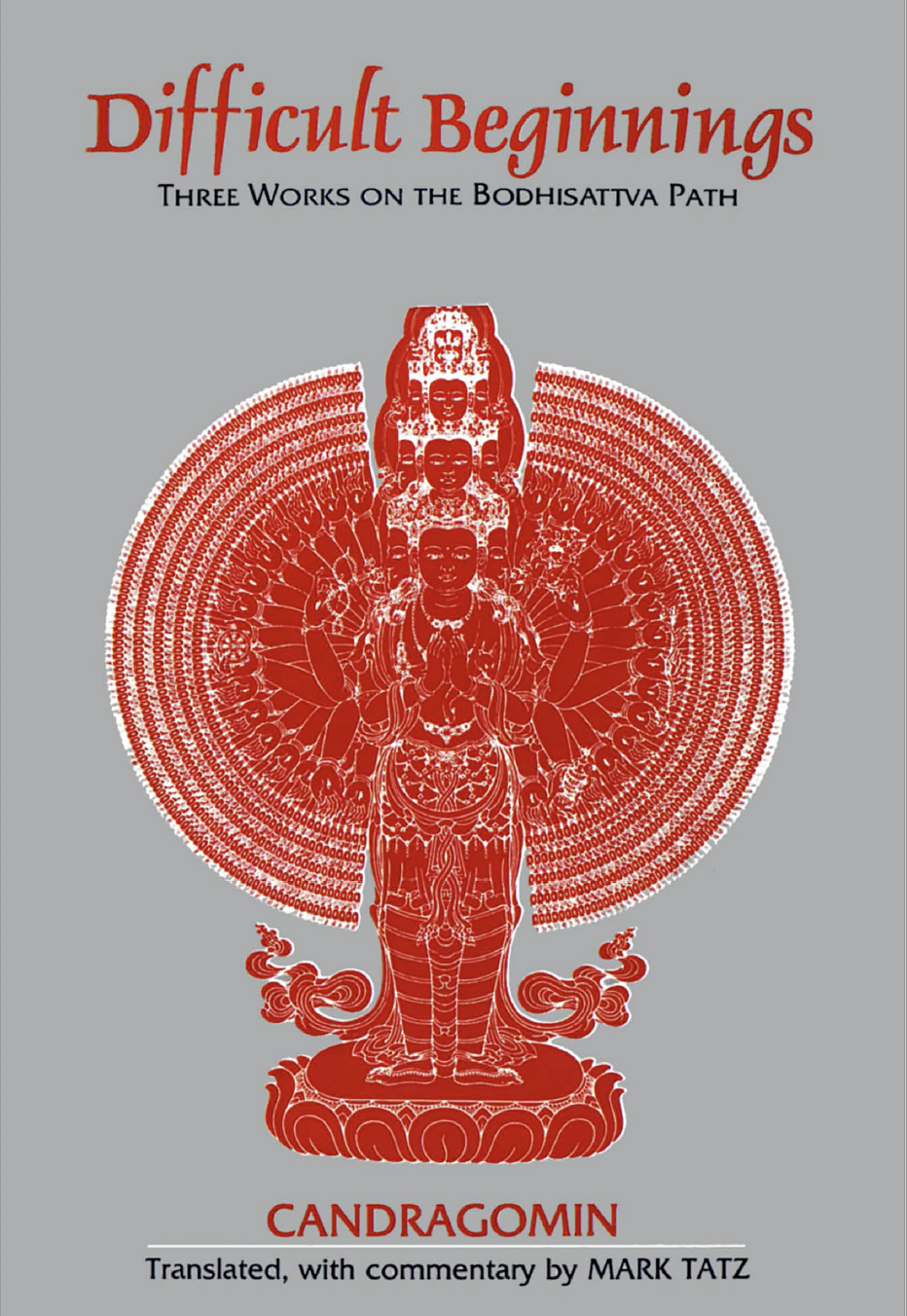
Difficult Beginnings

From Bodhicitta
LibraryBooksDifficult Beginnings
< Books
Books/Difficult Beginnings

Difficult Beginnings
Book


Please note that many items in our library are simply pages that represent a detailed library catalog entry and citation of someone else's work, presentation, or performance. Read our General Disclaimer for more information. You can find more information about this item on the publisher website.
Difficult Beginnings-front.jpg

Description

This is the first English translation of the works of Candragomin—a seventh-century Indian philosopher and poet—which have been highly influential in the practice of Buddhism over the past twelve centuries. The book provides an excellent introduction to Mahayana, the "middle way" of the Buddhist path. It will appeal to anyone interested in Eastern Religion.

Candragomin is regarded in the Indo-Tibetan tradition as an exemplar of the bodhisattva ideal. Difficult Beginnings presents three of the most important works. "Candragomin's Resolve" is a short verse aspiration. "Twenty Verses on the Bodhisattva Vow" is a basis for exposition of the bodhisattva vow. "Praise in Confession" recounts the problems that Candragomin encountered in his spiritual practice.

Dr. Tatz provides an excellent introduction to the theory and practice of the bodhisattva path, the ideal of attaining buddhahood—awakening—as well as the commitment to teach and guide others on this path. Also included is a fascinating account of Candragomin's life, and lengthy commentary on the three works presented here. (Source Source: Shambhala Publications)

Citation
Tatz, Mark, trans. Difficult Beginnings: Three Works on the Bodhisattva Path. By Candragomin. Boston: Shambhala Publications, 1985.
Publisher Link
Texts Translated


Translation of

 
This brief work condenses the major points of the chapter on moral discipline, śīla or tshul khrims in Asaṅga's Bodhisattvabhūmi into twenty verses. Likely intended as a mnemonic work, it covers the major disciplinary points that must be followed by those who have taken the bodhisattva vow.
Text
 
Candragomipraṇidhāna
The Candragomipraṇidhāna is an important Mahāyāna text attributed to Candragomin. The text is a praṇidhāna, which in Sanskrit means "vow," "aspiration," or "prayer." In Buddhist literature, praṇidhānas are typically aspirational prayers or bodhisattva vows that express the practitioner's dedication to achieving enlightenment for the benefit of all beings - a central concept in Mahayana Buddhism. The Candragomipraṇidhāna survives only in fragmentary form in Sanskrit. The fragment survives in a bundle of scattered leaves in the Kaiser Library, Kathmandu.
Text
 
Deśanāstava
The Deśanāstava is a fifth-century Buddhist hymn written by the poet and scholar Candragomin. It is also known by its English translation, the "Confessional Praise." The hymn's 52 verses are a form of confession. The author confesses his own faults while also praising the Buddha. It is one of several surviving Sanskrit writings by Candragomin, who is regarded as one of the most important Buddhist poets of India.
Text

  • Introduction 3
  • Bodhisattva Theory and Practice 3
  • Candragomin 8
  • Aspiration 12
  • Vow 13
  • Confession 16
  • Acknowledgments 20
  • Notes to the Introduction 21
  • Candragomin's Resolve 25
  • Twenty Verses on the Bodhisattva Vow 27
  • Commentary to the Twenty Verses 30
  • Praise in Confession 39
  • Commentary by Buddhasanti to the Praise in Confession 47
  • Notes to the Commentary 99
  • Index 111