Calming the Mind and Discerning the Real
From Bodhicitta
< Books
Books/Calming the Mind and Discerning the Real| 🤓 Admin Zone 🛠️ hidden to non-admins | |
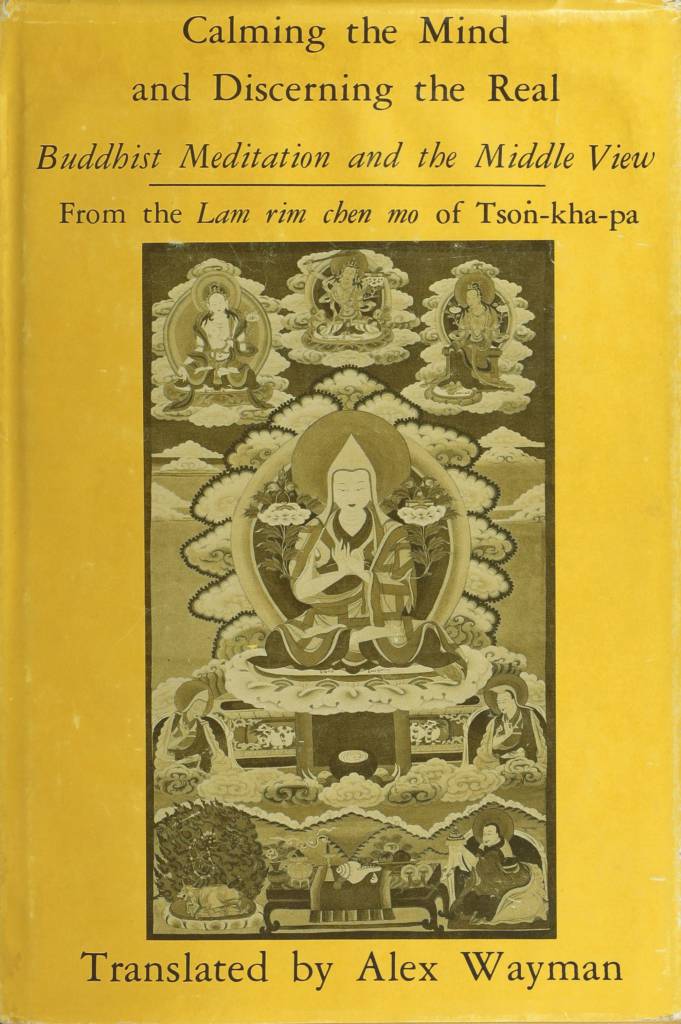
Calming the Mind and Discerning the Real: Buddhist Meditation and the Middle View from the Lam rim chen mo of Tsoṅ-kha-pa
Book
Please note that many items in our library are simply pages that represent a detailed library catalog entry and citation of someone else's work, presentation, or performance. Read our General Disclaimer for more information.

Description
Lam rim Chen mo (roughly, "the great book on stages of the path to enlightenment") is the abbreviated title of a massive encyclopaedic manual written by Tson-kha-pa, the founder of the Gelukpa sect of Tibetan Buddhism. Calming the Mind and Discerning the Real marks the first appearance in English of the two most important segments of this work. (Source Accessed Oct 14, 2025)
Citation
Wayman, Alex, trans. Calming the Mind and Discerning the Real: Buddhist Meditation and the Middle View from the Lam rim chen mo of Tsoṅ-kha-pa. New York: Columbia University Press, 1978.
Table of contents
- Prefaceix
- Introduction1
- The Lineage, and Atiśa's "Light on the Path to Enlightenment"3
- The Author of the Lam rim chen mo15
- Calming and Discerning as Natures and Categories26
- Asaṅga on the Ancillaries of Calming and the Supernormal Faculties31
- Discursive Thought and the bSam-yas Debate44
- Tsoṅ-kha-pa's Position on Discerning59
- The Translation70
- Tsoṅ-kha-pa's Sectional Titles74
- Introduction1
- Calming The Mind and Discerning The Real81
- Calming the Mind (Śamatha)97
- Reliance on the Equipment for Calming98
- After Recourse to that (Equipment), the Method of Cultivating Calming100
- By Reason of the Cultivation] The Standard of Accomplishment of Calming147
- Calming the Mind (Śamatha)97
- Discerning the Real (Vipaśyanā)173
- Reliance on the Equipment for Discerning177
- Engaging the Principle to be Refuted188
- Option of Pcisangika and Svatantrika as Refuting Agents283
- Relying on This Agent, the Method of Generating the View in Consciousness336
- Reliance on the Equipment for Discerning177
- Varieties of Discerning386
- The Way to Cultivate Discerning390
- Standard for Accomplishment of Discerning Through Cultivation414
- Discerning the Real (Vipaśyanā)173
- The Method of Pair-Yoking Calming and Discerning419
- Notes, Glossaries, and Bibliography433
- Abbreviations Used in the Notes and Bibliography434
- Notes435
- Glossaries483
- Bibliography493
- Index499
Interconnections
1 Partial translation of
.jpg)
Lam rim chen mo. In Tibetan, "Great Treatise on the Stages of the Path"; the abbreviated title for one of the best-known works on Buddhist thought and practice in Tibet, composed by the Tibetan luminary Tsong khapa Blo bzang Grags pa in 1402 at the central Tibetan monastery of Rwa sgreng. A lengthy treatise belonging to the lam rim, or stages of the path, genre of Tibetan Buddhist literature, the Lam rim chen mo takes its inspiration from numerous earlier writings, most notably the Bodhipathapradīpa ("Lamp for the Path to Enlightenment") by the eleventh-century Bengali master Atiśa Dīpaṃkaraśrījñāna. It is the most extensive treatment of three principal stages that Tsong kha pa composed. The others include (1) the Lam rim chung ba ("Short Treatise on the Stages of the Path"), also called the Lam rim 'bring ba ('"Intermediate Treatise on the States of the Path") and (2) the Lam rim bsdus don ("Concise Meaning of the Stages of the Path"), occasionally also referred to as the Lam rim chung ngu ("Brief Stages of the Path"). The latter text, which records Tsong kha pa's own realization of the path in verse form, is also referred to as the Lam rim nyams mgur ma ("Song of Experience of the Stages of the Path"). The Lam rim chen mo is a highly detailed and often technical treatise presenting a comprehensive and synthetic overview of the path to buddhahood. It draws, often at length, upon a wide range of scriptural sources including the Sūtra and śāstra literature of both the hīnayāna and Mahāyāna; Tsong kha pa treats tantric practice in a separate work. The text is organized under the rubric of the three levels of spiritual predilection, personified as "the three individuals" (skyes bu gsum): the beings of small capacity, who engage in religious practice in order to gain a favorable rebirth in their next lifetime; the beings of intermediate capacity, who seek liberation from rebirth for themselves as an arhat; and the beings of great capacity, who seek to liberate all beings in the universe from suffering and thus follow the bodhisattva path to buddhahood. Tsong kha pa's text does not lay out all the practices of these three types of persons but rather those practices essential to the bodhisattva path that are held in common by persons of small and intermediate capacity, such as the practice of refuge (śaraṇa) and contemplation of the uncertainty of the time of death. The text includes extended discussions of topics such as relying on a spiritual master, the development of bodhicitta, and the six perfections (pāramitā). The last section of the text, sometimes regarded as a separate work, deals at length with the nature of serenity (śamatha) and insight (vipaśyanā); Tsong kha pa's discussion of insight here represents one of his most important expositions of emptiness (śūnyatā). Primarily devoted to exoteric Mahāyāna doctrine, the text concludes with a brief reference to Vajrayāna and the practice of tantra, a subject discussed at length by Tsong kha pa in a separate work, the Sngags rim chen mo ("Stages of the Path of Mantra"). The Lam rim chen mo's full title is Skyes bu gsum gyi rnyams su blang ba'i rim pa thams cad tshang bar ston pa'i byang chub lam gyi rim pa. (Source: "Lam rim chen mo." In The Princeton Dictionary of Buddhism, 465-66. Princeton University Press, 2014. http://www.jstor.org/stable/j.ctt46n41q.27.)
1 Reviews

In this review, Robert Kritzer evaluates Alex Wayman's 1978 translation of the śamatha and vipaśyanā sections of Tsongkhapa's Lam rim chen mo, describing it as an important contribution to Tibetan Buddhist studies despite some organizational flaws. While praising Wayman's meticulous scholarship and impeccable methodology—particularly his approach of contextualizing Tsongkhapa's work within its Sanskrit sources and demonstrating the continuity of Buddhist philosophy from India to Tibet—Kritzer notes that the introduction feels hastily assembled and requires careful reading to follow. The translation itself is extremely literal and sometimes awkward, with unconventional renderings of technical terms that may challenge readers unfamiliar with Indian Buddhist philosophy, though the inclusion of an English-Tibetan-Sanskrit glossary helps mitigate these difficulties. Kritzer particularly commends Wayman's analysis of Tsongkhapa's treatment of śamatha, including his provocative reinterpretation of the famous debate between Kamalaśīla and Hvasang as concerning the proper sequence of samādhi rather than sudden versus gradual enlightenment, and his examination of how Tsongkhapa reconciles Prāsaṅgika Madhyamaka dialectic with practical concerns about meditation and philosophical argumentation. Overall, Kritzer concludes that while the work demands considerable effort from readers, it is ultimately worthwhile and well-suited for serious scholars in the field.