A Direct Path to Enlightenment (1975)
From Bodhicitta
< BooksBooks/A Direct Path to Enlightenment (1975)
| 🤓 Admin Zone 🛠️ hidden to non-admins | |
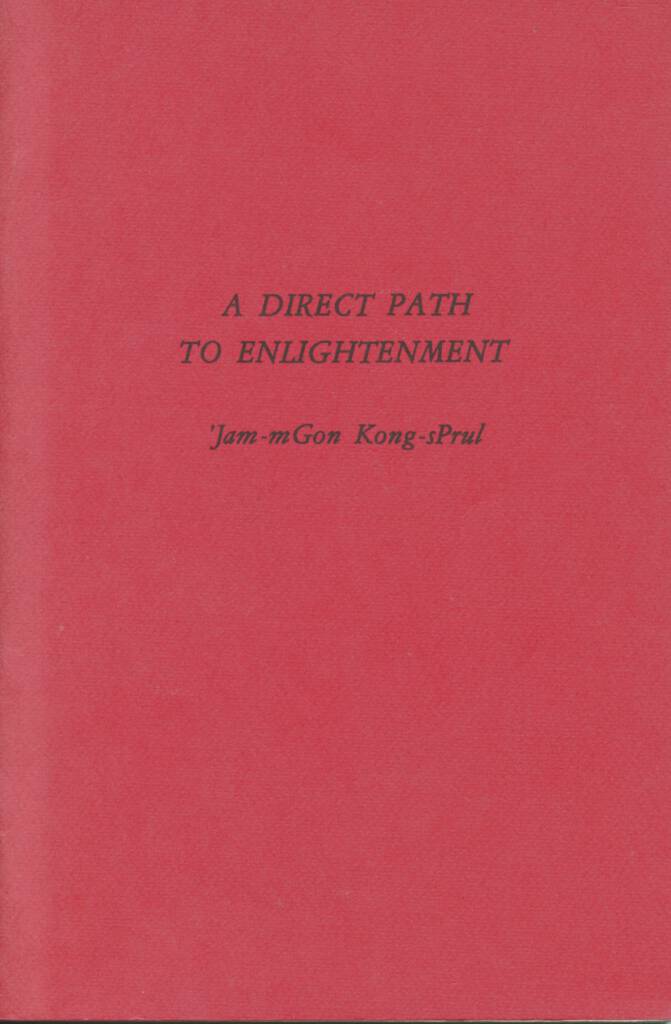
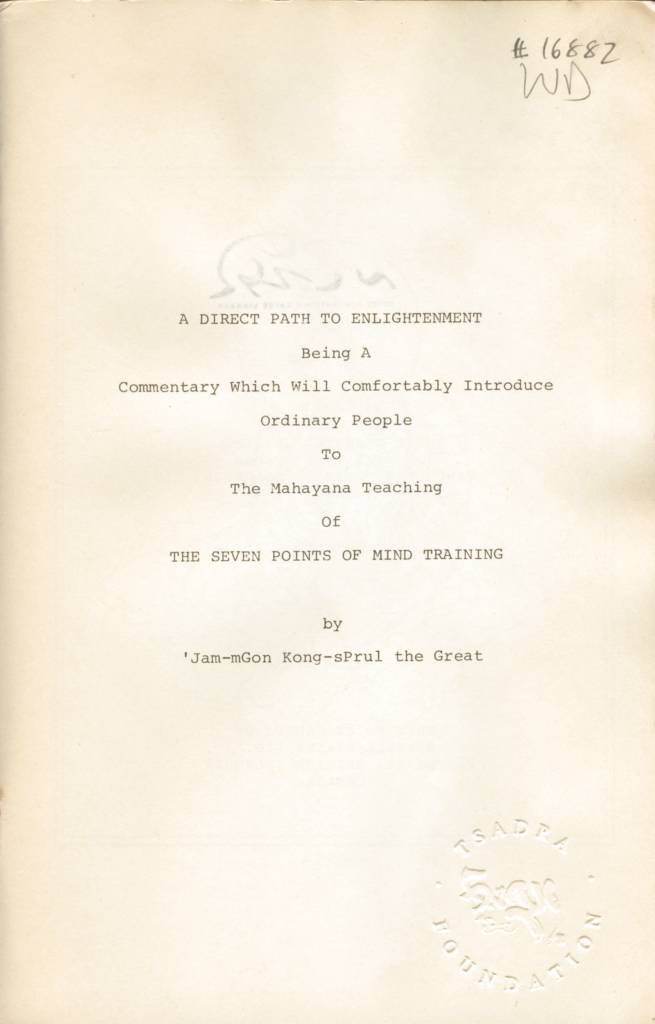
A Direct Path to Enlightenment Being a Commentary which will Comfortably Introduce Ordinary People to the Mahayana Teaching of the Seven Points of Mind Training
Book
Please note that many items in our library are simply pages that represent a detailed library catalog entry and citation of someone else's work, presentation, or performance. Read our General Disclaimer for more information.

Description
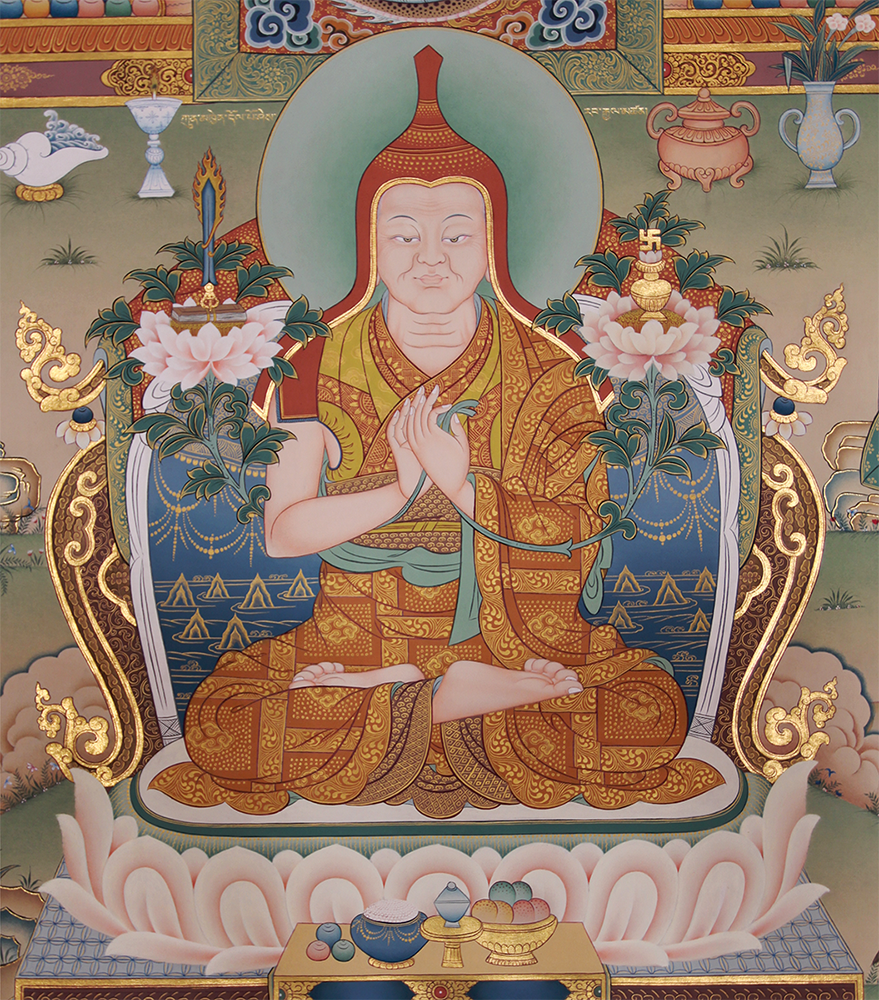
The text presented here in translation was written by Jamgon Kongtrul. It provides a practical commentary on one of the most important techniques of Mahayana meditation. This technique was taught in Tibet by Atisha about 1000 A.D. and spread to all of the four schools. Atisha wrote a text called "The Seven Points of Mind Training" and it is this text that Jamgon Kongtrul explains.
The text itself describes very clearly how to do a particular meditation to develop bodhicitta and all the commitments in both thought and deed that need to be observed to make this practice effective. (Source: Translator's Introduction)
This revised edition includes footnotes that have been added to provide the reader with the Tibetan for some of the more technical terms.
Citation
McLeod, Ken, trans. A Direct Path to Enlightenment Being a Commentary which will Comfortably Introduce Ordinary People to the Mahayana Teaching of the Seven Points of Mind Training. By 'Jam mgon kong sprul. 2nd ed. Vancouver: Kagyu Kunkhyab Chuling, 1975.
Interconnections
2 Full translation of

Blo sbyong don bdun ma. (Lojong Döndünma). In Tibetan, "Seven Points of Mind Training"; an influential Tibetan work in the blo sbyong ("mind training") genre. The work was composed by the Bka' gdams scholar 'Chad ka ba ye shes rdo rje, often known as Dge bshes Mchad kha ba, based on the tradition of generating bodhicitta known as "mind training" transmitted by the Bengali master Atiśa Dīpaṃkaraśrījñāna. It also follows the system laid out previously by Glang ri thang pa (Langri Tangpa) in his Blo sbyong tshig brgyad ma ("Eight Verses on Mind Training"). Comprised of a series of pithy instructions and meditative techniques, the Blo sbyong don bdun ma became influential in Tibet, with scholars from numerous traditions writing commentaries to it. According to the commentary of the nineteenth-century Tibetan polymath 'Jam mgon kong sprul, the seven points covered in the treatise are: (1) the preliminaries to mind training, which include the contemplations on the preciousness of human rebirth, the reality of death and impermanence, the shortcomings of saṃsāra, and the effects of karman; (2) the actual practice of training in bodhicitta; (3) transforming adverse conditions into the path of awakening; (4) utilizing the practice in one's entire life; (5) the evaluation of mind training; (6) the commitments of mind training; and (7) guidelines for mind training. (Source: "Blo sbyong don bdun ma." In The Princeton Dictionary of Buddhism, 126–27. Princeton University Press, 2014. http://www.jstor.org/stable/j.ctt46n41q.27.)

A commentary on the Seven Points of Mind Training by Jamgon Kongtrul. This text is included in Jamgon Kongtrul's Dam Ngag Dzo collection.
1 Other editions
_-_front.jpg)
The text presented here in translation was written by Jamgon Kongtrul. It provides a practical commentary on one of the most important techniques of Mahayana meditation. This techniqie was taught in Tibet by Atisha about 1000 A.D. and spread to all of the four schools. Atisha wrote a text called "The Seven Points of Mind Training" and it is this text that Jamgon Kongtrul explains.
The text itself describes very clearly how to do a particular meditation to develop Bodhicitta and all the commitments in both thought and deed that need to be observed to make this practice effective. (Source: Translator's Introduction)
1 Teaching on
Blo sbyong don bdun ma. (Lojong Döndünma). In Tibetan, "Seven Points of Mind Training"; an influential Tibetan work in the blo sbyong ("mind training") genre. The work was composed by the Bka' gdams scholar 'Chad ka ba ye shes rdo rje, often known as Dge bshes Mchad kha ba, based on the tradition of generating bodhicitta known as "mind training" transmitted by the Bengali master Atiśa Dīpaṃkaraśrījñāna. It also follows the system laid out previously by Glang ri thang pa (Langri Tangpa) in his Blo sbyong tshig brgyad ma ("Eight Verses on Mind Training"). Comprised of a series of pithy instructions and meditative techniques, the Blo sbyong don bdun ma became influential in Tibet, with scholars from numerous traditions writing commentaries to it. According to the commentary of the nineteenth-century Tibetan polymath 'Jam mgon kong sprul, the seven points covered in the treatise are: (1) the preliminaries to mind training, which include the contemplations on the preciousness of human rebirth, the reality of death and impermanence, the shortcomings of saṃsāra, and the effects of karman; (2) the actual practice of training in bodhicitta; (3) transforming adverse conditions into the path of awakening; (4) utilizing the practice in one's entire life; (5) the evaluation of mind training; (6) the commitments of mind training; and (7) guidelines for mind training. (Source: "Blo sbyong don bdun ma." In The Princeton Dictionary of Buddhism, 126–27. Princeton University Press, 2014. http://www.jstor.org/stable/j.ctt46n41q.27.)