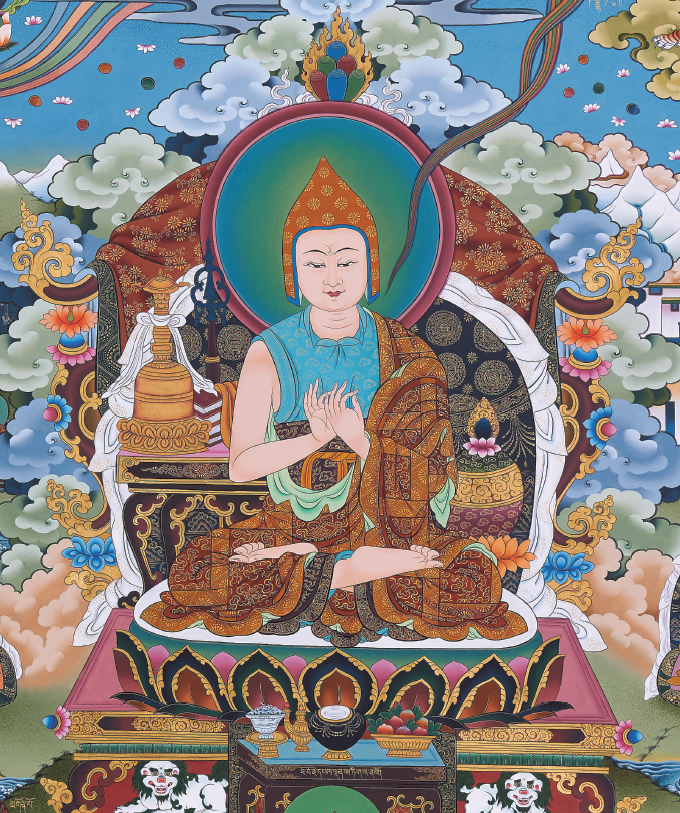
The Lamp for the Path to Enlightenment (Dowd 2021)
| 🤓 Admin Zone 🛠️ hidden to non-admins | |
Description
Few figures in the transmission of the Dharma from India to Tibet hold as central of a role as the great master Atiśa Dīpaṃkara Śrījñāna (982–1055?). Often referred to in Tibetan simply by the epithet of “Lord” (Tib. jo bo rje), Atiśa is the individual most associated with the eleventh-century revival of Buddhism in Tibet, which followed the tumultuous era of fragmentation (sil bu’i dus) that began with the 842 collapse of the Tibetan Empire. His impact on the Tibetan Buddhist Dharma continues to reverberate to this day, nearly a full millennium after he first arrived in the Land of Snows, and his teachings have inspired millions of Buddhists in Central Asia and now the world over. A brief introduction to his life and activities may shed light on this foundational text.
Atiśa was born in 982 as the second son of a royal house in Bengal, eastern India. On the eve of an adolescent marriage, he experienced a powerful vision of Tārā that motivated him to renounce the worldly life, even at this young age, and embark on the Buddhist path. He wandered through the jungles and mountains of India seeking the instruction of Buddhist masters, and he is said to have studied under a great number of mahāsiddhas. There are also accounts that he may have practiced the tantric sexual yogas at this time.
He received the bodhisattva vows from the master Bodhibhadra at the great Indian monastic university of Nālandā. At twenty-nine, the same age that Siddhartha left the palace, Atiśa had a dream in which he was urged by the Buddha himself to ordain, prompting him to take full monastic vows at a monastery in Bodh Gaya. Upon ordination, he was given the name Dīpaṃkara Śrījñāna, “He Whose Deep Awareness Acts as a Lamp.” With his relatively late ordination and scholarly pursuits, Atiśa’s biography is an inverse of Indian mahāsiddhas such as Nāropa, who only disrobed to practice tantra after many years living as a pure monk and scholar. Atiśa’s full monastic ordination after nearly two decades spent as a wandering yogi demonstrates the tremendous esteem with which he held the Vinaya and monastic discipline, values reflected in the Lamp for the Path and his broader missionary activities in Tibet.
Continue reading here . . .