| 🤓 Admin Zone 🛠️ hidden to non-admins | |
Description
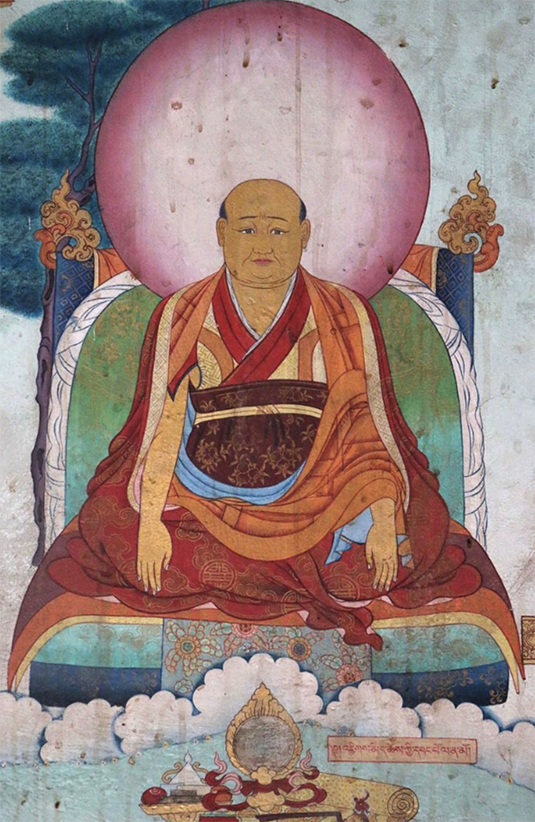
Although the explanation lineage of the Bodhicharyavatara reaching back to Ngok Loden Sherab and beyond was never severed in Tibet, by the nineteenth century, the knowledge and study of Shantideva's text had almost fallen into abeyance, being confined to the scholarly environment of a small number of monastic colleges. It seems that even copies of the text had become a rare commodity.[1] This was a situation that Patrul Rinpoche was to change almost single-handedly. He devoted his life to the practice and propagation of the Bodhicharyavatara. Traveling all over the east of Tibet, he is said to have expounded it more than one hundred times, sometimes in detailed courses lasting many months. It was he, more than anyone else, who restored Shantideva's teaching to the important position that it now occupies in the sutra teachings of all schools of Tibetan Buddhism.
The strength of Patrul Rinpoche's influence, and the reverence in which he was held, derived not only from his great erudition and skills as a teacher, but also from the power of his personality and the purity of his own example.[2] Indeed, a profound knowledge of the Bodhicharyavatara and a lifelong dedication to the implementation of its teachings could not fail to produce an unusual personality. He seems in many ways to have been like another great monk and yogi, Shabkar Tsogdruk Rangdrol, an elder contemporary whom he much admired but never met.[3] Like Shabkar, Patrul Rinpoche combined the practice of the Great Perfection[4] with a tireless implementation of the Mahayana teachings on wisdom and compassion so powerfully advocated in Shantideva's verses and the mindtraining instructions of Atisha and the Kadampas. Temperamentally too they were very similar. Untainted by worldly concerns of any kind, they were both free spirits unhindered by religious and social conventions. And both were renowned for their compassion toward human beings and animals alike.
Patrul Rinpoche was recognized at an early age as the third incarnation of a lama named Palge Samten Phuntsok, and his youth was spent at [https://treasuryoflives.org/institution/Pelge-Samten-Ling Palge Monastery] (whence his name: Palge Trulku, or Patrul for short). In the Tibet of his day, monasteries were often large and wealthy establishments and the labrang, or residences of their abbots and lamas, were appropriately spacious and well-appointed-the perfect setting, one might imagine, for a relatively comfortable life of scholarship and contemplation. Such a prospect was of no interest to Patrul Rinpoche, and at the youthful age of twenty, he took advantage of the fortuitous circumstances occasioned by the death of the monastic administrator: He closed down the labrang and left. And for the next fifty years or so, he lived the life of a wandering hermit and yogi of no fixed abode, his belongings consisting of little more than the clothes he was wearing and a few books. He had no home, no property, no worldly responsibilities. It is said that whenever he wished to set off on a journey, all he needed to do was to stand up and he was ready to go.
He sought teachings at the feet of many masters and became a scholar of profound learning. A word-perfect knowledge of many texts, stored in his exceptionally powerful memory, allowed him to give lengthy and detailed teachings at any time and place as need arose. He traveled alone and without retinue. His appearance was unkempt and people often mistook him for a beggar and treated him accordingly. Many amusing stories were remembered about him, passed down lovingly by his disciples and their disciples to the present day. Often he would disappear for long periods, practicing in solitude, in caves or under rocky overhangs, or just at the foot of a tree.[5] His commitment to the path of renunciation, compassion, and bodhichitta were legendary-so much so that many people came to regard him as the incarnation of Shantideva himself. For it was difficult to imagine a more perfect embodiment of the teachings of the Bodhicharyavatara.
The reports that have come down to us of Patrul Rinpoche's life are largely anecdotal. They reflect the experience of those who knew him and describe the sides of his character that impressed them most. The degree to which these subjective accounts succeed in defining Patrul Rinpoche as he really was is difficult to assess, but the picture they convey is of a person who had completely abandoned the "eight worldly concerns." According to Buddhist teaching, these eight preoccupations or urges are the ways in which ego-clinging manifests in daily life. They consist of the desire for happiness, success, importance and good reputation, and the wish to avoid their opposites: discomfort, defeat, obscurity and disgrace. The fact that Patrul Rinpoche had abandoned or "leveled" these tendencies meant that whatever happened to him in the way of pleasure or pain, praise or blame, gain or loss, fame or neglect, was of equal consequence. He simply didn't care. He was without hope or fear-in life generally and especially in his relations with people. He never manipulated others to his own advantage and he was never afraid of telling them the truth. He had not the slightest use for recognition and reputation and was always direct and sincere, unmoved by considerations of spiritual or social rank. Behind the mask of famous lama, noble man, distinguished scholar, beggar, or brigand he saw only the living being, caught in the sufferings and delusions of samsara. He had an unnerving ability to see into the most secret recesses of those whom he encountered and he treated everyone according to their need with an equal frankness and familiarity. To those in difficulty, he was kindness and gentleness personified but with those who had the ability to profit from his guidance on the path, he was a formidable teacher, ferociously tearing away the facades and pretences by which the ego defends and promotes itself. He had a reputation for being extremely fierce and it must have been devastating to be on the receiving end of one of his admonitions. Yet, as his disciples reported, his purposes were unfailingly compassionate and sincere; and for those who sought his guidance with a commensurate sincerity, he evoked a response of intense and lasting devotion. The reminiscences of Tenpa'i Nyima, the Third Dodrupchen Rinpoche, provide us with a fascinating vignette of what relations with Patrul Rinpoche were like.[6]
"Patrul," he writes, "uses fearful and overwhelmingly tough words, but there is no trace of hatred or attachment in them. If you know how to listen to them, they are, directly or indirectly, only teachings. Whatever he says is solid like gold-it is true ... Whoever is involved in unvirtuous activities, unless the person is unchangeable, he digs out that persons' faults at once and exposes them."
No amount of familiarity with the master, Dodrupchen Rinpoche continues, could ever reveal the slightest inconsistency in his behavior. There was no guile, no deceit. What you saw was the man himself. "He seems hard to serve, yet however close you are to him, it is impossible to find a single instance of dishonesty ... he never deviates from the Bodhisattva activities." And then the telling remark: "It is hard to separate from him."
The Bodhicharyavatara was Patrul Rinpoche's constant companion. He taught it incessantly. Wandering all over Tibet, he expounded it in many monasteries of all traditions, following the Rime practice of teaching according to the tradition to which the monastery belonged. When teaching Sakyapas, he would use the commentary of Sonam Tsemo; in Gelugpa monasteries, he would expound Gyaltsap's Dartik; and he would teach Kagyupas according to the commentary of Pawo Tsuglag Trengwa. His attentions, moreover, were not confined to monastic audiences. On many occasions he taught the Bodhicharyavatara to large gatherings of lay people, thereby providing a detailed explanation of the Mahayana path to the public at large, always emphasizing the importance of practice over mere learning.
Minyak Kunzang Sonam records in his biography of Patrul Rinpoche:
Thanks to the kindness of Patrul Rinpoche, the entire region became filled with the explanation and study [of the great texts] and very many people, down to ten-year-old monks, were able to adorn their mouths with the recitation of the Bodhicharyavatara ... As a result, the whole land was gloriously transfigured through the enormous numbers of people who, from being complete beginners, aspired and turned their minds to the systematic implementation of the practice of the complete Mahayana path ... And the members of the black-clothed laity, both men and women, by attending for just a few moments the explanation of the Bodhicharyavatara, came to understand that the good heart and bodhichitta are the living roots of the Mahayana teachings.[7]
Notes
- ↑ See Kretschmar, chap. 1, p. 37.
- ↑ Many of the details of this biographical note derive from the account of Patrul Rinpoche's life given in Tulku Thondup's Masters of Meditation and Miracles (hereafter Masters), pp. 201-10.
- ↑ See Ricard, Life of Shabkar, p. xv.
- ↑ Patrul Rinpoche was a disciple of Jigme Gyalwa'i Nyugu, himself a direct disciple of Jigme Lingpa, the revealer of the famous cycle of meditative and yogic practices known as the Longchen Nyingtik. Patrul Rinpoche composed a famous commentary on the preliminary practices to this cycle, a text entitled Kun bzang bla ma'i zhal lung and translated into English as The Words of My Perfect Teacher, in which he set down the oral instructions received from Jigme Gyalwa'i Nyugu.
- ↑ See Masters, p. 203.
- ↑ See Masters, p. 208.
- ↑ See "Orgyan 'jigs med chos kyi dbang po'i rnam thar:' in Complete Works of Patrul Rinpoche, vol. 8, pp. 221-222.