| 🤓 Admin Zone 🛠️ hidden to non-admins | |
Description
The historical context provided helps readers grasp the nuances of different Madhyamaka interpretations and the evolution of related ideas over time. By presenting various viewpoints and controversies in their historical context, this overview also sheds light on the influence of cultural and political factors on the development and transmission of philosophical ideas in Tibet.
Featured on
Madhyamaka was brought to Tibet by Shāntarakshita and his disciple Kamalaśīla. The Tibetans therefore first discovered the teaching of Nāgārjuna via the rich synthesis that incorporated, on the conventional level, the Yogācāra view together with the logico-epistemological tradition of Dignāga and Dharmakīrti. The eminence of the masters who transmitted it, as well as the sophistication of their system, ensured the popularity and wide diffusion of their version of Madhyamaka, which was to become standard in Tibet for the next four hundred years. The Denkarma catalog, drawn up in the reign of King Ralpachen (815-838), reveals that in the first great wave of translations, all the works of Nāgārjuna were translated, and many commentarial texts associated with the Yogācāra-Madhyamaka school, notably those by Shāntarakshita, Kamalaśīla, and Jñānagarbha (later to be referred to as the "three Madhyamikas from the East"). At the same time, the Lamp of Wisdom (Prajñāpradipa), Bhāvaviveka's commentary on the kārikās, together with the immense subcommentary on it by Avalokitavrata, was translated, along with Buddhapālita's commentary[1] and Shantideva's The Way of the Bodhisattva (Bodhicaryāvatāra) and Compendium of Instruction (Śikṣasamuccaya).[2]
Following the period of persecution between the assassination of Ralpachen in 838 and the murder of Lang Darma in 841, and in the aftermath of the general collapse of the Tibetan empire, the resurgence of Buddhism in Tibet seems to have been a long, difficult, and in some ways haphazard process. The first priority was the reestablishment of the monastic order, mainly through the intervention of surviving monastic lineages in the north and east (China and the kingdom of Tangut), and the refounding of monasteries, which, in the absence of royal patronage, was not an easy task.[3] Of greater interest to the present case, however, were the efforts made to reestablish contact with the Indian sources. This was achieved by heroic individuals like Marpa Lotsawa (1012-1096), who, at their own expense and at risk to their lives, braved the journey to India in search of teachers and training. They learned Sanskrit and the art of translation, and it was thanks to their labors that the flow of texts into Tibet resumed. These two activities, the reestablishment of the monastic order and the revival of translation, were in fact complementary. For in the absence of the unifying and supportive power of a central government, the newly founded monasteries became the focal points of religious and scholarly life, and this was often closely associated with the work of translation and the resulting textual traditions.[4]
The Ngok clan was particularly influential in this regard. Ngok Legpa'i Sherab (?1059-1109), for example, studied and worked with Rinchen Zangpo (958-1055), who was one of the most illustrious of the translators of the second diffusion. Later, when Atisha arrived in central Tibet in 1045, Legpa'i Sherab became one of his three most important disciples and studied with him at Nyethang. Ngok was particularly interested in Madhyamaka, and it was at his request that Atisha translated two important works of Bhāvaviveka: The Heart of the Middle Way (Madhyamakahṛdayakārikā) and its autocommentary, the vast and encyclopedic Blaze of Reasoning (Tarkajvālā). Atisha's willingness to invest time and effort in such a large translation project is particularly noteworthy given his predilection, clearly stated in his own writings, for the view of Chandrakīrti, whose works he must have encountered before leaving India for Tibet in 1041. Indeed, Atisha must have had a copy of at least the Madhyamakāvatāra with him since one of his translators, Naktso Tsultrim Gyalwa, made an early translation of it. It is perhaps significant, moreover, that Atisha's admiration for Chandrakīrti, whose disapproval of Bhāvaviveka he must surely have been aware of, clearly did nothing to diminish his evident appreciation for at least the usefulness of Bhāviveka's approach to Madhyamaka.[5]
In 1073, nearly twenty years after Atisha's death, Ngok Legpa'i Sherab founded the monastery of Sangpu, which in the days of its splendor was to be one of the most important centers of learning in Tibet. Three years later, he ordained his nephew, naming him Loden Sherab. The high hopes of the uncle turned out to be fully justified, for Loden Sherab, or Ngok Lotsawa, as he is often called, was to become one of the greatest translator-scholars that Tibet ever produced. He provided the Tibetans with a library of logical works, and it was thanks to him that Tibetan Buddhism took on the philosophical quality that has marked it ever since. Immediately following his ordination, the young Loden Sherab left for Tholing in the west of the country to attend a religious council summoned by the king of Guge.[6] This remarkable gathering seems to have been attended by all the important religious leaders and dignitaries of the country as well as by a number of Indian paṇditas from Kashmir.[7] Its main purpose seems to have been to mark the triumph of the Buddhist revival in Tibet and to discuss ways in which the propagation and practice of the Dharma could be further strengthened. Translation was an important topic on the agenda. The quality and accuracy of the texts already translated, and the pressing need to train new translators, were matters of the utmost concern. It was therefore decided to subsidize a delegation of students who would be sent to Kashmir to study Sanskrit and translate texts. Loden Sherab was one of the students selected. He set off immediately and was to remain in Kashmir for nearly twenty years (from 1076 till 1093), during which time he acquired a profound mastery of Sanskrit and studied with numerous paṇditas at whose feet he was to translate a series of texts of major importance.
Loden Sherab's sojourn in Kashmir coincided with that of another young student, Patsap Nyima Drak, who arrived there a year later in 1077. The interests of the two young men led them in quite different directions. Whereas Loden Sherab was temperamentally drawn to the study of logic, Patsap seems to have been mainly interested in Madhyamaka; and the works of Chandrakīrti—recently revived and the object of considerable interest— formed the center of his attention. Since they studied with the same teachers over such a long period, it is more than likely that Loden Sherab and Patsap knew one another. One wonders if they were friends. It is certainly interesting to reflect that it was the work of these two young translators, studying side by side and yet so differently preoccupied, that was in large measure to shape the intellectual life of Tibet for next nine hundred years.[8]
On his return to Tibet, Loden Sherab succeeded his uncle to the throne of Sangpu. He invited his teachers from India and all together produced a phenomenal series of new translations and reviewed and brought up to date several important texts translated during the first diffusion. He shared his uncle's interest in Yogācāra-Madhyamaka and translated Prajñākaragupta's Ornament for (Dharmakīrti's) Commentary on Valid Cognition (Pramāṇavārttikālankāra), the purpose of which was to demonstrate the compatibility of logic and Madhyamaka. In the same vein, he composed summaries of the texts of the "three Madhyamikas from the East" (Shāntarakshita, Kamalaśīla, and Jñānagarbha), once again bringing together the traditions of Madhyamaka and logic. Loden Sherab was moreover a gifted teacher and soon gathered around him an immense following. It was under his leadership and that of his immediate successors that Sangpu became the cradle of Tibetan scholasticism and remained for many years the most important center in the country for the study of the Madhyamaka syntheses of Bhāvaviveka and Shāntarakshita, as well as of the logico-epistemological tradition.
By the time Patsap returned to central Tibet in 1100—roughly seven years later than Loden Sherab—Sangpu, founded nearly thirty years earlier, was well established as a center of the kind of Madhyamaka to which, as we have seen, Chandrakīrti was opposed. Naturally enough, Patsap did not go to Sangpu but established himself instead at Lhasa, where, in collaboration with two of his Kashmiri mentors, Kanakavarman and Tilakakalaśa, he revised and refined his translations of Chandrakīrti's works: the Madhyamakāvatāra with its autocommentary, the Prasannapadā, and also a translation of Āryadeva's Four Hundred Stanzas (Catuḥśataka) together with Chandrakīrti's commentary on it. In addition, he revised the Tibetan of many of Nāgārjuna's works that had been translated during the first diffusion.
To begin with, Patsap seems not to have attracted much attention, but gradually he acquired a following. As with Chandrakīrti before him, he emphasized in his own teaching a deep distrust of the logico-epistemological tradition, believing it to be at odds with the fundamental Madhyamaka insight into the emptiness of all phenomena. For both author and translator, therefore, the purpose of Madhyamaka was to expose the hollowness of philosophical speculation; and to that end, they both considered that the undermining of such intellectual pretensions was best achieved through consequential arguments, and not through positive, independent, autonomous syllogisms.
It was at this time that the Tibetan terms thal 'gyur ba and rang rgyud pa, corresponding to the types of argument just mentioned, were invented and applied respectively to the position of Patsap and his school in opposition to the well-established brand of Madhyamaka propounded at Sangpu.[9] These convenient labels proved to be very popular, becoming a definitive feature of Madhyamaka terminology. Back-translated into Sanskrit as Prāsaṅgika and Svātantrika respectively, these labels, the use of which was strongly reinforced in the writings of Tsongkhapa, seem to have exerted a mesmerizing effect on Western scholars, many of whom, including such luminaries as T. R. V. Murti and Seyfort Ruegg, speak as though they refer to two actual schools of Madhyamaka thought founded by Chandrakīrti and Bhāvaviveka themselves. In fact, there is no historical evidence to suggest that the great Indian Madhyamikas ever thought of themselves, or each other, as anything other than Madhyamikas, the followers of Nāgārjuna, albeit with different philosophical concerns and expository techniques.
The Prāsaṅgika-Svātantrika terminology is obviously convenient as a means of broadly identifying the two approaches to Madhyamaka, whose differences became pressingly evident in Tibet after the return of Patsap. It is however problematic because it gives the impression that the difference between these two approaches could be reduced simply to a disagreement about the kind of arguments—consequences or autonomous syllogisms— that Madhyamikas are supposed to use to demonstrate their position. On the other hand, as we have indicated, there are good reasons for thinking that Chandrakīrti's critique of Bhāvaviveka was not confined to a disagreement about commentarial technique but implied a much-deeper suspicion of the role in Madhyamaka of the foundationalist logic of Dignāga that Bhāvaviveka had appropriated with such enthusiasm.[10] This aspect of Chandrakīrti's thought came very much to the fore in the philosophical controversies that followed the arrival of his works in Tibet. And if the position of Chandrakīrti in the Tibetan imagination was to change radically over the next two hundred years, for the time being, his rejection of the logico-epistemological tradition was perceived as an open affront to the well-established Svātantrika school of Sangpu.
The sheer quality of Chandrakīrti's writing, the excellence of Patsap's translations, and his skill in expounding them slowly but surely attracted disciples; and at length this new and unwelcome presence on the philosophical horizon could not be ignored. Eventually, the Svātantrika cause found its champion in the redoubtable figure of the sixth abbot of Sangpu, Chapa Chökyi Sengé. Until recently, the works of this powerful and original thinker had been lost, and his polemic against the supporters of Chandrakīrti was known only through secondhand reports.[11] Recently, however, some of his works have come to light. These include his Summary of [the Teaching of] the Three Madhyamikas from the East (Dhu ma shar gsum gyi stong thun), which has already been edited and studied in the academy,[12] and various other texts, including a commentary on the Bodhicaryāvatāra, which have been found and preserved in the newly published collection of Kadampa texts (Bka'gdams gsung 'bum). It is only necessary to say here that Chapa attacked the Madhyamaka interpretation of Chandrakīrti with the devastating dialectical skill of a scholar long trained in the school of Dignāga and Dharmakīrti. It has been suggested that his hostility toward Prāsaṅgika was exacerbated by the visit to Tibet of Jayānanda.[13] This Kashmiri scholar, learned in the works of Chandrakīrti, worked mainly with the students of Patsap, but at least once with the master himself, perhaps toward the end of the latter's life. The provocative title of Jayānanda's Hammer of Logic (Tarkamudgara) is ample evidence of his hostile attitude to the logico-epistemological tradition. Famously, he went to Sangpu and overconfidently challenged the Lion of Dharma in debate. After the contest, in which Chapa was victorious, Jayānanda eventually withdrew to the kingdom of Tangut, where he composed a long and detailed commentary on the Madhyamakāvatāra, the only one known to have been composed in Sanskrit.
The triumph of Svātantrika turned out to be partial and transient. Defeated Jayānanda may have been, but he cut a sufficiently attractive figure to entice away some of Chapa's most promising students, notably Mabja Jangchub Tsöndrü, who became a student both of Jayānanda himself and later of Patsap. Although Mabja composed an approving commentary of Jayānanda's Hammer, in which he abandoned the Svātantrika acceptance of the logico-epistemological tradition, he did not forget the lessons he had learned at the feet of his former master. And by a curious paradox, he used his knowledge of logic to defend his newly held Prāsaṅgika view against Chapa's penetrating critique. In so doing, Mabja and his fellow converts began a process in which the Prāsaṅgika position was by gradual degrees brought into closer proximity with the practices of the logical tradition, resulting eventually in a sort of hybrid that, for opposite reasons, both Chapa and Jayānanda would undoubtedly have regarded as a subversion.
At the risk of possible repetition, let us try to look a little more closely at the issues that divided the two sides and thereby come to a better understanding of the reasons that, over time, brought them into closer proximity. In the debate between Chapa and the proponents of Chandrakīrti's view, headed by Jayānanda, two quite different approaches to Madhyamaka confronted each other across a wide and apparently unbridgeable gulf. It may be suggested that in his critique of Bhāvaviveka's philosophy and his defense of Buddhapālita, Chandrakīrti was trying to return to the original thought of Nāgārjuna and his concern to show that the liberating truth that the Buddha taught was not just a brilliant idea, a new and true doctrine intended to supplant the false ideas of philosophy and religion. On the contrary, Nāgārjuna's intention was not to tell us what the ultimate is like but to lead us to, and if possible place us in, an experience of it—an experience that lies beyond the power of words to describe—to the amazing discovery of a state of "knowing" that lies beyond ordinary intellection. He was pointing, so to speak, to something that could not be spoken or conceived of, but only experienced in a state of meditative absorption—and that could be introduced only indirectly through the apophatic negations of consequential argument:
Release occurs when action and defilements cease. Action and defilements are derived from thoughts, And these come from the mind's construction. Emptiness is what arrests them.[14]
It is not known through other sources; it is peace; And not through mind's construction can it be constructed; It is free of thought; undifferentiated: This describes the character of suchness.[15]
Every point of reference subsides; All conceptual constructs utterly subside; At no time, nowhere, and to no one Did the Buddha any "Dharma" teach.[16]
Nāgārjuna's Middle Way, once again, is not another doctrine—in the sense of being a corpus of religious or philosophical tenets. Neither is it an agnostic "position of no position." It is rather the affirmation that although the liberating truth of the Buddha is something that the mind, such as we experience it in our present condition, is unable to grasp, it is nevertheless very far from being a mere "nothing." Instead, it is a state that stands revealed when the obstructing veils of conceptual activity have been drawn aside. As Chandrakīrti says,
The tinder of phenomena is all consumed, And this is peace, the dharmakaya of the Conquerors. There is no origin and no cessation. The mind is stopped, the kaya, manifests.[17]
If, in the centuries that followed the appearance of his writings, Chandrakīrti received no answer from the Madhyamikas of India, he certainly received one, figuratively speaking, from those of Tibet. It may well be that the ultimate truth is inconceivable and ineffable, that it is something that can only be experienced but not talked about. Nevertheless, in the task of communicating this information, there are obvious dangers. Simply to demolish every position that an interlocutor can possibly hold does not automatically ensure that a truth that lies beyond all positions will be understood. And as we have said, Nāgārjuna was the first to declare that the doctrine of emptiness is perilous. Misunderstood, it could have disastrous consequences. It seems obvious that the Prāsaṅgika method, designed as is it to place the interlocutor in the direct experience of the ultimate truth, will be effective only for disciples of extraordinary aptitude, those who have extremely sharp faculties and who are, in addition, possessed of great reserves of merit. Ordinary people, on the other hand, need more help; and it was perhaps for this reason that Bhāvaviveka and the Svātantrikas that followed him insisted that mere consequentialist arguments were insufficient. It was instead necessary to spell out the Madhyamaka view more explicitly by means of positive, "autonomous" arguments. This is undoubtedly one of the reasons why the Svātantrika approach proved so popular both in India and subsequently in Tibet. It was clearly more accommodating to beings of lesser acumen, who required explanation, and a training more gradual than the austere, apophatic approach of Prāsaṅgika. Not only did the latter demand extraordinary abilities in the disciple, but its rejection of logic and a theory of knowledge seemed to remove the very means by which ordinary beings could come to a clearer understanding both of their actual predicament in samsara and of the ways in which they could free themselves from it. In addition, the vision of the ultimate truth that Prāsaṅgika propounded, however glorious, seemed to place the Buddhas in a sphere utterly remote from the world of unenlightened beings.
It was against this characteristic stance of Patsap and his associates that Chapa Chökyi Sengé mounted a powerful opposition. On the admittedly slender basis of his Summary, it is possible to compile a short list of Chapa's positions, which were no doubt typical of the kind of Madhyamaka upheld at Sangpu.[18] For the most part, these positions concern the two truths. To begin with, Chapa argued that the locus for the distinction between the two truths is to be found in the object, that is, phenomena themselves as objects of knowledge (shes bya). Connected with this point is the further assertion that the two truths, located and coinciding within any given phenomenon, relate to each other as different aspects of a single entity (ngo bo gcig la ldog pa tha dad). Accordingly, the statement in the classic Madhyamaka texts to the effect that phenomena are neither existent nor nonexistent is to be understood as meaning that while phenomena are not existent on the ultimate level, they are not nonexistent (they exist) on the conventional level. The two truths are in other words regarded as counterparts; and it is understood that it is only the existence of phenomena on the ultimate level that is to be negated, or, to put it the other way round, the ultimate status of phenomena is their nonexistence. Accordingly, the ultimate truth is described technically by Chapa as a "nonaffirming or nonimplicative negation."[19] And this is further defined—in direct contrast with the view of Patsap—as an object of knowledge. These are the points that can be gleaned from Chapa's Summary
Two further points were ascribed to Chapa by later commentators. The first of these again concerns the distinction between the two truths. Whereas Chapa had spoken of the two truths as counterparts, with the implication that the ultimate truth is an object of knowledge, he was however careful to distinguish the kind of ultimate truth he was talking about. He considers that there are two kinds of ultimate. On the one hand, there is the ultimate truth that one can refer to in terms of an idea (as one must when contrasting the ultimate with the conventional truth) and that is an object of knowledge, and then there is the ultimate in itself, which is ineffable and transcendent. There is, in short, a "figurative ultimate" (rnam grangs pa'i don dam) and a "nonfigurative ultimate" (rnam grangs ma yin pa'i don dam). Obviously, when Chapa distinguishes the two truths in the way we have just described, the ultimate he refers to is the "figurative ultimate." This differentiation of the two truths was not Chapa's invention. A similar distinction, though with a different nomenclature, can be found in Bhāvaviveka.[20] Finally, with regard to the relative truth, Chapa makes the distinction between the correct relative (yang dag pa'i kun rdzob) corresponding to the causally functional things perceived by beings equipped with normally functioning sense powers, and the false relative (log pa'i kun rdzob) corresponding to optical illusions, figments of the imagination, and so on. The importance of this list of items, said to be defining features of Chapa's Svātantrika view, will become clear in due course, when we come to compare the Madhyamaka views of Tsongkhapa with those of the earlier tradition.
The debate between Chapa and Jayānanda could perhaps be regarded as the point when the two Madhyamaka schools in Tibet stood furthest apart. But as we have indicated, in the decades that followed, a certain rapprochement occurred.
This drawing together of the two approaches was an important feature of the Madhyamaka tradition propounded in the Sakya school, the evolution of which is reflected in the lives of its second and third hierarchs: Sonam Tsemo (1142-1182) and his brother Jetsun Drakpa Gyaltsen (1147-1216). Sonam Tsemo studied logic and Madhyamaka at Sangpu, where he became a devoted student of Chapa. He was the author of a commentary on the Bodhicaryāvatāra that, as he declared in the colophon, followed closely the Yogācāra-Madhyamaka view of his master. A strong sympathy for the Svātantrika approach is found also in the works of Drakpa Gyaltsen,[21] though it may have been tempered by an openness to the teaching of Chandrakīrti.[22] This suggests that, at that time, there was still a certain fluidity in the perceived relation between the Svātantrika and Prāsaṅgika approaches, allowing for a lessening of the gap between the two.
This convergence is visible also in the intellectual training of Sakya Paṇdita (Sapan for short) (1182-1251), the nephew of the two illustrious brothers, and the fourth Sakya hierarch. In 1200, at the age of eighteen, he received teachings from Zhutön Dorje Kyab on Nāgārjuna's Madhyamaka texts together with Jñānagarbha's Commentary on the Distinction between the Two Truths (Satyadvayavibhañga) and Shāntarakshita's Adornment of the Middle Way. A year later, he studied both logic and Prāsaṅgika Madhyamaka with Tsur Zhönnu Sengé, receiving the Pramāṇaviniścaya of Dharmakīrti and the Prasannapadā of Chandrakīrti.
Of even greater significance in Sapan's intellectual life, however, was his meeting with the Kashmiri pandita Shākyashrībhadra, who, fleeing the destruction of Nalanda, had recently arrived in Tibet with a small group of scholars. By that time, the destruction of Buddhism in India was well advanced. The great monastic universities were burned and desolate. The meeting of Chak Lotsawa with the great paṇdita Rāhulaśrībhadra, abandoned and hiding in the ruins of Nalanda, is a story of unbearable poignancy.[23] And the tiny contingent around Shākyashrībhadra was to be the last contact between Tibetans and a living tradition of Indian Buddhist scholarship. For Sapan, the encounter was a life-changing experience. He studied and mastered Sanskrit and was one of the first Tibetans to receive the title of paṇdita in recognition of his assimilation of the entire classical Indian curriculum. With Shākyashrībhadra, from whom he later received full monastic ordination, he studied and retranslated the Pramāṇavārttika. And in 1219, at the age of thirty-seven, he composed his masterpiece, the Treasury of Logic (Tshad ma rigs gter), in which he presented the doctrine of Dharmakīrti in a new light, challenging, and perhaps eclipsing, the earlier interpretations of Sangpu. This went hand in hand with a continued interest in Madhyamaka and, based on his study of the Prasannapadā, the definitive adoption by him of the Prāsaṅgika view. From then on, Sakya became a center of Prāsaṅgika Madhyamaka, albeit of a kind that was tempered by a keen interest in the logico-epistemological tradition. This was significant, since in harmony with the rapprochement mentioned earlier, it was symptomatic of a readiness to incorporate aspects of the logico-epistemological tradition that hitherto had been regarded as more typical of the Svātantrika approach. This, in turn, set the stage for the momentous developments that would occur with the appearance of Tsongkhapa in the following century.
Tsongkhapa and Madhyamaka
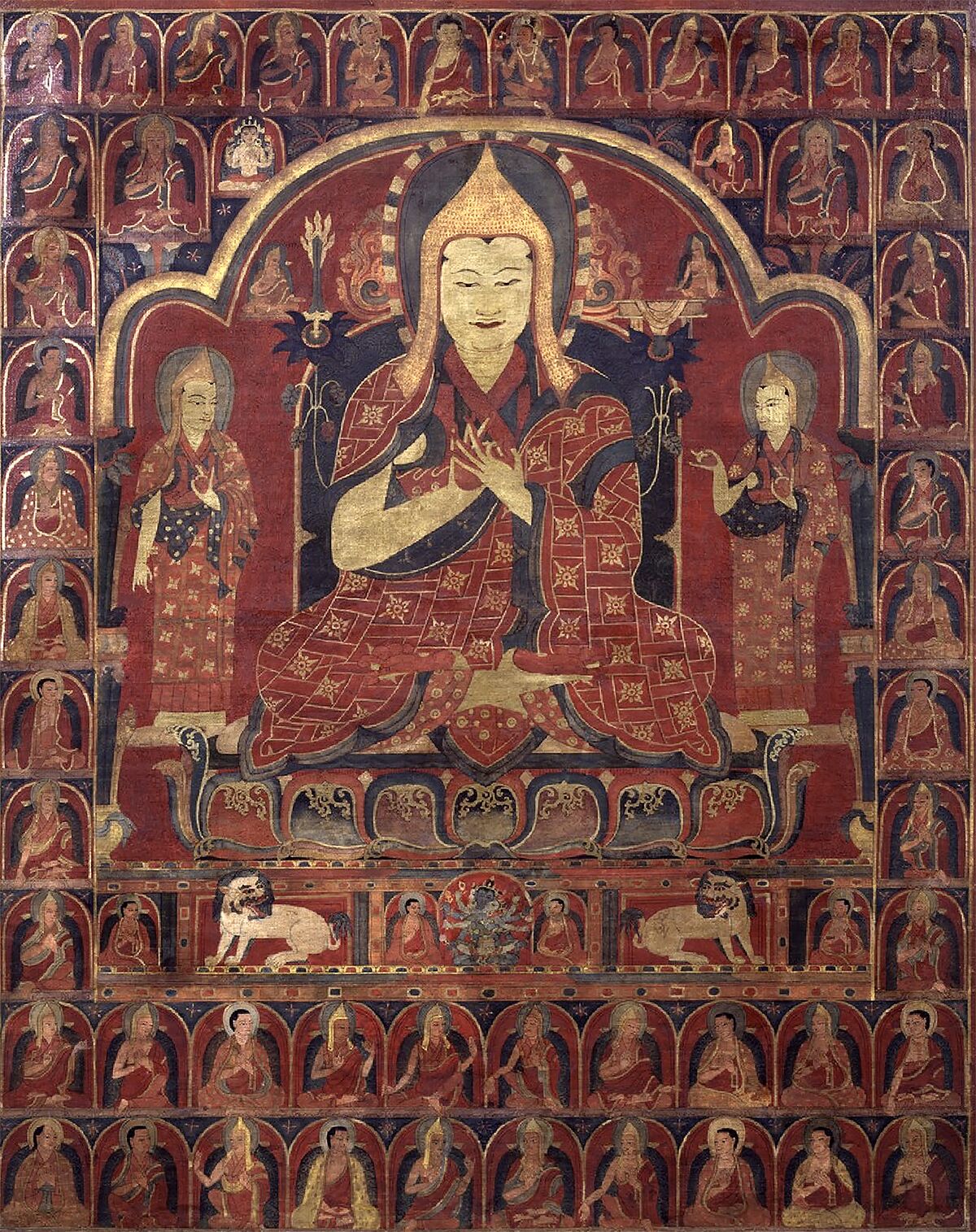
Tsongkhapa (1357-1419) was an intellect of the first magnitude and an independent thinker with widely eclectic interests. He lived at a time well before the relations between the different schools of Tibetan Buddhism had been soured by sectarian division, and like other great masters of his time, such as Longchenpa, he felt free to receive teachings from all traditions, sitting at the feet, it is said, of more than fifty masters. From his earliest youth, he received instruction in the Kadampa tradition of Atisha. To this he added, in later life, instructions in the logic tradition of Sangpu, the transmission of the six yogas of Naropa according to the tradition of Drikung Kagyu, and the Path and Fruit (Lamdré) teachings from the Sakya master Rinchen Dorje. He received instruction in the Great Perfection from the Nyingma master Lodrak Drupchen Namkha Gyeltsen; and in order to study the Kalachakra tantra, he went to Jonang itself. His principal teacher for Madhyamaka, however, was the great Sakya master Rendawa Zhonnu Lodrö, and at first he followed and upheld the general Madhyamaka view of that school as this had finally been established by Sapan and his disciples.
An assiduous scholar of wide interests and immense capacity, Tsongkhapa seems also to have been a genuine philosopher by temperament, driven by a restless searching quest for the kind of personal conviction that comes only from deep reflection and independent research. Beginning in his early thirties, however, and as a result of a series of visionary communications with the Bodhisattva Mañjuśrī[24] Tsongkhapa's understanding of Madhyamaka underwent a radical transformation, culminating in an interpretation that was unique and unprecedented in the annals of Tibetan, and for that matter, Indian, Buddhism.
We will examine presently the salient features of Tsongkhapa's view, but first it is important to advert to the far-reaching political and cultural effects of the change of direction in his understanding of Madhyamaka, which, in effect, divides his life into two periods. Thanks to his personal charisma, his formidable intelligence, his purity of life and insistence on the monastic ideal, as well as the skill and forcefulness with which he presented his novel teaching—Tsongkhapa soon acquired a large following. In 1401, at the age of forty-five, he founded the monastery of Ganden, which became his seat, and this was followed within the next two decades by Drepung (1416) and Sera (1419), founded by his direct disciples. These three monasteries, all within the vicinity of Lhasa, became the great centers of Tsongkhapa's tradition and the epicenter, eventually, of its political power. It was only gradually, however, that the Gandenpas, as they were first called, detached themselves from the Sakya matrix.[25] Inspired by the ideals of the Kadampa tradition, the new movement was marked by a strong emphasis on monastic discipline, and it quickly evolved a long and exacting curriculum of study. Under the leadership of Tsongkhapa's two principal disciples, Gyaltsap Darma Rinchen (1362-1432) and Khedrup Gelek Pelzang (1385-1438), who followed him successively as throne-holders of Ganden, the new order quickly acquired a strong sense of identity as a new and formidable elite confident of its ability to defend the philosophical positions of its founder in logic, epistemology, and Madhyamaka, sharply distinguishing them from the traditions of Sakya. Moreover, a sense of preeminence, underpinned by discipline, scholarship, and intense application, was further reinforced by Khedrup's pugnacious insistence on an exclusive fidelity to the teachings of Tsongkhapa, and his readiness to chastise sharply anyone who strayed from the party line.
It was not long before the new ideas expressed in Tsongkhapa's writings attracted hostile attention from the upholders of the mother tradition of Sakya. In the generations immediately following his death in 1419, Tsongkhapa's ideas, particularly in the area of Madhyamaka, were subjected to an onslaught of critical protest. Following in the footsteps of Rongtön Sheja Kunrig (1367-1449), one of the greatest masters of the Sakya tradition, Taktsang Lotsawa (1405-?1465), Gorampa Sonam Sengé (1419-1489), Serdok Panchen Shakya Chogden (1428-1507), and, in the following generation, the eighth Karmapa Mikyö Dorjé (1504-1557) attacked the new philosophy with powerful arguments and sometimes with considerable vituperation. As Georges Dreyfus comments, this hostility strengthened even further the sense of orthodoxy among the Gandenpas, "who gradually came to see themselves as forming a separate tradition claiming to possess the right view and hence to represent the apex of Tibetan Buddhism."[26] It was this self-confidence, moreover, that led to the choice (made by the Gandenpas themselves) of the name Gelug, "the tradition of virtue," as the designation of their school.
Against the attacks of its enemies, the new school was perfectly able to defend itself.[27] Taktsang was refuted, for example, by the first Panchen Lama, Lozang Chökyi Gyaltsen (1507-1661), and eventually and in detail in the massive doxography Great Exposition of Tenets composed by Jamyang Zhepa (1648-1751).[28] The eighth Karmapa received an answer from Jetsun Chökyi Gyaltsen (1469-1544/46), while Gorampa and Shakya Chogden were jointly refuted in The Replies to Go and Shak, begun by Sera Jetsun Chökyi Gyaltsen and completed by his disciple, Panchen Delek Nyima.[29]
Whether or not these counterblasts succeeded in destroying their targets, the most effective means of silencing the strident critique of Tsongkhapa's innovations were, as we have said, the condemnations that followed the rise to power of the Ganden Phodrang government.
This suppression of dissenting opinion, which remained effective for centuries, has been of great significance for the academic study of Buddhism in the West. For reasons that will now be clear, the Tibetan commentarial literature on Madhyamaka available in modern times for the inspection of Westerners has been, until recently, almost exclusively the work of scholars belonging to the Gelugpa tradition. And when, in the 1980s, Buddhist studies became an accepted part of the academic curriculum in Western universities, the presentation of Tibetan Buddhism tended to be from the Gelugpa perspective.
This was the natural consequence of the fact that of the young people who encountered Tibetan Buddhism—whether by actually going to India and meeting with Tibetans in exile or by encountering Tibetan masters visiting the West—those who had been attracted to Gelugpa teachers and who were powerfully inspired by the teachings and scholastic methods of their school were generally people who by temperament and intellectual capacity were most naturally attuned to the academic ideals of Western scholarship. Based for the most part in the Gelugpa tradition, they soon acquired, according to the Orientalist methods of the Western academy, a considerable knowledge of Buddhism, in terms of its history and doctrinal complexity, and this, coupled with a command of Tibetan and Sanskrit, naturally fitted them to academic work as the future professors of their respective faculties. Courses were created, texts were translated, and a great deal of scholarly material was amassed. And since this was overwhelmingly inspired by the Gelugpa tradition, the view of Tsongkhapa, especially in the field of Madhyamaka, has come to be widely regarded as the standard, if not the only, position. It is only comparatively recently, with the translation and study of texts—in no small measure inspired by masters and students of the rimé tradition—that new and competing points of view have come to light. It is thanks to this that it is now possible to place the views of Tsongkhapa and his disciples, on a full range of topics, both sutra and tantra, in a much clearer historical perspective and to appreciate for the first time the degree to which—especially in the case of Madhyamaka—they were innovative and controversial and by no means representative of the Tibetan tradition as a whole: a fact that had been very effectively obscured by the banning of non-Gelugpa texts in Tibet.[30]
The academic study of Buddhism has certainly been enriched by the influx of scholars who were able to benefit from contact with the living Tibetan tradition, even if until now that contact has been somewhat lopsided in favor of a single school. But if the academy has been benefited by such an encounter, it too has exerted a positive influence on the scholarship concerned. The maxims of intellectual freedom and the principles of impartial, scientific research, untrammeled by the dictates of religious and political ideology, have encouraged the scientific study of the history of Buddhism both in India and Tibet, leading to the rediscovery of many things that in the continuance of time had been forgotten or suppressed within the traditions concerned. Everyone stands to benefit from the discoveries of objective research, even if, when brought before the tribunal of impartial study, certain cherished fictions may have to be abandoned.
After Tsongkhapa, Madhyamaka in Tibet effectively divides into two factions: the Gelug school, on the one hand, and its opponents on the other: the Sakya, Kagyu, and Nyingma schools whom Mipham refers to generically as the ngarabpa (snga rabs pa), or "earlier schools." Whereas Tsongkhapa claimed to be following the instructions of Mañjuśrī received in private visions, he was accused by his critics of abandoning tradition (a serious charge in Tibet) and of producing a newfangled interpretation of his own invention—making the outrageous claim to have achieved an understanding of the view of Buddhapālita and Chandrakīrti hitherto unknown, not only in Tibet but even in India.[31]
Obviously, it is not possible here to give anything approaching an adequate assessment of Tsongkhapa's view. But as a preparation for a reading of Mipham's commentary on the "Wisdom Chapter" and his subsequent debate with Drakar Tulku, it is essential to have at least a summary grasp of the salient points of Tsongkhapa's position. For present purposes, three areas seem to be of particular importance: first, Tsongkhapa's understanding of the distinction between the Svātantrika and Prāsaṅgika positions; second, his manner of defining the two truths; and third, his description of the way in which the ultimate truth, emptiness, is to be realized.
The Svātantrika-Prāsaṅgika Distinction
Tsongkhapa was, of course, aware that the Svātantrika-Prāsaṅgika terminology was the invention of Tibetan scholasticism during the later diffusion. He nevertheless insisted that they corresponded with the critique made by Chandrakīrti in the Prasannapadā and were therefore not arbitrary inventions.[32] He believed that Bhāvaviveka's advocacy of autonomous proof, and Chandrakīrti's rejection of this, indicated a fundamental difference in their understanding of the status of phenomena. The foundationalist character of the whole logico-epistemological enterprise meant that, when establishing emptiness, Bhāvaviveka, Shāntarakshita, and the other Indian Svātantrikas were effectively compromised by their use of positive, autonomous arguments, which inescapably bound them to a genuine, if subtle, belief in real existence. This effectively disqualified them from a correct interpretation of the view of Nāgārjuna. For Tsongkhapa, this meant that the difference between the Svātantrika and Prāsaṅgika approaches was not just a matter of textual exegesis or pedagogical technique but involved a fundamental difference of view. This led to the conclusion that only the Prāsaṅgikas, Buddhapālita and Chandrakīrti, were the true Madhyamikas, for they alone had penetrated to the essence of Nāgārjuna's teaching: the authentic view of emptiness as expounded by the Buddha in the Prajñāpāramitā sūtras. The Svātantrikas, for their part, were, however subtly, advocates of real existence (dngos po smra ba). And this led to the startling conclusion that the proponents of Svātantrika were not really Madhyamikas at all: their view was insufficient to ensure even liberation from samsara.[33] At a single stroke, Bhāvaviveka, Shāntarakshita, Kamalaśīla, Jñānagarbha, and with them the vast majority of the would-be Madhyamikas of India, were relegated to a secondary position.
Previously, in the doxographical literature of the first diffusion, Bhāvaviveka and Shāntarakshita were described simply as Madhyamikas and were differentiated according to the way they presented the conventional truth (as Sautrantika-Madhyamaka and Yogācāra-Madhyamaka respectively). Henceforth, they would be globally classified, and dismissed, as Svātantrikas, imperfect in their view and inferior to Chandrakīrti.
At this point, one may well reflect on the somewhat questionable benefits of doxographical literature. As a literary genre, doxography, or the presentation of tenets, has had a long and successful history in Buddhist scholasticism, and its existence seems in fact to be more or less coterminous with the Madhyamaka tradition itself. In these schematic presentations, the various views of Buddhist tradition are identified according to their defining features and principal exponents and arranged in an ascending scale according to the perceived subtlety of their view in order to demonstrate the supremacy of the Madhyamaka, or rather (post-Tsongkhapa) Prāsaṅgika, view. The obvious usefulness of doxography as a scholastic tool ensured its continuous popularity in Tibet from the first compositions of Kawa Peltsek and Yeshe De in the eighth century to the gigantic achievement of Jamyang Zhepa a thousand years later.[34] Yet summary presentations of tenets are not without their drawbacks. As with secondary literature generally, potted histories of philosophical systems are an irresistible temptation for busy students working their way through a heavy curriculum en route to the study of the "highest system." The inevitable result is that doxographies, rather than original texts, become the object of study. Henceforth, the great authors are acknowledged in passing, and their writings are reduced to little more than dictionary entries and laid aside as mere museum pieces. Following the demotion of the Svātantrikas, this effectively happened in the study of Madhyamaka in Tibet. It is quite significant that when, in 1876, Mipham composed his explanation of the Madhyamakālaṃkāra, it was the first commentary to be composed on Shāntarakshita in almost four hundred years. This suggests that a misuse of doxography may contribute to a narrowing of scholastic interest, resulting in the neglect, and perhaps even the eventual loss, of texts.
The impoverishment of the intellectual field, however, is not the only unintended result of doxography. The arrangement of views and tenet systems in ascending order so as to demonstrate the supremacy of Madhyamaka creates the unfortunate and irresistible impression that Madhyamaka is itself just another tenet system, albeit the supreme one. On the other hand, it is arguable that the whole point of Nāgārjuna's message was precisely to demonstrate the hollowness of tenet systems by showing the incapacity of the ordinary intellect to penetrate and express the profound truth of emptiness.
The conception of Madhyamaka as the best of tenet systems is, in effect, a striking feature of Tsongkhapa's own presentation. For him, Madhyamaka is very far from being the "system of pure philosophical criticism" that it is for thinkers like T. R. V. Murti, and still less, a thesis-less "position of no position."[35] For Tsongkhapa and his followers, Prāsaṅgika Madhyamaka becomes a fully fledged philosophical system, equipped with its own specific features—characterized by "eight great difficult points" that set it apart from other Buddhist schools.
There are in fact two lists of eight points. The following is drawn from Tsongkhapa's commentary on the Madhyamakāvatāra, The Perfect Illumination of [Chandrakīrti's] Meaning (Dgongs pa rab gsal). Here, the Prāsaṅgikas are said to make the following assertions:
- 1. The fundamental ground consciousness (ālayavijñāna, kun gzhi rnam shes) has no existence even conventionally.
2. The mind's self-cognition is refuted even on the conventional level.
3. Autonomous probative arguments are rejected as a means to demonstrate emptiness.
4. Phenomena exist extramentally, over against the cognizing mind.
5. In order to achieve liberation, the Shrāvakas and Pratyekabuddhas achieve a full realization of emptiness of both the personal and phenomenal selves.
6. Apprehension of, and clinging to, the phenomenal self is an obscuration through defilement (kleśavaraṇa, nyon mongs kyis sgrib pa).
7. The state of destruction is defined as an actual, impermanent, entity (zhig pa dngos po).
8. On the basis of the last point, the Prāsaṅgikas have a special presentation of the three times.
A similar but not identical list is given in a collection of lecture notes (zin bris) made by Tsongkhapa's disciple Gyaltsap Darma Rinchen in which, instead of the last two points given above, it is said, first, that the Prāsaṅgikas deny that conventional phenomena exist by way of their own characteristics and, second, that the Buddhas are aware of the impure perceptions of unenlightened beings. Finally, the sixth point given above is amplified by Gyaltsap, who adds that, for the Prāsaṅgikas, the habitual tendency to dualistic appearance is counted as a cognitive obscuration.
Tsongkhapa's assertion that the Svātantrikas have a view inferior to that of the Prāsaṅgikas, and therefore do not even rank as true Madhyamikas, was strongly rejected by his opponents from the earlier tradition. They said that he had exaggerated the difference between the two groups to a degree not substantiated in the texts themselves. On the contrary, for the earlier tradition, Bhāvaviveka, Chandrakīrti, and Shāntarakshita were all true Madhyamikas. Their disagreement was not about the Madhyamaka view, which they all shared, but about the exegetical, and by extension, pedagogical, procedure in explaining Nāgārjuna's texts. It was a question of what kinds of arguments were appropriate in bringing out Nāgārjuna's meaning.
Although they did, of course, recognize differences in the Prāsaṅgika and Svātantrika approaches, Tsongkhapa's critics rejected, needless to say, all his eight great difficult points of Prāsaṅgika.[36] They do not, however, seem to have regarded them as of uniform importance. Shakya Chogden states, for example, that the rejection of the conventional existence of the fundamental ground consciousness and the self-cognizing mind has no bearing on the doctrine of emptiness and is therefore irrelevant to the Svātantrika-Prāsaṅgika debate.
Generally, Mipham agrees with the ngarabpa rejection of Tsongkhapa's assessment of the Svātantrika-Prāsaṅgika distinction as a difference of view. Similarly, he takes exception to the eight difficult points, although, at least in the Ketaka, he is concerned with some more than others. This naturally reflects the fact that only some of Tsongkhapa's difficult points pertain to the arguments laid out in the "Wisdom Chapter": the refutation of the Cittamātra doctrine of the self-cognizing mind, for example, or the debate about the realization of the Arhats. On the other hand, he is much less interested in the dialectical question of autonomous versus consequential arguments. Even though, etymologically speaking, this is the basis of the terms "Svātantrika" and "Prāsaṅgika," Mipham considers it to be of only secondary importance in distinguishing the two Madhyamaka approaches.[37]
The Two Truths
A second important point that divides Tsongkhapa's Madhyamaka view from that of his ngarabpa critics concerns his assessment of the two truths: their nature and the way that they are related. Attracted as he was to the logico-epistemological tradition of Dignāga and Dharmakīrti, Tsongkhapa was strongly committed to the use of reasoning as a tool for understanding Madhyamaka. For him, reasoned analysis is the primary means of anchoring the doctrine of emptiness within a view of the world that makes sense, laying out a path that—given intelligence and careful thought—was open to the ordinary intellectual functions of any human mind. No doubt this reflected the course that Tsongkhapa plotted for himself in response to the directives received in his communications with Mañjuśrī. Although the latter directed Tsongkhapa to rely on the Prāsaṅgika teachings of Rendawa Zhonnu Lodrö, he nevertheless emphasized that Tsongkhapa should take particular care to "save the relative truth"—to avoid, in other words, any kind of presentation of the two truths that, in questioning the reality of the relative phenomena, might diminish the importance of conventional existence as a basis for correct ethical conduct. This is born out too in Tsongkhapa's insistence on the reality of an extramental world as a distinctive feature of Prāsaṅgika—distancing himself from what he perhaps regarded as the counterintuitive idealism of Shāntarakshita in favor of an approach to phenomena more in harmony with Bhāvaviveka's presentation of the conventional truth. Tsongkhapa's presentation of the two truths is a reflection of these concerns.
It is important to be aware that there are two ways of positing the two truths.[38] As we have seen when discussing the opinions of Chapa, there is, first, what might be called the "ontological" way, according to which the two truths are seen to be two distinct aspects of any given phenomenon. Like Chapa, Tsongkhapa favors this view, which harmonizes well with an understanding of phenomena as objective, extramental realities. According to this view, phenomena seem to exist and function unproblematically as long as they are not closely examined; but when they are subjected to searching analysis, they prove to be "unfindable." They lose that quality of discrete, independent "entity" that they seemed previously to have. The unfindability of phenomena is thus their ultimate status or truth. By contrast, their seeming autonomy as functioning things is their relative, or conventional, truth. At first sight, this view seems quite close to that of Bhāvaviveka. Tsongkhapa is however careful to distance himself from it. He rejects Bhāvaviveka's formula that phenomena exist on the relative level "according to their characteristics" as being the hallmark of Svātantrika, and in its place, he substitutes a more subtle and complex account involving what is one of the most difficult aspects of his Madhyamaka interpretation: the identification of the object of negation.
Like all Madhyamikas, Tsongkhapa believes that freedom from samsara depends upon the realization of the ultimate truth: the emptiness or "unfindability" of phenomena. It is only through such a realization that beings can free themselves from their deeply ingrained tendency to relate to things as if they were really or "truly" existent. This is the fundamental misperception of phenomena that provides the basis for the craving and aversion that in turn give rise to samsara. Because liberation depends on the dissipation of the mistaken understanding of the nature of phenomena, it is crucially important, Tsongkhapa insists, to find exactly where the misunderstanding lies. More succinctly, it is necessary to identify the correct object of negation, and for Tsongkhapa, this is not the phenomenon itself, but the mistaken understanding that the phenomenon exists truly. This aspect of Tsongkhapa's presentation is admittedly difficult to understand, and it has been the object of much controversy. Tentatively, we might define it thus. On the conventional level, phenomena exist; they do not however exist truly. And it is the thing's true existence and not the thing itself that is the object of negation. The Madhyamaka dialectic does not refute phenomena in themselves. In the words of the frequently cited catchphrase: "The pot is not empty of pot; it is empty of true existence."
This presentation is famously beset with an important problem. In order to refute the true existence of phenomena, and not phenomena themselves, it stands to reason that, as a first step, one must be able to tell the difference between the truly existent thing and the thing itself. And yet it is accepted that such an object of negation is so subtle and difficult to identify that it is necessary to have practically realized emptiness in order to be able to discern it. Thus Tsongkhapa's presentation seems to fall into an inescapable circularity, of which the upholders of his tradition are well aware. The solution most commonly adopted is to proceed on the basis of a "well-founded assumption" grounded in one's faith in the tradition. One must accept provisionally, until such time as emptiness is realized, the validity of Tsongkhapa's distinction.[39] Once again, the whole point of defining the object of negation as "true existence" is to "save the conventional," to preserve the understanding that the conventional validity of things is not undermined by the doctrine of emptiness. To put it another way, the relative truth in itself is not destroyed by the realization of the ultimate. Instead, for Tsongkhapa, the two truths are mutually entailing and of equal importance. For him, in other words, the doctrine of the two truths is not a skillful means devised to wean beings away from their clinging to phenomena, in order to lead them to the realization of the ultimate truth. On the contrary, the doctrine of the two truths actually corresponds to the constitution of phenomena. The two truths remain embedded, so to speak, in phenomena themselves, like two parallel threads: two aspects within a single nature (ngo bo gcig la ldog pa tha dad).
To maintain that the two truths are distinguished because they represent the actual makeup ofphenomena has at least one advantage. Since the two truths are mutually entailing, they are of equal validity, and as such they are—the conventional truth included—the objects of a Buddha's enlightened mind. This easily dispenses with the problem of a Buddha's knowledge of conventionalities, as this emerges in the extreme Prāsaṅgika presentations of Jayānanda and Patsap, according to which a fully enlightened mind has no experience of the false perceptions of the relative that are concomitant with samsaric ignorance and therefore has no perception of samsaric phenomena.
Nevertheless, for Tsongkhapa's critics, the ideas that conventionalities are not in themselves refuted by ultimate analysis and that the two truths are parallel—mutually entailing—entities remain highly problematic. To say that the object of negation is some putative "true existence," and not phenomena themselves, may be a way to preserve one's confidence in the nondeceptive perception of things on the conventional level. In Mipham's view, however, it undermines what for him is the entire soteriological purpose of the teachings on emptiness, which is to free beings from the clinging to phenomena that is the cause of their suffering. Beings perceive phenomena; they do not perceive the true existence of phenomena. And since, on this basis, they are attached to things themselves, not to their true existence, it stands to reason that it is things, and not some putative true existence of things, that must be negated. For Mipham, therefore, to say that phenomena are not empty of themselves but only of their true existence is an important mistake, and he energetically refutes it on many occasions.[40]
The Ultimate Truth
A third important difference that divides Tsongkhapa's Madhyamaka presentation from that ofthe earlier schools concerns the ultimate truth itself: its nature and the way it is to be realized. This question is articulated specifically in relation to the refutation of the so-called tetralemma, the four ontological extremes spoken of in Nāgārjuna's kārikās. These four extremes may be understood in the following way. Phenomena are not (1) existent; they are not (2) nonexistent; they are not (3) both existent and nonexistent; and they are not (4) neither existent nor nonexistent. Applied practically to the question of causation, that is, as an analysis of the observed "fact" of production, Nāgārjuna says—indeed proves—that "really existent things" are not produced from themselves; they are not produced from something else; they are not produced both from themselves and from something else; and they do not arise uncaused.
According to the interpretation of the earlier school, an interpretation with which Mipham is in full agreement, the purpose of the systematic analysis of the tetralemma is to show that the true status of phenomena is not to be found in any of these four ontological extremes. Every possible position that the mind can take in its bid to understand the status of existent things is destroyed by systematic analysis. Even though phenomena constantly and inescapably appear to us, when they are examined as to their actual nature, it is discovered that their status is logically inexplicable. Whatever that status may be—and we cannot ignore the fact that things continue undeniably to appear—it is something that the mind is powerless either to conceive of or express. Moreover, the arrival at such an understanding is not an ordinary discovery. It in no way resembles the finding of some hitherto unknown object in ordinary experience. Passing through the different stages of analysis associated with each of the four extremes, the ordinary mind—the mind of everyday experience—is itself brought to the limit of its powers of intellection, which must then be transcended. At that point, it is said, the mind becomes completely still, resting in a state that is completely free of conceptual elaboration (spros bral). It is a state that Chandrakīrti describes as a condition of utter silence. Even though, on the basis of a common experience of consciousness and knowing, this state is beyond the power of ordinary beings to imagine, the freedom from conceptual elaboration—so it is said—is very far from being a state of unconsciousness. It is the wisdom of the Āryas, the noble beings who have passed beyond samsara. It is a state of mind—if we can still use that term—in regard to which ordinary thinking people have absolutely no point of reference. And yet, it cannot be denied.
Furthermore, it is said that this wisdom lies beyond the duality of subject and object, the duality that radically characterizes the states of ordinary knowledge. This being so, it follows that when the mind completes the fourfold refutation of phenomenal existence, it is not only the nature of phenomena but also the nature of the mind itself that stands nakedly revealed. And this, according to thinkers of the earlier tradition, constitutes the complete realization of emptiness, the ultimate truth according to the Mahayana. It is liberation by definition. Because it is beyond concepts, it cannot be described. Because it cannot be described, it cannot be taught. It is not an idea, or a piece of information that can be transmitted in the ordinary manner from one person to another. It is an understanding that can only be indirectly provoked by demonstrating to the mind the falsity of every conceptual position that it can possibly take. It is a state in which the Buddhas constantly abide. It is experienced in the meditation of the Āryas, the Bodhisattvas residing on the grounds of realization. It is never experienced by ordinary beings. For when beings experience it, they cease to be ordinary.
Of the refutations of the four extremes, the first, the negation of existence, is accomplished through the application of the four or five great Madhyamaka arguments.[41] It is the most important of the four refutations because it is the basis for the following three. Mipham describes the procedure in the following way:
Freedom from the four conceptual extremes arises in a person's mind in the following manner. In the case of a beginner who penetrates it step by step, perfect and stainless reasoning first eliminates the "conceived object," that is, the misconception that all compounded or uncompounded phenomena really exist. Reasoning then refutes the conceived objects of the three remaining extremes: that things do not exist, that they both exist and do not exist, and that they neither exist nor do not exist. Subsequently, thanks to meditating in accordance with the extraordinary certainty wherein the conceived objects of the extreme ontological positions have no place, the point will come where all conceptual extremes will stand refuted in a single stroke, and the practitioner will behold the dharmadhatu clearly. It is as the great and omniscient Gorampa Sonam Senge has said: "The intellect of ordinary people, which investigates ultimate reality, cannot refute in a single stroke all four conceptual extremes. But by refuting these four extremes one after the other and by meditating properly, one reaches the path of seeing. This is called the view that sees the dharmadhatu."[42]
In contrast with the thinkers of the earlier tradition, Tsongkhapa takes a quite different approach. He is suspicious of the description of the ultimate truth as freedom from conceptual elaboration, which on some occasions he compares to the state of quietist "no-thought" supposedly advocated by the Chinese monk Hva-shang (pronounced "Hoshang"), who is said to have been refuted by Kamalaśīla in the legendary debate at Samye in the eighth century. Instead, Tsongkhapa asserts that the realization of the ultimate truth of phenomena must first proceed from the correct identification of the object of negation—the true existence of phenomena, as distinct from phenomena themselves. This is followed by a profound analysis consisting in the application of the five great Madhyamaka arguments, which demonstrate that truly existent phenomena cannot be found. This closely resembles the refutation of the first ontological extreme as described above. The goal of the Madhyamaka analysis is therefore a mental state of perfect conviction in the nonfinding of the object of negation. When, after long examination, this state of profound certainty is reached, the practitioner suspends the analytical investigation and rests his or her mind in the state of nonfinding. When the state of absorption dissipates, the previous analysis is resumed; and this alternating procedure is repeated again and again. The mental understanding of emptiness is gradually enhanced until a profound realization—a direct, nonconceptual experience—of emptiness is achieved. For Tsongkhapa, therefore, emptiness, the nonfinding of the object of negation, is the true goal of Madhyamaka practice. As emptiness, pure and simple, it is described as a nonaffirming negation: a negation that implies no residue, a negation that "has no strings attached." Through assiduous application, the mind is purified and brought to a profound experience of emptiness. And even if this experience is said to be characterized by a nondual immediacy, it is nevertheless considered to remain within the reach of the mind itself, understood in the ordinary sense, and to constitute its object. In other words, for Tsongkhapa, the realization of emptiness does not imply a fundamental difference between the mind that achieves this state and the mind that, earlier on, had been engaged in intellectual analysis.
The refutation of inherent existence resulting in a nonaffirming negation is not, in Tsongkhapa's system, followed by the refutation of the other ontological extremes. For him, the rules of logic show that the procedure of successive refutation described in the tetralemma is not to be taken literally. According to the law of the excluded middle, the denial of one term automatically involves the affirmation of its opposite; there is no third, or middle, possibility. Consequently one may begin by denying the true existence of phenomena, but if one then goes on to say that phenomena are not nonexistent, one is implicitly affirming that phenomena exist. When, therefore, Nāgārjuna speaks about the first two refutations, Tsongkhapa interprets him, not as implying some mysterious third affirmation, a state beyond existence and nonexistence, but simply as meaning, first, that phenomena do not exist on the ultimate level and, second, that they are not deprived of existence on the conventional level. The same procedure is then applied by implication to the third and fourth extremes. For Tsongkhapa, in other words, the tetralemma is not an intellectual yoga intended to push the mind beyond the confines of habitual intellection and into a meditative state free from mental proliferation. Instead it is a pedagogical tool for clarifying one's understanding of the relationship between the two truths and for arriving at a correct idea of emptiness.[43]
Before moving on to an examination of Mipham's presentation of Madhyamaka, let us attempt a brief recapitulation in the hope of bringing into focus the various points that have been made in this admittedly summary account of Madhyamaka in Tibet.
Introduced to Tibet in the eighth century, Shāntarakshita's Yogācāra-Madhyamaka synthesis flourished untroubled for about four hundred years. It was, as we have said, highly receptive to the logico-epistemological tradition of Dignāga and Dharmakīrti; and the favor in which it was held at Sangpu could only have been strengthened by Loden Sherab's translations of major logical texts in the twelfth century. Nevertheless, the supremacy of Shāntarakshita's Madhyamaka tradition was challenged by the arrival in Tibet of Patsap Nyima Drak's translations of Chandrakīrti. Having made so little impact in India, Chandrakīrti's Madhyamaka teaching was completely new to most Tibetans, despite the fact that Atisha both knew and appreciated it. The novelty of Chandrakīrti, as compared with Shāntarakshita was, of course, illusory, in the sense that it depended on the date, not of the composition, but of the translation, of his works—Shāntarakshita's synthesis being the more recent, indeed the last, major development in the history of Indian Buddhist thought. On the other hand, Chandrakīrti's strong disapproval of the logico-epistemological tradition must have come as a shock in that it suddenly called into question what had come to be regarded as an integral component of the Madhyamaka tradition that was, by then, so well established.
It was at this time that, as a means of conveniently labeling the two diverging approaches, the terms rang rgyud pa and tha' 'gyur ba (back-translated into Sanskrit as "Svātantrika" and "Prāsaṅgika," respectively) were coined. Although these terms referred to types of arguments supposedly preferred by each group in establishing the Madhyamaka view, it became clear that the Svātantrikas and Prāsaṅgikas were marked by other, possibly more important, differences. A polarization inevitably occurred, and this came to a head in the emblematic contest between Chapa, the abbot of Sangpu, and Jayānanda, a Kashmiri paṇdita. Although, with the defeat of Jayānanda, the triumph of Svātantrika seemed assured, it was soon undermined by the defection of several important Sangpu scholars, such as Mabja, who were attracted to Chandrakīrti's view as presented by Patsap and Jayānanda. The conversion of these scholars to the Prāsaṅgika outlook did not however erase the logical skills that they had acquired during their long studies at Sangpu; and this in the end worked in favor of a rapprochement between the contending philosophies. Thus by the dawn of the fourteenth century, a balance was struck in which the Prāsaṅgika school, with its characteristically "apophatic" understanding of the ultimate truth, approached through the use of consequentialist arguments, was regarded as supreme, but was nevertheless marked by a strong interest in, and sympathy for, the logico-epistemological tradition. Henceforth, the union of the traditions of the two "kirtis" (Chandrakīrti and Dharmakīrti), as advocated by Sakya Paṇdita, became the accepted view of Sakya, exerting a powerful influence on the other schools, both Kagyu and Nyingma. It was a synthesis in which Patsap seemed to triumph but in which the views of Loden Sherab and Chapa were still influential. It is clear that, by the fourteenth century, the general estimate of Chandrakīrti and Prāsaṅgika was markedly different from the way they were perceived in the twelfth.
Building on this new synthesis (which would scarcely have won the approval of either Chapa or Jayānanda), Tsongkhapa went on to elaborate a still-newer interpretation of Madhyamaka that strongly affirmed the supremacy of Prāsaṅgika, while combining it with an even stronger appeal to the logical tradition of Sangpu and exhibiting numerous positions that were strikingly similar to those of the arch-Svātantrika, Chapa. It is indeed a matter of textual fact that many of the latter's most fundamental positions—the division between the figurative and nonfigurative ultimates, the equal validity and mutual entailment of the two truths, the understanding of the ultimate as a nonaffirming negation that is the object of the conventional mind, and so on—all reappear, emphatically asserted, in Tsongkhapa's system. It is difficult to assess how much the latter acknowledged the similarity, but although the paradox was eagerly pounced upon by Tsongkhapa's immediate critics, the similarity would eventually fade from view with the loss of Chapa's works and the suppression of those of Tsongkhapa's assailants. The findings of modern scholarship, however, tend to confirm the fourteenth-century assertion of Taktsang Lotsawa that despite his vociferous devotion to Chandrakīrti, Tsongkhapa was a Svātantrika in disguise. However much Chapa's view came to be eclipsed by the "New Prāsaṅgika," he seems in effect to have had the last laugh. As Kevin Vose observes, "The reason why Tsongkhapa so vehemently argued for the superiority of Prāsaṅgika, when so much of his system accords with that of Svātantrika authors, remains a great mystery only partially solved by his followers' defense of his system from Taktsang Lotsawa's charge that Tsongkhapa really was a Svātantrika."[44] Whether this fact is viewed in a positive or negative light depends, of course, on one's assessment of the relative validity of the Svātantrika and Prāsaṅgika systems. And it need hardly be added that if the description of Tsongkhapa as a Svātantrika is perceived as a criticism, it is so only according to an alleged hierarchy of views for which Tsongkhapa was himself largely responsible. Of course, it could be argued that the system of Tsongkhapa is indeed Prāsaṅgika; and this is surely true in the sense that he himself understood this term. The problem is that no one, apart from the Gelugpas, share this understanding.[45]
Notes
- ↑ It is in the Prajñāpradipa that Bhāvaviveka's criticism of Buddhapālita occurs. Bhāvaviveka does not mention Buddhapālita by name, but the latter is identified in the commentary by Avalokitavrata. It was perhaps this that prompted the translation of Buddhapālita's commentary in the early period. It should be noted that the translation of Buddhapālita, and for that matter, Shantideva's Bodhicaryāvatāra, does not in any way suggest that Prāsaṅgika-Madhyamaka was in some way established in Tibet in the early period. The term itself did not exist at that time. Buddhapālita's commentary was simply classified as "Madhyamaka." It could be identified as "Prāsaṅgika" only after the translation of Chandrakīrti. See Vose, Resurrecting Candrakīrti, 178n20.
- ↑ See Lang, "Spa-tshab Nyi-ma-grags," 119-30
- ↑ See Davidson, Tibetan Renaissance, 92-112.
- ↑ See Davidson, Tibetan Renaissance, chap. 4. See also Vose, Resurrecting Candrakīrti, 42-45.
- ↑ The account of Atisha's approval of Bhāvaviveka is, however, complicated by a problem of pseudepigraphy. He is known to have praised a passage in a text ascribed to Bhāvaviveka but that cannot have been written by the author of the Prajñāpradipa and the Madhyamakahṛdaya. See Vose, Resurrecting Candrakīrti, 14-25.
- ↑ See Roerich, Blue Annals, 70.
- ↑ Among these paṇditas was Sūkṣmajana who belonged to a celebrated family of Kashmiri scholars. He was the teacher of Rinchen Zangpo. His son, Mahājana, instructed Marpa. His grandson Sajjana was to be the tutor of Loden Sherab, and his great grandsons Mahājana and Sūkṣmajana were the teachers of Patsap. See Lang, "Spa-tshab Nyi-ma-grags," 133.
- ↑ See Vose, Resurrecting Candrakīrti, 45-52, on which this account is broadly based
- ↑ The term rang rgyud pa (Svātantrika) seems to have been first used by Jayānanda in his commentary on the Madhyamakāvatāra, referring to those whom he and, in his view, Chandrakīrti opposed. See Vose, Resurrecting Candrakīrti, 188n119. The term thal 'gyur ba (Prāsaṅgika) seems to have been the purely Tibetan invention of Patsap. See Vose, Resurrecting Candrakīrti, 171n4. The Prāsaṅgika-Svātantrika terminology—that is to say, the meaning that it bore at the time of its invention as contrasted with the meaning it came to assume in later Tibetan and even Western scholarship, is a large and difficult issue. The complexities are brought out in Vose, Resurrecting Candrakīrti, 36-39.
- ↑ This point is discussed with great clarity in Dreyfus, Recognizing Reality, 451-54.
- ↑ For example, the 'Blue Annals (Roerich), Butön, and Shakya Chogden. See Tauscher, "Phya pa chos kyi seng ge as a Svātantrika," 243n3
- ↑ See Tauscher, Phya pa chos kyi seṅ ge, and Tauscher, "Phya pa chos kyi seng ge as a Svātantrika."
- ↑ See Vose's indispensable account in Resurrecting Candrakīrti, 52-60, of which this brief account is an attempted summary.
- ↑ Nāgārjuna, Root Stanzas, chap. 28, v. 5, p. 84
- ↑ Ibid., chap. 28, v. 9, p. 84.
- ↑ Ibid, chap. 25, v. 24, p. 121
- ↑ Madhyamakāvatāra, chap. 11, v. 17, p. 106
- ↑ See Tauscher, "Phya pa chos kyi seng ge as a Svātantrika," 237.
- ↑ See also Brunnhölzl, Center of the Sunlit Sky, 192, where he points out that Chapa seems to have been the first to identify the ultimate as a nonimplicative negation.
- ↑ See Ames, "Bhāvaviveka's Own View," 45.
- ↑ See Davidson, Tibetan Renaissance, 366.
- ↑ See Vose, Resurrecting Candrakīrti, 59.
- ↑ See Gold, Dharma's Gatekeepers, 12.
- ↑ To begin with, these communications seem to have required (strangely enough) the services of a medium. Eventually, Tsongkhapa had visions of Mañjuśrī on his own account. For Tsongkhapa's curious relationship with Lama Umapa, and the derision this provoked among his critics, see Cabezon and Geshe Lobsang Dargyay, Freedom from Extremes, 131 and 311n196.
- ↑ See Dreyfus, Sound of Two Hands, 26.
- ↑ Ibid., 27.
- ↑ See Cabezon and Geshe Lobsang Dargyay, Freedom from Extremes, 30, which is the source of these details.
- ↑ See Hopkins, Maps of the Profound, 527-693.
- ↑ See Lopez, "Polemical Literature," and Cabezon and Geshe Lobsang Dargyay, Freedom from Extremes, 265n154.
- ↑ See the trenchant assessment of Karl Brunnhölzl, Center of the Sunlit Sky, 17: With a few exceptions, the majority of books or articles on Madhyamaka by Western—particularly North American—scholars is based on the explanations of the Gelugpa school. . . . Many of these Western presentations give the impression that the Gelugpa system is more or less equivalent to Tibetan Buddhism as such and that this school's way of presenting Madhyamaka (especially with respect to its Consequentialist branch) is the standard or even the only way to explain this system. . . . In fact the peculiar Gelugpa version of Madhyamaka is a minority position in Indo-Tibetan Buddhism, since its uncommon features are neither found in any Indian text nor accepted by any of the other Tibetan schools. Thus the current situation in the West in no way represents the richness of Madhyamaka views that existed in India and are still transmitted in all four major Tibetan Buddhist schools.
- ↑ For Gorampa's views on Tsongkhapa's originality, see Gorampa Sonam Senge, Distinguishing the Views, 77.
- ↑ See Ruegg, Three Studies, 95.
- ↑ In the Legs bshad snying po, Tsongkhapa compares the Svātantrikas to poorly disciplined monks who, having broken the rule, are barely tolerated in the monastic community. See McClintock, "The Role of the 'Given,'" 155n7.
- ↑ See Hopkins, Maps of the Profound.
- ↑ See Murti, Central Philosophy of Buddhism, particularly chaps. 6 and 7.
- ↑ See Hopkins, Maps of the Profound, 324-28.
- ↑ See Mipham, Teaching to Delight, 133. Further details of Mipham's attitude to other of the eight difficult points can be found in the commentary on the Madhyamakāvatāra, including a rather humorous dismissal of the theory of "disintegration as a positive entity." See Mipham, Word of Chandra, 223-25.
- ↑ Tsongkhapa's interpretation of the two truths and the way it differs from that of the earlier tradition, as represented in particular by Gorampa Sonam Senge, is the subject of an important and detailed study by Sonam Thakchoe. See his Two Truths Debate.
- ↑ See Dreyfus, Sound of Two Hands, 284-85, and Dreyfus, Recognizing Reality, 457-58.
- ↑ See especially his commentary on Chandrakīrti's Madhyamakāvatāra. See Mipham, Word of Chandra, 165-83
- ↑ These arguments, sometimes called the arguments of absolutist reasoning, or reasoning that aims to establish the ultimate truth are the following: the argument of neither one nor many (gcig du bral gyi gtan tshigs), which shows that phenomena exist neither in the singular nor the plural; the diamond splinters argument (rdo rje gzegs ma'i gtan tshigs), which is an investigation of the causes of phenomena; the argument from interdependence (rten 'brel gyi gtan tshigs), which examines the nature of phenomena; the argument that refutes existent and nonexistent effects (yod med skye 'gog gi tan tshigs), which investigates resultant effects; finally, the argument related to four possible alternatives (mu bzhi skye 'gog gi tan tshigs), which is an investigation of the causal process itself. Sometimes the argument of neither one nor many and the argument from interdependence are grouped together in the investigation of the nature of phenomena. See Jigme Lingpa and Kangyur Rinpoche, Treasury of Precious Qualities, book 1, pp. 425-28. See also Brunnhölzl, Center of the Sunlit Sky, 235-62
- ↑ Mipham, Teaching to Delight, 137.
- ↑ For a brief and clear exposition of this question, see Kassor, "Gorampa Sonam Senge."
- ↑ Vose, Resurrecting Candrakīrti, 222n78.
- ↑ A clear discussion ofthe Svātantrika elements in Gelugpa Prāsaṅgika can be found in Brunnhölzl, Center of the Sunlit Sky, 190-91.