Issues of Controversy and Their Development
| 🤓 Admin Zone 🛠️ hidden to non-admins | |
Description
This detailed examination of the arguments and counterarguments of both scholars, contextualized within the broader Tibetan Buddhist philosophical landscape, offers a comprehensive look at how different schools of thought interpret key Madhyamaka concepts. It provides insight into the methods of Tibetan scholastic debate and the ways in which different traditions engage with and interpret canonical texts, serving as a valuable resource for those seeking to deepen their understanding of Tibetan Buddhist philosophy and ongoing discussions surrounding the interpretation of foundational texts.
Featured on
The texts exchanged between Mi pham and Rab gsal discuss a wide range of topics, from rather trivial issues such as mistakes in spelling or grammar, to the most essential matters like the nature of reality; from mistakes that are considered as personal idiosyncrasies, to substantial differences between established scholastic traditions.
The development of the debate is fundamentally determined by Rab gsal's first criticism. In this text, the 'Ju lan, Rab gsal raises the issues that have to be addressed not only in Mi pham's direct answer, but that also continue to be discussed in Rab gsal's reply and Mi pham's further answer. As already described in the earlier chapter, Rab gsal organises his accusations into four topics, divided into two categories: "faults of great impudence" (spyi brtol che ba'i nyes pa), comprising topics I and II, and "faults that are raised after investigation" (brtag zin bslang ba'i nyes pa), containing topics III and IV. Each of these topics is related to a specific passage of the BCA. In his answer, the Rab lan, Mi pham almost always follows the text of Rab gsal precisely and hence also its structure. While the later works, Rab gsal's Ga bur chu rgyun and Mi pham's short reply, use a different meta-structure, the issues discussed are very often grouped together according to the fourfold thematic outline introduced in Rab gsal's first text.
Due to its overarching importance for all texts involved, this structure is also adopted in the present overview. While the aim of this chapter is to offer a comprehensive presentation of the content of the debate as it evolved, it does not aspire to include all individual lines of argumentation. Unlike the following chapter, it focuses solely on the main issues within a certain topic. The selection of these issues is based on the respective context and the weight that is ascribed to them in the individual texts. While subplots of a more secondary nature are neglected, this presentation allows us to monitor the main threads of the debate and the dynamic intellectual sparring it involved. Thereby, the discussion of the selected topics is followed through its various steps – from Rab gsal's 'Ju lan to Mi pham's Yang lan. As described in the earlier chapter, the presentation of the individual topics and the relation between them is rather clear in the first step of the debate, that is, Rab gsal's 'Ju lan and Mi pham's Rab lan. In contrast, the later works, i.e., Rab gsal's Ga bur chu rgyun and Mi pham's Yang lan, often merely hint at a position stated earlier, and it is thus sometimes extremely difficult to know at precisely which passage a certain criticism is aiming. In view of this situation, the presentation of the content shows a clear focus on the first step of the debate, and only includes discussions from the second step when the relation between an earlier and later statement is clear.
The individual discussions are highly technical and often assume a tremendous prior knowledge of the problems involved and their background in Tibetan scholasticism. Before discussing a certain topic, the following presentation will therefore first establish the necessary background: the general context of a certain passage in the BCA, and its place in Tibetan scholasticism, particularly within the Dge lugs tradition, which then helps to contextualise the statements in Mi pham's Nor bu ke ta ka and to understand why these were attacked by Rab gsal. A synopsis at the end of each topic will then tie these various layers together.
Topic I: The Interpretation of BCA IX.1
The first of the four issues is concerned exclusively with problems that arise in the interpretation of BCA IX.1:[1]
The Sage taught this whole entourage (parikara) as having insight as its aim. Therefore, one should generate insight with the wish for the cessation of suffering.[2]
imaṃ parikaraṃ sarvaṃ prajñārtha hi munir jatau/ tasmād utpādayet prajñāṃ duḥkhanivṛttikāṅkṣayā//[3] yan lag 'di dag thams cad ni// thub pas shes rab don du gsungs// de yi[4]phyir na sdug bsngal dag// zhi bar 'dod pas shes rab bskyed//[5]
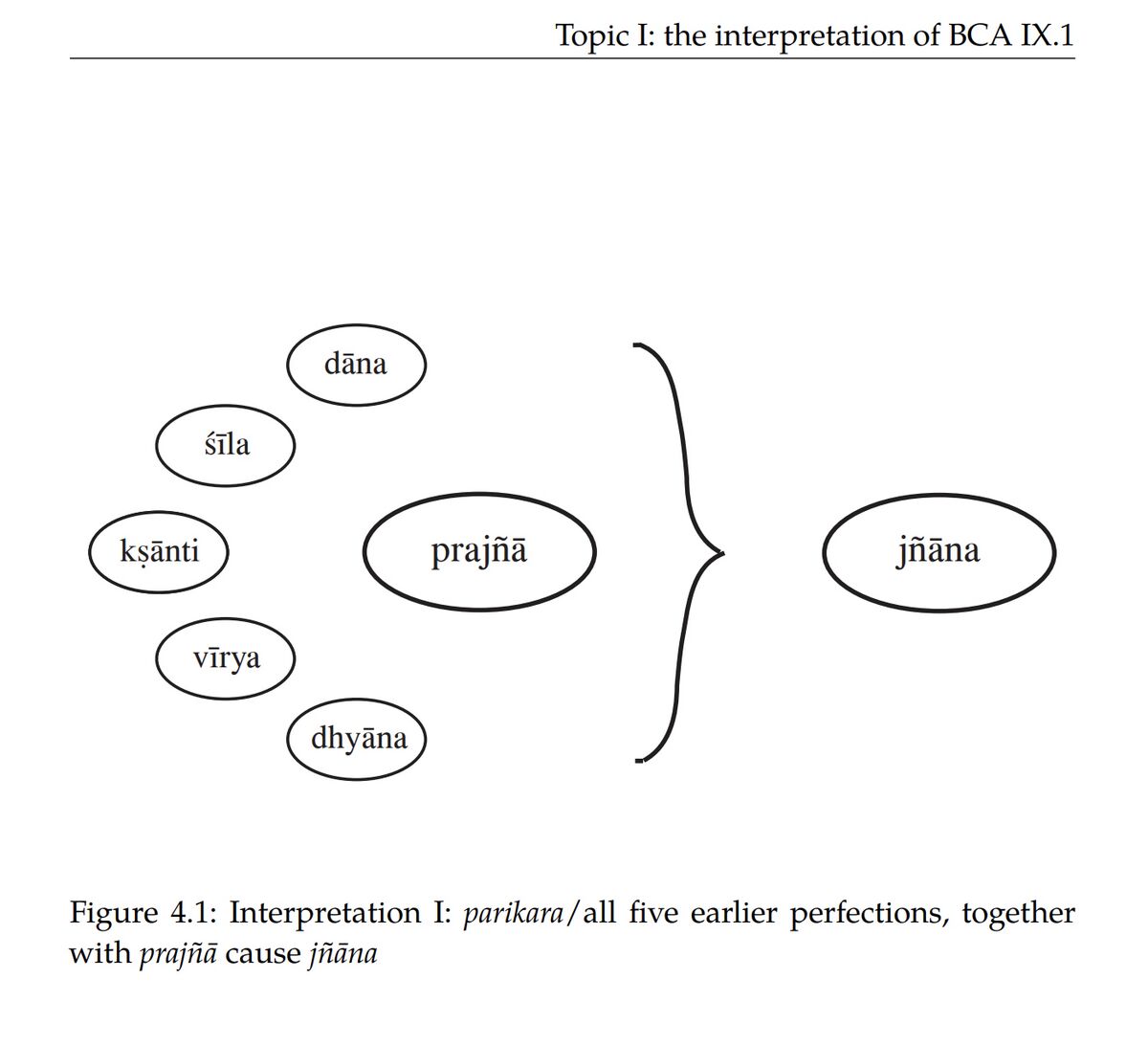
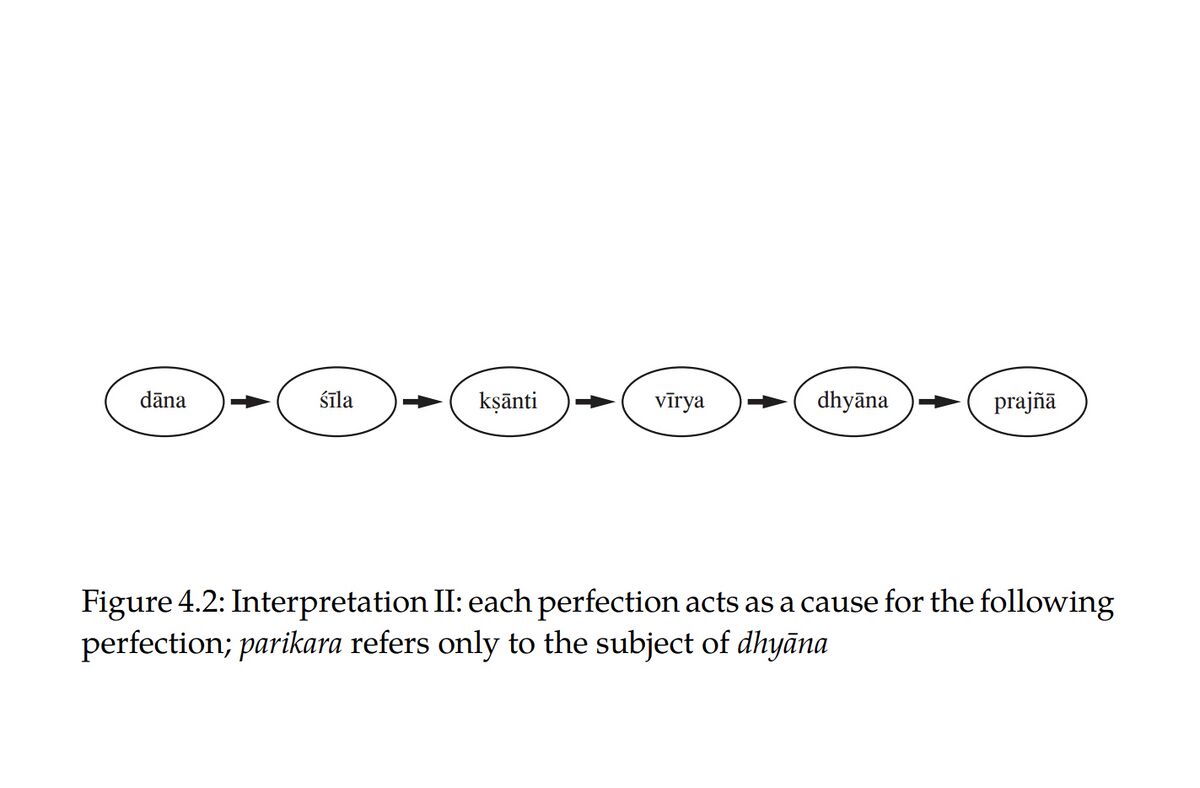
With this verse, the famous ninth chapter of the BCA opens. It points out the importance of insight (prajñā) – the perfection (pāramitā) that forms the main subject of the chapter and gave it its name. Insight is explained as a means for ending suffering – the overall goal of Buddhism – and other preparatory means, i.e., "this whole entourage (parikara)," are also explained as "aiming at" insight. But what precisely is meant by "entourage" and what is its relation to insight? This needs further annotation, which it received in the Indian as well as in the Tibetan tradition. Scholars of all Tibetan Buddhist schools regard Prajñākaramati's commentary as the most eminent Indian work on the BCA, and it is for this reason that it is used here to outline some principle issues concerning the interpretation of this verse.[6] In his Bodhicaryāvatārapañjikā (BCAP), two different ways of interpretation are laid out. The first relates parikara to all five perfections and establishes insight as the primary aspect (pradhāna) among the other perfections.[7] Here, all five perfections act as a cause (kāraṇa, hetu) for gnosis (jñāna) or the awakening of a complete Buddha (saṃbuddhabodhi);[8] but only if they are accompanied by insight do they "reach the state of [being] a cause of that (highest gnosis) and receive the title 'perfections'."[9]Even though insight is explained as the primary aspect and as the "eye" or leader (netra) of the other perfections, complete awakening cannot be accomplished without them.[10] "For this reason," so Prajñākaramati summarises, "the entourage of generosity (dāna) etc. is established as having insight as its aim."[11] A second interpretation explains parikara as denoting śamatha that was laid out in the preceding chapter. Here, śamatha is explained as the cause of generating insight (prajñā) and hence to have insight as its aim.[12]
A look at Rgyal tshab's commentary on the BCA gives an impression of the standard interpretation of this passage in the Dge lugs school, that is, Rab gsal's scholastic background.[13]
Like Prajñākaramati, Rgyal tshab points out two ways of explaining "entourage" (parikara). It can either refer exclusively to śamatha – which is explained in the chapter of concentration (dhyāna) – or to all the five perfections that are explained in the preceding chapters.[14] Among these two possibilities, Rgyal tshab shows a clear preference: according to a certain interpretation, "the earlier (way of relating parikara to śamatha) is also possible, but it is good if it is explained here according to the latter (way of relating it to all five perfections)."[15] A major issue in Rgyal tshab's expla-
nation is the question of whether the accumulation of merit (bsod nams kyi tshogs) is a prerequisite for developing insight. He emphasises that merit is not needed for the insight that corresponds to the realisation of Śrāvakas and Pratyekabuddhas; it is, however, needed to attain omniscience, the state of a Buddha.[16]
Both of these issues, the two ways of interpreting parikara and the question of the importance of the accumulation of merit, will reappear in the controversies on this verse. . . .
Synopsis
In his outline, Rab gsal classified this topic under the rubric "refuting faults of great impudence" (spyi brtol che ba'i nyes pa dgag pa). This suggests that the errors that Rab gsal found in Mi pham's commentary on this passage of the BCA are not based on fundamental doctrinal differences between the traditions of the two, thus on established "errors," but that these are – in Rab gsal's eyes – merely personal idiosyncrasies, caused, for example, by a lack of thorough investigation or proper knowledge of the commentarial tradition. Rab gsal expressed this idea succinctly in his taunting verses at the end of the first (and major) point of criticism:[17]
Through the magical display of negative thought that is content within itself The Indian texts as well are abandoned along with the Tibetan ones. Then both are gone; trapped (rgyar chud) in the conduct Of Devadatta, [you] should regard [him] as the second Teacher.
With the clear intention of highlighting the role of insight in the accomplishment of buddhahood, Mi pham explained that all other perfections are a "support" (grogs) of insight. He contrasted this interpretation with another one that views earlier and later perfections as cause and effect (and therefore gives more importance to the other perfections that act as a cause of insight), but paid no further attention to it. Rab gsal seemed to have understood Mi pham's preference for the earlier and his disregard of the later model as an utter refutation of the interpretation that relates all perfections as cause and effect (rgyu 'bras), a view that would play down the role of the other perfections and focus on the importance of insight alone. In his criticism, Rab gsal referred to various texts that lay out the legitimacy of explaining the perfections as cause and effect. The whole issue is effectively resolved by Mi pham's clarifying reply pointing out that both interpretations are valid.
Connected to these two different ways of understanding the relationship of the perfections are two different interpretations of the literal explanation of "entourage" (parikara) and "aim" (artha). Viewing the perfections as cause and effect, parikara can be explained as being related to śamatha, the practice immediately preceding insight. Here, śamatha acts as a cause of insight and thus has insight as its "aim." Rab gsal pointed out this understanding to counter Mi pham's commentary that related parikara to all perfections, which support insight in its striving for awakening and thus have insight as their "aim." Again, Mi pham resolved the controversies with regard to the interpretation of "aim" (artha) by pointing out the possibility of two different, but not contradictory interpretations. The question of the interpretation of parikara, on the other hand, was left open. Mi pham clearly refuted the possibility of relating parikara to concentration (dhyāna) in his commentary, and did not reply to Rab gsal's criticism that pointed out the validity of such an interpretation as indicated in Prajñākaramati's BCAP.
All in all, the controversies that developed in relation to this topic appear not to be based on fundamental differences. Rather, Rab gsal's criticism seemed to have been instigated by the phrasing of Mi pham's commentary, a phrasing that sounded unfortunate to his opponent's ears, as it would belittle the importance of the other perfections attested in various scriptures.
Topic II: The Interpretation of BCA IX.78
The second topic deals most prominently with the interpretation of BCA IX.78, in particular its third verse line, but touches also on problems that appear in the explanations of the two preceding verses. The wider context of this passage is the defence of the doctrine of selflessness, which was established earlier in BCA IX.58–70, against possible objections. BCA IX.76 deals with the doubt that the postulated non-existence of a self is incompatible with the Buddhist principle of compassion towards other beings. After all, as BCA IX.76ab argues, "If a being does not exist, for whom is compassion [to be developed]?"[18] The answer is given in BCA IX.76cd: a self is surely imagined by delusion (moha), but as such it is accepted for the sake of a certain result (kārya), namely the attainment of buddhahood, for which the development of compassion is necessary.[19] This, quite naturally, leads to the next objection, presented in BCA IX.77a: "Whose result is it? There is no being."[20] As a self does not exist, there is no one who could attain a result and hence, the answer to the earlier objection is doubtful. In his answer in BCA IX.77bcd, Śāntideva agrees that this is true with regard to the absolute level (paramārthataḥ),[21] but argues further that the delusion of [the achievement of] a result (kāryamoha) – on the conventional level (saṃvṛteḥ)[22] – is accepted as a means towards the Buddhist goal. He concludes in BCA IX.77cd: "But for the sake of pacifying suffering the delusion of a result is not averted."[23] Prajñākaramati's commentary then lists the doubts to which the next verse of the BCA is the answer. An opponent might question the use of the meditative cultivation of selflessness, arguing that one also has to accept the delusion of a self (ātmamoha) if one accepts the delusion of a result (kāryamoha), since the former is the cause of the latter and both are equally erroneous states of mind.[24] This then leads to the focus of this topic, BCA IX.78:
But egoism,[25] which is the cause of suffering, is increased due to the delusion of a self. Objection: Because of that, however, it cannot be averted. [Response:] The best is the meditative cultivation of selflessness.[26]
duḥkhahetur ahaṃkāra ātmamohāt tu vardhate/ tato 'pi na nivartyaś cet varaṃ nairātmyabhāvanā//[27] sdug bsngal rgyu yi nga rgyal ni// bdag tu[28] rmongs pas 'phel bar 'gyur// de las kyang bzlog med ce na// bdag med bsgom pa mchog yin no//[29]
In the first two verse lines, Śāntideva counters the earlier objection by pointing out that delusion of a self (ātmamoha) leads to egoism (ahaṃkāra), which is a cause of suffering. While the root text does not specify any details of the relation between the "delusion of a self" and "egoism," Mi pham and Rab gsal had very different ideas in this regard, as will be shown below. These two verse lines are followed by the next, in this case extremely condensed, objection "Because of that, however, it cannot be averted." The terseness of this line provides ample opportunity for interpretation; hence, it is not surprising that it became the major issue in the disagreement between Mi pham and Rab gsal on this topic. According to Prajñākaramati, the subject is egoism (ahaṃkāra), which cannot be averted for a certain reason, namely, "that," i.e., "seeing a self" (ātmadarśana).[30] In Sanskrit, the reason is indicated by the ablative case ending, which is translated in Tibetan with the particle las. The use of this particle includes a range of various functions, of which the indication of a reason is a rather special case, but is commonly found in this usage in texts translated from Sanskrit. As will be shown later, this ambiguity of the grammatical function enabled Mipham to interpret this verse line in a very distinct way and therefore led to friction among the Tibetan interpreters. The opponent's objection is then followed by Śāntideva's answer in BCA IX.78d, which presents meditative cultivation of selflessness (nairātmyabhāvanā) as the "cause of the cessation of egoism" (ahaṃkāranivṛttihetu).[31]
In the Dge lugs tradition, as shown in Rgyal tshab’s commentary, the issues of BCA IX.78 are connected to an earlier verse of this chapter, namely BCA IX.26.[32] There, the conceptualisation (kalpanā) [of things] as truly established (satyataḥ) was described as the cause of suffering.[33] According to Rgyal tshab, it is in this way that the objection raised in BCA IX.78c must be understood. Rebuffing the earlier statement that suffering is stimulated through the delusion of a self, an opponent counters:[34]
Objection: Through that, i.e., the averting of such a delusion (of a self), however, grasping as truly [established] (bden 'dzin) cannot be averted; one is not able to avert it, and even if one averts it once, it appears again, like the skandhas of samsaric existence, and therefore does not become utterly exhausted.
While Rgyal tshab shares Prajñākaramati's basic grammatical construction of the verse line, in the sense that for both scholars, the ablative case ending – or the particle las in Tibetan – indicates a reason, he has a different understanding of the content of this reason. According to Rgyal tshab the pronoun "that" in BCA IX.78c must be read as "the averting of the delusion of a self." In this interpretation, the opponent in the BCA concedes that it is possible to avert the delusion of a self, but counters that such does not suffice for averting "grasping as truly [established]" (bden 'dzin), which is seen as the cause for suffering. Unlike Prajñākaramati, for whom "that" refers to "seeing a self" (ātmadarśana) as the active cause that prevents averting egoism (ahaṃkāra), Rgyal tshab explains the pronoun as an antidote to the delusion of a self, which, however, does not constitute a sufficient cause for averting another kind of grasping, namely grasping phenomena as truly established. . . .
Synopsis
The point of departure of the controversies in this topic is Mi pham's critical commentary on the interpretation of, and, in particular, the grammatical construction of BCA IX.78c. In his explanations, Mi pham explicitly objected to other interpretations and contrasted them with his own understanding of this passage. This he called "the idea of myself alone," a phrasing that suggests that Mi pham was aware of the idiosyncratic nature of his way of reading.
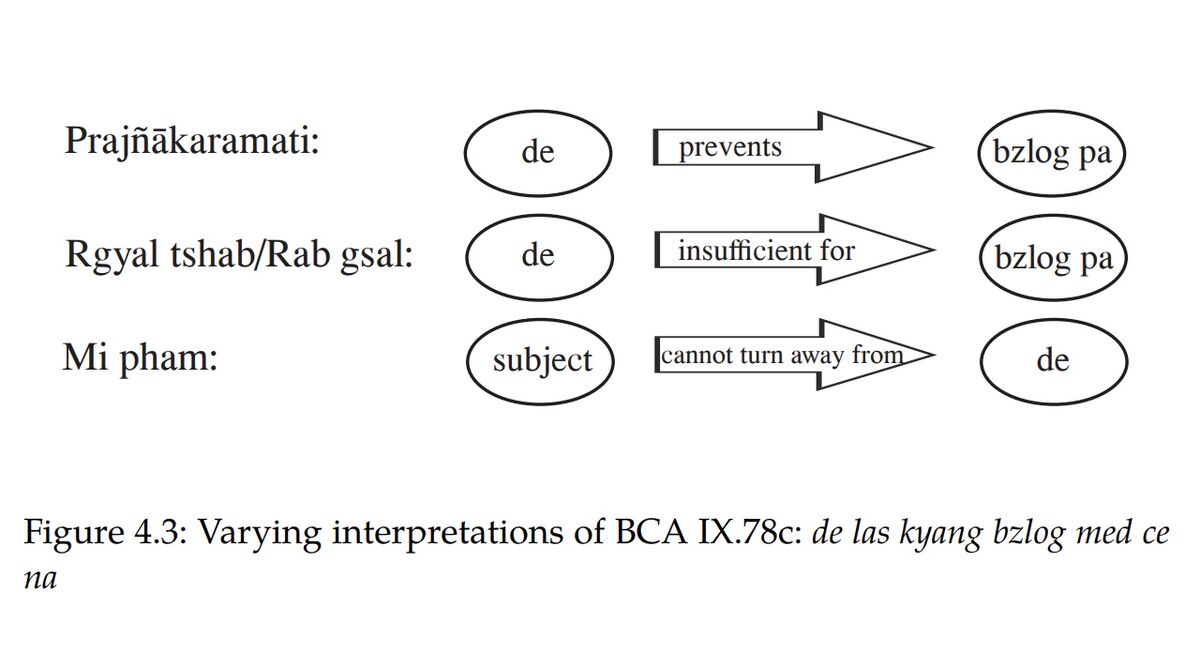
Although Rab gsal's refutation extended also to the commentary on the textual surroundings, including the other verse lines of BCA IX.78, but also its two preceding verses, the main issues remained Mi pham's critical remarks and his interpretation of BCA IX.78c. Along with the earlier topic, the discussion of this second topic is listed under "refuting faults of great impudence" (spyi brtol che ba'i nyes pa dgag pa). Again, Rab gsal's criticism seemed not to be instigated by major doctrinal differences, but by the provocative phrasing found in Mi pham's commentary. To Rab gsal, this was merely a "reflection of a picture of crooked stubbornness and confusion" ('gal 'khrul gya gyu'i ri mo gzugs brynan),[35] a "raising of denials that burdens the scriptures of the great paṇḍitas of the Noble Land with the defilements of one's own faulty explanations,"[36] a "chatter, that has no basis,"[37] etc. By referring to the respective passages in the authoritative commentaries of Prajñākaramati and Kalyānadeva, he pointed out that Mi pham's interpretation is not backed up by the Indian tradition. Mi pham, on the other hand, argued that divergence from the Indian commentaries does not, in itself, constitute a fault, as long as there is no contradiction in meaning. In his response, Rab gsal did not give in to Mi pham's attempt to reconcile his peculiar way of reading with more traditional interpretations. He pointed out that it was Mi pham who had refuted the others in the first place, and hence would contradict himself by claiming consensus with regard to the meaning. Again, refuting this objection seems difficult, and, instead, Mi pham opted to not mention this issue at all in his last letter.
While discussing Mi pham's commentary on BCA IX.78ab, Rab gsal set forth his own understanding of the complete verse. In analogy to Rab gsal's criticism of the content of his reading, Mi pham turned against Rab gsal’s interpretation. In the course of the controversies, Mi pham referred to a couple of valid readings of this passage, and it seems obvious that he also accepted other possibilities of interpretation, not only the one he suggested. Even though he pointed out that his criticism of Rab gsal's understanding was intended as "teasing remarks" (nyams mtshar), rather than as a fully developed attack, arguments on this matter were exchanged and continued up to Mi pham's last letter.
Clearly, the main reason for this debate was Mi pham's refutation of other explanations in his Nor bu ke ta ka. While the acceptance of other interpretations in his later answer suggests that Mi pham's earlier remarks were not intended as strictly as their phrasing might imply, they provided Rab gsal with an opportunity for criticism against which Mi pham could defend himself only with difficulty.
Topic III: The Interpretation of BCA IX.41–49
The question of the general context of this passage of the BCA is already part of the controversies that developed about its interpretation. In the Dge lugs tradition, as expressed in Rgyal tshab's commentary, the section of the verses BCA IX.41–57 is labelled "proving that even for someone who wishes mere liberation, realisation of emptiness is necessary."[38] According to this view, the respective verses show that Śrāvakas and Pratyekabuddhas also need to attain complete understanding of emptiness in order to achieve their desired soteriological goal, which is the state of an Arhat. Yet, in the outline of Rdza Dpal sprul, according to whose explanations Mi pham composed his commentary on the ninth chapter of the BCA, the very same passage "proves that the Mahāyāna is the highest."[39] As the title indicates, this tradition reads this passage of the BCA as a proof that the Mahāyāna is supreme to the Hīnayāna,[40] the path of Śrāvakas and Pratyekabuddhas. As will be shown below, this supremacy is established in one way in terms of the complete realisation of emptiness (the Mahāyāna) as opposed to an incomplete realisation of emptiness (the Hīnayāna). Even though Mi pham uses slightly different titles in his own outline, the content of his commentary follows closely the ideas expressed in the outline of his master.[41]
The passage under consideration starts with the objection of a (Hīnayāna) opponent, questioning the need for the realisation of emptiness to achieve the goal of liberation in BCA IX.41ab: "Liberation is [achieved] because of seeing the truth. Why [should it be achieved] through seeing emptiness?"[42] As Prajñākaramati's commentary explains,[43] the "truth" that was mentioned refers to the "Four Noble Truths" (catvāri āryasatyāni), a core piece of Buddhist doctrine, emphasised particularly in the Hīnayāna tradition. Countering this objection, Śāntideva answers in BCA IX.41cd that the path of emptiness was established by the scriptures as a prerequisite for awakening: "Since the scriptures say that there is no awakening without this path."[44] This is followed by a discussion of the authenticity of the Mahāyāna scriptures, which continues until BCA IX.44. Śāntideva's main aim in this passage is to point out that the same arguments his (Hīnayāna) opponent uses to establish the authenticity of the literary corpus of his tradition equally apply to the Mahāyāna literature.[45] BCA IX.45ab addresses the issue of the beginning of this passage, the need to realise emptiness, from another angle: "The teaching has its root in monkhood, and precisely monkhood hardly exists."[46] Śāntideva argues that the teaching, that is, the doctrine of the Buddha, is based on monkhood. Among the various types of monks, this statement refers to the highest form of monkhood, a monk that is "without kleśas" (bhinnakleśa), as Prajñākaramati points out [47] Such a state then "hardly exists, i.e., is not right without seeing emptiness, is not logical just because of seeing the truth."[48] And, just as true monkhood is not possible without realising emptiness, the same applies to the achievement of the Buddhist goal, that is, nirvāṇa, as BCA IX.45cd continues: "For those whose minds contain references, nirvāṇa, too, hardly exists."[49]
While the earlier verses of this passage form the basis of understanding the latter verses, their literal interpretation was not a point of discussion between Mi pham and Rab gsal. The later part of this passage is a different matter, and it is for this reason that the following verses are also quoted in their Tibetan translation.
In BCA IX.46ab, Śāntideva addresses a possible objection of his opponents:
Objection: Liberation is due to the abandoning of kleśas. Response: Then it must be immediately after that. kleśaprahāṇān muktiś cet tadanantaram astu sā/[50] nyon mongs spangs pas grol na de'i// de ma thag tu der 'gyur ro//[51]
Others might argue that liberation (mukti) is gained by dispelling the kleśas, which is brought about by seeing the Four Noble Truths.[52] In this case, Śāntideva counters, in the rephrasing of his commentator, "it must be, i.e., liberation must come to be, immediately after that, i.e., right immediately after the abandoning of kleśas."[53] That liberation is not achieved immediately after abandoning the kleśas is proven in the other half of this verse, BCA IX.46cd:
And for those a capacity of karman is seen, even though it is without kleśas. dṛṣṭaṃ ca teṣu sāmarthyaṃ niḥkleśasyāpi karmaṇaḥ//[54] nyon mongs med kyang de dag la// las kyi nus pa mthong ba yin//[55]
Śāntideva argues that, even though the kleśas are abandoned, there is still "a capacity, a potential (śākti), that brings forward a[nother] fruit."[56] Hence, as karman is not completely extinguished, this cannot be true liberation. For whom is this the case? Which state of mind does Śāntideva refer to exactly? According to his commentator Prajñakaramati, this refers to people who are devoid of kleśas, and, specifically, to Arhats, such as Maudgalyāyana or Aṅgulīmāla.[57] As will be seen later, the Dge lugs tradition strongly objects to relating this passage to Arhats, and the question of to whom Śāntideva is referring in his explanations can be seen as the key problem in the controversies between Mi pham and Rab gsal.
The following verses in the BCA dwell further on the issue of whether liberation is possible for those people who have abandoned kleśas – be they true Arhats according to the understanding of Prajñākaramati and later Mi pham, or be they Arhats in name only, as understood in the Dge lugs tradition. BCA IX.47ab addresses a possible objection:
Objection: It is ascertained that desire, the cause, does not exist at that time. tṛṣṇā tāvad upādānaṃ nāsti cet saṃpradhāryate/[58] re zhig nyer len sred[59] pa ni// med ces nges pa nyid ce na/[60]
An opponent might argue that for those people who have abandoned kleśas, desire (tṛṣṇā), which is "the cause of rebirth" (punarbhavopādāna),[61] does not exist at the present moment; hence, they are actually liberated and not subject to rebirth. This objection is then rebutted in the latter half of the verse, BCA IX.47cd:
[Response:] Why does desire not exist for them, though it is non-afflicted, like delusion?[62] kim akliṣṭāpi tṛṣṇaiṣāṃ nāsti saṃmohavat satī//[63] sred[64] 'di [65] nyon mongs can min yang// kun rmongs bzhin du ci ste med//[66]
Śāntideva counters that even though those people have abandoned kleśas, desire might still be present in them, but in a "non-afflicted" (akliṣṭa) form. An example of such a form of desire is delusion (moha). In BCA IX.48, the existence of desire in such people is proven through the existence of its cause, feeling (vedanā):
Desire has feeling (vedanā) as its cause and feeling is present in them. A mind that contains references has to abide somewhere. vedanāpratyayā tṛṣṇā vedanaiṣāṃ ca vidyate/[67] sālambanena cittena sthātavyaṃ yatra tatra vā//[68] tshor ba'i rkyen gyis sred pa yin// tshor ba de dag la yang yod// dmigs pa dang ni bcas pa'i sems//'ga' zhig la ni gnas par 'gyur//[69]
Śāntideva argues against those who deny the existence of desire in people, who have abandoned the kleśas, but not realised emptiness, that the presence of desire can be concluded through the presence of its cause, that is, feeling (vedanā). The only method to overcome this and achieve liberation is seeing emptiness, but when the mind clings to an object such as the Four Noble Truths, liberation is doubtful.[70] This thought is continued in BCA IX.49:
Without [seeing] emptiness the mind that is suppressed rises again Just as in non-perceptual concentration (asaṃjñisamāpatti). Therefore, one should cultivate emptiness. vinā śūnyatayā cittaṃ baddham utpadyate punaḥ/ yathāsaṃjñisamāpattau bhāvayet tena śūnyatāṃ//[71] stong nyid dang ni bral ba'i sems//'gags pa slar yang skye ’gyur te// 'du shes med pa'i snyoms 'jug bzhin// des na stong nyid bsgom par bya//[72]
As Prajñākaramati points out, a mind that did not realise emptiness is not liberated, but rises again, "even though it vanished for a short while due to the power of concentration."[73] To illustrate this process, the example of non-perceptual concentration (asaṃjñisamāpatti) is mentioned.
The promulgation of emptiness as the only method to achieve liberation that is expressed in this verse can be seen as the culmination and common aim of the preceding verses. Beginning with BCA IX.45, various consequences of lacking the realisation of emptiness are pointed out: inability for monkhood and nirvāṇa, the presence of karman, the presence of desire – although "non-afflicted" –, the presence of feeling (vedanā), and a mind that contains references. But to whose state of mind do these descriptions refer exactly? In Prajñākaramati's commentary on BCA IX.46cd, Arhats such as Maudgalyāyana or Aṅgulīmāla are explicitly mentioned as the object of the explanations.[74] The question of whether attributes like the presence of karman and desire can be reconciled with the state of a true Arhat – and Śāntideva's intention was thus indeed to relate this whole passage to Arhats – or whether such was not the case, forms the core issue of the controversies that developed between Mi pham and Rab gsal about this passage.
Interpreting This Passage in the Dge lugs School – Scholastic Background
As indicated above, in the Dge lugs tradition the passage under discussion is read as a proof that Śrāvakas and Pratyekabuddhas need to have an understanding of emptiness in order to attain their desired goal, arhatship. The discussion in the BCA, beginning with IX.41, is seen as an argument between a Śrāvaka opponent, who questions the doctrine of emptiness and claims that "liberation, the result of an Arhat, is attained because of cultivating a direct perception of the sixteen aspects of the Four Truths, such as impermanence etc.,"[75] and Śāntideva, who, as a proponent of the Mahāyāna, counters that "even for the attainment of the result of a Śrāvaka- or Pratyekabuddha-Arhat the realisation of emptiness is definitely necessary."[76] In the Dge lugs interpretation, verses BCA IX.45–49 are therefore related to states that are achieved by the path of the Four Truths, but do not necessitate a realisation of emptiness. That means that the subjects of these descriptions are Śrāvakas who did not attain arhatship, since they did not make use of the path of emptiness.[77] This general view also has consequences with regard to the literal annotation of individual verse lines. Discarding all kleśas is asserted to result in achieving the state of an Arhat. Since this passage is understood as not referring to Arhats, the kleśas mentioned in BCA IX.46 must be specified as "manifest (mngon gyur) kleśas." According to this reading, Śāntideva is said to refute the assumption that abandoning only manifest kleśas would result in liberation, since those adepts still have karman for further rebirth, although they are devoid of manifest kleśas.[78] At this stage, Rgyal tshab's commentary makes reference to another reading of this passage by "some commentaries and Tibetans" who relate it to Arhats. Although this is also the intention of Prajñākaramati, as was shown earlier, Rgyal tshab vehemently opposes this way of reading.[79]
The Dge lugs understanding of this passage also affected the interpretation of the following verse, BCA IX.47. In the first part of it, the opponent counters that desire, the cause of further rebirth, is not present in the adepts who practice the Four Noble Truths. The second part is Śāntideva's reply to that, which we have translated above (p.129) in the following way:
[Response:] Why does desire not exist for them, though it is non-afflicted, like delusion? kim akliṣṭāpi tṛṣṇaiṣāṃ nāsti saṃmohavat satī// sred 'di nyon mongs can min yang// kun rmongs bzhin du ci ste med//
Rgyal tshab’s interpretation of this verse differs considerably. It was already noted (p.129) that Rgyal tshab does not relate the pronoun 'di (eṣām) to the adepts, as the Sanskrit text suggests, but directly to desire (sred pa/'tṛṣṇā'). Further, the particle yang (api) is not understood in its restricting function – which we translated as "though” –, but as an indicator of an inclusion. Translating the verse line according to this interpretation leads to a different rendering:
[Response:] Why is there not also this desire that is non-afflicted, similar to delusion?
Rgyal tshab explains this line in the following way:[80]
You must accept also this desire that is non-afflicted according to the explanations in the Abhidharma for the mental continuum of the person who is believed to be an Arhat – why is there not an afflicted and a non-afflicted [sort] according to the explanations in the Abhidharma with regard to desire as well, similar to the acceptance of both an afflicted and non-afflicted [sort] for delusion, i.e., not-knowing, in the Abhidharma.
In Rgyal tshab's view, Śāntideva is implying that the opponent, who is rooted in the Abhidharma explanations, has to accept two kinds of desire, one that is afflicted and one that is non-afflicted – just as such is accepted in the Abhidharma tradition with regard to delusion – and points out that the non-afflicted type of desire is present in the adepts who understood the Four Truths, but did not realise emptiness. Rgyal tshab emphasises further that this differentiation of afflicted and non-afflicted desire is acknowledged in the opponent's own tradition, but not in the way desire is understood in his (and Śāntideva's) – Prāsaṅgika – system.[81] The adept in question then, is described as having abandoned one (the afflicted) kind of desire, the desire that derives from grasping a self as a self-sufficient entity, but not another (the non-afflicted) kind of desire, the desire that derives from grasping a self that is inherently established (ngo bo nyid kyis grub pa):[82]
Therefore, [Śāntideva's statement] says: even though the manifest desire that derives from self-grasping that conceives a person to be self-sufficient, substantially existent (rdzas yod), is abandoned at that time, why is there not the desire that derives from the view of the transitory [collection to be the self] ('jig lta) that conceives a person to be inherently established (ngo bo nyid kyis grub pa) […].
Clearly, an adept who views a person as inherently established cannot be an Arhat. Rgyal tshab once again opposes the position that understands this passage as referring to Arhats and understands the intention of this passage to be that "Śrāvakas and Pratyekabuddhas lack the realisation of the selflessness of phenomena."[83] According to him, this passage shows that also Śāntideva, "this Ācārya" (slob dpon 'di), accepts that grasping persons and phenomena as truly established (bden 'dzin) is a form of kleśa, that is, obscuration of afflictions (nyon sgrib), a thought that is explained in more detail in Tsong kha pa's Dgongs pa rab gsal.[84] Even though this text is a commentary on Candrakīrti's famous Madhyamakāvatāra, it contains a detailed discussion of the present passage of the BCA, which must be regarded as the basis for Rgyal tshab's explanations of the relevant part of the BCA.[85] In his commentary on Madhyamakāvatāra I 8d,[86] Tsong kha pa discusses the realisation of Śrāvakas and Pratyekabuddhas and that of Bodhisattvas:[87]
Thus, Bodhisattvas outshine Śrāvakas and Pratyekabuddhas also through their generation of mental power (blo'i stobs), only after having seized the dūraṅgamābhūmi; on the sixth bhūmi and below, it is not the case that [those] outshine [them] through [their] mental power.
Proving that the realisation or "mental power" of Śrāvakas and Pratyekabuddhas and of Bodhisattvas is the same prior to the seventh bhūmi implies that Śrāvakas and Pratyekabuddhas also have an understanding of emptiness. Tsong kha pa further points out that the Prāsaṅgika system classifies grasping as truly established (bden 'dzin) as obscuration of afflictions and accepts that this kind of grasping, together with its seeds, is abandoned by Śrāvakas and Pratyekabuddhas, too.[88] In the Dge lugs tradition, the question of the realisation of emptiness by Śrāvakas and Pratyekabuddhas and the distinction between obscuration of afflictions (nyon sgrib) and obscuration of knowables (shes sgrib) are key issues for their understanding of the Prāsaṅgika approach, a philosophical view that the Dge lugs school, in particular, emphasises as the highest among the various Buddhist systems. The most prominent manifestation of the Dge lugs appreciation of the Prāsaṅgika approach is a work called Dka' gnad/gnas brgyad, a text that defines the eight characteristics of the Prāsaṅgika approach from a Dge lugs viewpoint.[89] In the sixth chapter of this work, the Prasaṅgika tradition is distinguished by its assertion that the Śrāvakas and Pratyekabuddhas' realisation of emptiness extends to phenomena (dharma) and is not to be limited to persons, as the Svātantrika tradition claims.[90] There, understanding the emptiness of phenomena is described as a prerequisite for attaining the state of an Arhat,[91] the issue that is debated in the controversies concerning the present passage of the BCA. In chapter seven,[92] the Svātantrika approach is characterised as one that accepts grasping [things] as truly established (bden 'dzin) and the seed of this grasping as obscuration of knowables (shes sgrib/jñeyāvaraṇa), while the Prāsaṅgika tradition asserts the very same to be obscuration of afflictions (nyon sgrib/kleśāvaraṇa). Since Arhats are held to have abandoned obscuration of afflictions, this classification implies that Arhats have also abandoned grasping [things] as truly established (bden 'dzin), and hence have understood emptiness.[93] While these characteristics are presented in a systematic way in the Dka' gnad/gnas brgyad, they also appear in Tsong kha pa's Dgongs pa rab gsal. Here, Tsong kha pa refers to the present passage of the BCA as a proof of his own position in the interpretation of Madhyamakāvatāra I 8d, which argues that Śrāvaka and Pratyekabuddha-Arhats do indeed realise emptiness. While explaining BCA IX.41–48 in detail, Tsong kha pa opposes the position of "some commentators and Tibetans," which relates this passage to Arhats who have abandoned all kleśas.[94] If one understood this passage as referring to Arhats, it would not only deprive Tsong kha pa of an argument in favour of his interpretation of the Madhyamakāvatāra, but it would also criticise two of the cornerstones of the Dge lugs understanding of the Prāsaṅgika tradition. There is no need to investigate Tsong kha pa's explanation of this passage in more detail, as the important aspects have already been discussed in the presentation of Rgyal tshab's commentary, which follows the model of his master very closely, at times even literally. It is, however, important to consider the immense doctrinal background that is connected to this specific passage of the BCA. . . .
Synopsis
The central issues in the controversies connected to this topic are the questions of the overall role of the passage BCA IX.41–49 and whether the descriptions of religious adepts lacking a realisation of emptiness found in the later part of this passage, BCA IX.45–49, refer to (true) Arhats or not.
In the Dge lugs tradition, represented by Rgyal tshab's commentary on the BCA, but also by Tsong kha pa's Dgongs pa rab gsal, which discusses the relevant verses of the BCA in detail, this passage was read as a proof that realisation of emptiness is required for attaining the state of an Arhat. As such, this passage became important for key elements in the Dge lugs conception of Prāsaṅgika doctrine, such as the realisation of emptiness of Śrāvaka- and Pratyekabuddha-Arhats and the distinction between obscuration of afflictions (nyon sgrib) and obscuration of knowables (shes sgrib), presented systematically in the Dka' gnad/gnas brgyad, the standard definition of Prāsaṅgika thought as it is conceived in the Dge lugs tradition.
Mi pham, in contrast, read this passage as a proof of the supremacy of the Mahāyāna over the Hīnayāna tradition, whereby the latter's inferiority is established as a lack of (complete) understanding of emptiness. Śāntideva's descriptions of religious adepts that lack this realisation in BCA IX.45–49 must therefore refer to Arhats, an interpretation that is also supported by the Indian commentaries. According to Mi pham, the Dge lugs understanding of this passage is seen as a misinterpretation that neglects the Indian tradition to save its own doctrinal stance:[95]
The section of these verses of the "Chapter of Insight" (i.e., the ninth chapter of the BCA) is important as a source for the Śrāvakas and Pratyekabuddhas' lack of complete realisation of emptiness. Therefore, since [you] worried about harm for the position of your own tradition, [you] created a new way of explanation that pulled [the original] to a different meaning.
Mi pham thus attacked the Dge lugs interpretation explicitly in his commentary on the BCA. In so doing, he addressed not only the general issue of whether this passage refers to Arhats or not, but also refuted specific ways of literal interpretation of certain verses that had been chosen in the Dge lugs tradition, most importantly in connection to BCA IX.46 and 47.
Naturally, this disapproval of Mi pham's formed the main subject of Rab gsal's criticism, who had to rebuke Mi pham's remarks in order to defend the tradition of his forebears. In his perception, Mi pham's explanations are merely "a slipping out of harsh words (brdab tshig) that – driven by the wind of conceptions and bad karman"[96] – have pursued a dwelling in the Crushing Hell (bsdus 'joms dmyal ba),[97] "aimless gossip,"[98] "a [piece of] Bi sha tsi[99] advice that is neither Indian nor Tibetan,"[100] etc. He even extended his criticism to Mi pham as a person, whom he described as a "great drunkard"[101] and "possessed by the demon of terrible hatred."[102]
Among the various issues raised in the controversies, Mi pham's argument that the Indian tradition, too, relates this passage to Arhats (as shown in Prajñākaramati's commentary on BCA IX.46) is of particular importance. Rab gsal did not deny that the Indian commentaries related this passage to Arhats, but he confined the role of scriptural authority: all scriptures must be investigated as to whether they have to be understood literally, or whether they point to a meaning that is different from the literal one, a task that can only be accomplished by the use of reasoning. While Mi pham, in turn, accepted Rab gsal’s argument in general, he was doubtful about its underlying motivation, suggesting that Rab gsal simply wanted to save his own tradition.
All in all, it seems that both parties persistently insisted on their respective points of view, positions, which were – by both parties – not considered a mere personal choice, but as being based on the firm ground of the respective religious traditions. Other than with regard to the earlier topics, Rab gsal classified the aspects he criticised in Mi pham's commentary as "faults that are raised after examination" (brtag zin bslang ba'i nyes pa), thus assuming that the criticism that Mi pham stated against the Dge lugs interpretation was preceded by a process of thorough investigation. In his response, Mi pham described the exegetical differences as being based on the religious affiliations, that to the Snga rabs pa tradition in the case of Mi pham, and that to the Phyi rabs pa tradition in the case of Rab gsal. For both philosophers, understanding the opponent's position as a part of a larger tradition did, however, not imply that this position was acceptable.
While this is the case for the general issue of relating the relevant passage of the BCA to Arhats, it is also true for the question of the status of ālaya and svasaṃvedana, a topic that is not directly connected to the current passage of the BCA, but that was introduced into the discussion on it and received much attention, owing to its importance in doctrinal terms.
Topic IV: Issues Related to BCA IX.2
Unlike the earlier three topics, this section is not committed primarily to the specific interpretation of a certain passage of the BCA. Instead, a passage from Śāntideva's work serves as a departure point for a more general discussion. In his outline, Rab gsal refers to the issues at stake as "[faults] that are connected to the principle (tshul) of satyadvaya."[103] The concept of "satyadvaya" is arguably the most central element in Madhyamaka philosophy (as indicated, for example, by the production of secondary literature dealing explicitly with this idea).[104] In the secondary literature, satyadvaya is commonly translated as the "two truths" or "two realities," thus emphasising either its epistemological or ontological aspect. Since both aspects are important in the present discussion, I refrain from translating this technical term and will use the Sanskrit term in order to accommodate all possible conceptions associated with it.[105] In the BCA, the concept of satyadvaya is introduced and most concisely formulated in BCA IX.2:
saṃvṛti (conventional) and paramārtha (absolute),[106] these are considered as the two satyas. Reality (tattva) is not the sphere of mind (buddhi); mind is said to be saṃvṛti.[107] //saṃvṛtiḥ paramārthaś ca satyadvayam idaṃ matam/ buddher agocaras tattvaṃ buddhiḥ saṃvṛtir ucyate//[108] kun rdzob dang ni don dam ste// 'di ni bden pa gnyis su 'dod// don dam blo yi spyod yul min// blo ni kun rdzob yin par brjod//[109]
In the Nor bu ke ta ka, Mi pham's commentary on this specific verse is the most detailed among all verses of the BCA. It starts with a succinct explication of Śāntideva's words and proceeds with a more general introduction to the fundamental features of Mi pham's Madhyamaka thought (issue that are, of course, all related to the principle of satyadvaya, discussed in BCA IX.2). Thereby, Mi pham presented his ideas often in sharp contrast to the way these doctrinal issues were accepted in the mainstream Dge lugs tradition, and was therefore attacked by Rab gsal.[110] Considering the importance of Madhyamaka thought as the supreme philosophical system accepted by all Tibetan Buddhist traditions, the extent to which the two adversaries discussed this fourth topic, in particular, is not surprising. Rab gsal devoted nearly half of his first criticism to the discussion of this topic; this is actually exceeded by Mi pham, whose answer to these issues stretches over two hundred pages, three-quarters of his first reply to Rab gsal. The extension of this topic poses – even more than is the case with the earlier topics – the problem of how its content can be summarised in a reasonable way. In order to decide which individual issues form the core elements of the present topic, I have relied upon Rab gsal's treatment of this topic. In his criticism, Rab gsal formulated the "opponent's position" (phyogs snga), a position that is drawn from Mi pham's statements in the Nor bu ke ta ka and which formed Rab gsal's principal target, in the following fashion:[111]
In the Ṭikka (i.e., the Nor bu ke ta ka)[112] it is stated: non-existence of true establishment (bden med) is the mere nominal (rnam grangs pa) absolute (don dam), and emptiness that is free from all extremes is the actual (rnam grangs ma yin pa) absolute proper. In the Svātantrika scriptures, explanations are given emphasising the former, and in the Prāsaṅgika scriptures, [explanations are given emphasising] the latter. The way of existence of things, paramārthasatya, is free from all extremes of existence, non-existence, etc., and hence not the sphere (spyod yul) of mind (blo), since mind and words (sgra) are conventional (kun rdzob), but are not absolute (don dam pa).
Among the many explanations that Mi pham gave in the Nor bu ke ta ka (and which are also addressed in the following controversies), Rab gsal chose this as expressing the core of his opponent's view. Altogether, it comprises four principal issues.
Firstly, Mi pham's refutation of a certain conception of emptiness and, secondly, his proposition of an alternative view, both of which issues aim at a correct conception of emptiness. In the summary of his adversary, Mi pham is said to oppose the position that mere non-existence of true establishment (bden med) is the ultimate form of emptiness. Instead, he views this non-existence as a provisional conception of emptiness, here denoted as the "nominal (rnam grangs pa) absolute." Ultimate emptiness, the "actual (rnam grangs ma yin pa) absolute," in contrast, should be free from all proliferations (spros pa) and all four extremes, i.e., the extremes of existence, non-existence, both, and neither.
The third issue discusses how emptiness is conceived of in the two principal traditions of Madhyamaka thought, i.e., the Svātantrika and the Prāsaṅgika.
The last issue concerns the interpretation of the latter part of BCA IX.2 and the question of whether the absolute can be described as an object of mind (blo) and words (sgra), or not.
A review of the relevant passages confirms that these four issues can be seen as the key elements of the controversies, and it is for this reason that the following presentation of the fourth topic will focus solely on these selected problems.[113] It will start with an – admittedly brief – glance at the (mainstream) viewpoint on the particular topic in the Dge lugs tradition, and then contrast it with Mi pham's explanations in the Nor bu ke ta ka, and continue with the development of the debates proper.
Emptiness as Non-existence of True Establishment (bden med)
Madhyamaka philosophy is intrinsically connected with the idea that all phenomena (dharma) are empty (śūnya), and hence its proponents are synonymously called Mādhyamika, Śūnya(tā)vādin, or Niḥsvabhāvavādin.[114] There are, however, considerable differences concerning the precise understanding of emptiness. The premise that something is empty leads to the question of what exactly it is empty of or what is negated – or, using the (Tibetan) technical terminology: what is the object of negation/the negandum (dgag bya) of Madhyamaka analysis? The specification of, and answer to, this question became a central issue in the Dge lugs school. Its founder, Tsong kha pa, considered the identification (ngos 'dzin) of the negandum to be of the utmost importance for the correct understanding of emptiness:[115]
In order to be sure that a certain person is not present, you must know the absent person. Likewise, in order to be certain of the meaning of "selflessness" or "the lack of intrinsic existence," you must carefully identify the self, or intrinsic nature, that does not exist. For, if you do not have a clear concept of the object to be negated, you will also not have accurate knowledge of its negation.
According to Tsong kha pa, analytical reasoning and meditative practice in the Madhyamaka tradition must first have a clear understanding of the negandum, that is, an inherent nature or essence (ngo bo) that is conceived as "truly established" (bden grub), in order to counteract and refute this conception.[116] Among the two commonly accepted ways of refutation – a non-implicative negation (med dgag) and an implicative negation (ma yin dgag) – the Dge lugs tradition accepts the former as corresponding with the highest form of paramārtha (satya).[117] Emptiness or paramārtha (satya) – as understood in the Dge lugs tradition – can thus be summarised as the "nonexistence of a truly established essence in the form of a non-implicative negation" – or, in the Tibetan terminology, a "bden med med dgag."[118] This conception of emptiness is also employed by Rgyal tshab in his commentary on BCA IX.2:[119]
Moreover, if the conventional is empty of true [establishment], then the acceptance of this very emptiness of true [establishment] (bden stong) as paramārthasatya can in no way be disproven. If this were not the case, then the conventional would become truly established (bden grub).
Again, emptiness as a mere absence of a truly established essence (bden grub kyi ngo bo) is described as paramārthasatya, and it is precisely this conception of the ultimate emptiness or absolute as bden med med dgag that became the object of the controversies between Mi pham and Rab gsal. . . .
Synopsis
With its discussion of the concept of satyadvaya, the second verse of the ninth chapter of the BCA became of the utmost importance for understanding the principle issues of Madhyamaka philosophy. Later generations of Indian as well as Tibetan thinkers placed this verse at the centre of their respective interpretation of Madhyamaka thought and used it to argue for their position. It figures prominently in all related philosophical controversies in Tibet, and a major part of the debate between Mi pham and Rab gsal is also connected to this single verse.
The distinction of two "truths" or "realities" – saṃvṛtisatya and paramārthasatya – that this verse introduces was understood in various ways. Within the Dge lugs tradition, for example, paramārtha – the "absolute" – was conceived of as a lack or negation of a truly established essence (ngo bo bden grub) of saṃvṛti – the "conventional." Of the two possible ways of negation, a non-implicative negation (med dgag) was seen to correspond to the actual (rnam grangs ma yin pa) or ultimate (mthar thug pa) absolute.
It is precisely this conception of the highest form of emptiness or the absolute as bden med med dgag that Mi pham criticised in his Nor bu ke ta ka. In this work, he divided the absolute into two kinds, a provisional form of the absolute, termed "nominal" (rnam grangs pa) absolute, and an "actual" (rnam grangs ma yin pa) absolute. For him, the conception of emptiness as a "mere non-implicative negation" (med dgag tsam) eliminates only the extreme of existence (yod mtha') and conforms to the earlier, provisional form of the absolute, while the actual absolute must go beyond that and transcend all four extremes of existence, non-existence, both, and neither. Mi pham did not formulate his explications as a direct criticism of the Dge lugs tradition, but it is clear that he was aiming specifically at the established doctrinal position of this school.
In his attempt to defend the doctrines of his native tradition, Rab gsal accused Mi pham of various contradictions: his position was not in accordance with the authoritative (Indian) scriptures, it contradicted other statements by Mi pham himself, and it deviated from the laws of logic and led to a nihilistic view.
Mi pham's reply to the first accusation is especially remarkable: quoting more than one hundred and fifty passages from numerous scriptures, he tried to prove that in the Indian scriptures too, emptiness was not described as a mere negation. In his later reply, Rab gsal countered this evidence by arguing that all these scriptures refer to a particular context, namely when the absolute is fathomed by an intellectual process of reasoning. Depending on this particular state of mind, only the nominal absolute can be approached. This would, however, not affect the established doctrine of the Dge lugs school that views the absolute in general as a mere absence of an established essence (ngo bo bden grub).
In his approach to the other objections made by Rab gsal, Mi pham argued for a distinction of levels. In a certain context, for example, when teaching emptiness, this emptiness may very well be described as a negation and also formulated by closely following logical principles. This form of emptiness pertains to the nominal absolute. Ultimately, however, emptiness goes beyond the limitations of language and logic, and is, as such, not restricted to a mere negation of existence, but is free from all kinds of proliferations.
Both Rab gsal and Mi pham distinguish between nominal and actual absolutes to delineate different levels of the absolute. However, while for Rab gsal this distinction seems important only for distinguishing different modes of cognising emptiness, for Mi pham any cognition that views emptiness as a mere negation is not getting at the ultimate absolute. The main difference between Mi pham and Rab gsal is to be seen in the way they emphasise the negational aspect of emptiness, and as this issue is firmly established in the respective doctrinal positions, it is not easily resolved.
Ultimate Emptiness and Freedom from Extremes
The first issue was mainly concerned with Mi pham's opposition to viewing mere non-existence of true establishment (bden med) as the ultimate form of emptiness and the controversies that evolved out of this; the second issue, in contrast, focused on Mi pham's alternative conception of the ultimate absolute as being beyond all extremes.
It is commonly accepted that Madhyamaka philosophy should culminate in a view that neither tends to the extreme of annihilation (chad mtha'), nor to the extreme of eternalism (rtag mtha'). This position is expressed by the fundamental Madhyamaka statement that things are "neither existent nor non-existent" (yod min med min).[120] Following Tsong kha pa, this formulation is, however, not to be understood literally: applying such contradictory qualities as "existent" and "non-existent" to a single logical subject is not possible, as these qualities are said to be mutually exclusive (phan tshun gzhan sel ba).[121] Tsong kha pa solves the apparent contradiction by adding a specification: "neither existent nor non-existent" is rightly understood as "neither existent on the absolute level nor non-existent on the conventional level."[122] While for Tsong kha pa and his followers this represents a correct concept of the unity of the two satyas, which avoids leaning towards either extreme, Mi pham confronts the Dge lugs tradition with a different understanding. . . .
Synopsis
As commonly accepted, Madhyamka philosophy culminates in a view that escapes both the extreme of eternalism (rtag mtha') and the extreme of annihilation (chad mtha'). In their precise understanding on how this can be achieved, however, Tibetan philosophers disagreed.
In the Dge lugs tradition, the fundamental Madhyamaka statement that things are "neither existent nor non-existent" was interpreted – in order to follow logical principles – by adding certain specifications: understood correctly, it means that things are "neither existent on the absolute level nor non-existent on the conventional level." For Mi pham, in contrast, this view is based on a conception of the two satyas as separate, and conforms to the way emptiness is approached in the Svātantrika tradition with a – temporary – emphasis on the nominal (rnam grangs pa) absolute. A direct approach to the actual (rnam grangs ma yin pa) absolute – the characteristic of the Prāsaṅgika tradition, as it is seen by Mi pham – goes beyond the dichotomy of existence and non-existence and is free of all modes of grasping ('dzin stangs), assertions (khas len), proliferations (spros pa) with regard to all four extremes, existence, non-existence, both, and neither, and thereby realises the unity or coalescence of the two satyas.
Rab gsal argued that the Dge lugs interpretation of the unity of the two satyas as non-existence on the absolute level and existence on the conventional level is not an invention of his own tradition, but corresponds to the intention of authoritative scriptures. For him, the combination of two types of cognitions is essential: while the realisation of non-existence on the absolute level does not refute the extreme of annihilation, the elimination of this extreme is effectuated by the realisation of existence on the conventional level. Mi pham's demand to go beyond this concept would, according to Rab gsal, inevitably lead to a nihilistic position – similar to that of Hwa shang Mahāyāna – where any mental activity is seen as a hindrance to awakening.
With regard to this issue, too, both positions seem to be firmly established in the doctrinal background of the two adversaries. In its approach to the unity of the two satyas, the Dge lugs tradition emphasised logical principles, while for Mi pham, the absolute is ultimately beyond logic and language. Both, however, agreed that the realisation of a unity of the two satyas is of the utmost importance; in his last letter, Mi pham made some conciliary remarks to the effect that Rab gsal's concept of the two satyas would also be capable of refuting both the extreme of permanence (rtag mtha') and the extreme of annihilation (chad mtha').
Svātantrika and Prāsaṅgika
The classification of Indian Madhyamaka as Svātantrika or Prāsaṅgika is known to be problematic. Ostensibly not an Indian invention, this distinction reflects an attempt to systematise an intricate tradition made by Tibetan doxographers in the eleventh century.[123] While all later Tibetan philosophers readily use this distinction in their categorisation of their Indian predecessors, as well as a means of self-identification and delimitation of their own doctrinal space, the role they ascribe to this distinction varies. Tsong kha pa, the founder of the Dge lugs tradition, is particularly famous for conceiving of a fundamental difference between the two Madhyamaka traditions and emphasising the supremacy of the Prāsaṅgika. This is expressed inter alia in the Dka' gnad/gnas brgyad, a work that formulates the "eight difficult points," i.e., the eight core characteristics of the Prāsaṅgika tradition.[124] For other Tibetan scholars, such as Rong ston (1367–1449) and Go rams pa (1429–1489), the differences are minor and consist only in methodological issues.[125] The exact characterisation of each of these two Madhyamaka traditions, as well as the general problem of the nature of their differences, have been issues of dispute throughout Tibetan history and were naturally also a "hot topic" in the debates between Rab gsal and Mi pham discussed here. . . .
Synopsis
Since the eleventh century, Tibetan philosophers have been using the distinction between Svātantrika and Prāsaṅgika to systematise the Indian Madhyamaka tradition, and also to demarcate their own doctrinal space. The role they ascribe to this distinction, however, varies. While earlier Sa skya scholars, such as Rong ston and Go rams pa, perceived it as concerning mainly methodological issues, the Dge lugs tradition, beginning with its founder Tsong kha pa, emphasised a fundamental difference between both traditions and established the supremacy of the Prāsaṅgika.
While Mi pham uses this distinction to delineate two different approaches to the absolute, he followed his intellectual predecessors by emphasising their common ultimate aim. For Mi pham, the Svātantrika is characterised by a – temporary – focus on the nominal (rnam grangs pa) absolute that entails a separation of the two satyas, conceiving of things as "neither existent on the absolute level, nor non-existent on the conventional level." In so doing, Mi pham ascribed to the Dge lugs stance on satyadvaya a close connection to the way emptiness is approached through the methodology of the Svātantrika tradition, a tradition from which the Dge lugs school tries hard to distance itself. For Mi pham, however, this approach is only of provisional importance. Ultimately, the Svātantrika, too, arrives at understanding emptiness or the absolute to be free from all proliferations and extremes, a realisation, which the Prāsaṅgika tradition aims at from the very beginning.
While Mi pham ascribed to the Dge lugs school a close resemblance to the Svātantrika tradition, this specific aspect, did not figure prominently in the later discussions. Instead, Rab gsal decided to directly criticise Mi pham's explanations of the two approaches, often by pointing out contradictions between individual statements. He also attacked Mi pham for playing down the fundamental difference between Svātantrika and Prāsaṅgika that is accounted for in his school.
In his answer, Mi pham seized the opportunity to further clarify his understanding of the two traditions, giving lengthy explanations of this matter. As before, he pointed out that a difference between them is legitimate, but only of a superficial nature; their ultimate aim is the same.
It seems that, owing to the heavy doctrinal weight that is connected with this issue, progress in the sense of an approximation of claims was not possible; instead, the debate remained restricted, for the most part, to the repetition of established doctrinal positions.
The Absolute as An Object of Mind (blo) and Words (sgra)
Until now, we have discussed the different concepts of the absolute set forth by Mi pham and Rab gsal, as well as the perspectives of the two Mādhyamika traditions, the Svātantrika and the Prāsaṅgika, in this matter. The last of the four issues of this fourth topic pertains to another "hot topic" in Madhyamaka philosophy specifically, but also in the Buddhist tradition as a whole. Buddhist scriptures, especially of the Prajñāpāramitā genre, describe the absolute (paramārtha) as inconceivable and beyond the scope of linguistic expression. On the other hand, it is commonly accepted, and also communicated in the literary corpus of Buddhism, that the Buddhist path leads to a realisation of the absolute and that this path uses oral or written instructions as guidance. In his seminal paper on this problem, Seyfort Ruegg summarised this tension in the following way:[126]
In other words, if the paramārtha is altogether unthinkable and unknowable, is not absolute reality in its function as the base or ground of spiritual practice – i.e. the prakṛtisthagotra or tathāgatagarbha – cognitively quite inaccessible also? And in this case are we not faced with a curios and rather paradoxical situation in which an absolute that is immanent in all beings from the soteriological point of view would nonetheless be altogether transcendent from the gnoseological point of view?
As Buddhism developed, different scholars took diverging stances on this matter, especially in the Tibetan tradition. In arguing for the respective positions, the second half of BCA IX.2 was frequently mentioned, which was translated above as follows:
Reality (tattva) is not the sphere of mind (buddhi); mind is said to be saṃvṛti.[127]
This passage seems to state clearly that the absolute or reality as such is beyond cognition and hence it was used by Tibetan philosophers – in particular by those belonging to other schools than the Dge lugs – as an argument for the inconceivable and inexpressible nature of the absolute. Scholars from the Dge lugs tradition, in contrast, objected to this, insisting that this passage should not be interpreted in a literal way, as Sweet explains:[128]
The Geluk view, exemplified by Gyaltshap (Rgyal Tshab) and Tsgonkhapa [sic], holds that the second half of this stanza should not be taken in its literal sense, because if ultimate truth were not the object of some type of intellectual understanding, it would be unknowable, and it would therefore follow that all religious practice aiming at the realization of the ultimate would be in vain. The earlier Sakya and later Nyingma commentators dissented from this line of interpretation, arguing that ultimate truth "cannot be objectified by the mind because it transcends all discursiveness (prapañca)," although these commentators do affirm a non-intellectual intuition of the ultimate.
The passage Sweet quoted as representative for the view of the Sa skya and Rnying ma commentators stems from Mi pham's Nor bu ke ta ka[129] and, as expected, this position was sharply criticised by Rab gsal. As noted by Sweet, the Dge lugs tradition opted against a literal understanding of this passage. In his commentary, Rgyal tshab clearly refutes the position that the absolute is not a knowable (shes bya). As he points out, the basis of dividing (dbye gzhi) the two satyas is knowables.[130] Following this definition, both satyas are knowables and hence a literal interpretation of the BCA is contradictory:[131]
Therefore, explaining the intention of the Bodhicaryāvatāra to be that paramārthasatya is not a knowable (shes bya) and is not realised by any [kind of] mind is explaining wrongly.
Understanding the BCA in a literal way, according to Rgyal tshab, would mean that no mind whatsoever could realise the absolute. This interpretation would lead to certain unwanted consequences, such as that a mind would not be present when one meditates on the absolute.[132] Following Rgyal tshab's view, the absolute is only excluded as an object for a dualistic (gnyis su snang ba) mind; it is, however, known by direct valid cognition (mngon sum tshad ma). . . .[133]
Synopsis
The tension between descriptions of the absolute (paramārtha) being inconceivable and beyond the scope of linguistic expression on the one hand, and, on the other, the principal claim that the absolute can be realised by following the Buddhist path, using oral or written instructions as guidance, is fundamental in Buddhist scholasticism. In the doctrinal positions that developed concerning this problem, the second half of BCA IX.2 was of particular importance. Understood literally, this verse clearly stated that the absolute is not an object of mind, and it is this position that was taken in the Snga rabs pa tradition of Tibetan Madhyamaka philosophy, to which Mi pham belongs. In the Phyi rabs pa tradition, headed by Tsong kha pa and his Dge lugs school, such an interpretation was strongly refused; instead, this tradition argued that both satyas must be knowables (shes bya). The passage of the BCA must be interpreted so that the absolute is only excluded as an object for a dualistic (gnyis snang) mind.
In his commentary, Mi pham clearly followed in the footsteps of his predecessors and opted for a literal interpretation of the respective verse line. However, he also declared that – on the level of ordinary conventions – it is possible to describe the absolute as a knowable (shes bya), and hence as an object of mind. For him, the controversy is only superficial and merely a matter of designation.
Rab gsal's criticism seemed to aim only at a simplified version of Mi pham's complex explanations, namely, the plain interpretation that the absolute is not a knowable. Viewing it as a direct attack on the doctrines of his own school, Rab gsal objected to Mi pham's position by pointing out contradictions between this position and the authoritative Indian scriptures, and also other statements of the Nor bu ke ta ka. In his reply, Mi pham pleaded again for a more nuanced picture. On the level of ordinary conventions, the absolute can indeed be described as a knowable (shes bya); however, it is not the object of a referential (dmigs can) or dualistic (gnyis snang) mind. For Rab gsal, these concessions exhibit again the contradictory nature of Mi pham's explanations; furthermore, he also interpreted them as a betrayal of Mi pham's own doctrinal background. In view of these entrenched positions, Mi pham did not take up this particular issue in his last letter.
While it seems that Mi pham tried from the very beginning to mediate between the traditional positions on this important question, stances taken in the Snga rabs pa and the Phyi rabs pa traditions, Rab gsal was not willing to take a step in this direction. In view of this situation, both parties stuck to their original positions without modifying these in any substantial way in the ongoing discussion.
Notes
- ↑ The counting of the verses of the BCA follows Oldmeadow 1994.
- ↑ For my translation of the root text I used the explanations in Prajñākaramati's commentary (BCAP), as well as its translation by Peter Oldmeadow (1994). The translation of the term parikara is in particular problematic. In his commentary (as edited by La Vallée Poussin), Prajñākaramati gives the following explanation regarding the literal meaning of parikara: parikaram iti parivāraṃ paricchedaṃ saṃbhāram iti yāvat (BCAP 344.7–8); here and below, bold print marks elements of the original text in the commentary. Considering that this passage seems to point out the mere literal meaning of the term (and as we can see in the course of the BCAP such a mere gloss of a certain word is a very typical feature of Prajñākaramati's commentary) and comparing it with the Tibetan translation of this passage, I share Oldmeadow's doubt (1994: 4, n.4) that paricchedaṃ might better be changed to paricchadaṃ. Thus, Prajñākaramati explains parikara (entourage) as retinue (parivāra), following (paricchada), and gathering or collection (sambhāra). BCAP 350.8 explains kāṅkṣā (wish) as desire (abhilāṣa) and wish or will (chanda); BCAP 350.6–7 glosses nivṛtti (cessation) as extinction (nirvāṇa) and pacification (upaśama).
- ↑ Cf. BCAP 344.4–5.
- ↑ yi D: yis P.
- ↑ Cf. BCA (D, fol. 30b7–31a1; P, fol. 35a3–4); for the Tibetan text of the BCA, the Derge as well as the Peking edition were compared.
- ↑ Dietz (1999: 35ff.) gives an overview of the ten Indian commentaries that are contained in the Tibetan Bstan 'gyur and characterises the BCAP as the most important among them. In the course of the debate between Mi pham and Rab gsal, both scholars refer repeatedly to the Indian commentaries to support their respective interpretations. Thereby, the references to the BCAP outnumber by far the references to the other commentaries, showing evidently that both scholars accept Prajñākaramati as the primary Indian authority on the BCA.
- ↑ Cf. BCAP 344.11–13.
- ↑ Cf. BCAP 344.14–345.5
- ↑ BCAP 345.9–10: taddhetubhāvam adhigacchanti/ pāramitānāmadheyaṃ ca labhante/.
- ↑ Cf. BCAP 345.17–346.4.
- ↑ BCAP 346.4: tasmād dhānādiparikaraḥ prajñārtha iti siddhaṃ//.
- ↑ For this second interpretation, see BCAP 348.4–349.5.
- ↑ Rgyal tshab Dar ma rin chen (1364–1432) was a direct disciple and one of the two main followers of Tsong kha pa, the founder of the Dge lugs school. As such, his scholastic interpretations – including his commentary on the BCA – have shaped the view of future generations fundamentally. For his dates, see TBCR, http://www.tbrc.org/#library_person_Object-P65 [accessed March 03, 2011]. In his commentary Spyod 'jug rnam bshad rgyal sras 'jug ngogs ('Jug ngogs) Rgyal tshab's explanations of the ninth chapter of the BCA are very closely related to his teacher Tsong kha pa's work on the very same chapter, called Spyod 'jug shes rab le'u'i tīkka blo gsal (Blo gsal). The colophon of the Blo gsal does not mention an author, but suggests that it contains Tsong kha pa's elaborations that were later written down by one of his disciples; cf. Blo gsal 36b5ff. This idea is shared by Seyfort Ruegg, who also mentions another work, the Shes rab le'u'i zin bris, which also contains explanations of Tsong kha pa on the ninth chapter of the BCA that were written down by his disciple Rgyal tshab; see Seyfort Ruegg 2004: 337, n. 33. In the present investigation, Rgyal tshab's 'Jug ngogs and Tsong kha pa's Blo gsal are used as representatives for the standard tradition of textual exegesis of the ninth chapter of the BCA in the Dge lugs school. For a translation of Rgyal tshab's commentary, see Sweet 1977.
- ↑ Cf. 'Jug ngogs 206.12–14.
- ↑ 'Jug ngogs 206.14–15: snga ma yang rung mod kyang 'dir phyi ma ltar bshad na legs so/. Note that this passage is a literal quote from Blo gsal 2b1–2.
- ↑ Cf. 'Jug ngogs 207.10–12: "For the extinction of the seed of obscuration of afflictions (nyon sgrib) alone, one need not be adorned by limitless accumulations, but [such] is needed for the extinction of the seed of obscuration of knowables (shes sgrib)" (nyon sgrib kyi sa bon zad pa tsam la tshogs mtha’ yas pas brgyan pa mi dgos kyang/ shes sgrib kyi sa bon zad pa la dgos). Note that in the Dge lugs tradition, it is accepted that Śrāvakas and Pratyekabuddhas have abandoned only obscuration of afflictions, whereas a Buddha has abandoned both, obscuration of afflictions and obscuration of knowables.
- ↑ 'Ju lan 373.4–5: phug tu 'tshengs pa'i ngan rtog cho 'phrul gyis// 'phags yul gzhung yang bod kyi zhar la spangs// da ni gnyis med de ba datta yi// bslab pa'i rgyar chud ston pa gnyis par 'jal//. In this verse, Rab gsal compares Mi pham's way of interpretation to the behaviour of Devadatta, the Buddha's cousin, who intrigued against the Buddha for his personal gain.
- ↑ BCAP 486.5: yadi sattvo na vidyeta kasyopari kṛpeti cet/. The commentary explains kṛpā (compassion) as karuṇā, the standard term in Buddhist doctrine that is usually translated as "compassion."
- ↑ Cf. BCAP 487.13 ff., for Prajñākaramati's explanations on this part of the verse, or, respectively, Oldmeadow 1994: 165f., for a translation of this part.
- ↑ BCAP 489.7: kāryaṃ kasya na cet sattvaḥ.
- ↑ BCAP 489.11.
- ↑ BCAP 489.19.
- ↑ BCAP 490.3: duḥkhavyupaśamārthaṃ tu kāryamoho na vāryate//.
- ↑ BCAP 490.17–18: kāryamoho 'vidyāsvabhāvo 'pyupagamyate/ tathaivātmamoho 'pi taddhetutvād astu/.
- ↑ Here, egoism – as a translation of the technical term ahaṃkāra (Tib. nga rgyal) – is not applied in its everyday usage of the term, as an excessive preoccupation with oneself, but as denoting the basic notion of the existence of oneself as a coherent personality and one's identification with it.
- ↑ As before, the translation of individual terms is based upon Prajñākaramati's commentary. The BCAP (491.5–6) explains ātmamoha (delusion of [believing in] a self) as an "erroneous view of [seeing] a self in what is not a self" (anātmany ātmaviparyāsadarśana). Further, bhāvanā (meditative cultivation) is glossed with abyāsa, denoting a repeated practice, which is said to be varam (best), or paramount (uttamam); cf. BCAP 492.12. For a translation of the relevant part of the BCAP, see Oldmeadow 1994: 169–173.
- ↑ Cf. BCAP 491.3–492.11.
- ↑ tu D : du P.
- ↑ Cf. BCA (D, fol. 33b6–7; P, fol. 38b2–3)
- ↑ 48
- ↑ Cf. BCAP 492.13.
- ↑ At this stage, both Rgyal tshab ('Jug ngogs 248.17–8) and Tsong kha pa (Blo gsal 24a2) refer back to BCA IX.26. The relevant quote was apparently overlooked in Sweet's translation, cf. Sweet 1977: 236.
- ↑ Cf. BCA IX.26cd: satyataḥ kalpanā tv atra duḥkhahetur nivāryate// (BCAP 405.10).
- ↑ 'Jug ngogs 248.20–249.3: kho na re de 'dra ba'i rmongs pa ldog pa de las kyang bden 'dzin ldog pa med pa ste/ ldog mi nus la lan cig ldog kyang 'khor ba'i phung po ltar slar yang 'byung bas gtan zad du 'gyur ba med do zhe na/. Note again that Rgyal tshab's commentary is very close to the way Tsong kha pa explains this passage; cf. Blo gsal 24a3.
- ↑ Cf. 'Ju lan 376.2: 'gal 'khrul gya gyu'i ri mo gzugs brynan
- ↑ 'Ju lan 376.5: rang gis nyes bshad kyi dri ma 'phags yul paṇ chen gyi gzhung la 'gel ba'i bsnyon gdeng ba.
- ↑ 'Ju lan 377.3: long gtam rtsa ba med pa.
- ↑ 'Jug ngogs 230.14–15: thar pa tsam thob par 'dod pas kyang stong nyid rtogs dgos par bsgrub pa. For a translation of the relevant passage of Rgyal tshab's commentary, cf. Sweet 1977: 208ff.
- ↑ Spyod 'jug sa bcad 142.4: theg chen mchog tu sgrub pa. For an edition and translation of Dpal sprul's detailed outline of the BCA, see Viehbeck 2005: 86ff.
- ↑ Note that the distinction Mahāyāna-Hīnayāna is not used as a self-evident categorisation, but as a distinction that followers of the Mahāyāna, such as Śāntideva and his Tibetan successors, use to distinguish their specific tradition from other Buddhist traditions. Often, as here in the BCA, it is employed in a polemical context, e.g., to defend Mahāyāna doctrines against possible objections from other Buddhist traditions.
- ↑ In Mi pham's outline, BCA IX.41–53, called "abandoning objections with regard to the Mahāyāna, the means of expression" (rjod byed theg chen la rtsod spong), belongs together with its preceding passage, BCA IX.6–40, "abandoning objections with regard to emptiness, the object to be expressed" (brjod bya stong nyid la rtsod spong), and its subsequent section, BCA IX.54–58, a "summary of their content" (de dag gi don bsdu ba), to the overall section "abandoning objections" (rtsod spong), i.e., a passage that defends the tenets and scriptural tradition of the Mahāyāna; cf. the sa bcad of the Nor bu ke ta ka in Chapter Seven.
- ↑ BCAP 425.15: satyadarśanato muktiḥ śūnyatādarśanena kiṃ/.
- ↑ BCAP 425.16.
- ↑ BCAP 426.14: na vinānena mārgeṇa bodhir ity āgamo yataḥ//.
- ↑ This passage is not of special importance for the later controversies, and therefore not presented in more detail. For Prajñākaramati's commentary on this passage, see BCAP 427ff., or, for a translation, Oldmeadow 1994: 103ff.
- ↑ BCAP 435.10: śāsanaṃ bhikṣutāmūlaṃ bhikṣutaiva ca duḥsthitā/.
- ↑ Cf. BCAP 436.13: tatrāpi bhinnakleśo bhikṣuḥ pradhānaṃ/ tasyaiveha grahaṇaṃ/ tadbhāvo bhikṣutā//.
- ↑ BCAP 436.17–437.1: [...] duḥsthitā/ śūnyatādarśanam antareṇāsamañjasā kevalasatyadarśanato na yucjate/.
- ↑ BCAP 438.5: sāvalambanacittānāṃ nirvāṇam api duḥsthitaṃ//.
- ↑ BCAP 438.9.
- ↑ BCA (P, fol. 37a3; D, fol. 32b3).
- ↑ Cf. BCAP 438.10–11: yadi cāryasatyadarśanataḥ kleśāḥ prahīyante/ tato vimuktir upajāyate/.
- ↑ BCAP 438.11–12: tadanantaraṃ kleśaprahāṇāt samanantaram evāstu sā muktir bhavatu/.
- ↑ BCAP 438.14.
- ↑ BCA (P, fol. 37a3–4; D, fol. 32b3).
- ↑ BCAP 438.16–17: sāmarthyaṃ phaladānaṃ prati śaktiḥ/.
- ↑ BCAP 438.15–16: teṣu prahīṇakleśeṣu [prahīṇaklaśeṣu]/ āryamaudgalyāyanāryāṅgulīmālaprabhṛteṣu/.
- ↑ BCAP 439.16.
- ↑ sred : D sred; P srid.
- ↑ 113
- ↑ Cf. BCAP 440.1–2.
- ↑ In the present Sanskrit text of the BCA, it is clear that it is desire (tṛṣṇā) that exists "for them" (eṣām). This last expression shows the genitive plural case ending of the masculine form of the pronoun idam; it is not possible to relate the pronoun to desire. In the Tibetan translation, however, the corresponding expression for "tṛṣṇaiṣām" is "sred 'di," a formulation that suggests that the pronoun 'di (this) would refer to sred pa (desire). This interpretation was chosen by both Mi pham and Rab gsal, and probably by most of the readers of the Tibetan translation of the BCA. As will be shown later, such a reading of the line had further consequences for the way this passage is understood in the Dge lugs tradition.
- ↑ Cf. BCAP 440.5.
- ↑ sred : D sred; P srid.
- ↑ 'di : P 'di; D de.
- ↑ BCA (P, fol. 37a4; D, fol. 32b3–4).
- ↑ Cf. BCAP 440.9.
- ↑ BCAP 441.8.
- ↑ BCA (P, fol. 37a4–5; D, fol. 32b4).
- ↑ See Prajñākaramati's explanations in BCAP 441.9–13, or a translation of this passage in Oldmeadow 1994: 120.
- ↑ Cf. BCAP 441.14–15.
- ↑ BCA (P, fol. 37a5–6; D, fol. 32b4–5)
- ↑ Cf. BCAP 441.17–18: samādhibalāt kiyatkālaṃ nivṛttam api.
- ↑ Cf. BCAP 438.15–16.
- ↑ Cf. 'Jug ngogs 230.15–18: nyan thos sde pa kha cig na re bden pa bzhi'i rnam pa mi rtag sogs bcu drug mngon sum du mthong ba goms pas grol ba dgra bcom pa'i 'bras bu thob par 'gyur gyi/ chos thams cad bden pas stong pa nyid mthong bas ci zhig bya dgos pa med cing mi rigs so zhe na/.
- ↑ 'Jug ngogs 231.9–10: nyan rang dgra bcom pa'i 'bras bu thob pa la yang stong nyid rtogs pa nges par dgos par thal/.
- ↑ 'Jug ngogs 233.20–234.1: nyan thos 'phags pa chos can/ dgra bcom pa mi thob par thal/ stong nyid rtogs pa'i shes rab lam du mi byed pa'i phyir/.
- ↑ 'Jug ngogs 234.9ff. or Sweet 1977: 214f., respectively, for a translation of this passage.
- ↑ 'Jug ngogs 235.13–16: 'grel pa 'ga' zhig dang bod rnams nyon mongs med kyang me'u dgal gyi bu dang 'phags pa sor 'phreng can la sogs pa la sngon so skye'i dus su bsags pa'i las kyi 'bras bu sdug bsgal 'byin pa mthong bas de ma thag tu grol ba ma yin no zhes pa ltar mi bya ste/.
- ↑ 'Jug ngogs 236.2–6: khyod dgra bcom par 'dod pa'i gang zag de'i rgyud sred pa 'di mngon pa nas bshad pa ltar gyi nyon mongs can min yang/ mngon pa nas kun rmongs ma rig pa la nyon mongs can yin min gnyis su 'dod pa bzhin du sred pa la yang mngon pa nas bshad pa ltar gyi nyon mongs can yin pa gcig dang min pa gcig kyang ci ste med de 'dod dgos so|
- ↑ 'Jug ngogs 236.6–8: gzhung des ni sde pa gnyis dang theg chen pa la thun mong du grags pa ltar gyi nyon mongs can ma yin pa'i sred pa [srid pa] yod par stan gyi rang lugs kyi sred pa la nyon mongs can yin min gnyis su 'dod pa gtan min par shes par bya'o/.
- ↑ 'Jug ngogs 236.8–11: des na gang zag rang rkya thub pa'i rdzas yod du 'dzin pa'i bdag 'dzin gyis drangs pa'i sred pa [srid pa] mngon gyur ba re shig spangs kyang gang zag ngo bo nyid kyis grub par 'dzin pa'i 'jig ltas drangs pa'i sred pa [srid pa] ci ste med ces pa yin pas/ [...]. This very same sentence is also found in the Dgongs pa rab gsal, Tsong kha pa's commentary on Candrakīrti's Madhyamakāvatāra, and one of the most influential texts for the understanding of Madhyamaka philosophy in the Dge lugs tradition; see Dgongs pa rab gsal 61.4–6.
- ↑ Cf. 'Jug ngogs 237.7: nyan rang la chos kyi bdag med rtogs pa med pa.
- ↑ 'Jug ngogs 237.10–12: gang zag dang phung po bden 'dzin nyon mongs su 'dod pa slob dpon 'di'i yang bzhed pa yin te rgyas par shes par 'dod na rje nyid kyis mdzad pa'i dbu ma la 'jug pa'i rnam bshad chen mo las shes [shas] par bya'o//.
- ↑ Cf. Dgongs pa rab gsal 50ff., for Tsong kha pa's interpretation of Madhyamakāvatāra (MAv) I 8d, and 58ff., for his explanations of the current passage of the BCA. See also Hopkins 1980: 145ff. and 154ff., for a translation of the respective passages.
As shown, the earlier passages of the 'Jug ngogs are often closely related to the formulations in the Tsong kha pa's Blo gsal. The 'Jug ngogs' explanations of the present passage, however, are closer to Tsong kha pa's Dgongs pa rab gsal and are often mere literal quotes of this work. However, the exact relation between those three texts needs more investigation and lies outside the scope of the present study. - ↑ See MAv 19.
- ↑ Dgongs pa rab gsal 51.16–18: de ltar na sa ring du song ba kho na nas bzung nas/ byang sems kyis rang gi blo'i stobs bskyed pas kyang/ nyan rang rnams zil gyis gnon gyi/ sa drug pa man chad du ni blo'i stobs kyis zil gyis gnon pa ma yin no//.
- ↑ Dgongs pa rab gsal 52.10–13: lugs 'dis ni/ gang zag bden 'dzin thams cad nyon mong can gyi ma rig par bzhed la/ de slar mi skye ba'i tshul gyis spong ba la/ de dag gi sa bon zad dgos shing/spangs pa de yang dgra bcom pa gnyis dang thun mong ba yin pas/ bden 'dzin gyi sa bon spong ba ni shes sgrib spong ba min no//.
- ↑ This work (of which different versions exist) consists of Tsong kha pa's oral instructions, that were written down by his disciple Rgyal tshab Dar ma rin chen. For an introduction and translation of this text, see Seyfort Ruegg 2002: 139ff.
- ↑ See Seyfort Ruegg 2002: 227, for a detailed annotated translation of this chapter. Further, Lopez 1988 deals with the different stances taken by Bhāviveka and Candrakīrti on the question of the realisation of emptiness by Śrāvakas and Pratyekabuddhas.
- ↑ Cf. Seyfort Ruegg 2002: 230: "If dharmas having no self-nature are not understood, it is not possible either to maintain that nirvāṇa will be achieved." See also Seyfort Ruegg's explanation of this in n.137
- ↑ Seyfort Ruegg 2002: 234ff.
- ↑ Seyfort Ruegg 2002: 247, in particular.
- ↑ Cf. Dgongs pa rab gsal 60.1–4: gzhung de rnams ni de ltar bshad dgos kyi/ 'grel pa 'ga' zhig dang bod rnams/ nyon mongs med kyang mau gal gyi bu dang/ 'phags pa sor 'phreng can la sogs pa la sngon so skye'i dus su bsags pa'i las kyi 'bras bus sdug bsngal 'byin pa mthong bas/ de ma thag tu grol ba ma yin no// zhes pa ltar mi bya ste/.
- ↑ Rab lan 250.5–6: sher le'i tshigs bcad 'di skabs nyan rang la stong nyid rdzogs par rtogs pa med pa'i khungs su che bas rang lugs kyi khas blangs la gnod dogs [C dwogs] pas don gzhan du 'dren pa'i 'chad tshul gsar pa zhig mdzad pa.
- ↑ Cf. 'Ju lan 384.5: rnam rtog las ngan rlung gis bdas [AC brdas] pa'i brdab tshig shor ba.
- ↑ This is one of the eight hot hells, see Bod rgya tshig mdzod chen mo:bsdus 'joms. Here, this description simply seems to refer to the most miserable state imaginable.
- ↑ 'Ju lan 390.4: gtad so med pa'i 'chal gtam.
- ↑ Even though slightly different in spelling, this seems to be identical with bi sha tse, a disease that causes paralysis of the hand; cf. Goldstein: bi sha tse. This might allude to Mi pham's own physical condition; he often complained about being troubled by physical impairment. See, for example, Rab lan 463.2.
- ↑ Cf. 'Ju lan 393.4: rgya min bod min gyi bi [B bu] sha tsi'i gdams pa.
- ↑ 'Ju lan 386.5: ra ro ba chen po.
- ↑ 'Ju lan 392.5: zhe sdang mi bzad pa'i gdon gyis brlam pa.
- ↑ 'Ju lan 384.3: bden gnyis kyi tshul du 'brel ba.
- ↑ For the Dge lugs conception of satyadvaya, Newland 1992 and Tauscher 1995 are most important. Mention must also be made of Sonam Thakchoe's work about the differences of this central idea between the thought of Tsong kha pa and Go rams pa (Thakchoe 2007). Mi pham's approach to satyadvaya can be found within more general works on his Madhyamaka philosophy, such as Pettit 1999, Phuntsho 2005, Duckworth 2008, and 2011. Further, I have dealt with Mi pham's presentation of satyadvaya as it is found specifically in the Nor bu ke ta ka – although briefly – in two earlier articles, see Viehbeck 2009a and Viehbeck 2012.
- ↑ Tauscher 1995: 200–214 gives a detailed discussion of these two aspects and of the problem of rendering satya. As I have stated elsewhere (Viehbeck 2012: 301ff.), Mi pham clearly distinguishes two models of establishing satyadvaya: one describes the two satyas from an ontological perspective, as mode of existence (gnas tshul) and mode of appearances (snang tshul), the other endorses an epistemological perspective, conceiving the two satyas as authentic or inauthentic cognition. See also Duckworth 2008: 6ff. and Duckworth 2010c, for further explanation on these two models.
- ↑ See Viehbeck 2012: 298f.), for a discussion of the problems involved in rendering these technical terms. In the following discussion, these two terms are commonly used to denote a certain level of conversation, i.e., they are used to distinguish whether a statement has been made with a view to an ordinary, commonsense way of describing the world, referred to as kun rdzob (saṃvṛti) or, synonymously as tha snyad (vyavahāra), or whether a statement refers to the true nature or reality of things, being then denoted as don dam (paramārtha). In the later discussion, I will use the tentative translation "conventional" for saṃvṛti or vyavahāra, and "absolute" for paramārtha, even though I am aware that this rendering excludes other meanings of the terms.
- ↑ There is a slight discrepancy between the Sanskrit version and the Tibetan version. While Sanskrit tattva is usually rendered in Tibetan as de nyid, the Tibetan text reads don dam at this point, which is the Tibetan equivalent of Sanskrit paramārtha. The Dunhuang version of the BCA (cf. Saito 1993: 2) also shows don dam in the respective passage.
- ↑ Cf. BCAP 352.3–4.
- ↑ BCA (D, fol. 31a1; P, fol. 35a4).
- ↑ Stated succinctly, one can say that Mi pham's principle critique of the (present) Dge lugs stance of Madhyamaka was that the Dge lugs approach is similar to that of the Svātantrika tradition. Certainly, this must have appeared as a very strong accusation to a philosophical tradition, such as the Dge lugs school, that heavily emphasises the superiority of their own Prāsaṅgika tradition to the Svātantrika; cf. Viehbeck 2012: 308.
- ↑ 'Ju lan 396.5–6: ṭikkar/ bden med ni rnam grangs pa'i don dam tsam dang/ mtha' kun dang bral ba'i stong nyid ni rnam grangs ma yin pa'i don dam nyid yin la/ rang rgyud pa'i gzhung du snga ma dang/ thal 'gyur ba'i gzhung du phyi ma nyid rtsal du bton nas bshad la/ dngos po'i gnas lugs don dam pa'i bden pa ni/ yod med sogs kyi mtha' kun dang bral bas blo yi spyod yul min te/ blo dang sgra ni kun rdzob yin gyi don dam pa ma yin pa'i phyir ro// zhes zlos so/. Note that Rab gsal's summary of Mi pham's position is a very close paraphrase of statements in the Nor bu ke ta ka and also includes literal quotes.
- ↑ Rab gsal addresses Mi pham's commentary on the BCA consistently as "ṭikka" or "ṭika," thereby obviously referring to the Sanskrit word ṭīkā, which is commonly used to denote a commentary on another text.
- ↑ This choice, of course, excludes certain topics that are also of importance to the Madhyamaka stance of the two adversaries, and that occur during the development of the controversies; here, mention must be made of the following issues in the 'Ju lan: the "ceasing of mind" (sems bkag) at the time of awakening, starting with pp. 406.5–407.2 (JL IV.10); the status of svasaṃvedana and ālaya, starting with pp. 407.2–408.3 (JL IV.11); the relation between self-grasping (bdag 'dzin) with regard to a person and self-grasping with regard to phenomena, starting with p. 408.3–6 (JL IV.12); the difference between the Sūtra and the Mantra traditions, starting with pp. 408.6–409.6 (JL IV.13).
- ↑ On these terms, see Seyfort Ruegg 1981: 1–3.
- ↑ Lam rim chen mo 169.6–9: gang zag 'di mi 'dug snyam du nges pa la med rgyu'i gang zag de shes dgos pa ltar/ bdag med pa dang rang bzhin med pa zhes pa'i don nges pa la'ang med rgyu'i bdag dang rang bzhin de legs par ngos zin dgos te/ dgag par bya ba'i spyi legs par ma shar na de bkag pa'ang phyin ci ma log par mi nges pa'i phyir te/. Translation according to Cutler 2002: 126; see also Wayman 1978: 188f.
- ↑ For an extensive discussion on the conception of the negandum (dgag bya) in Tsong kha pa's writings, see Tauscher 1995: 75ff.
- ↑ See Tauscher 1995: 296f. and 308f., for a discussion of these two types of negation in this context. Tauscher 1995: 291–326, especially 323, explains the distinctions of paramārtha(satya) in relation to these negations as found in the works of Tsong kha pa.
- ↑ Newland, in his fundamental study on the concept of satyadvaya in Dge lugs Madhyamaka, presents this aspect as common to the various types of emptiness that can be distinguished: "All of these emptinesses are non-affirming negatives that are mere absences of inherent existence." (Newland 1992: 160)
- ↑ 'Jug ngogs 210.4–6: gzhan yang kun rdzob bden pas stong pa yin na bden stong nyid don dam bden par khas blangs pa la gnod pa cung zad kyang med la de min na kun rdzob bden grub tu 'gyur te/.
- ↑ This statement is found in various sūtras, such as the Ratnakūṭa (cf. Frauwaller 1994: 167) or the Śālistambasūtra (cf. Cabezón & Dargyay 2007: 80, 287), and the relevant passage of the latter sūtra is commonly cited in the Madhyamaka-related śāstras. In this regard, Seyfort Ruegg mentions the Jñānasārasamuccaya ascribed to Āryadeva, Bhāviveka's Madhyamakaratnapradīpa, Jitāri's Sugatamatavibhaṅgakārikā(bhāṣya), Advayavajra's Tattvaratnāvalī, and the Subhāṣitasaṃgraha ascribed to Sarahapāda (Seyfort Ruegg 2000: 143)
- ↑ See, e.g., Tsong kha pa's Gser phreng as quoted in Tauscher 1995: 60.
- ↑ Tsong kha pa's general understanding of yod min med min is discussed extensively in Tauscher 1995: 56ff.
- ↑ Cf. Dreyfus & McClintock 2003, for discussions of the differentiation of the Svātantrika and Prāsaṅgika traditions from various perspectives, and – more recently – Seyfort Ruegg 2006: 324ff., who lists seven criteria for the distinction of the two Madhyamaka traditions. The question, that of course arises, is to what extent this Tibetan categorisation is useful or harmful when one investigates the Indian tradition. In contrast to more sceptical voices, Seyfort Ruegg has argued in favour of the Svātantrika-Prāsaṅgika distinction as a hermeneutical tool, even for approaching the Indian tradition, provided that its limitations are considered: "Recognition of the constraints and limitations of the Svātantrika-Prāsaṅgika distinction as applied in the sources need not lead inexorably to the conclusion that it is arbitrary historically and worthless philosophically, that it has neither descriptive (taxonomic and doxographic) nor analytical and heuristic usefulness. Provided it is handled with due care, and with an appreciation of its historical limits, it can prove interesting even for the study of the Indian sources, in spite of the fact that the distinction as such has not been mentioned there." (Seyfort Ruegg 2006: 345)
- ↑ As pointed out by Lopez, the establishment of the Prāsaṅgika view as the pivotal system in Tibetan philosophy was, to a large extent, influenced by Tsong kha pa: "The primacy of the Prāsaṅgika view was firmly established for the Tibetan tradition by Tsongkha-pa, the founder of the Ge-luk (dGe-lugs) order, in works such as the Great Exposition of the Stages of the Path (Lam rim chen mo), the Essence of the Good Explanations (Legs bshad snying po), and the Great Commentary on (Candrakīrti's) 'Supplement' ('Jug dik chen mo). In these works he presents both the central issues and most intricate points of the Prāsaṅgika school with a precision and style unmatched in Buddhist literature. Thus, it can be said that from the time of Tsong-kha-pa, if not before, the Prāsaṅgika school was the dominant philosophical system in Tibet." (Lopez 1987: 22) However, even though the Dge lugs school achieved a hegemonic status with regard to its politcal power, and thus its philosophical ideas had a great impact on Tibetan philosophy as a whole, there were still philosophers who had a quite different opinion on the nature of the Svātantrika-Prāsaṅgika distinction.
- ↑ Dreyfus 2003a: 318–328 and Cabezón 2003: 289ff. give an overview of the respective positions.
- ↑ Seyfort Ruegg 1971: 494.
- ↑ Note again, that the Sanskrit text reads tattva (reality), while the Tibetan translation reads don dam (paramārtha/absolute). Both words, however, are used synonymously, denoting absolute/ultimate/true reality.
- ↑ Sweet 1979: 79–80.
- ↑ Cf. Nor bu ke ta ka 8.4–5.
- ↑ Cf. 'Jug ngogs 208.14–17: shes par bya ba yang zhes pas shes bya dbye gzhi [...] bstan to//.
- ↑ 'Jug ngogs 208.17–18: des na don dam pa'i bden pa shes bya ma yin pa dang blo gang gis kyang ma rtogs pa spyod 'jug gi dgongs par 'chad pa ni log par 'chad pa'o//.
- ↑ For Rgyal tshab's criticism of his opponent's position, see 'Jug ngogs 209.9–210.7, or, respectively, Sweet 1977: 173f., for a translation.
- ↑ Cf. 'Jug ngogs 210.12–14: rang nyid dngos su rtogs pa'i blo mngon sum tshad ma de la rang nyid gnyis su snang ba'i sgo nas de'i spyod yul du 'gyur ba min pa gang zhig rang 'jal ba'i mngon sum tshad ma des shes par bya ba yin pa'o//. A similar description of the process of realising emptiness was also given by Rab gsal in the earlier discussions, see p.159 and p.172.