An Overview of Mipham's Interpretation of Madhyamaka
| 🤓 Admin Zone 🛠️ hidden to non-admins | |
Description
This examination of Mipham's writings and his responses to critics allows readers to understand the subtleties of the debates and the reasoning behind different positions. It explains the historical and cultural context of these philosophical discussions, including the role of sectarian affiliations and efforts to preserve and revive traditional interpretations, illustrating the diversity of Madhyamaka positions in Tibet.
Featured on
The point has been made that, following Tsongkhapa's innovative interpretation, the Madhyamikas of Tibet can be broadly divided into two groups: on the one hand, the Gelug school, and on the other hand, the ngarabpa upholders of the earlier tradition, which in the fifteenth century meant the Nyingma, Sakya, and Kagyu schools. Mipham generally identifies himself with the second group. Nevertheless, it is important to notice that when, at the behest of Jamyang Khyentse Wangpo, he began to compose his commentaries and recover the sutra tradition of the Nyingma school, he was able to look back at the disagreement between the critics and defenders of Tsongkhapa from a distance of four hundred years. Obviously, he was not caught up in the heat of religious faction and was able to survey the controversy with a comparatively dispassionate eye. Moreover, in accordance with his own specific agenda—that of presenting the Nyingma interpretation of Madhyamaka, which in some important respects was different from that of the fifteenth-century Sakyapas—it was important for him to recover the teaching of Shāntarakshita, who remains an important figure in the Nyingma tradition.
In so doing, he was forced to confront the overwhelmingly dominant doxographical distinction according to which Shāntarakshita, as a Svātantrika, had been relegated to a position inferior to that of Chandrakīrti. Obviously, in commenting on such a text, Mipham could not proceed without taking steps to justify his interest in Shāntarakshita's view. To fail to do so, and to give the impression that he himself upheld the Svātantrika position, would have been unintelligible in the intellectual climate of his time since it would have committed him to a view that was universally regarded as inferior and outmoded.[1] Mipham therefore prefaces his commentary on the Madhyamakālaṃkāra with a long and very remarkable essay in which he gives a succinct but masterly review of the traditional presentation of tenet systems; suggestively reassesses the relation between the Yogācāra and Madhyamaka schools; and presents in exceptionally clear terms his understanding of the difference between Svātantrika and Prāsaṅgika in a way that reveals the complementarity and indispensable importance of both approaches. And he arrives at a reevaluation, in terms of which the description of Tsongkhapa as a Svātantrika—if one chose so to describe him—would not by any means be a reproach. The preamble to the commentary on the Madhyamakālaṃkāra is a tour de force, giving ample proof of Mipham's outstanding gift for synthesis, whereby, through a thoughtful reclassification of the positions concerned, he is able to bring into a meaningful harmony the wide spectrum of Madhyamaka interpreters, ranging from Dolpopa at one extreme to Tsongkhapa on the other.[2] Since in the early pages of the Ketaka, Mipham refers to this preamble and invites his readers to consult it, it is appropriate here to give a summary of its basic lineaments.[3]
Mipham begins his introduction with a brief review of various Indian tenet systems, Buddhist and non-Buddhist. He recognizes that with the exception of the materialists, all philosophical systems necessarily evolve an explanation of the fact that the way phenomena appear does not correspond to their true nature. Philosophies and religions are differentiated according to what they think that true nature is. The awareness of the disparity between appearance and reality automatically implies a theory of two truths, however inchoate this may be in non-Buddhist systems. The Buddhist schools, which represent an important advance in worldly religious and philosophical systems, are also differentiated according to the progressive refinement in their understanding of the two truths. Until the view of Madhyamaka is reached, however, all are found on examination to be incapable of transcending the notion of a truly existing basis for appearance. It is only in Madhyamaka that "not even the slightest degree of a real, inherent existence is ascribed to any object of knowledge."[4]
Within the Madhyamaka tradition, Mipham identifies (following the distinction made in the doxographies of the early diffusion) three approaches.[5] Some, he says, referring to the Prāsaṅgikas, do not subject conventional phenomena to analysis, but simply affirm them according to the way they appear empirically in the common consensus. Others, referring to Bhāvaviveka, examine phenomena and assert them in the manner of the Sautrāntikas and other substantialists. Finally, Shāntarakshita and his followers posit conventional phenomena according to the Cittamātra view—"and thus this text, the Madhyamakālaṃkāra, inaugurates for the first time, the tradition of Yogācāra-Madhyamaka."[6]
As a preparation for a commentary on a text that expounds this view, Mipham makes some positive remarks about the Mind-Only school, which he praises for its sophistication, adding that "it is, moreover, in agreement with the view of the glorious Dharmakīrti."[7] The combination of Madhyamaka with non-Madhyamaka tenet systems, which is a feature of the two Svātantrika schools just mentioned, prompts Mipham to make some penetrating remarks about the difference between the two truths and the methodologies appropriate to them. Each of the two truths has its particular way of reasoning and speaking. When, for example, phenomena are asserted on the level of relative or conventional truth, it is important always to bear in mind that such phenomena are relative. To talk about them as relatively real does not imply any sort of commitment to their existence in an ultimate sense. All statements made about them—regarding their particular features and function—are provisional, contingent on their relative status. By contrast, statements made about phenomena from the ultimate point of view are made with regard to their ultimate existence. Such statements have to do with the question of whether they exist truly from their own side, or in away that resists analysis. And of course, from the ultimate point of view, no phenomenon does. Consequently, the term "true" has a quite different meaning depending on whether it is considered from the ultimate or conventional levels. When things are said to be "true" ultimately, the meaning is that they really do exist; they possess a final and ultimate status that can "withstand analysis." On the other hand, when things are said to be true conventionally, it means that they exist and function on the level of ordinary life, that is, within the common consensus of people possessed of healthy faculties, who are neither insane nor equipped with defective sense powers. On this level, therefore, a distinction can be made between "correct conventional truth" and "false conventional truth." Horses and people are "true"—in the sense that they exist objectively for all to see—in a way that unicorns, hobbits, four-sided triangles, and so on, are not. On the conventional level therefore, the phenomenal world can be examined and understood empirically, according to the rules of logic, epistemological theory, and science, without any consideration being given to its ultimate ontological condition. If, by contrast, phenomena were to be examined according to "ultimate valid cognition," that is, according to the five Madhyamaka arguments, they would not be even slightly established.
The point being made here is that when Madhyamikas make statements about phenomena on the conventional level, in the clear understanding that they are conventional, their understanding of the ultimate emptiness of those same phenomena is not in the least compromised. Some Madhyamikas (the Svātantrikas) choose to submit conventional phenomena to analysis, others (the Prāsaṅgikas) leave them as they are and do not analyze them. This being so, however, there are no grounds for concluding that this difference of approach implies a difference in the understanding of the ultimate. "In brief," says Mipham, "no Madhyamika (whether Prāsaṅgika or Svātantrika) refutes things as they are commonly perceived. On the other hand, no Madhyamika asserts an entity that is truly and intrinsically existent."[8] On this essential point, all Madhyamikas of whatever stamp are exactly the same. And therefore, Mipham concludes, it is "inappropriate to assign a high or low position to a tenet system simply on the basis of how it explains the relative."[9]
For Mipham, therefore, as also for Gorampa and the other ngarabpas, the Prāsaṅgikas and Svātantrikas are not differentiated according to their ultimate view, their understanding of emptiness. The difference lies in their approach to conventional phenomena. It is understood on all hands moreover that liberation from saṃsāra is achieved when the ultimate truth, the emptiness of phenomena, is realized. Consequently, it is only by realizing emptiness that beings can free themselves from the tyrannical, hypnotic hold that phenomena have over them.
Obviously, the teaching that phenomena are empty must be demonstrated by reason. This involves a presentation of the doctrine of the two truths. As the teachings say repeatedly, the two truths belong to the very constitution of phenomena. It is in phenomena themselves that the ultimate truth of emptiness and the relative truth of phenomena merge. As the Heart Sutra says, "Form is emptiness; emptiness is form." In the very moment that phenomena appear, they are empty; being empty, they are able to appear. Needless to say, this fact about phenomena is not by any means apparent. And it is not something that will ever occur to the saṃsāric mind, which is at all times entranced by the seeming reality of things. In the beginning therefore, the two truths must be presented through the medium of ideas, and this means that they must be notionally distinguished even though in reality they can never be found apart from each other—any more than, say, the color and shape of a visible object, which are only logically, but never actually, separable.
Given the difference between an analytical distinction between the two truths, which is no more than a provisional, intellectual exercise, and the perfect merging or union of the two truths as this actually occurs in phenomena, it is possible, and necessary, to differentiate two kinds of ultimate. When the two truths are being distinguished and presented, one speaks in terms of the "figurative ultimate" (rnam grangs pa'i don dam) or the "approximate ultimate" (mthun pa'i don dam). This is a representation, an idea, of the ultimate. By contrast, the "authentic ultimate (don dam mtshan nyid pa) or the "nonfigurative ultimate" (rnam grangs ma yin pa'i don dam) is the ultimate truth in itself, which is not an object of ordinary knowledge, and which cannot be described but only experienced.
Mipham thus adopts a distinction originally formulated by the Svātantrikas and uses it deftly as a means to distinguish the two Madhyamaka approaches. As he says, "Within the context of the two truths, (the figurative ultimate) is the counterpart of the relative and is simply an avenue of approach that is in harmony with the actual ultimate in itself. For if one meditates on it, it has the power to destroy one's powerful clinging to the reality of things, which has been built up by force of habit from time without beginning."[10] Perhaps one could say that the figurative ultimate is the ultimate that can be talked about. It is moreover only in terms of the figurative ultimate that statements concerning the ultimate—as when one says, for instance, that phenomena are not produced, or that emptiness and dependent arising are synonymous—are made. "And the philosophical investigations implied by such statements, however perfect and far-reaching they may be, are only a means of bringing certainty in the postmeditation period,"[11] that is, the state in which the mind is not actively immersed in the direct nonconceptual experience ofthe actual ultimate in itself. And as Mipham goes on to say, all descriptive indications ofthe actual ultimate are no more than vague metaphors. "For the actual ultimate in itself is beyond all conceptual constructs such as existence or nonexistence, production or nonproduction, and so on. It is not the domain of thought and language; it is what the Aryas see with the utterly stainless primordial wisdom of meditative equipoise."[12]
To recapitulate: the figurative ultimate is an idea that refers conceptually to the nonfigurative ultimate. And the latter is not an idea about the ultimate, but the profound experience of the ultimate itself. Therefore, when the two truths are being distinguished—and this, it should be remembered, is something that occurs only on the relative level—one is in the presence of the conventional truth, on the one hand, and the figurative ultimate on the other. By contrast, on the level of the nonfigurative ultimate in itself, no distinction between the two truths is made. The procedure in which the two truths are provisionally and notionally distinguished is the method of Svātantrika Madhyamaka. This separation of the two truths creates a space, so to speak, in which conventional phenomena can be analyzed so as to demonstrate their deceptive nature. This is obviously a means whereby the minds of disciples can be coaxed away from their ingrained clinging to phenomena as real and brought to the understanding that ultimately they are empty.
Unlike Bhāvaviveka and Shāntarakshita, who utilize non-Madhyamaka tenet systems to demonstrate the hollowness of conventionalities, Chandrakīrti aims straight for the ultimate truth in itself. In so doing, he does not philosophize about the conventional but simply takes phenomena as they appear within the common consensus of ordinary beings. As Mipham says,
When [Chandrakīrti] establishes the ultimate in itself, which accords with the field of wisdom of Aryas while they are in meditative equipoise, it is sufficient for him to refer to, as objects of assessment, the phenomena of samsara and nirvana as they appear and are experienced on the empirical level, without analyzing or examining them. Since from the beginning these phenomena are beyond the four conceptual extremes, it is not necessary for him to enter into a close philosophical investigation of the way that phenomena appear on the conventional level. When one assesses appearances with words and concepts, one may for instance say that phenomena exist or do not exist [according to their characteristics], [or] that phenomena are or are not the mind. But however one may assert them, they do not exist in that way on the ultimate level. Therefore, with the consequences of the Prāsaṅgika reasoning, which investigates the ultimate, Chandrakīrti is merely refuting the incorrect ideas of the opponents. And given that Chandrakīrti's own stance is free from all conceptual references, how could he assert a theory of his own? He does not. In this way, he can refute, without needing to separate the two truths, whatever assertions are made concerning existence and nonexistence. . . . In Chandrakīrti's tradition, assessment is made using the valid reasoning that investigates the ultimate nature of the two truths united—the actual ultimate in itself (rnam grangs ma yin pa'i don dam). As Chandrakīrti quotes from a scripture in his autocommentary to the Madhyamakāvatāra: "On the ultimate level, O monks, there are no two truths. This ultimate truth is one."
Thus the honorable Chandrakīrti emphasizes and establishes the ultimate in itself from the very beginning. He does not refute mere appearances, for these are the very basis for investigation into the ultimate; they are the means and gateway to it. He therefore accepts them as a basis for debate and establishes them as being beyond all conceptual extremes.[13]
It is important to understand that, despite the way in which Chandrakīrti's method is inevitably described, what is being referred to is not a process of philosophical exposition. The recognition, right from the beginning, of the ultimate in itself, is necessarily a meditative experience, not merely an intellectual exercise. It is moreover in this context—that of the ultimate in itself (rnam grangs ma yin pa'i don dam)—that no assertion can possibly be made. As Chandrakīrti says in the first chapter of the Prasannapadā, the ultimate is a state of noble silence. On the other hand, in the postmeditation period, Mipham says clearly that, just like everyone else, Chandrakīrti establishes his own position and refutes those of his opponents concerning the path and result in accordance with the two ways of valid cognition: direct perception and inference. "And thus," Mipham says, "even the Prāsaṅgikas make assertions on the conventional level and these cannot be invalidated.[14] On the conventional level, Chandrakīrti, like any other Buddhist teacher, expounds the Dharma, the system of the grounds and paths and so on, as we find laid out in the Madhyamakāvatāra. It is only in the establishment of the ultimate that no statement or description is given.[15]
If, as is the case with Chandrakīrti, the establishment of the view means to enter directly into the state beyond mental construction, it follows that the disciple who is able to take such a step must be of a very exceptional capacity, and it stands to reason that the vast majority of people require a more gradual method. This is precisely the utility of the Svātantrika approach, which examines the conventional in detail and in a sense describes the ultimate. For Mipham, therefore, the real criterion of difference between the Svātantrika and Prāsaṅgika lies not in the way they explain the relative truth but in the way the ultimate is presented. Prāsaṅgika stresses the ultimate in itself, whereas, as a means to explaining the Madhyamaka view, the Svātantrika emphasizes the approximate or figurative ultimate. The Svātantrika method is designed not for those of extremely high aptitude, who are able to enter the ultimate directly, but for those who need to proceed by stages. Nevertheless, the goal for both Svātantrika and Prāsaṅgika is the same. As Mipham says, "The two truths are, to begin with, distinguished, and each is established as having assertions proper to it by being examined with the appropriate kind of reasoning. Finally, the actual ultimate truth in itself, which is completely free from all assertion, is reached. Therefore the two approaches, Svātantrika and Prāsaṅgika, belong respectively to those who follow the gradual path (rim gyis pa) and those whose realization is not gradual but immediate (cig car pa)."[16] And commenting on the practical application of the two approaches, he remarks, "The intelligent should ask themselves sincerely whether they would be able to realize the profound view of the glorious Chandrakīrti (the Middle Way of primordial wisdom in meditative equipoise) without relying on the path set forth according to the present [Svātantrika] approach."[17]
The difference therefore is one of pedagogy. The two approaches exist simply to cater to the different capacities of disciples; they do not in any sense reflect the view of the teacher who sets forth the path in a manner suited to his hearers. Therefore, Mipham concludes, "those who... thus attain the experience of the ultimate truth in itself may be called either Prāsaṅgikas or Svātantrikas depending on the way they make or do not make assertions in the postmeditation period. But one should know that in terms of their realization, there is no difference between them."[18] And as Mipham concludes with regard to Shāntarakshita himself, his presentation of the ultimate in itself, as this occurs toward the end of the Madhyamakālaṃkāra, "is in perfect agreement with the view of the glorious Chandrakīrti."[19]
In conclusion, we should note that, even Mipham, despite the lengths that he goes to in order to valorize the Svātantrika approach, maintains, as does Longchenpa, that the Prāsaṅgika is the superior path. This is not simply a reflection of the fact that it is the path for those who are capable of immediate realization. It is superior in being the direct entry into the ultimate level. It does not pass through a lengthy examination of the conventional, making statements in accordance with other tenet systems, as in Svātantrika. And even if, in the final analysis, both Prāsaṅgikas and Svātantrikas arrive at the same realization, the latter is delayed by the provisional apprehension of existence on the relative level. Mipham expresses this very clearly in the following passage in which, incidentally, the Svātantrika method is described in a way that naturally invites comparison with the Gelugpa interpretation.
The Svātantrikas [as a result of their provisional separation of the two truths] do at first experience a certain clinging to the notion of the approximate ultimate. Thinking that the apprehension of the reality of phenomena deceives us and leads us into samsara, and that the object of such an apprehension is mistaken because, on the ultimate level, it has no reality whatsoever, they attach great importance to the apprehending of emptiness in the manner of a nonimplicative negative. Although the Svātantrikas refute the four extremes, they do so with provisos such as "in an ultimate sense" or "as inherently existing" or "as truly existing." And after differentiating the two truths, they go on to distinguish the way of refuting the extreme of existence from the way of refuting the extreme of nonexistence, and so on. As a result, believing that phenomena do not exist on the ultimate level, they cling to their nonexistence. And believing that, on the relative level, phenomena exist according to their characteristics (because if one were to regard them as not existing in this way, one would be denying conventional appearances), they cling to existence.[20]
Subsequently, Mipham brings into even sharper focus the similarity but with some important differences—between Svātantrika and Gelugpa approaches. He pointedly refers to the fact that whereas Tsongkhapa tried to distance himself from Svātantrika by repudiating Bhāvaviveka's assertion that on the conventional level phenomena exist "according to their characteristics," nevertheless, in his anxiety to "save the conventional, he elaborated an even more problematic theory to the effect that the object of negation is only true existence and not phenomena themselves—which therefore remain unrefuted even by the great Madhyamaka arguments. Mipham contends that, in the end, the ingenious theory of the Gelugpas is futile and merely complicates the issue:
Therefore, inasmuch as certain "Prasangikas" remain on the level of the approximate ultimate truth, making assertions about the distinction of the two truths, there is no distinguishing them from Svatantrikas. All the same arguments, with which they refute phenomena as existing according to their characteristics even on the conventional level, apply also to conventional, validly established phenomena. Both are similar in that neither can resist ultimate analysis. When the existence of phenomena according to their characteristics is refuted even on the conventional level, nothing is gained—apart from making it more difficult to talk about empirical experience! In any case, the Svatantrikas do not themselves say that phenomena exist according to their characteristics in a manner that resists investigation into their ultimate status. Therefore, what grounds have their contestants [here, the Gelugpas] for claiming that their method of realizing the ultimate is superior?[21]
In his treatment of the Gelugpa account, Mipham concurs in all important respects with Gorampa and the rest of Tsongkhapa's earlier critics. Indeed, his critique is possibly even more effective in being expressed moderately and without vituperation. Nevertheless, he is careful never to attack Tsongkhapa personally. Given the fact that Mipham was a convinced upholder of the nonsectarian movement, there is no reason to doubt the sincerity of the humble and respectful manner with which he invariably refers to Tsongkhapa. No sarcasm is detectable in his words: "In the snowy land of Tibet, the great and venerable lord Tsongkhapa was unrivaled in his activities for the sake of the Buddha's teaching. And with regard to his writings, which are clear and excellently composed, I do indeed feel the greatest respect and gratitude."[22] There is, however, a striking contrast between Mipham's veneration of Tsongkhapa, on the one hand, and his penetrating critique of his view, on the other. Mipham's assessment seems to oscillate between an approbation of some of Tsongkhapa's positions, regarded as unproblematic expressions of a Svātantrika approach that Mipham valued, and a determination to demolish Tsongkhapa's philosophical innovations and their pretended Prāsaṅgika affiliations. This discrepancy has led some scholars to accuse Mipham of inconsistency.[23] Closer scrutiny suggests, however, that Mipham's admittedly complex attitude to Tsongkhapa was in point of fact quite coherent.
We have seen that, in Mipham's view, the adoption by Bhāvaviveka and Shāntarakshita of non-Madhyamaka tenet systems in order to articulate the conventional truth did not in any way compromise the subtlety of their own personal realization of the ultimate truth. On this assessment, all the great Madhyamikas of India, both Svātantrika and Prāsaṅgika, shared an equally elevated view. The manner in which they approached the conventional, on the other hand, was dictated, in the last analysis, by the need to explain the truth to others and to guide them on the path according to their varying capacities and needs. Such are the dictates of compassion and the Bodhisattva path.
It is interesting to see that Mipham is quite ready to extend this liberal assessment equally to Tsongkhapa, whose personal view is beyond reproach whatever may be the questionable nature of his teaching methods. "For my own part," he says in his answer to Drakar, "I have an equal and impartial respect for all the excellent teachings of the holy masters of both our own and other schools. . . . But however may be the assertions of the wise and accomplished masters of other schools, I have cultivated the attitude of thinking that they were made according to need and were meaningful for the training of their disciples." More to the point, Mipham remarks elsewhere with regard to the refutations of the tetralemma, that beginners who have not gained certainty in the reasoning involved, and who merely talk about the absence of conceptual extremes, are unable to dislodge their clinging to inherent existence and consequently go astray. "This being so, and in order to protect them with his compassionate hand, he [Tsongkhapa] said that, for the time being, it is very important to continue apprehending or focusing on the absence of inherent existence as this is revealed by reasoned inquiry."[24] This, according to Mipham, was an expedient devised according to need and did not correspond to the actual view of Tsongkhapa himself. He makes the same point when, in his answers both to Drakar Tulku and Pari Rabsel, he mentions a short text that Tsongkhapa offered to his master Rendawa. This text, Mipham says, shows beyond doubt that whatever Tsongkhapa may have said to his disciples, he himself regarded the ultimate, not as a nonimplicative negation, but as the state beyond mental elaboration. He was, in other words, a Prāsaṅgika in the authentic sense:
In the scroll that Tsongkhapa composed and offered to Rendawa, he said that when the noble beings of the Prāsaṅgika tradition rest in meditation, they remain evenly in the nonfigurative ultimate that is free from all assertion. And he said that, afterward, in their postmeditative state, the figurative ultimate—the fact that phenomena occur through dependent arising and are like reflections—arises unobstructedly. Therefore, since Tsongkhapa said that the sphere ofnoble beings is the authentic freedom from conceptual elaboration, namely, the nonfigurative ultimate, it is clear that he considered the state of nonelaboration to be the ultimate nature.[25]
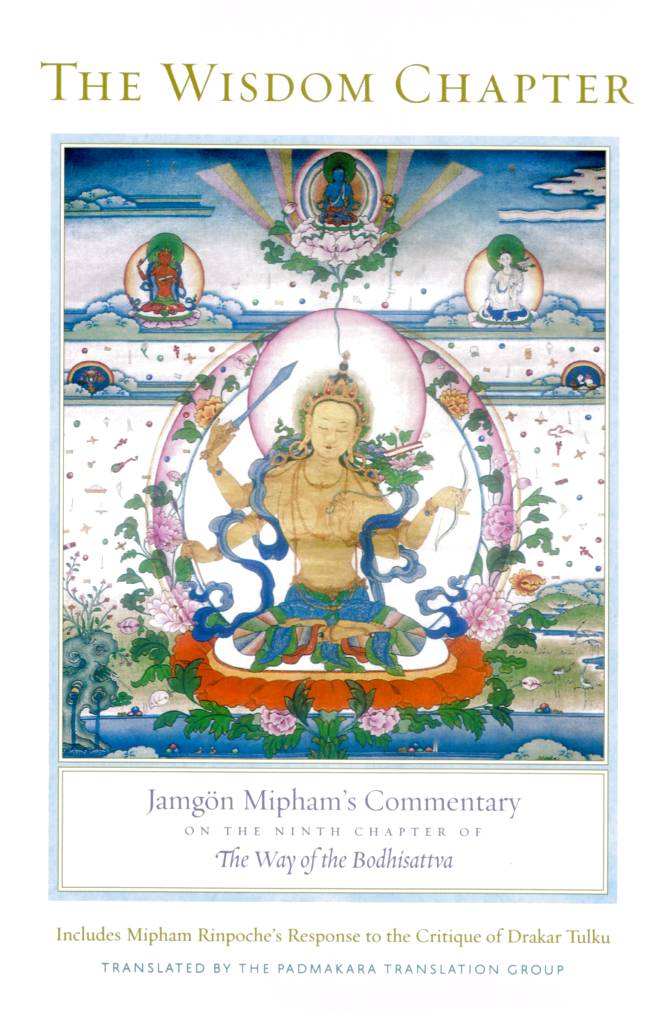
The "Wisdom Chapter" and Mipham's Commentary
Shāntideva does not identify himself as belonging to any school. Nevertheless, on the basis of circumstantial evidence, the "Wisdom Chapter" is generally regarded, by Mipham included, as a Prāsaṅgika text. This straightforward classification has been somewhat complicated by recent archaeological discoveries. Famously, the cache of manuscripts discovered at Tunhuang, on the Silk Road, contained a text of the Bodhicaryāvatāra that is earlier and shorter than the canonical version preserved in the Tengyur. Akira Saito, who made this discovery, considers the shorter version to be more authentic, in the sense that the later version, based on the translation of Kawa Peltsek and subsequently revised by Rinchen Zangpo and then by Ngok Loden Sherab, contains about two hundred extra stanzas, which may, in the opinion of Western scholars, be intercalations deriving from the commentarial literature.[26] The point at issue is that Saito mentions that the Tengyur contains at least one commentary on the earlier version of the "Wisdom Chapter," made from the point of view of the Yogācāra school. Therefore, however obvious Shāntideva's Prāsaṅgika affiliations may have been to later Tibetan scholarship, based on the expanded version of Shāntideva's work, there was a time when the orientation of the Bodhicaryāvatāra could be, and was, perceived differently.
It should be noted that the version of the Bodhicaryāvatāra in the Tengyur is a translation of the text explained by Prajñākaramati, whose commentary, extant in Sanskrit, preserves the root text in the original language. This longer version of the "Wisdom Chapter" discusses a number of themes—the manner of distinguishing the two truths, the ineffable nature of the ultimate, the refutation of the (Yogācāra) doctrine of the truly existent self-cognizing mind, and indeed the general structure of the Bodhicaryāvatāra around a presentation of the pāramitās—that figure importantly in the writings of Chandrakīrti. And this naturally supports the contention that Shāntideva was a Madhyamika with clearly Prāsaṅgika leanings. Saito also points out the probably significant fact that the stanzas in the "Wisdom Chapter" of the canonical Bodhicaryāvatāra that do not appear in the Tunhuang version and concern the refutation of the Creator God (119-26) and the assertions of the Sāṁkhya school (65 and 127-38) are marked by the frequent use of consequentialist arguments. This, in turn, suggests that, in the centuries following the composition of the Bodhicaryāvatāra, not only had such metaphysical questions become important in the debate between Buddhist and non-Buddhist schools, but Shāntideva himself was coming increasingly to be associated with the approach of Chandrakīrti, which resurfaced, and became popular, in India in the course of the eleventh century. If this is true, it does of course throw interesting light on the supposition, cited earlier in this essay, that Chandrakīrti had vanished from the scene in India until his resurrection in the eleventh century. Prajñākaramati (950-1030) in his commentary on the Bodhicaryāvatāra, the only commentary on that text preserved in Sanskrit, cites Chandrakīrti on several occasions. This, together with the several references to him in the writings of Atisha (982-1054), shows beyond doubt that Chandrakīrti was again becoming known by the turn of the eleventh century. Prajñākaramati's text was translated into Tibetan at least by the first half of the twelfth century, by which time the study of Chandrakīrti's writings was well established in Tibet. And it was largely owing to the fact that Prajñākaramati frequently cited Chandrakīrti's works in the elucidation and confirmation of Shāntideva's views that, from then on, the identification of the latter as a Prāsaṅgika Madhyamika became hard to resist. On the other hand, prior to the translation of Prajñākaramati's commentary—that is, during the earlier diffusion—Shāntideva's Prāsaṅgika affiliations were not self-evident.
Nevertheless, following the translation of the works of Chandrakīrti, and in particular the commentary by Prajñākaramati, the proximity of view between Chandrakīrti and Shāntideva became widely accepted, so that by Mipham's time, no one questioned the fact that the "Wisdom Chapter" was a Prāsaṅgika text. Moreover, in an environment in which Prāsaṅgika had come to be regarded by all Tibetan schools as the highest view, there was no need for Mipham to preface his commentary on the "Wisdom Chapter" with a justificatory introduction, as he had with his commentary on the Madhyamakālaṃkāra, which, as a Svātantrika text, was by then almost unknown. In the case of the "Wisdom Chapter," on the other hand, a commentary that pointedly revived the ngarabpa position of Tsongkhapa's critics was bound to attract attention.
Be that as it may, it is important to bear in mind that, as we have said, the Ketaka Jewel was not composed with polemical intentions. In obedience to the command of Jamyang Khyentse Wangpo, it was first and foremost an interpretation of Shāntideva's text, according to the Nyingma tradition, which, in its particular way, also regarded the Prāsaṅgika approach as supreme. In contrast with his other works, which seem to have been composed spontaneously and apparently without a great deal of planning,[27] Mipham tells us that he prepared the Ketaka with unusual care. He had received a five-day explanation of the text from Patrul Rinpoche himself, and in preparation for his composition, he read all the Indian commentaries in the Tengyur and all the important commentaries that had been composed in Tibet. No doubt realizing that a commentary on the "Wisdom Chapter" would be carefully scrutinized by the scholars of other schools, and would therefore require an exceptionally clear exposition of Prāsaṅgika Madhyamaka from the Nyingma perspective, Mipham doubtlessly wished to be in full possession of the commentarial field. Therefore at various places in the commentary, and prompted by Shāntideva's verses, Mipham does not fail to express the Nyingma understanding of the crucial points of the Prāsaṅgika approach, which in this respect does not differ from that of Gorampa and the rest of Tsongkhapa's ngarabpa critics. Stanza 2, for example, prompts a brief but penetrating exposition of the two truths in terms of appearance and emptiness, combined with a clear statement to the effect that the understanding of emptiness as a nonimplicative negation (the Gelugpa interpretation but mentioning no names) is "no more than a point of entry to Great Emptiness, which is free from all four ontological extremes" and is therefore the figurative ultimate. This, in turn, gives rise to a brief definition of the specificity of the Prāsaṅgika approach and subsequently an explanation of how the ultimate truth that transcends word and deed is nevertheless "knowable" in being the field of the meditative wisdom of the Āryas. On various occasions, as the commentary unfolds, Mipham adverts critically (though again without mentioning names) to several of Tsongkhapa's eight difficult points. For example, Shāntideva's response to objections to the doctrine of emptiness contains a lengthy refutation of the Cittamātra doctrine of the self-knowing mind, which is clearly reminiscent of the critique made by Chandrakīrti in the Madhyamakāvatāra. This, in turn, prompts Mipham to supply a lengthy refutation of the opinion that the self-knowing mind has no existence even conventionally. Later on, when commenting on the debate between Shāntideva and the representatives of the Shrāvaka path, Mipham is obliged to advert in critical terms to Tsongkhapa's contention that, in gaining the state of arhatship, the Shrāvakas and Pratyekabuddhas achieve a full realization of emptiness.
Despite the extent of the material discussed, the Ketaka is a concise text.[28] It is clear but all too brief; and the value of Mipham's answers to Drakar Tulku lies precisely in the fact that, in them, he explains in far greater detail, through defense and counterattack, the controversial points that, briefly mentioned in the Ketaka commentary, leave the reader hungry for further elucidation.
Mipham's Answers to Criticism
Although Mipham gives obedience to his teacher as the principal motive for his compositions, it is clear that he was himself disturbed by the use in Nyingma monasteries of textbooks of Gelugpa provenance; and the recovery of a Nyingma voice in the realm of sutra studies was certainly an important part of his rimé agenda. Mipham's efforts were not, however, always appreciated even among Nyingmapas. The monastery of Dodrupchen, for example, followed the practice of interpreting the tantras according to the Nyingma tradition but used Gelugpa textbooks for the exposition of sutra topics, which of course included Madhyamaka. From one point of view, this posed no problem. Indeed, the easy coexistence of the two traditions was by no means uncommon in the distant provinces of Kham and Amdo, far from the center of political power. Moreover, given that texts on sutra topics belonging to the Nyingma tradition were unavailable—a deplorable situation that Mipham strove to rectify—institutions like Dodrupchen had little option but to make use of Gelugpa texts, the pedagogical quality of which Mipham himself had appreciated in his youth. Nyingma khenpos with Gelugpa leanings in their Madhyamaka view cannot have been an uncommon occurrence. And it is known that the detailed manifesto of Nyingma Madhyamaka figuring in the commentary to the Madhyamakālaṃkāra caused some misgivings in Nyingma circles that had been schooled in the Gelugpa view. For example, Khenpo Damcho Zangpo of Dodrupchen questioned certain of Mipham's assertions in the commentary on the Madhyamakālaṃkāra and is said to have challenged Mipham to a debate. Instead he received a written reply. The title of this short text, Clearing Away the Doubts of Damcho, suggests a certain lenience, but in general, as we shall see, Mipham had some rather sharp things to say about professed upholders of the Nyingma school who persisted in advocating the Gelugpa position. Again, this disapproval must be placed in the context of Mipham's rimé concern for the preservation of the tradition, which we have mentioned earlier.
Much more than the commentary on the Madhyamakālaṃkaara, however, it was the Ketaka that provoked real controversy. It is difficult to gauge how long it took for the latter text to become known. All that we can say is that a full ten years passed before the first surviving critique Drakar Tulku's short text A Pleasurable Discourse for Those of Clear Understanding—arrived.[29] Composed in 1888, this seems to have reached Kham quite quickly in the following year, and true to form, Mipham composed an immediate reply: the Light of the Day Star.
What happened afterward is not altogether clear. We know that Drakar composed two rejoinders to Mipham's reply. The first of these was the short Discourse on the Profound,[30] which is in fact a brief résumé in verse of the Pleasurable Discourse. The second, however, was a much-longer text entitled An Emetic for Extracting the Bloody Vomit of Wrong Views.[31] Unfortunately, neither of these two texts is dated. The only chronological indication we have is found in the colophon to the Emetic, which says that it was composed "many" or perhaps just "several" (du ma) years later. As we shall see, this is a perplexing reference. In any case, Mipham did not reply to either of these later texts. It is not even certain that he received them. In his first reply to the critique of Pari Rabsel, he does mention that he received two controversial tracts "from Lhasa," remarking that since they consisted mostly of scriptural references and bogus reasonings, he did not reply. Whether these two texts were Drakar Tulku's replies, we shall probably never know.
The general tone of supercilious condescension in the Pleasurable Discourse as well as the wording of the title of the Emetic, together with what Gene Smith calls the "considerably more vulgar and occasionally indecent observations"[32] in the latter text itself, have contributed to the negative perception of Drakar as a surly and disrespectful critic. And it is true that his attitude of contemptuous dismissal—especially coming from a young and inexperienced scholar of twenty-two years—is liable to strike an admirer of Mipham as insufferable impudence. It is probably a mistake, however, to read too much into the vocabulary of Tibetan eristic, in which, as in its medieval European counterpart, vituperation is both a frequent and expected component—part of the rough and tumble of debate as this was often practiced in the monasteries.[33] It is true that Mipham adopts a relatively calmer and more humble demeanor, but in this kind of exchange, politeness itself can serve as an effective weapon. He too has his moments of sarcastic wit.
Before moving on to a more detailed consideration of the Light of the Day Star, we should note that Mipham's exchange with Pari Rabsel,[34] the great scholar of Kumbum, was both much more extensive and in the end more affable. Pari Rabsel composed his first messages—an introductory letter followed by the critique itself—in 1897. They reached Mipham five years later in 1903, only nine years before Mipham's death. Once again, Mipham replied with characteristic virtuosity and speed, composing his Illuminator of Suchness, a text of 230 pages, in his spare time over a period of eighteen days. This initiated a series of exchanges between the two masters that lasted till their deaths, by which time they had become friends.[35] Finally, a rather late refutation of Mipham's Madhyamaka view was composed by Denma Lozang Chöying (1890-1949), a scholar from Drepung who appears to have been influenced by Drakar and who writes in the same vein. Given his dates (Denma Lozang was twenty-two years old when Mipham died), it is unlikely that Mipham even saw his work. Certainly, it received no answer.
Notes
- ↑ Dreyfus remarks that to propound a Svātantrika view in nineteenth-century Tibet would have been as odd as a modern scientist asserting the supremancy of Newtonian physics in the twentieth. See Dreyfus, "Would the True Prāsaṅgika," 330.
- ↑ This, it should be noticed, is in marked contrast to the attitude of Gorampa, who identifies the positions of Dolpopa and Tsongkhapa as extreme views and rejects them both in favor of his own middle position.
- ↑ See Mipham, Teaching to Delight, 92-145.
- ↑ See Mipham, Teaching to Delight, 101.
- ↑ Doxographies in the early diffusion can be found in the works of Kawa Peltsek, Yeshe De, and Rongdzom Paṇdita. In this period, before the landscape was complicated by the arrival of Chandrakīrti's writings, two kinds of Madhyamaka were identified according to their presentation of the relative truth. The systems of Bhāvaviveka and Shāntarakshita were described simply as mdo sde spyod pa'i dbu ma pa (Sautrāntika-Madhyamaka or those Madhyamikas who use the Sautrāntika system) and rnal 'byor spyod pa'i dbu ma pa (Yogācāra-Madhyamaka, or Madhyamikas who use the Yogācāra system), respectively. According to this perspective, the Prāsaṅgikas could be described as "Madhyamakas who assert phenomena in harmony with the world" ('jig rten grags pa'i dbu ma pa).
- ↑ See Mipham, Teaching to Delight, 101
- ↑ Ibid.
- ↑ Ibid., 102.
- ↑ Ibid.
- ↑ Ibid., 108.
- ↑ Ibid.
- ↑ Ibid., 108-9.
- ↑ Ibid., 111-13.
- ↑ Ibid., 113.
- ↑ As Cabezon and Geshe Lobsang Dargyay say, no system can be completely apophatic, proceeding exclusively through negation and refutation without making any positive statements. Even though Chandrakīrti rejects logic as a means of delivering the ultimate truth directly, this does not mean that he abandons logic as a semantic tool. That would be absurd. Like everyone else, he communicates ideas and formulates arguments logically. See Cabezón and Geshe Lobsang Dargyay, Freedom from Extremes, 11 and 249n30.
- ↑ Mipham, Teaching to Delight, 113.
- ↑ Ibid., 297.
- ↑ Ibid., 109.
- ↑ Ibid., 114.
- ↑ Ibid., 131.
- ↑ Ibid., 133.
- ↑ Light of the Day Star, p. 198.
- ↑ See Thakchoe, Two Truths Debate, 176n58; Dreyfus, "Would the True Prāsaṅgika," 321.
- ↑ Mipham, Teaching to Delight, 139.
- ↑ Mipham, Reasoning That Perfectly Illuminates Suchness, 147. See also Karma Phuntsho, Mipham's Dialectics, 147.
- ↑ See the account in Saito, "Shāntideva."
- ↑ See the remark of Khenpo Kunzang Pelden: "When these great interpretative commentaries ...were written, he (Mipham) did not have to peruse other texts or make notes. Like a magicians legerdemain, they were written extremely rapidly, just as they appear." See Kunzang Pelden, Gangs ri'i. Translated in Pettit, Mipham's Beacon of Certainty, 29.
- ↑ More expansive expressions of Mipham's Madhyamaka view can be found in the commentary on the Madhyamakāvatāra (Dbu ma 'jug pa'i 'grel pa zla ba'i zhal lung dri med shel phrengs), translated into English as The Word of Chandra, and the Compendium of Difficult Points in the General (Sutra) Scriptures (Gzhung spyi'i dka'gnad gsung gros phyogs bsdus rin po che'i za ma tog). These texts were assembled from teaching notes by disciples after Mipham's death—unlike the commentary to the Madhyamakālaṃkāra, the Ketaka, and the Answers to Criticism (Brgal lan), which are all by Mipham's own hand.
- ↑ Zab mo dbu ma'i gnad cung zad brjod pa blo gsal dga' ba'i gtam. See Drakar Tulku, Gsung 'bum, 12:397-432.
- ↑ 'Jam dbyangs rnam rgyal gyi 'dod tshul la klan ka bgyis pa zab mo'i gtam. See Drakar Tulku, Gsung 'bum, 11:43 3-47.
- ↑ Mipham rnam rgyal gyis rtsod pa'i yang lan log lta'i khong khrag 'don pa'i skyug sman. Drakar Tulku, Gsung 'bum, 12:449—742.
- ↑ Smith, Among Tibetan Texts, 233.
- ↑ This point was made in private correspondence by Thubten Jinpa. See also Dreyfus, Sound of Two Hands, 217-18. It should be noticed too that the title of Mipham's Ketaka Jewel is itself (probably intentionally) provocative. In the Indo-Tibetan tradition, the ketaka was a magical gem, used for removing infection.
- ↑ Dpa' ris blo bzang rab gsal (1840-ca. 1919).
- ↑ For a detailed study of the debate between Mipham and Pari Rabsel, as well as connected issues in the debate with Drakar Tulku, see Viehbeck, "Case of 'Ju Mipham."