A Short Account of the Commentarial Tradition in Tibet
| 🤓 Admin Zone 🛠️ hidden to non-admins | |
Description
This chronological framework proves valuable for understanding how the Bodhicaryāvatāra was received, studied, and commented upon in Tibet over more than a millennium. By highlighting key figures and schools involved in its transmission and interpretation, the article provides a starting point to explore the many commentators and traditions involved in the diffusion of the Bodhicaryāvatāra in Tibet. Moreover, it contextualizes the text's importance within broader historical and cultural developments in Tibet, such as the early diffusion of Buddhism into Tibet, the development of Tibetan scholastic traditions, and the arising of the nonsectarian Rime movement in Eastern Tibet. This broader perspective allows readers to appreciate the Bodhicaryāvatāra not just as a philosophical text but as a living tradition that has played a significant role in shaping Tibetan Buddhist thought and practice.
Featured on
The Bodhisattvacharyavatara (conveniently abbreviated as Bodhicharyavatara) composed by the eighth-century Indian master Shantideva has occupied an important place in the Tibetan Buddhist tradition almost from its inception. Shantarakshita (725-783), the renowned abbot of the great university of Nalanda, invited by King Trisongdetsen to help in the establishment of the Buddhist teachings in Tibet, could scarcely have been ignorant of the life and achievements of his remarkable contemporary and confrere, and it is clear that when he inaugurated the great work of translation of sutras and shastras into Tibetan, the Bodhicharyavatara figured prominently among the many texts brought from India for that purpose.
Its first translator, Kawa Peltsek, was one of the first seven men (the so-called sad mi mi bdun) chosen to take part in an experiment to see whether Tibetans were capable of holding monastic vows. And since their ordination is said to have occurred in 767, we may conclude that he was born around 740.[1] We do not know exactly when Kawa Peltsek completed his translation. The first mention of it is in the Denkarma catalogue compiled probably in 824.[2] In any event, the fact that the Bodhicharyavatara should have been translated so soon after its composition (it is quite possible that Shantideva was still alive), on a par with other texts considered to be of the first importance for the propagation of Buddhism in Tibet, testifies to the speed with which the work had established itself already in India, or at least at Nalanda, as what we would nowadays call a "popular classic." Butön's statement, repeated by Kunzang Pelden, that a hundred and eight commentaries were composed on the Bodhicharyavatara in India alone is perhaps a pious exaggeration, but there can be no doubt of the esteem (following the universal astonishment that had greeted its first recitation) in which it was held, both in its native country and in Tibet. The Tengyur contains ten Sanskrit commentaries rendered into Tibetan, the most important of which, the Panjika of Prajnakaramati, has also survived in the original language. The translation of so many commentaries suggests that the Bodhicharyavatara was widely taught and studied. This is hardly surprising, for it is a detailed exposition of the gradual, systematic practice of the paramitas, and as such was tailor-made for the kind of Mahayana sutra tradition that Shantarakshita was at pains to transmit to the Tibetans, and which, a generation later, his disciple Kamalashila is said to have defended so successfully against the inroads of the Chinese Chan tradition.
Over a period of about three hundred years, the Tibetan version of the Bodhicharyavatara was revised twice: first by Rinchen Zangpo (958-1055) at the beginning of the New Translation period, and finally by Ngok Loden Sherab (1059-1109) about one hundred years later. That there should have been two widely spaced revisions to the translation is itself an interesting fact, pointing not only to the gradual discovery by the Tibetans of the existence of rival Sanskrit versions of Shantideva's work, but also to the sustained interest that its sublime message continued to excite. During the first three centuries of its existence in Tibetan, it was, in all probability, expounded and studied with the help of the Sanskrit commentaries just mentioned, aided by the oral tradition preserved from the expositions of the Indian masters present in Tibet during the early translation period, and again, following Langdarma's persecution of Buddhism, by Atisha (892-1054) and the panditas who assisted the later translators.
Atisha and the masters of the Kadampa tradition held Shantideva's shastra in particular veneration and numbered it among their "six indispensable treatises:'[3] The evidence suggests nevertheless that, however popular it may have been, the Bodhicharyavatara did not stimulate scholarly commentary on the part of the Tibetans themselves. Historically speaking this is unsurprising, given that the scholastic and commentarial tradition, which was to become so much a part of Tibetan scholarship, really only began in the twelfth century with the founding of the monastery of Sangphu by the two masters from Ngok, Lekpa'i Sherab and his nephew, the translator Loden Sherab. According to the Blue Annals, the earliest Tibetan commentaries on the Bodhicharyavatara were composed by Loden Sherab himself, Chapa Chokyi Senge, and a contemporary scholar named Nyangdren Chokyi Yeshe. These three works have been lost, but commentaries by two of Chapa's disciples-Sonam Tsemo, the second hierarch of Sakya, and Tsang Nakpa[4]—still survive.
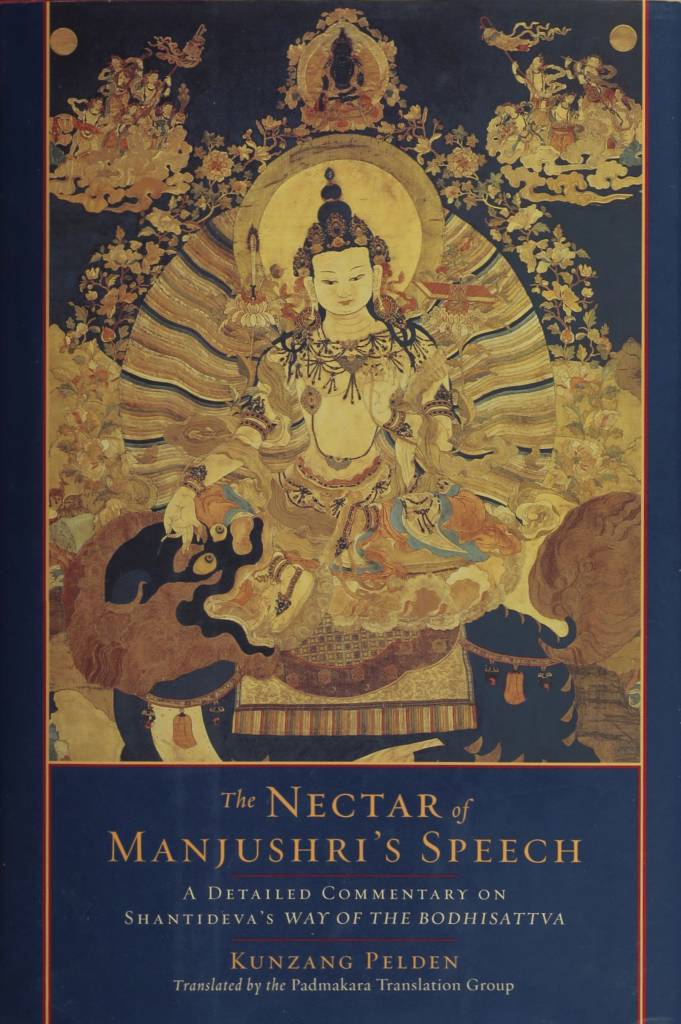
From these first beginnings until the present time, a series of important commentaries appeared, among which the most notable were composed by Butön Rinchen Drup (1290-1364), Sazang Mati Panchen Jamyang Lodro (1294-1376), Ngulchu Thogme Zangpo (1295-1369), Sonam Gyaltsen Pal Zangpo (1312-74), Je Tsongkhapa (1357-1419), Gyaltsap Darma Rinchen (1362-1432), Pawo Tsuglag Trengwa (1504-66), Mipham Rinpoche (1846-1912), Khenpo Zhenga (1871-1927), Minyak Kunzang Sonam (Thubten Chokyi Drakpa) (nineteenth century), and Khenpo Kunzang Pelden (1862-1943).[5]
Although incomplete, this is nevertheless a representative and suggestive list.[6] The chronological grouping of the authors, moreover, indicates that interest in the Bodhicharyavatara was particularly strong in two periods-first in the thirteenth and fourteenth centuries and then much later in the nineteenth and early twentieth centuries-separated by a lapse of nearly three hundred years, from the death of Pawo Tsuglag Trengwa to the birth of Mipham Rinpoche. This apparent lull in scholarly activity coincided with a prolonged period of political unrest occurring in Tibet during the sixteenth and seventeenth centuries-a period of almost continuous crisis that must surely have been prejudicial to centers of learning. And the resulting intellectual stagnation could only have been aggravated by the increase in sectarian intolerance that followed the civil war in Tsang and the ensuing political settlement.[7] This unhappy state of affairs eventually provoked (in the nineteenth century) a reaction, in the form of the Rime or nonsectarian movement, inaugurated by the combined efforts of a number of outstanding masters principally of the Nyingma, Sakya, and Kagyu schools. Their aim was to recover and preserve the many different streams of learning and spiritual practice of all traditions of Tibetan religion, the continued existence of which had been under threat owing to the social and political conflicts of the previous age, as well as to the oppressive spirit of religious prejudice that subsequently prevailed.
Another thing to notice in the earlier commentaries on the Bodhicharyavatara is the distribution of traditional allegiances that they reveal. In an earlier and more generous age, before relations had been soured by the antagonisms just mentioned, the different schools of Tibetan Buddhism, though distinct in their views and practices, enjoyed an easy coexistence. It was not unusual for keen students to receive teachings from a variety of traditions; and it was precisely this spirit of open, mutual respect and healthy eclecticism that the Rime movement was intent on reviving. Once again, these facts are reflected in our list of commentaries. We find that in the early period, interest in the Bodhicharyavatara was broadly pervasive. Butön and Ngulchu Thogme Zangpo were Kadampas; Sazang was a Jonangpa; Je Tsongkhapa and his disciple Gyaltsap were Gelugpas; and Pawo Tsuglag Trengwa was a Kagyupa. By contrast, the four commentaries composed in the later period suggest a somewhat different picture. Although one was by the Gelugpa master Minyak Kunzang Sonam and the other three were composed by Nyingmapas, the inspiration for all of them derived from a common source, the teaching of Patrul Rinpoche. In other words, the existence of these commentaries-and they are the most important to appear in modern times-is evidence that, after a lull of nearly three centuries, and thanks to the Rime movement, there occurred a resurgence of interest in the Bodhicharyavatara, which was in very large measure due to the activities and extraordinary personality of Patrul Rinpoche.
Notes
- ↑ This date for the ordination of the semi midun (sad mi mi bdun) is in the writings of the Fifth Dalai Lama, as mentioned in the Tshig mdzod chen mo, p. 3204. According to the Vinaya, candidates for full ordination must have reached their twentieth year. Assuming the accuracy of the cited date, Kawa Peltsek could not have been born later than 747.
- ↑ The Denkarma (ldan dkar ma) was a catalogue compiled by Kawa Peltsek and Namkha'i Nyingpo listing all the texts that until that time had been translated into Tibetan. Assuming the accunrcy of the date given, Kawa Peltsek would have been in his eighties. See Kretschmar, Shantideva's "Bodhisattvacharyavatara" (hereafter Kretschmar), chap. 1, p. 13.
- ↑ The five others were the Mahayana-sutralankara of Maitreya and Asanga, the Bodhisattvabhumi of Asanga, the Shikshasamucchaya of Shantideva, the Jatakamala of Aryashura, and the Udanavarga.
- ↑ We are indebted to Gene Smith for information about Tsang Nakpa's commentary and a copy of his text, as also that of Sonam Tsemo's. Both these commentaries are of interest for the Madhyamaka tradition. They appeared at the time when Chandrakirti's works were being introduced to Tibet through the translations of Patsap Nyima Drak (1055-1145). The quotation from the Madhyamakalankara at the beginning of Sonam Tsemo's commentary on the Bodhicharyavatara's ninth chapter suggests that he propounded the view of the Yogachara-Madhyamaka school of Shantarakshita, which Chapa strenuously defended. By contrast, the Blue Annals reports that Tsang Nakpa followed the view of Chandrakirti "preferring it to that of his teacher Chapa" even though he apparently did not expect it to survive Chapa's onslaught! See Blue Annals, p. 334. See also Smith, Among Tibetan Texts, p. 326, n. 763.
- ↑ See Kretschmar, chap. 1, p. 21.
- ↑ Gene Smith lists a number of other commentaries composed in the earlier period especially by the masters of the Kadampa tradition. See Among Tibetan Texts, p. 228.
- ↑ See Smith, Among Tibetan Texts, pp. 227-72; and Dreyfus, Recognizing Reality, pp. 33-41.