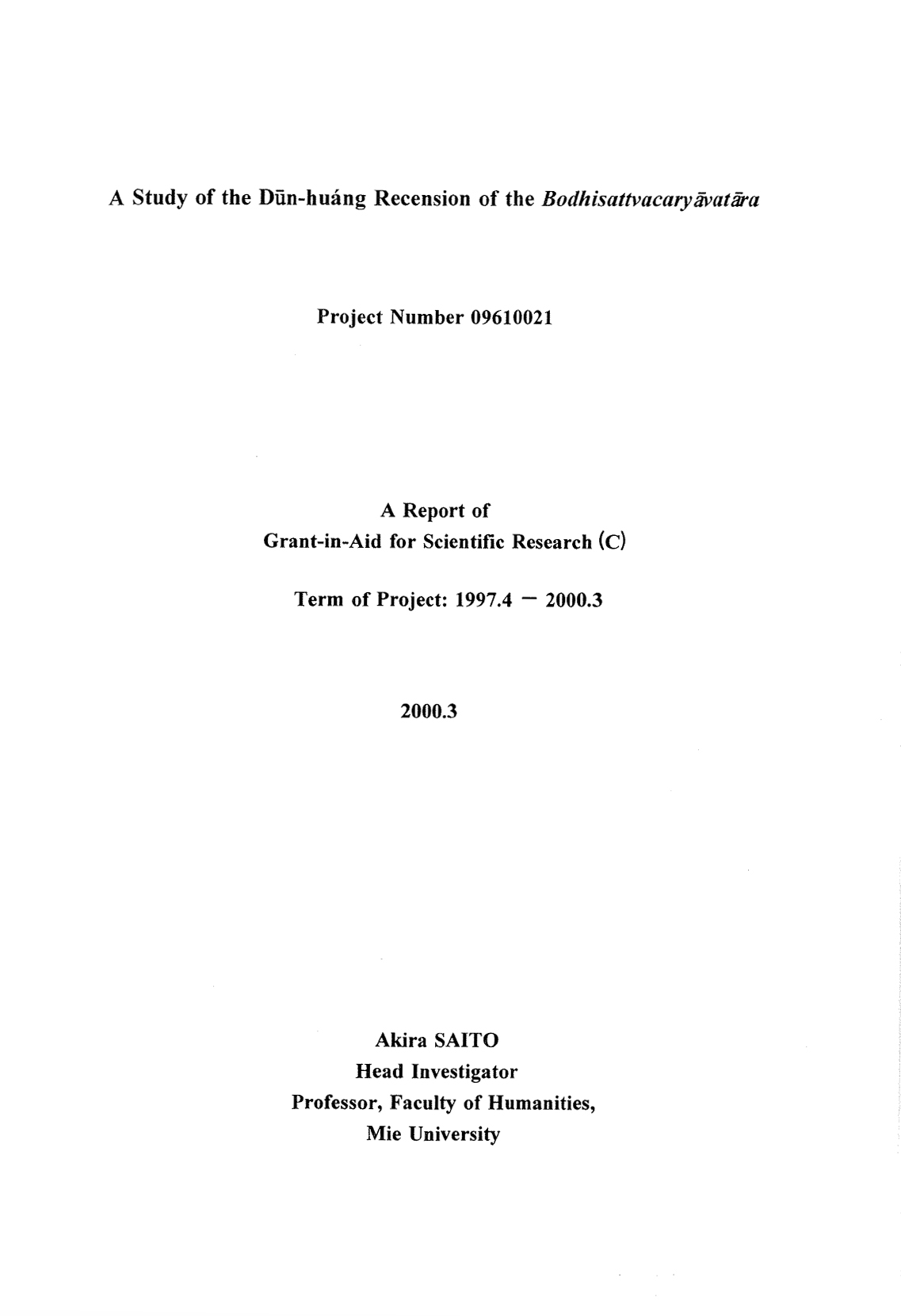
A Study of the Dūn-huáng Recension of the Bodhisattvacaryāvatāra
From Bodhicitta
< Books
(Redirected from A Study of the Dūn-huáng Recension of the Bodhisattvacaryāvatāra)Books/A Study of the Dūn-huáng Recension of the Bodhisattvacaryāvatāra
| 🤓 Admin Zone 🛠️ hidden to non-admins | |
A Study of the Dūn-huáng Recension of the Bodhisattvacaryāvatāra
Book
- A Comparative of Sanskrit, Tibetan and Mongolian on Prajñāpāramitā Chapter of Śāntideva's Bodhicaryāvatāra (2) (The Commemoration Number Published on the Occasion of the Seventieth Birthday of Professor Ryojun Fuyo)
- A Descriptive Catalogue and Restoration of the Tibetan Language Text of Bodhicaryavatara from Dunhuang Documents
- A Study of Akṣayamati (Śāntideva)'s Bodhisattvacaryāvatāra as Found in the Tibetan Manuscripts From Tun-huang
- A Study of the Dūn-huáng Recension of the Bodhisattvacaryāvatāra
- Action and Its Result in the Bodhicaryāvatāra
- Akṣayamati's Bodhisattvacaryāvatāra as Found in the Tibetan Manuscripts from Dūn-huáng
- An Index to the Bodhicaryāvatāra Pañjikā, Chapter IX
- An Inquiry into the Relationship between the Śikṣāsamuccaya and the Bodhi(sattva)caryāvatāra
- Bodhicaryāvatāra of Śāntideva (Bhattacharya)
- Byang chub sems dpa'i spyod pa 'jug pa (2007, mtsho sngon)
- Byang chub sems dpa'i spyod pa la 'jug pa rtsa ba dang 'grel pa (si khron mi rigs dpe skrun khang)
- Catalogue of the Tibetan Manuscripts from Tun-huang in the India Office Library
- Critique of Self in the Early and Later Versions of the Bodhi(sattva)caryāvatāra
- Die lHan kar ma
- Notes on the Deśanā-ritual in the Bodhicaryāvatāra: Evidence of Its Revision
- Notes on the Interpretation of Bodhi(sattva)caryāvatāra V.104–106
- On Agama and Yukti in Bu ston's Byang chub sems dpa'i spyod pa la 'jug pa'i 'grel pa
- On Akṣayamati's Bodhisattvacaryāvatāra
- On Philosophical View of the Bodhisattvacaryāvatāra
- On the Role of Vairocanarakṣita in the Later Transmission Period: A Cross-section of the "Bodhisattva theory" Tradition
- On the Textual Problems of Śāntideva's Bodhi(sattva)caryāvatāra: With Special Reference to Chapter 9 Entitled "Perfection of Wisdom (Prajñāpāramitā)"
- Polemics in Indo-Tibetan Scholasticism - A Late 19th-Century Debate Between 'Ju Mi pham and Dpa' ris Rab gsal
- Relocation of the Verses on "The Equality of Self and Others" in the Bodhicaryāvatāra
- Remarks on Akṣayamati (Blo gros mi zad pa), Being the Author of the Earlier Version of the Bodhisattvacaryāvatāra
- Remarks on the Tabo Manuscript of the Bodhisattvacaryāvatāra
- Some New Remarks on the Bodhicaryāvatāra Chapter V
- Studies in the Philosophy of the Bodhicaryāvatāra (2000)
- Textcritical Notes on Sanskrit Texts: I. Bodhi(sattva)caryāvatāra
- The Original Bodhicaryāvatāra
- The Transmission of the Bodhicaryāvatāra: The History, Diffusion, and Influence of a Mahāyāna Buddhist Text
- Śāntideva in the History of Mādhyamika Philosophy
- Śāntideva's Critique of 'I' or Self in the Early and Later Recensions of the Bodhi(sattva)caryāvatāra
- Śāntideva's Philosophy as Expressed in the Early Version of His Bodhisattvacaryāvatāra, Chapter 8
Please note that many items in our library are simply pages that represent a detailed library catalog entry and citation of someone else's work, presentation, or performance. Read our General Disclaimer for more information.

Description
Contains the transliterated text of the Bodhisattvacaryāvatāra (Byang cub kyi sems kyi phan yon bshad pa) of A. Stein No. 628 (Chapters 1, 2, 6, 7, 8) and a Japanese translation of Chapter 8 of the Bodhisattvacaryāvatāra-1 and Bodhisattvacaryāvatāravyākhyāna [pañjikā]
Citation
Saitō, Akira. A Study of the Dūn-huáng Recension of the Bodhisattvacaryāvatāra. A Report of Grant-in-Aid for Scientific Research (C). Project Number 09610021. Tsu, Japan: Mie University, 2000.
Table of contents
- Preface3
- Relevant Publications during the Term of Project4
- Table of Contents5
- Abbreviations6
- Part I Transliterated texts of the Dūn-huáng recension (Stein No. 628) of the Bodhisattvacaryāvatāra7
- Chapter 1 Byang cub kyi sems kyi phan yon bshad pa (Ka 1a1–2a8)9
- Chapter 2 Byang cub kyi sems yongs su gzung ba (Ka 2a8–5b8)15
- Chapter 6 Brtson 'grus bstand pa (Ka 14b7–17b1)29
- Chapter 7 bSam gtan bstand pa (Ka 17b1–19a7)41
- Chapter 8 Shes rab bstand pa (Ka 19a7–22a3)49
- Part II Japanese translation of Chapter 8 of the Bodhisattvacaryāvatāra-1 and
*Bodhisattvacaryāvatāravyākhyāna (pañjikā)63
- Translation65
- Notes97
- Errata to the Edited Text103
- References105
- I (in a chronological order of the publications)105
- II (in an alphabetical order of the authors' names)107
Interconnections
1 Recension of

An "Introduction to Bodhisattva Practice," the Bodhisattvacaryāvatāra is a poem about the path of a bodhisattva, in ten chapters, written by the Indian Buddhist Śāntideva (fl. c. 685–763). One of the masterpieces of world literature, it is a core text of Mahāyāna Buddhism and continues to be taught, studied, and commented upon in many languages and by many traditions around the world. The main subject of the text is bodhicitta, the altruistic aspiration for enlightenment, and the path and practices of the bodhisattva, the six perfections (pāramitās). The text forms the basis of many contemporary discussions of Buddhist ethics and philosophy.
2 Partial translation of
An "Introduction to Bodhisattva Practice," the Bodhisattvacaryāvatāra is a poem about the path of a bodhisattva, in ten chapters, written by the Indian Buddhist Śāntideva (fl. c. 685–763). One of the masterpieces of world literature, it is a core text of Mahāyāna Buddhism and continues to be taught, studied, and commented upon in many languages and by many traditions around the world. The main subject of the text is bodhicitta, the altruistic aspiration for enlightenment, and the path and practices of the bodhisattva, the six perfections (pāramitās). The text forms the basis of many contemporary discussions of Buddhist ethics and philosophy.

Written by Prajñākaramati (950–1030), the Bodhicaryāvatārapañjikā is considered to be the most important Indian commentary on the Bodhicaryāvatāraby Śāntideva. This commentary explains the words in the verses (tshig 'grel), with additional commentaries on difficult points. Excluding The Dedication Chapter, it has only nine chapters.
2 Scholarship on
An "Introduction to Bodhisattva Practice," the Bodhisattvacaryāvatāra is a poem about the path of a bodhisattva, in ten chapters, written by the Indian Buddhist Śāntideva (fl. c. 685–763). One of the masterpieces of world literature, it is a core text of Mahāyāna Buddhism and continues to be taught, studied, and commented upon in many languages and by many traditions around the world. The main subject of the text is bodhicitta, the altruistic aspiration for enlightenment, and the path and practices of the bodhisattva, the six perfections (pāramitās). The text forms the basis of many contemporary discussions of Buddhist ethics and philosophy.
Written by Prajñākaramati (950–1030), the Bodhicaryāvatārapañjikā is considered to be the most important Indian commentary on the Bodhicaryāvatāraby Śāntideva. This commentary explains the words in the verses (tshig 'grel), with additional commentaries on difficult points. Excluding The Dedication Chapter, it has only nine chapters.