Śāntideva's Works in India and Nepal
Articles/Śāntideva's Works in India and Nepal
| 🤓 Admin Zone 🛠️ hidden to non-admins | |
Description
This comprehensive timeline proves valuable for scholars and students interested in the history and textual transmission of Śāntideva's works. It offers insights into how the Bodhicaryāvatāra was interpreted, commented upon, and preserved in India and Nepal. The examination of both Indian and Nepalese traditions deepens our understanding of the text's significance in various Buddhist communities. By highlighting the often-overlooked Newar Buddhist tradition, the article opens up new avenues for research and underscores the importance of studying lesser-known Buddhist lineages involved in preserving and interpreting important Buddhist texts.
Featured on
1. India
There are few reliable sources for the history of the BCA in India. India has not had the same tradition for writing historical accounts of dynasties, religious establishments, etc., as for instance the Chinese and Tibetans, and it has not been uncommon for scholars of Indian Buddhism to have to rely on travel accounts by Chinese pilgrims, such as Xuánzàng (602-664), or descriptions written by later Tibetan historians, such as Tāranātha (1575-1608), when reconstructing the actual history of a tradition deeply rooted in myth and hagiography. Moreover, Buddhism more or less gradually died out as a separate religious tradition in India in the 13th-15th centuries, partially, it has been argued, due to the introduction of Islam.[1] Therefore, the large and influential movement of Mahāyāna Buddhism that prospered in India for over a millennium has not been preserved in any living Indian tradition up to the present, with one very important exception being the Newar community in Kathmandu, Nepal. This last case will be presented separately in the next chapter. What follows then, as a description of the history of the BCA in India, is based mainly on Tibetan sources that have preserved accounts of the life of the presumed author of the BCA, Śāntideva, as well as several Indian commentaries on the BCA in Tibetan translation. Some ms. material has also fortunately been preserved in Sanskrit, but a lot of it has not received its due attention yet. Issues relating to this will be discussed in the later chapter on manuscripts.
Most sources agree that the author of the BCA was a monk by the name of Śāntideva (7th Century CE).[2] Two sources, however, disagree. The Chinese translation (BCAChi) accredits it to Nāgārjuna (2nd Century CE),[3] philosopher and purported founder of the Mādhyamika branch of Mahāyāna Buddhism. It has been somewhat of a tradition, though, both in the Chinese and Tibetan traditions for accrediting Nāgārjuna with a lot more literary works than he could possibly have authored. This statement need not therefore be taken too seriously.[4]
The other source that gives a different name is the BCATib1, the Tibetan translation of the BCA1 executed around 800 CE.[5] This translation reports that the author was Akṣayamati (Blo gros myi zad pa), and this attribution has been discussed in some detail in Saito (1993). Saito has reached the conclusion that Akṣayamati was in fact an epithet applied to Śāntideva.[6] On the occasion of Śāntideva's first public recitation of the BCA the members of the audience were so impressed that they exclaimed that this excellent teacher must be the bodhisattva Akṣayamati himself. It should also be noted that another work by Śāntideva, the Śikṣāsamuccaya (ŚS), quotes extensively from the Akṣayamatinirdeśasūtra (Akṣ), indicating that Śāntideva himself had a personal relationship with this bodhisattva.[7] Being reasonably convinced that Śāntideva was in fact the author of the BCA, we turn now to the task of reconstructing an account of who this person was.
Śāntideva
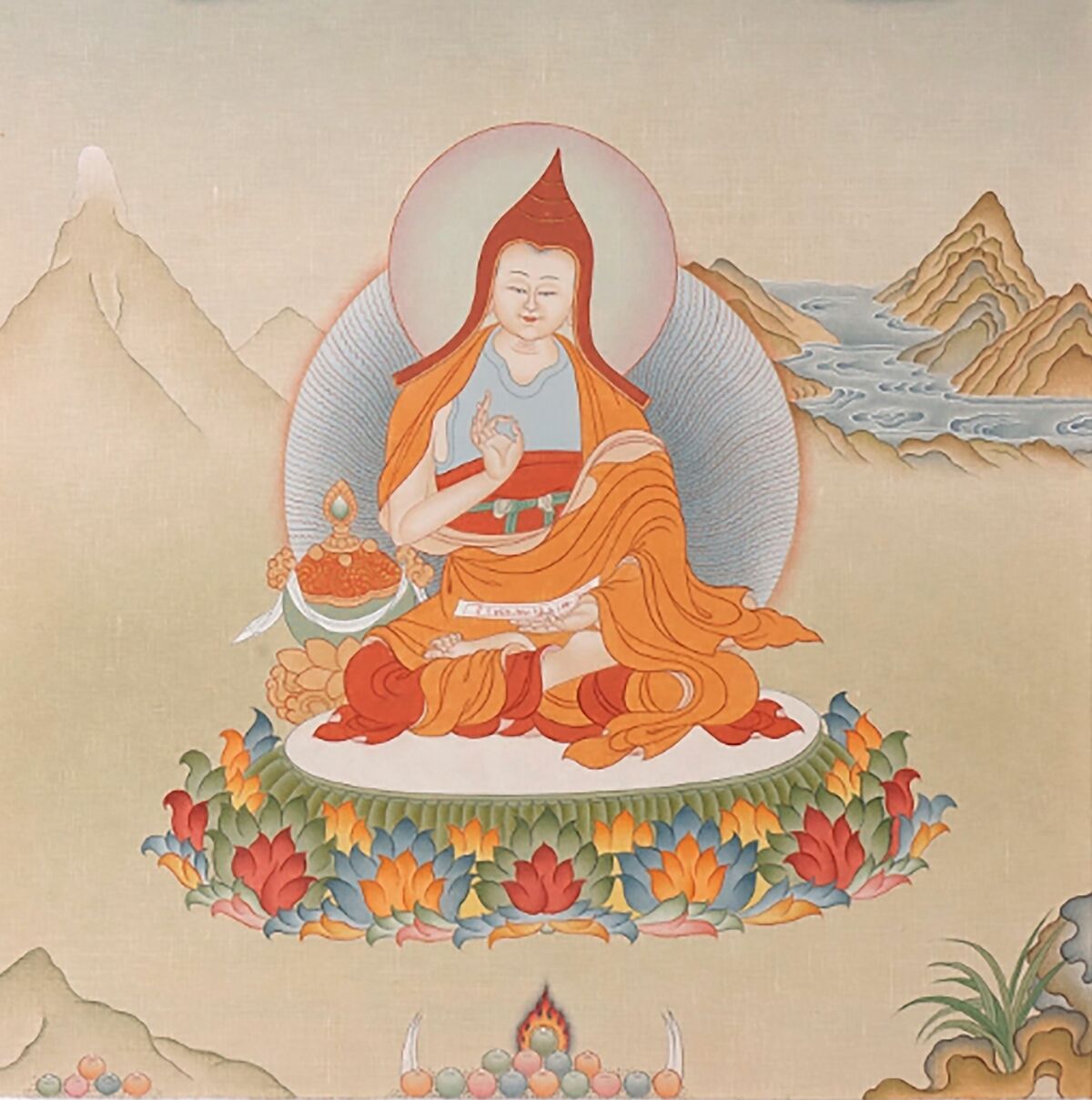
from a thangka by Sahil Bhopal
Scholars have not been able to reach any agreement concerning the exact dating of Śāntideva. In the extant biographies he is said to have been the student of Jayadeva, who is known to have been the successor of Dharmapāla (c. 529-60 CE) as abbot (upādhyāya) at the great monastic university of Nālandā in the present state of Bihar, India. Moreover, the earliest known quote from the BCA is found in Śāntarakṣita's (c. 725-88) Tattvasiddhi. It is therefore generally agreed that he must have lived sometime between the middle of the 6th and the middle of the 8th Century, but more exact dates have varied with almost every new publication related to Śāntideva.[8] In the absence of more accurate evidence, and as a working proposition for the present purposes, I think it safe to suggest that he lived during the 7th Century CE. Concerning the details of his life we have to rely on the works attributed to him and the biographies that have been transmitted by the tradition. The accounts of his life are hagiographic in character, painting an idealized picture with elements that are reminiscent of other accounts of great Buddhist personalities. They can therefore not be read literally, but as documentation of how Śāntideva was revered, and what he has meant to the tradition of Mahāyāna Buddhism. Still, there is no need to disregard them completely as historical evidence, and they may well be giving us some accurate information regarding the individual himself.
There are primarily four accounts of Śāntideva's life-story that have been employed by modern scholarship. These four are quoted in full in Pezzali (1968), and were written by Vibhūticandra (12th-13th Century), Bu ston rin chen grub (1290-1364), Tāranātha (1575-1608), and Sum pa mkhan po Ye shes dpal 'byor (1704-1777).[9] The first, and the oldest account available, is extant both in Sanskrit and Tibetan,[10] while the last three are Tibetan indigenous works. These sources have been narrated in several publications concerned with Śāntideva's works and philosophy, so that his life-story is now almost as famous within academic Buddhist scholarship as it is within the Tibetan Buddhist tradition.[11] There are some slight variations on details between the accounts, and in the following abbreviated account of Śāntideva's life I base myself mainly on Vibhūticandra's version. A few variations between this and the Tibetan accounts will be mentioned as they have become important within the Tibetan Buddhist tradition.
Śāntideva was born as the son of the king Mañjuvarman of Saurāṣṭra, in the modern state of Gujarat. At the time when he was to ascend the throne his mother warned him against the worldly life of a ruler by bathing him in scalding hot water, saying that such a life would lead to much worse suffering than that. She advised him to leave and take up a life of religion, and suggested that he seek out the teacher Mañjuvajra in Bhaṃgala (Bengal). He set out, and was helped by a young girl, who was in fact the goddess Tārā, to find the teacher, and stayed with Mañjuvajra, who was in fact the bodhisattva Mañjuśrī, studying for 12 years. During his stay there he had visions of Mañjuśrī, and developed a strong relationship with this bodhisattva.
His teacher then advised him to go to Madhyadeśa, and there he went into the service of a king named Pañcamasiṃha, and took the name Acalasena. Śāntideva carried a wooden sword, and some jealous co-ministers told the king this, complaining that carrying such a weapon was quite useless when protecting the king. The king ordered Śāntideva to show him the sword, and he did so, on the premise that the king should cover one eye. The brilliant lustre of the sword caused the uncovered eye of the king to fall out. The king was curiously pleased by this feat, realizing what a powerful figure Śāntideva must be, and implored him to stay. Śāntideva refused, and instead left for the monastery of Nālandā, where he became a monk and received the name Śāntideva ("lord of calm"), because of his high level of tranquillity. He was also given the name Bhusuku due to his ability to remain in meditative concentration (samādhi) while eating (bhuñjāna), sleeping (supta), and while in his hut (kuṭī). The Tibetan tradition, however, differs on this point. They say that the name Bhusuku was given to Śāntideva because it seemed that all he did was to eat, sleep, and defecate, and that the other monks were quite angry at him for giving the order a bad reputation. This version is reminiscent of the stories of the great tantric adepts (mahāsiddha) who outwardly seem quite ordinary, but who secretly are actually great masters. It is also one of the favourite twists of the story for Tibetans, and when recounting it a teacher will typically be grinning broadly when reaching this point of the story. The other monks at Nālandā wished to test Śāntideva, according to the Tibetan version they wished to him humiliated and expelled, and a very lofty seat was erected for him to teach on. Śāntideva, to the amazement of all, ascended the seat with ease, and asked them whether they wished to hear an old composition or something new. When requested to teach something new he decided that the BCA would fit the circumstances well, and began to recite. When he reached verse 9.34, the verse summarizing the view of the 9th chapter, saying "When neither existence nor non-existence appears to the mind, since there is no other mode of operation, without grasping, it becomes tranquil,"[12] Mañjuśrī appeared in front of him, and they ascended into the sky and disappeared. The Tibetan account reports that his voice could still be heard. Seeing their mistake the monks felt remorse, and in Śāntideva's hut they found his three compositions, the BCA, the Śikṣāsamuccaya (ŚS), and the Sūtrasamuccaya. The Tibetan account goes on describing further miracles Śāntideva performed in other places, and finally that he renounced the monastic life and lived the life of a wandering yogin, practicing Vajrayāna in many unconventional ways.
The ŚS is extant in both Sanskrit and Tibetan,[13] and is a sort of compendium of quotes from Mahāyāna literature. The Sūtrasamuccaya has however not been found.[14] Concerning Śāntideva's tantric affiliations it has been suggested by Bendall (1902) that the ŚS actually shows some tantric influence. Hara Prasad Śāstri (1913) also notes that there are tantric works that are attributed to Śāntideva, as well as several works attributed to Bhusuku, one of Śāntideva's other names. Although no conclusion has of yet been reached concerning this, it need not be unlikely that Śāntideva was also involved in Vajrayāna practices given the proposed time period he lived in. There is a further twist in the Tibetan account that relates how there appeared three different accounts of the BCA. The monks present had memorized what Śāntideva recited, and in the end it appeared that the Kashmiri scholars had memorized more than a thousand verses, but had missed the verses of homage in the beginning. The scholars from Eastern India had memorized only 700 verses, missing the homage, as well as the second and ninth chapters. The scholars from Central India were missing the homage and the tenth chapter. They decided to go and ask Śāntideva which was the correct version, and he declared that it was the one memorized by the scholars from Central India. It seems likely that this account was a later Tibetan addition to explain the discrepancies between the earlier (BCA1) and later (BCA2) editions of the text, as both these editions reached Tibet and there was some confusion about which was the correct one.[15]
The Indian Commentators
Ten works related to the BCA have been preserved in the bsTan 'gyur (Tg), the commentarial section of Tibetan Buddhist canon.[16] Of these only two have partially been preserved in Sanskrit, the Bodhicaryāvatārapañjikā (BCAP)[17] by Prajñākaramati (10th Century) and the Bodhicaryāvatāratātparyapañjikāviśeṣadyotanī (BCATPVD)[18] by Vibhūticandra (12th-13th Century). The last of these were mentioned above, as only the introduction containing the biography of Śāntideva is preserved. In addition to this there is one anonymous commentary extant in Sanskrit that was first noted by La Vallée Poussin (1901-14), the Bodhicaryāvatāraṭippaṇi (BCAṬIP).[19] No work has until now been done on this text, and a preliminary analysis of it will be presented in the chapter on manuscripts below. Two of the works in the Tg are actually abbreviations of the BCA, and they will be treated under a separate headline below. Only a few details are known about the authors of the commentaries that are signed. Their names and the little we know about them, are the only reliable information we have for the history of the BCA in India after Śāntideva.
What seems to be the earliest commentary preserved is the Bodhisattvacaryāvatāravivṛttipañjikā (BCAV),[20] but its author is not known.[21] The Bodhisattvacaryāvatāravivṛtti[22] is in fact equivalent to chapters eight and nine of the BCAV, and these two can therefore be considered the same work. Saito (1993) has edited chapter nine of this commentary, and has reached the conclusion that it is a commentary to the BCA. As it is the only commentary to this earlier edition of the BCA, it is therefore of crucial importance in our understanding of the history of the BCA, and is a testament to the fact that there was in fact an earlier version of the BCA which was later added to. The most famous commentary, and the one most relied upon both in Tibet and in modern scholarship, is Prajñākaramati's BCAP. We know that this commentator was a member of Vikramaśīlā monastery in present Bihar, and that he was the contemporary of Ratnākaraśānti, Jñānaśrīmitra, and Nāḍapāda (Nāropā).[23] He is also widely considered to have been a proponent of the Prāsaṅgika branch of Mādhyamika philosophy, in an era mostly dominated by the Yogācāra-Mādhyamika branch, and is one of the main reasons why Śāntideva is considered to belong to the Prāsaṅgika branch. However, as Saito (1996) has pointed out, based on an analysis of the BCA , we can not be too careful when applying this label to Śāntideva.
Kṛṣṇapāda (10-11 Century) wrote the Bodhisattvacaryāvatāraduravabodhanirṇayanāmagranthā[24], which is a short commentary dealing with some chosen passages from the BCA that are difficult to understand. Kṛṣṇapāda also wrote several other works on Mādhyamika, and is known to have been one of the teachers of Atiśa Dipaṃkaraśrījñāna (982-1054 CE) who was an important figure in the popularization of the BCA in Tibet.[25] Kalyāṇadeva (11th Century?) wrote the Bodhisattvacaryāvatārasaṃskāra,[26] but nothing further is known about this figure. Vairocanarakṣita (11th Century) wrote the Bodhisattvacaryāvatārapañjikā,[27] and was a contemporary of Atiśa at Vikramaśīla. Ishida (2004)[28] discusses the life and works of Vairocanarakṣita, suggesting that he shows some affinity with Prajñākaramati as they both wrote commentaries on the BCA, the ŚS, and the Śikṣyalekha by Candragomin (620-680). He is also said to have been the student of Abhāyakaragupta (d. 1125) who was an important contributor to the theory of Buddhanature (tathāgatagarbha). The last known author of a commentary is Vibhūticandra (12th-13th Century), who wrote the BCATPVD. He was originally from Varendra, was affiliated with the monastery of Jagaddala located in what is today Bangladesh, and was one of the scholars who accompanied the Kasmiri scholar Śākyaśrībhadra (1127-1225 or 1145-1243) to Tibet in 1204. There is also a commentary to chapter nine only by an unknown author, the Prajñāparicchedapañjikā.[29] We can also add to this information that Tiān Xīzāi (Devaśāntika?; d. 1000) from the Tamasāvana Saṅgārama (?) in Jālandhara, Kashmir, brought the BCA2 to China and translated it there in 985 CE.[30]
Two Abbreviated Versions
In addition to the commentaries there are also two abbreviated versions attributed to Dharmapāla (or Dharmakīrti; c. 1000 CE) of Suvarṇadvīpa (Sumatra), the Bodhisattvacaryāvatāraṣattriṃśātapiṇḍārtha (BCAṢP)[31] and the Bodhisattvacaryāvatārapiṇḍārtha (BCAPiṇ).[32] These texts have been treated in Eimer (1981). Dharmapāla is said to have been born in a royal family on the island of Suvarṇadvīpa, and received the name Senasena (Tib. si na si na). He travelled to India where he met his teacher Mahāśrīratna, and was there given the name Dharmakīrti, which is the name he is known by in the biography of Atiśa.[33] He was famed for his erudition, and many disciples came from India to visit him. It is not certain whether he went back to Suvarṇadvīpa, and people came from India to visit him there, or whether he stayed on in Northern India and taught there. He was one of Atiśa’s main teachers, and it was he who brought the two abbreviations to Tibet, and had them translated and popularized there. Relics of Dharmapāla are also said to have been brought to Tibet and kept at Reting (rwa sgreng) Monastery, north of Lhasa. The two abbreviated versions contain exclusively verses from the BCA, around 80 and 30 verses respectively. Almost all of the verses in the shorter BCAPiṇ is also contained in the BCAṢP, and the latter can therefore be considered an enlarged version of the former.[34] Dharmapāla is considered to belong to the lineage of mental purification practice (blo 'byong),[35] and the texts were apparently meant to be used for meditation practices where it would be inconvenient to recite the whole BCA.
Judging from the amount of commentaries, and the temporal (8th-13th Century) and geographical (Kashmir to Bangladesh and Sumatra) span, the BCA was clearly very popular and influential throughout the 500 last years of the history of Buddhism in India. This was probably the case due to its versatile nature, as it has elements of devotion, of moral instruction, as well as complicated philosophical considerations. It could be used both as a guide for meditation and as a subject of philosophical debate. Its centrality in later Indian Buddhism is also illustrated by the fact that it made its way to all the countries that imported the Mahāyāna style of Buddhism—Nepal, Tibet, China,[36] and Mongolia—and it is to each of these areas that we turn next in order to trace the BCA’s later history.[37]
2. Nepal
- "It is a curious fact that scholars interested in Mahāyāna Buddhism in India have paid
so little attention to Nepal—indeed it may actually be perverse."
Gregory Schopen[38]
- "It is a curious fact that scholars interested in Mahāyāna Buddhism in India have paid
Nepal has played an invaluable role in modern Buddhist scholarship. The large majority of Sanskrit manuscript material that has been preserved and made available to scholars has come from Nepal. Most of those made available during the early period of Buddhist scholarship in the 19th Century were collected by Brian Houghton Hodgson (1800-1894), British resident to Nepal in the years 1820-1843, and distributed to libraries in India and Europe.[39] Among these were several manuscripts of the BCA. Still more continue to be discovered in Nepal, for instance through the work of the Nepal-German Manuscript Cataloguing Project (NGMCP).[40] The indigenous Buddhism of Nepal, that of the Newars[41] of the Kathmandu Valley, has on the other hand received little attention, as Gregory Schopen laments in the above quote. One reason for this was that Nepal was largely sealed off from foreigners until 1951, when king Tribhuvan returned to power. Another and more important reason seems to have been a general assessment of Newar Buddhism as a degenerate form of Buddhism, a form that under the strong influence of Hinduism surrendered to the caste system and a hollow ritualistic form of Vajrayāna, lacking the intellectual capacity of the much more highly acclaimed Tibetan Buddhism. This view has fortunately been adjusted in recent times, and, for instance, Lewis (2000) paints a picture of the Newar Buddhists as a lively community serving as a last surviving oasis and unique link to the later Buddhism of Northern India. Judging from the
relatively abundant manuscript remains, the BCA seems to have had an important place in Newar Buddhism. No work that I know of has dealt with this in particular, so it is previously uncharted territory that this chapter is presenting. Based on the manuscript remains, and some historical assumptions, we will here try to present what on reasonable grounds can be said of the history of the BCA in Nepal. To specify, early historical references to Nepal usually refer to the cultures and kingdoms centered in the Kathmandu Valley and the immediate surroundings. The modern state of Nepal was a result of the conquest of the Kathmandu Valley by the Gorkha dynasty in 1768, and land grants later given to these by the British administration of India. The official language of Nepal today, the Indo-European Nepali, was likewise originally the language of the Gorkhas, and is not directly related with the Tibeto-Burman Newari.
Early Traces
The Newars were a people of Tibeto-Burman origins who presumably emigrated from the East or North-East towards what is today the Kathmandu Valley long before the Licchavi-period (about 400-880 CE).[42] Under the influence of Indian culture they were converted to Hinduism and Buddhism, and became famed even beyond their valley for their skills as traders and artisans. From the 7th Century CE and onwards the road taken by most Indian Buddhist missionaries to the newly converted Buddhist kingdom of Tibet went through the Kathmandu Valley. The first presence then of the BCA in the valley, that can be accounted for with some sense of historical certainty, is the fact that the BCA was brought to Tibet, probably through the Kathmandu Valley, and translated there some time around 800 CE by the duo Sarvajñādeva and Ka ba dPal brtseg.[43] These are speculations, but the fact that the text was important enough to be brought to Tibet and included among the exclusive new religious imports at this early time shows that it must have had a high status. A status we can expect it also had within the Buddhism of the Kathmandu Valley.
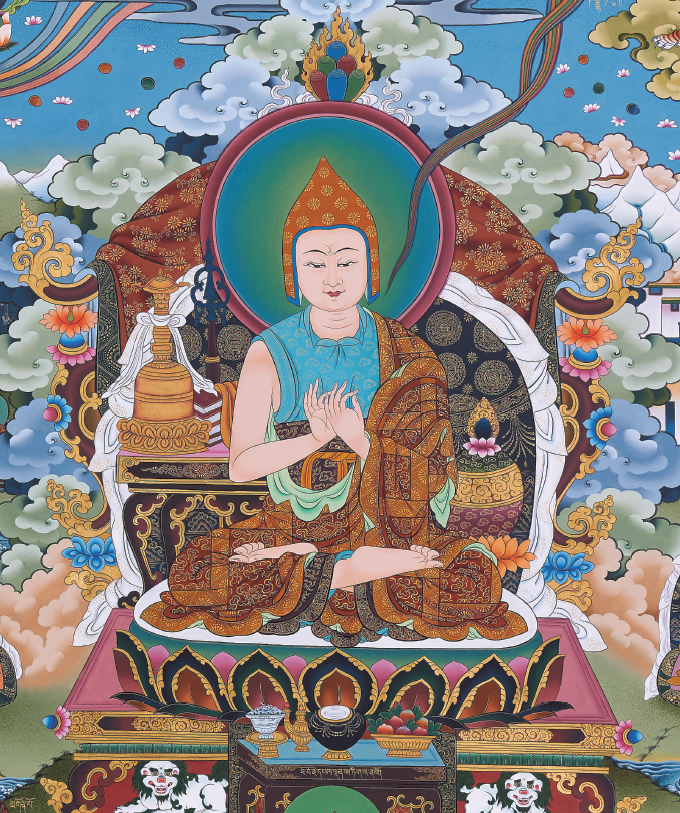
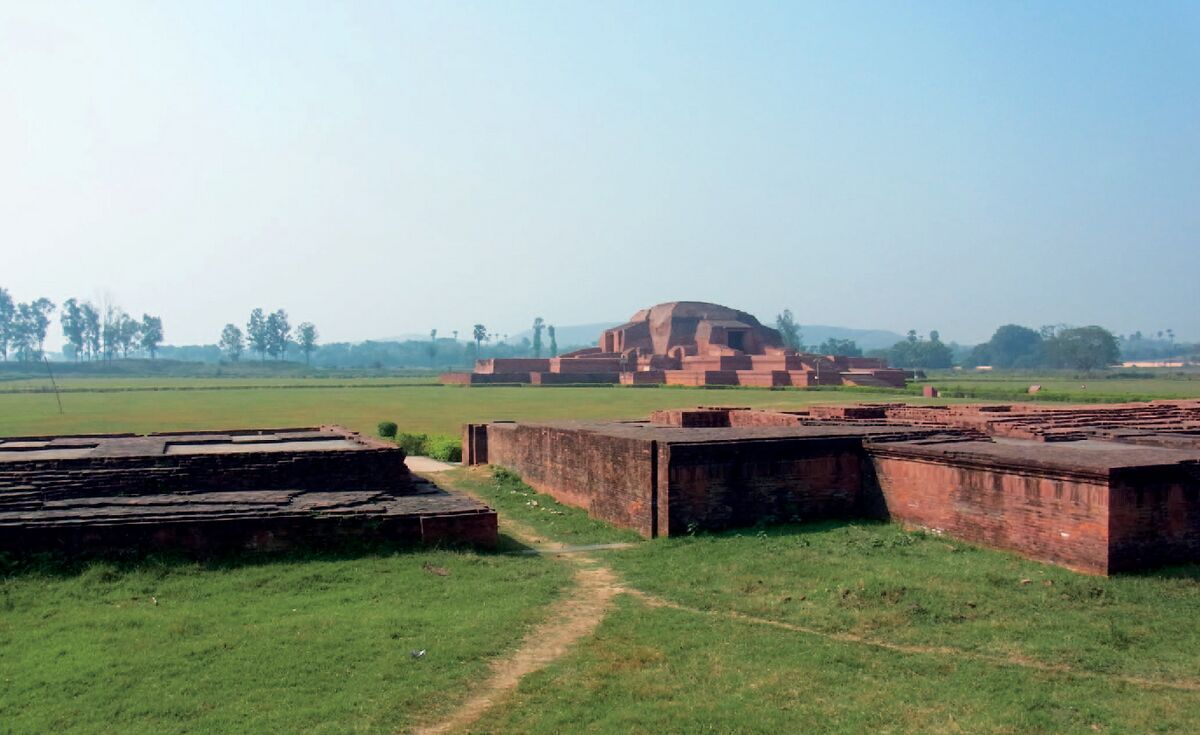
A more certain presence of the BCA in the valley happens during what is referred to as the transitional period (879-1200 CE), with the arrival in 1040 of the monk Atiśa Dīpaṃkaraśrījñāna (982-1054 CE). Atiśa, abbot at the great Buddhist monastery Vikramaśīla that was located in what is today the state of Bihar, India, had been invited to Tibet by the king of Gugé (gu ge) in Western Tibet. On his way he spent a year in Kathmandu, and founded there the Thaṃ Vihāra (given the Sanskrit name Vikramaśīla-mahāvihāra), which can still be visited today.[44] Atiśa taught the BCA to disciples in Tibet, and it became a work of central importance to the bKa' gdams pa, the Tibetan philosophical school founded by him. He is said to have emphasized the teaching of the BCA in Tibet, and brought with him the already mentioned abridgements of the BCA, the BCAṢP and the BCAPiṇ, as well as his own Bodhisattvacaryāsūtrikṛtāvavāda,[45] which is not actually a commentary to the BCA, but a general instruction on the conduct of the bodhisattva. The BCA was therefore also probably a text he emphasized during his stay in Kathmandu.
Source: Semantic Scholar.org
The earliest dated manuscript that has been preserved connected with the BCA is Kol. G. 3830, containing Prajñākaramatī's (10th Century CE) commentary Bodhicaryāvatārapañjikā (BCAP), dated to 1078 CE, only 38 years after Atiśa's visit.[46] The manuscript is reported by Hara Prasad Śāstri (1917: 49) to be written in a Newari script, so we can expect that it is a copy executed in Kathmandu. The copying of manuscripts was a central religious activity vital for upholding the Buddhist tradition. Several texts do in fact themselves stress the importance and rewards that result from copying them, such as for instance the Vajracchedikā Prajñāpāramitā.[47] Lewis (2000: 16) suggests that "after the Muslim conquest of polities across the Gangetic plains, the Newar Saṃgha's major areas of religious focus turned to perfecting ritual expressions of the doctrine within society and preserving the dharma via manuscript copying." From this time onward we have a relatively large body of manuscripts of the BCA, attesting to the popularity of this text. The earliest dated manuscript of the BCA itself is a specimen copied in 1180 CE (NGMCP C 14/2), the next is dated to 1399 CE (Lon. 2927), and apart from these there are ten other palm-leaf manuscripts, dated and undated, that were probably copied around this same time period.[48]
The Malla Period
During the Malla Dynasty (1200-1768) Newari Buddhism began to develop its own particular characteristics for which it is also known today. Nepal had inherited a type of Hindu-Buddhist culture that was typical for the whole of India before the Muslim conquest. The Kathmandu Valley hosted many small monasteries modelled on the great monastic institutions found in North-India at the time,[49] and its Buddhism was most likely predominantly of an exoteric Mahāyāna devotionalism with esoteric Vajrayāna practices reserved for the specialists. King Jayasthitimalla (r. 1382-95) is said to have formalised the arrangement of the Nepalese society into a caste structure that also included the Buddhists, and this seems to have paved the way for the extraordinary development, seen from a traditional Buddhist perspective, that took place here. There was a gradual turn to non-celibacy among the monks living in the monasteries, and these became instead a caste group with hereditary claims to religious status and ownership of the religious institutions. A special ceremony was devised to uphold these rights, and members were first ordained as monks, and then, usually just a few days later, initiated into the Mahāyāna bodhisattva community (saṃgha) as householders. Two main castes developed, the Śākya and the Vajrācārya. The latter were seemingly the descendants of Vajrayāna ritual experts, and had a monopoly on the transmission and practice of the esoteric Vajrayāna practices still upheld today.
As in Tibet the BCA probably played an important role in the transference of bodhisattva vows. From the manuscript remains we see that the tradition of copying the BCA was upheld throughout this period, first on palm-leaf, as discussed above, and later, starting in the 17th Century, on paper. Two paper manuscript of the 17th Century have been preserved, NGMCP H 380/8 and Unk. M. The scribe of the former manuscript was Jayamunī Vajrācārya, of who nothing further is so far known. Judging from his name he must have been a member of the Vajrācārya caste. The main stronghold for Newari Buddhism was the town of Lalitpur (Patan), situated in the south of the Kathmandu Valley. During the period 1482-1768 the valley was divided into three city states, Kathmandu, Bhaktapur, and Lalitpur, and the last became, as it still is today, the centre for Newari Buddhism. The Asha archives of Patan holds several copies of the BCA and related texts, and we can expect that many of the manuscripts that have made it to other collections in Nepal and abroad were also originally from Patan.[50]
Modern Nepal
After the Gorkha conquest of the Kathmandu Valley in 1768, and the following unification of the modern state of Nepal, Hinduism became the dominant religion, and Newari Buddhism has since then suffered a gradual decline. This did not however have any immediate effect on the interest for the BCA, and throughout the 19th Century the text was copied frequently, and later also translated into Newari (BCANew). There are 12 manuscripts in the NGMCP catalogue that date from this period, the earliest, NGMCP B 97/7, copied in 1784. The two manuscripts kept in Paris, but originally from Nepal, are probably also from around the 18th-19th Centuries, as well as others that I have not been able to investigate further.[51] E 2511/1 is reported to have been copied by Ratnānanda Vajrācarya, another member of this Buddhist caste that we so far have no further information on.[52]
Lewis (2000: 18) comments that due to "declining patronage, Hindu state discrimination, and anti-Mahāyāna missionizing by the revitalist Theravādin monks, the Newar Buddhist saṃgha has struggled to survive over the last century." One way of tackling this has been to make Buddhist literature more available, both in Sanskrit and in Newari. The introduction of the printing press into the Newar community in 1909 greatly facilitated this, and since then over a thousand Buddhist publications have been produced. The translation of the BCA into Newari is probably a fairly recent development, as the manuscripts containing it are a relatively new addition in the collections available to me. Only one manuscript is dated, NGMCP E 1789/39, which was copied in 1952 CE. There are also two manuscripts containing the same Newari commentary, the Bodhicaryāvatārabhāṣā, written by Ratna Bahādur Vajrācārya (1893-1955).[53] The manuscript NGMCP E 1374/25-1375/1, produced in 1943 CE, is perhaps a copy originating from the authors own hand. It is probably the older of the two, as it is written on a loose-leaf manuscript format, while E 10/3 is in a modern book format. In the latter the full Sanskrit verses of the BCA have been added into the text for reference. This manuscript material bears witness to a growing interest in the BCA in the 20th Century, or at least an interest that is just as lively as in previous centuries.
During my studies at a Tibetan Buddhist monastery near Boudhanath, Kathmandu, from 2002-2006 I met several young men from the Newar Buddhist community who were concerned for the future of their tradition. Some were members of the Vajrācārya caste, and they came to study in the Tibetan Buddhist tradition for inspiration to take back to their own community, and the work they were to take up there. Among the texts taught most often at the monastery was the BCA. Perhaps the Tibetan Buddhist emphasis on this text, and their growing influence in the Kathmandu Valley, will have an influence on the Newar tradition of the BCA. With the growing concern for keeping their tradition alive, and the increased availability of Buddhist literature, it is at least likely that the Newars' transmission of the BCA will not end any time soon. That there is a particular Newar tradition of the BCA is not something that is widely known within scholarly circles, a peculiar fact as the Newars are the only ones who have kept its tradition alive in the original language of Sanskrit. Further research into this tradition is required, and of particular interest is the Newari commentary that has been revealed. Both as a testimony to the last surviving "Indian" Buddhist tradition of the BCA, and as an important work of Newari literature, this would indeed merit a study of its own.[54]
Notes
- ↑ See for instance Jensen (1994: 428).
- ↑ These sources included all Sanskrit mss. of the BCA that have been checked, the Sanskrit account of Śāntideva's life found in the ms. Kol. G. 9990, the Tibetan canonical translation as found for instance in Tg, as well as several Tibetan accounts of Śāntideva's life story, which will be discussed further below.
- ↑ See T 1662 543c18-23.
- ↑ Lancaster (1979: K 1121), a catalogue of the Chinese Buddhist canon, states that Śāntideva is the author, but that Nāgārjuna has written the verses. As the whole text is in verses it is difficult to see how this statement should be understood. It can be mentioned though that the Dūnhuáng ms. Lon. IOL Tib J 628, a Tibetan translation of BCA1, begins the text with a quote from Nāgārjuna's Mūlamadhyamakakārikā (MMK); see Garfield (1995) for a translation of the MMK.
- ↑ A discussion of this translation in relation to the canonical Tibetan translation found in the Tg (BCATib3) will be discussed in the chapter on Tibet.
- ↑ Saito (1993: 6-7).
- ↑ See Braarvig (1993, vol. II) for Akṣ; Braarvig (1993, vol. II: 1-1i) gives a short discussion of the Bodhisattva Akṣayamati; for a list of the quotes from Akṣ in ŚS see Braarvig (1993, vol. II: 1v).
- ↑ Clayton (2006: 32) summarizes the various dates proposed: Tāranātha (?): c. 650; Bhattacharya [in Krishnamacharya (1926)]: c. 691-743; Pezzali (1968): 685-763; Ruegg (1981): c. 700; Saito (1996): 725-65.
- ↑ There are also accounts found in the commentaries of dPa' bo gtsug lag phreng ba (1504-1566) [see Brunhölzl (2004)], Kun bzangs dpal ldan (1862-1943) [see Kretschmar (2003-)], and others.
- ↑ Jong (1975) showed that the Sanskrit account given by Pezzali (1968) was in fact the same as that found in the introduction to Vibhūticandra's Bodhicaryāvatāratātparyapañjikāviśeṣadyotanī (BCATPVD) found in Tibetan translation in Tg sha 192b4-285a7; the Sanskrit version is found in the ms. Kol. G. 9990.
- ↑ The biography of Śāntideva is recounted, among others, in Minayev (1889: 226-228), La Vallée Poussin (1892: 70-75), Hara Prasad Śāstri (1913), Finot (1920: 11-13), Pezzali (1968: 3-45), Jong (1975), Sweet (1977: 2-3), Crosby (1996: vi-x), Brassard (2000: 15-17), Brunnhölzl (2004: 601-603), and Clayton (2006: 33-36).
- ↑ Minayev (1889: 210): yadā na bhāvo nābhāvo mateḥ saṃtiṣṭhate puraḥ / tadānyagatyabhāvena nirālambā praśāmyati //
- ↑ Bendall (1903) and Tg khi 3a2-194b5.
- ↑ Clayton (2006: 36-38) discusses this missing work in some detail.
- ↑ See Saito (1997); the Tibetan translation process is discussed in detail below.
- ↑ According to Saito (1997: 79) Bu ston mentioned two additional commentaries in his first index to the Tibetan canon, but these were not included in the final version of Tg; Ejima (1966) contains a discussion of the different commentaries on the BCA, but as this article is in Japanese I have not been able to benefit from its discussion; according to Brunnhölzl (2004: 611) Tibetan sources say that there existed more than one hundred Indian commentaries on the BCA.
- ↑ La Vallée Poussin (1901-14) and Tg la 41b1-288a7.
- ↑ Ms. Kol. G. 9990 and Tg sha 192b4-285a7.
- ↑ Ms. NGMCP B 23/4.
- ↑ Tg la 288b1-349a7.
- ↑ Brunnhölzl (2004: 611) suggests that Dānaśīla might have written this work. He gives no reference for this suggestion. If so it is possible that this is the same Dānaśīla mentioned by Tāranātha as a contemporary of King Gopāla (r. c. 750-770/775), and perhaps the one who, according to Ruegg (1981-117), collaborated with dPal brtseg (the translator of BCATib ) and dPal 'byor snying po in the translation of the Hastavālavṛtti, and with Jinamitra, Śīlendrabodhi and Ye shes sde in the translation of Candrakīrti's Yuktiṣaṣṭikāvṛtti.
- ↑ Tg sha 178a7-188a7.
- ↑ Ruegg (1981: 116); Nāḍapāda was a major figure in the lineage of teachings that developed into the bKa' brgyud sect in Tibet.
- ↑ Text no. 5277 in the Beijing edition of the bsTan 'gyur.
- ↑ He was perhaps also, as Atiśa, related to the monastic university of Vikramaśīla.
- ↑ Tg sha 1b1-90b3.
- ↑ Tg sha 90b5-159a3.
- ↑ This article is in Japanese, and has therefore only been of limited help to me.
- ↑ Tg sha 159a3-178a1.
- ↑ Tiān Xīzāi and the Chinese translation will be further discussed in the chapter on China below.
- ↑ Tg sha 188a7-191b3.
- ↑ Tg sha 191b3-192b6.
- ↑ The works attributed to him are on the other hand signed Dharmapāla.
- ↑ Eimer (1981: 77); the opposite is not the case, as Eimer points out that the colophon of the shorter version has been added to in the longer version.
- ↑ See the further discussion of this in the chapter on Tibet below.
- ↑ Including Korea, Japan, and Vietnam, which were countries that also employed the Chinese Buddhist canon.
- ↑ The BCA has had somewhat of a renaissance in India in the last century, partly due to the development of Indian historical scholarship, and the BCA has now been translated both into Hindi [Shastri (1955), Tripathi (1989), Sharma (1990), and Siṃha (1993)] and Bengali [Mukhopādhyāya (1962)].
- ↑ Lewis (2000: ix).
- ↑ 63
- ↑ The NGMCP and its work will be presented in the chapter on manuscripts.
- ↑ "Newar", linked with the Sanskrit nepāla and the modern name for the country of Nepal, is a word of Tibeto-Burman origins. According to Lienhard (1988: ix) it is related with Tibeto-Burman nhet.pā̆ (ŋepā̆) which means "cow-herd", thus corresponding to Skt. gopāla ("cow-herd"), and it is noteworthy that the first historically recorded dynasty of Nepal was that of the Gopālas.
- ↑ Lienhard (1988: ix); the dynasty of this period was probably called Licchavi due to a claim of family relationship with the ancient Indian aristocratic family of the same name that ruled a small kingdom in the central Ganges valley at the time of Śākyamuni Buddha.
- ↑ See for instance Ruegg (1981: 85).
- ↑ The Thaṃ Vihāra is close to the British embassy in central Kathmandu.
- ↑ Tg khi 237a3-238a6 and Jo bo’i chos chung, gi 10a5-11b1.
- ↑ The contents of this and other mss. will be dealt with in a later chapter.
- ↑ See Harrison (2006: 150).
- ↑ These are all listed in the appendix.
- ↑ Such as the already mentioned great monasteries at Nālandā and Vikramaśīla.
- ↑ See the chapter on manuscripts and the appendix for more on these.
- ↑ Such as for instance those held in the Asha archives.
- ↑ A 121/8 is reported in the colophon to have been copied at the Ratnakṛti Vihāra by a Vajrācārya that I am unable to decipher the name of. I have not been able to locate this vihāra.
- ↑ The works of Ratna Bahādur Vajrācārya have been dealt with in Yoshizaki (2007). This article is in Japanese, and since I have not knowledge of this language it has been difficult to benefit from its findings.
- ↑ Recently V. Divyavajra (1986) published what seems to be a Sanskrit edition with Newari translations of the BCA and the BCAP. This has not been available to me so far, but would indeed be of interest in further work on the BCANew.



