| 🤓 Admin Zone 🛠️ hidden to non-admins | |


Description


The Introduction chapter of this book, Rulu's seventh, explores the origin of the concept of the Tathagata store, and discusses how teachings on the Tathagata store have come to be accepted in China as the mainstream of Mahayana teachings and a distinct school of thought, standing apart from and along with the Madhyamaka School and the Yogacara School. Highlights of teachings on the Tathagata store presented in this chapter include why all sentient beings possess the Tathagata store, meanings of the dharma body and its four virtues, a comparison between the self claimed by those on non-Buddhist paths and a true self taught by the Buddha, meanings of one's Buddha nature, and how one's Tathagata store and alaya consciousness (alaya-vijnana) are unified.
This book presents the English translations of six sutras selected from the Chinese Buddhist Canon. The Mahavaipulya Sutra of the Tathagata Store gives a basic teaching and describes by nine analogies that one's Tathagata store is shrouded by one's afflictions. The Sutra of Neither Increase Nor Decrease reveals that the Tathagata store is a Tathagata's dharma body, and that the realm of sentient beings neither increases nor decreases. The Sutra of Shrimala's Lion’s Roar gives teachings on one's afflictions that shroud one's Tathagata store and inspires all sentient beings to ride the One Vehicle to attain Buddhahood. The Mahayana version of the Sutra of Angulimalika reveals that as one's Tathagata store transcends all dharmas, all dharmas are one's Tathagata store. The Sutra of the Unsurpassed Reliance teaches one to rely on one's Tathagata store in order to walk the bodhi path to Buddhahood. The Sutra of the Vajra Samadhi reveals that one's inherent awareness, the pure awareness of one's true mind, has a mass of benefits. This book will benefit readers at all levels and can serve as a basis for scholarly research. (Source: Author House)


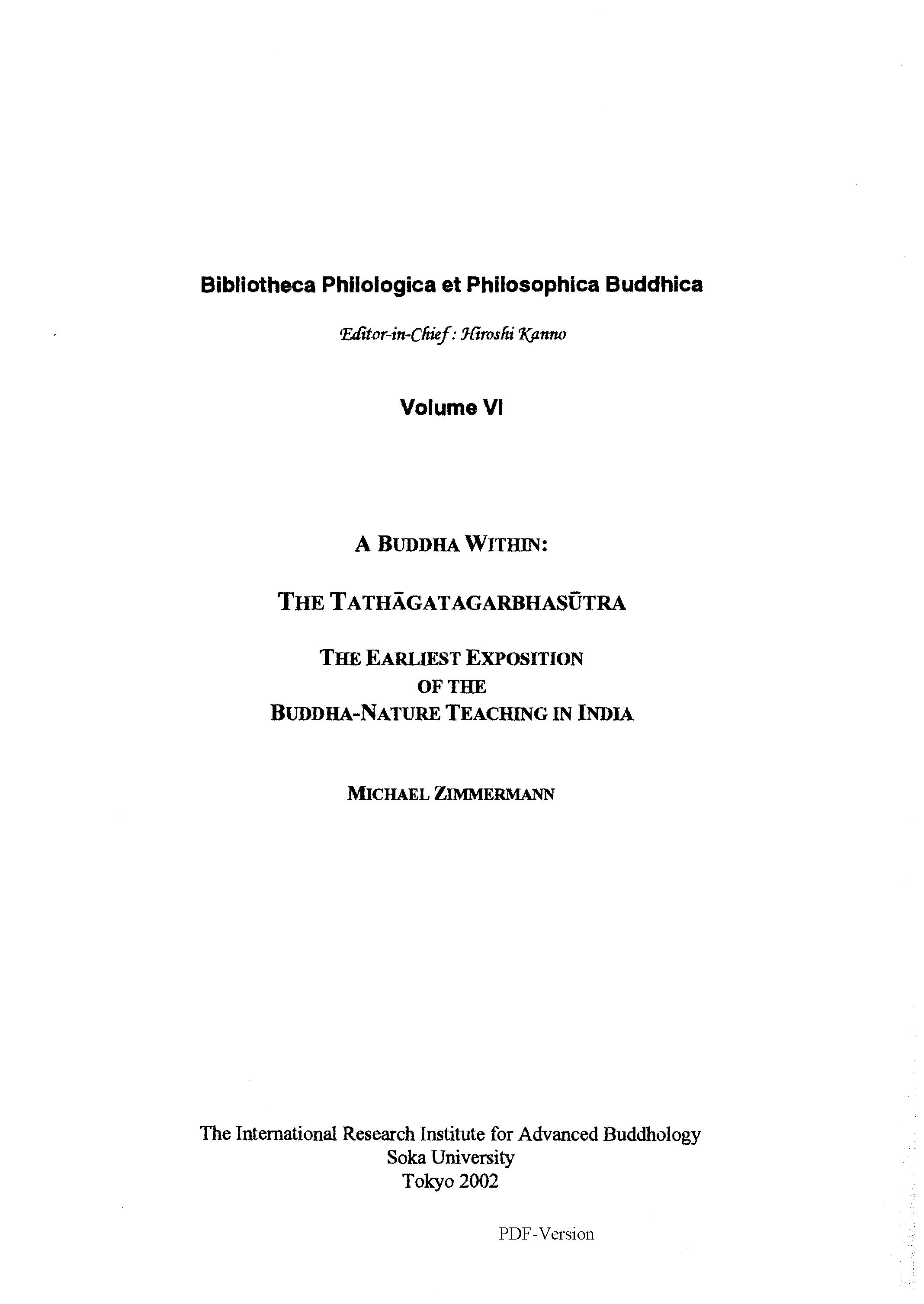
In his comprehensive study of the development of the tathāgatagarbha teaching, J. Takasaki also deals with the sūtra which bears the name of this Mahāyāna philosophical current.[1] The Tathāgatagarbhasūtra (TGS) has generally been referred to as the earliest expression of this doctrine and the term tathāgatagarbha itself seems to have been coined by this very sūtra. In this paper I intend to introduce the textual history and doctrinal content of the TGS and offer some speculations concerning the possible motivations lying behind its compilation. By pointing out some interesting parallels concerning the structure and formulations in the Saddharmapuṇḍarīkasūtra (SP), I shall then suggest that the SP and the TGS carry a similar compositional line. Finally, I shall determine the position and role of the TGS in Mahāyāna Buddhism as a sūtra presupposing the doctrine of the SP and providing its metaphysical foundation. (Zimmermann, introductory remarks, 143–44)
Notes
- Jikidō Takasaki 高崎直道, Nyoraizō shisō no keisei (Formation of the Tathāgatagarbha Theory), Tokyo 1974 (Shunjū-sha): pp. 40–68.

The Introduction chapter of this book, Rulu's seventh, explores the origin of the concept of the Tathagata store, and discusses how teachings on the Tathagata store have come to be accepted in China as the mainstream of Mahayana teachings and a distinct school of thought, standing apart from and along with the Madhyamaka School and the Yogacara School. Highlights of teachings on the Tathagata store presented in this chapter include why all sentient beings possess the Tathagata store, meanings of the dharma body and its four virtues, a comparison between the self claimed by those on non-Buddhist paths and a true self taught by the Buddha, meanings of one's Buddha nature, and how one's Tathagata store and alaya consciousness (alaya-vijnana) are unified.
This book presents the English translations of six sutras selected from the Chinese Buddhist Canon. The Mahavaipulya Sutra of the Tathagata Store gives a basic teaching and describes by nine analogies that one's Tathagata store is shrouded by one's afflictions. The Sutra of Neither Increase Nor Decrease reveals that the Tathagata store is a Tathagata's dharma body, and that the realm of sentient beings neither increases nor decreases. The Sutra of Shrimala's Lion’s Roar gives teachings on one's afflictions that shroud one's Tathagata store and inspires all sentient beings to ride the One Vehicle to attain Buddhahood. The Mahayana version of the Sutra of Angulimalika reveals that as one's Tathagata store transcends all dharmas, all dharmas are one's Tathagata store. The Sutra of the Unsurpassed Reliance teaches one to rely on one's Tathagata store in order to walk the bodhi path to Buddhahood. The Sutra of the Vajra Samadhi reveals that one's inherent awareness, the pure awareness of one's true mind, has a mass of benefits. This book will benefit readers at all levels and can serve as a basis for scholarly research. (Source: Author House)In his comprehensive study of the development of the tathāgatagarbha teaching, J. Takasaki also deals with the sūtra which bears the name of this Mahāyāna philosophical current.[1] The Tathāgatagarbhasūtra (TGS) has generally been referred to as the earliest expression of this doctrine and the term tathāgatagarbha itself seems to have been coined by this very sūtra. In this paper I intend to introduce the textual history and doctrinal content of the TGS and offer some speculations concerning the possible motivations lying behind its compilation. By pointing out some interesting parallels concerning the structure and formulations in the Saddharmapuṇḍarīkasūtra (SP), I shall then suggest that the SP and the TGS carry a similar compositional line. Finally, I shall determine the position and role of the TGS in Mahāyāna Buddhism as a sūtra presupposing the doctrine of the SP and providing its metaphysical foundation. (Zimmermann, introductory remarks, 143–44)
Notes
- Jikidō Takasaki 高崎直道, Nyoraizō shisō no keisei (Formation of the Tathāgatagarbha Theory), Tokyo 1974 (Shunjū-sha): pp. 40–68.