| 🤓 Admin Zone 🛠️ hidden to non-admins | |
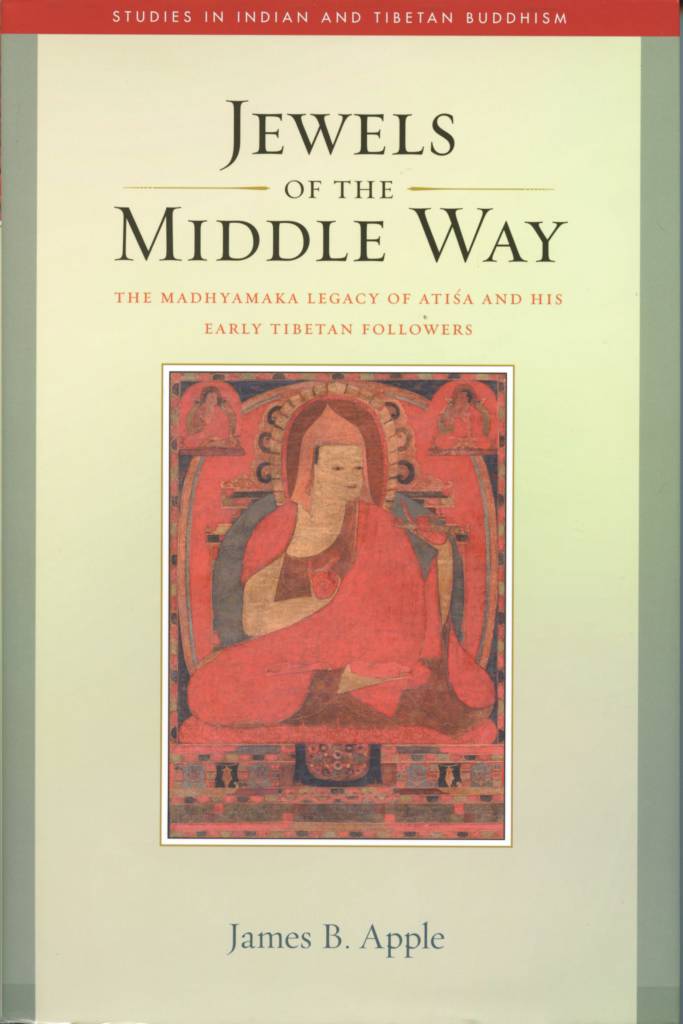
Jewels of the Middle Way: The Madhyamaka Legacy of Atiśa and His Early Tibetan Followers
Book
Please note that many items in our library are simply pages that represent a detailed library catalog entry and citation of someone else's work, presentation, or performance. Read our General Disclaimer for more information. You can find more information about this item on the publisher website.

Description
This book presents a detailed contextualization of the Madhyamaka (Middle Way) school in India and Tibet, along with translations of several texts in the Bka’ gdams gsung ’bum (Collected Works of the Kadampas), recently recovered Tibetan manuscripts that are attributed to Atiśa and Kadampa commentators. These translations cohere around Atiśa’s Madhyamaka view of the two realities and his understanding of the practice and the nature of the awakening mind.
The book is organized in three parts based on the chronology of Atiśa’s teaching of Madhyamaka in India and Tibet: (1) Lineage Masters, the Mind of Awakening, and the Middle Way; (2) Articulating the Two Realities; and (3) How Mādhyamikas Meditate. Each part focuses on a specific text, or set of texts, specifically related to Atiśa’s Middle Way. The authorship and date of composition for each work is discussed along with an outline of the work’s textual sources followed by an analysis of the content. (Source: Wisdom Publications)
Citation
Apple, James. Jewels of the Middle Way: The Madhyamaka Legacy of Atiśa and His Early Tibetan Followers. Studies in Indian and Tibetan Buddhism. Somerville: Wisdom Publications, 2018.
Publisher Link
Table of contents
- Prefaceix
- Introduction: Atiśa's Middle Way in India and Tibet1
- Part 1. Lineage Masters, the Mind of Awakening, and the Middle Way
- 1. Atiśa's Open Basket of Jewels: Special Instructions on the Middle Way63
- Part 2. Articulating the Two Realities
- 2. Atiśa's Entry to the Two Realities(Satyadvayāvatāra)117
- 3. Collection on the Two Realities: A Kadampa Commentary123
- 4. A General Explanation of, and Framework for Understanding, the Two Realities, attributed to Atiśa171
- Part 3. How Mādhyamikas Meditate
- 5. Atiśa's Special Instructions on the Middle Way (Madhyamakopadeśa)269
- 6. Prajñāmukti's Commentary on Special Instructions on the Middle Way (Madhyamakopadeśavṛtti)279
- 7. Collection of Special Instructions on the Middle Way: A Kadampa Commentary291
- Appendix of Translated Passages327
- Table of Tibetan Transliteration333
- Abbreviations341
- Notes343
- Bibliography423
- Index455
- About the Author469
Interconnections
2 Full translation of

Atiśa based his teaching of Madhyamaka thought and practice on the two realities, conventional reality (saṃvṛtisatya) and ultimate reality(paramārthasatya). Entry to the Two Realities succinctly lays out in twenty-eight verses a general exposition on the two realities. Atiśa composed this work between 1012 and 1025 while residing in Sumatra and studying under Serlingpa. Serlingpa inquired about Atiśa's philosophical views in a letter and Atiśa composed this set of verses as a response. Atiśa wrote Entry to the Two Realities in order to change the philosophical view of Serlingpa from a Yogācāra position to that of the Madhyamaka. Atiśa's introductory text on Madhyamaka presents his understanding based on the synthesis of a number of previous Indian Madhyamaka thinkers. (Source: James Apple, Atiśa Dīpaṃkara: Illuminator of the Awakened Mind, 127.
Atiśa's Open Basket of Jewels: Special Instructions on the Middle Way (Ratnakaraṇḍodghāṭamadhyamakopadeśa)m is one of the primary works among his collected writings and perhaps the most extensive of his extant writings composed in India. The text outlines a number of significant features regarding his theory and practice of Mahāyāna Buddhism in general, as well as his understanding of Madhyamaka in particular. The term ratnakaraṇḍodghāṭa refers to an open karaṇḍa, a "basket or covered box," made of jewels (ratna) or containing jewels. In this instance, the jeweled box or box of jewels is the text itself, containing over 120 citations from sūtras and tantras, as well as śāstras and hymns attributed to seminal Buddhist figures such as Nāgārjuna and Āryadeva. The citations of these sources indicate that Atiśa had access, possibly in a temple or monastic library or depository,
to a great number of Indian Buddhist texts when he composed this work.
Date and Place of Authorship
According to the colophon of the canonical version of Open Basket of Jewels, the text was written in the great temple of Vikramaśīla, under the patronage of King Devapāla. The colophon explains that Atiśa composed the work at the requests of his Tibetan disciple and translation partner Tsultrim Gyalwa. The colophon also mentions that the translation was redacted by Atiśa, Tsultrim Gyalwa, and the layperson Tsöndrü Sengé. Therefore the text must have been composed before Atiśa left for Tibet circa 1040, as Tsöndrü Sengé passed away in Nepal on the journey to Tibet (Chattopadhyaya 1981, 302). This information also demonstrates the pedagogical relationship Atiśa had with his Tibetan students in India, in that Atiśa composed Open Basket of Jewels as an introduction for them to understand his Madhyamaka lineage, its source texts, and its primary practices. (Apple, Jewels of the Middle Way, 63)2 Scholarship on
Atiśa based his teaching of Madhyamaka thought and practice on the two realities, conventional reality (saṃvṛtisatya) and ultimate reality(paramārthasatya). Entry to the Two Realities succinctly lays out in twenty-eight verses a general exposition on the two realities. Atiśa composed this work between 1012 and 1025 while residing in Sumatra and studying under Serlingpa. Serlingpa inquired about Atiśa's philosophical views in a letter and Atiśa composed this set of verses as a response. Atiśa wrote Entry to the Two Realities in order to change the philosophical view of Serlingpa from a Yogācāra position to that of the Madhyamaka. Atiśa's introductory text on Madhyamaka presents his understanding based on the synthesis of a number of previous Indian Madhyamaka thinkers. (Source: James Apple, Atiśa Dīpaṃkara: Illuminator of the Awakened Mind, 127.
Atiśa's Open Basket of Jewels: Special Instructions on the Middle Way (Ratnakaraṇḍodghāṭamadhyamakopadeśa)m is one of the primary works among his collected writings and perhaps the most extensive of his extant writings composed in India. The text outlines a number of significant features regarding his theory and practice of Mahāyāna Buddhism in general, as well as his understanding of Madhyamaka in particular. The term ratnakaraṇḍodghāṭa refers to an open karaṇḍa, a "basket or covered box," made of jewels (ratna) or containing jewels. In this instance, the jeweled box or box of jewels is the text itself, containing over 120 citations from sūtras and tantras, as well as śāstras and hymns attributed to seminal Buddhist figures such as Nāgārjuna and Āryadeva. The citations of these sources indicate that Atiśa had access, possibly in a temple or monastic library or depository,
to a great number of Indian Buddhist texts when he composed this work.
Date and Place of Authorship
According to the colophon of the canonical version of Open Basket of Jewels, the text was written in the great temple of Vikramaśīla, under the patronage of King Devapāla. The colophon explains that Atiśa composed the work at the requests of his Tibetan disciple and translation partner Tsultrim Gyalwa. The colophon also mentions that the translation was redacted by Atiśa, Tsultrim Gyalwa, and the layperson Tsöndrü Sengé. Therefore the text must have been composed before Atiśa left for Tibet circa 1040, as Tsöndrü Sengé passed away in Nepal on the journey to Tibet (Chattopadhyaya 1981, 302). This information also demonstrates the pedagogical relationship Atiśa had with his Tibetan students in India, in that Atiśa composed Open Basket of Jewels as an introduction for them to understand his Madhyamaka lineage, its source texts, and its primary practices. (Apple, Jewels of the Middle Way, 63)