Dharmadhātustava

From Bodhicitta
LibraryTextsDharmadhātustavaFull text
< Texts
Revision as of 03:19, 4 October 2025 by AlexC (talk | contribs) (AlexC moved page Texts/RKTST 10 to Dharmadhātustava)
(diff) ← Older revision | Latest revision (diff) | Newer revision → (diff)

Texts/Dharmadhātustava

धर्मधातुस्तव
Dharmadhātustava
ཆོས་ཀྱི་དབྱིངས་སུ་བསྟོད་པ།
chos kyi dbyings su bstod pa
Praise of the Dharmadhātu (84000)
Text


Please note that many items in our library are simply pages that represent a detailed library catalog entry and citation of someone else's work, presentation, or performance. Read our General Disclaimer for more information.

Description

Also known as the Dharmadhātustotra, it is a praise written in verse attributed to Nāgārjuna. A Sanskrit manuscript found in Tibet was recently published in 2015. However, before this it was only extant in Tibetan and Chinese translations, though fragments of this text were found to be quoted in other Sanskrit texts. It is notable as perhaps the only work of Nāgārjuna that takes a positivistic view of emptiness and the existence of wisdom, in this case represented by the dharmadhātu. In fact much of the language echoes descriptions of buddha-nature. Though modern scholarship has thus called the attribution of this text to Nāgārjuna into question based on its contents, Tibetan scholars have utilized the text as a support for works that promote or defend tathāgatagarbha and it is especially prominently featured in works on other-emptiness (gzhan stong) and Great Madhyamaka.
Citation
Nāgārjuna (ཀླུ་སྒྲུབ་). Dharmadhātustava [धर्मधातुस्तव]. chos kyi dbyings su bstod pa [ཆོས་ཀྱི་དབྱིངས་སུ་བསྟོད་པ།]. [Praise of the Dharmadhātu (84000)]. Translated by Kṛṣṇapaṇḍita, Nag 'tsho lo tsA ba tshul khrims rgyal ba, Dānapāla. Tengyur, RKTST 10 http://www.rkts.org/cat.php?id=10&typ=2.


Full translations

 
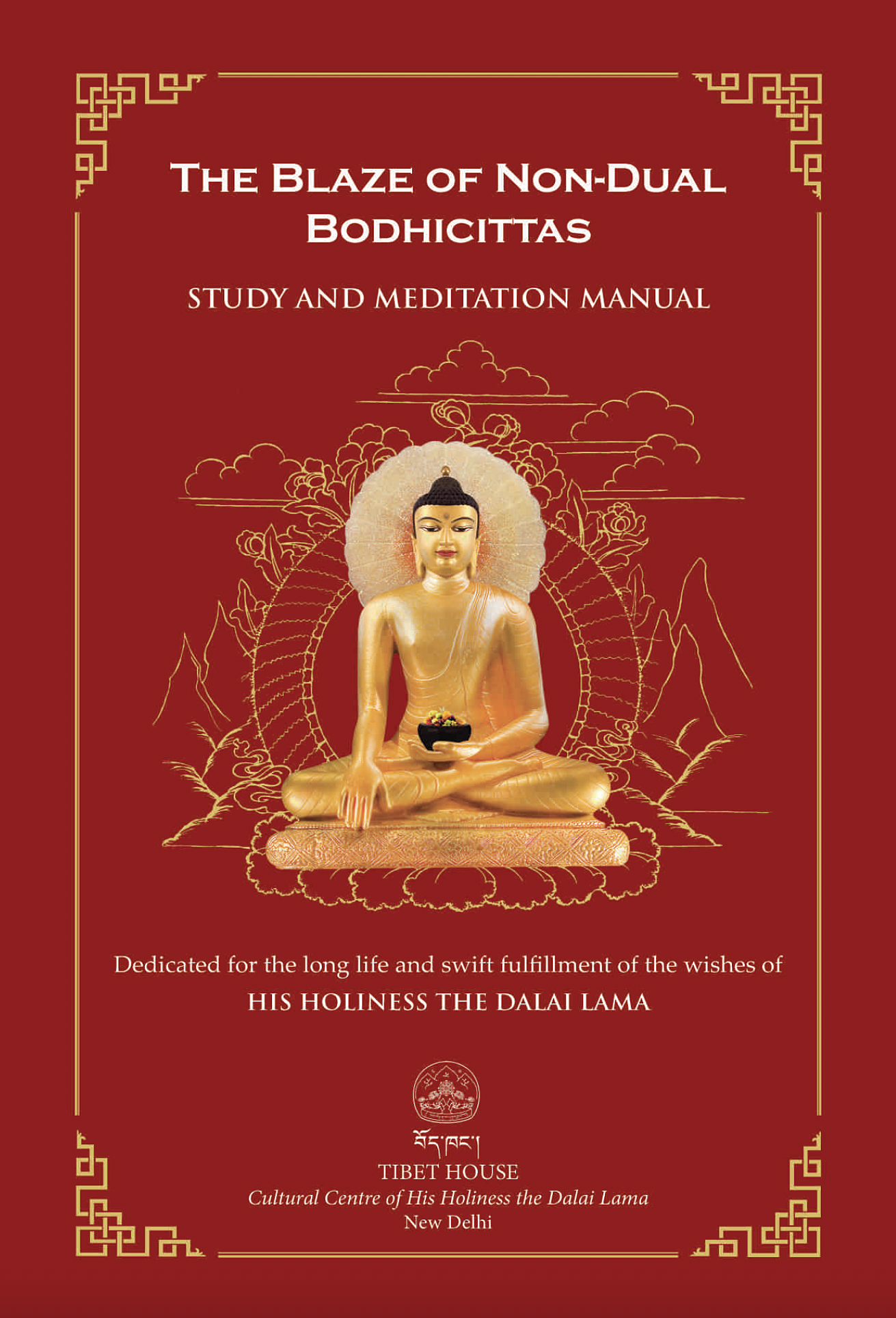
The Blaze of Non-Dual Bodhicittas (Damdul 2019)
The initial idea for this study, reflection and meditation manual took seed in 2004, when I first started to translate for His Holiness the Dalai Lama. I found many of the Nalanda texts frequently taught by His Holiness to be very useful; it occurred to me that a compilation of these in the English language would greatly benefit many seekers who might otherwise lack the opportunity to access them. It is only now, after many years of sharing the working drafts of this manual at Tibet House in New Delhi, as well as in many other places that the idea has finally come to fruition.

The book is divided into five parts:

I. Daily Recitation and Practice
II. Selected Texts for Study, Reflection and Meditation
III. Additional Prayers, Vows and Commitments
IV. Daily Dedication Prayers
V. Appendix

Part I and Part IV serve as a useful guide for all, who have an inclination towards dharma practice, but do not know how to start and design a daily practice session. It is also useful for those seekers who might be misguided and surmise that dharma practice comprises only of mantra recitation and so forth, thereby missing its essence.

Part II helps strengthen the practitioner’s dharma practice on the basis of selected compositions of great scholars and yogis. The actual breakthrough in the mental transformation happens through changes in the thought process, for which study and reflection are the cornerstones. Any of these profound texts and short extracts may be selected for study, reflection or meditation, on an on-going basis.

Part III reinforces and rejuvenates dharma practice and to that end, may be undertaken on a regular or occasional basis.

Part V introduces the reader to meditation practices, both shamatha (calm abiding) and vipasyana (special insight), including meditation on the breath, as well as methods to cultivate Bodhicitta and the wisdom of emptiness. While there are many texts on the wisdom of emptiness, the meditation included here is designed for all those who are not thoroughly introduced to this subject and still want to familiarise and habituate themselves with the wisdom of emptiness.

Brief notes, Endnotes and Glossary have been added to help the readers unfold the meanings of the texts with ease. (preface, xiv–xv)

Book

Number 10
Canon bstod tshogs
Sanskrit dharmadhātustava (D)
Alternate Titles chos kyi dbyings su bstod pa
Alternate Titles - Sanskrit dharmadhātustotra;dharmadhātustava
Author Nāgārjuna
Author (Tibetan) slob dpon chen po klu sgrub
Translator lo tsA ba tshul khrims rgyal ba
Translator Pandita rgya gar gyi mkhan po kr-iSh+Na paN+Di ta
Colophon chos kyi dbyings su bstod pa slob dpon chen po klu sgrub kyis mdzad pa rdzogs so// //rgya gar gyi mkhan po krishna paN+Di ta dang/ lo tshA ba tshul khrims rgyal bas bsgyur ba'o//
Title from Colophon chos kyi dbyings su bstod pa


Texts/Dharmadhātustava/Full text