| 🤓 Admin Zone 🛠️ hidden to non-admins | |
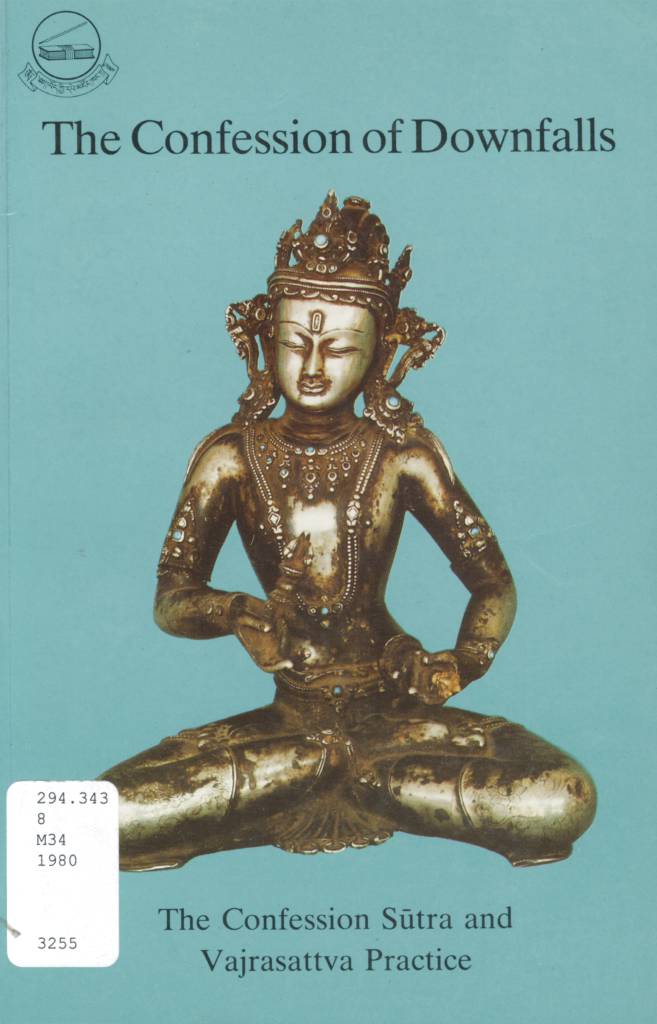
The Confession of Downfalls: The Confession Sūtra and Vajrasattva Practice
Book
Please note that many items in our library are simply pages that represent a detailed library catalog entry and citation of someone else's work, presentation, or performance. Read our General Disclaimer for more information.

Description
The Confession of Downfalls contains translations along with extensive commentaries to the two main sutra and tantra practices of mental purification in Tibetan Buddhism, the Sutra of Three Heaps and the visualization and mantra recitation of Vajrasattva.
The commentaries include excerpts from a śāstra by the Indian master Nāgārjuna to the Sūtra of Three Heaps and both practices are supplemented by verbally transmitted commentaries from the Tibetan lamas Geshe Ngawang Dhargyey, Geshe Rabten, Tubten Zopa Rinpoche, and Gegen Kyentse. (Source Accessed Feb 23, 2026)
Citation
Beresford, Brian C., trans. and ed. The Confession of Downfalls: The Confession Sūtra and Vajrasattva Practice. Dharamsala: Library of Tibetan Works and Archives, 1993.
Interconnections
2 Full translation of

The Sūtra of the Three Heaps (Skt. Triskandhakasūtra; Tib. 'Phags pa phung po gsum pa zhes bya ba theg pa chen po'i mdo, Toh 284) is a Mahāyāna liturgical sūtra set at hermitage called chos kyi dbye dgon pa. Its first part is an extended practice in which the practitioner offers homage, makes offerings, confesses all obscuring karma, rejoices in the virtue of all beings, exhorts the buddhas to turn the wheel of Dharma, and supplicates them not to pass into nirvāṇa. The practitioner then takes all roots of virtue as their own, dedicates them to awakening, and generates bodhicitta on the model of past buddhas and bodhisattvas. In the second part, Mañjuśrī teaches the bodhisattva Sarvadharmapratijñāsthita the "irreproachable" heaps of confession, rejoicing, exhortation, supplication, and dedication, understood in the light of emptiness and non-apprehension.
This text should be distinguished from the popular confession liturgy addressed to the thirty-five buddhas, widely recited as the "Three Heaps" or Bodhisattva's Confession of Downfalls. That liturgy circulates under the same Tibetan title, 'Phags pa phung po gsum pa zhes bya ba theg pa chen po'i mdo, but its content is an excerpt from the Upāliparipṛcchā (Toh 68), which itself calls the practice the "Dharma discourse of the Three Heaps." It is the Upāliparipṛcchā passage, not Toh 284, that Śāntideva quotes in the Śikṣāsamuccaya (ch. 8) and prescribes for recitation three times by day and three times by night in the Bodhicaryāvatāra (5.98).

The Bodhyāpattideśanāvṛtti (Byang chub kyi ltung ba bshags pa'i 'grel pa; "Commentary on the Declaration of Downfalls of a Bodhisattva") is a commentary on the Triskandhakasūtra attributed to Nāgārjuna. The text explains the origin, structure, and practice of the confession liturgy addressed to the thirty-five buddhas, covering the four forces of confession, the visualization and homage to each of the thirty-five buddhas, and the concluding dedication. It was translated from Sanskrit into Tibetan by the Indian abbot Śāntarakṣita and the Tibetan translator Devaghoṣa. The text is preserved in the Tengyur, sūtra section, volume ji, folios 209b–220b.