| 🤓 Admin Zone 🛠️ hidden to non-admins | |
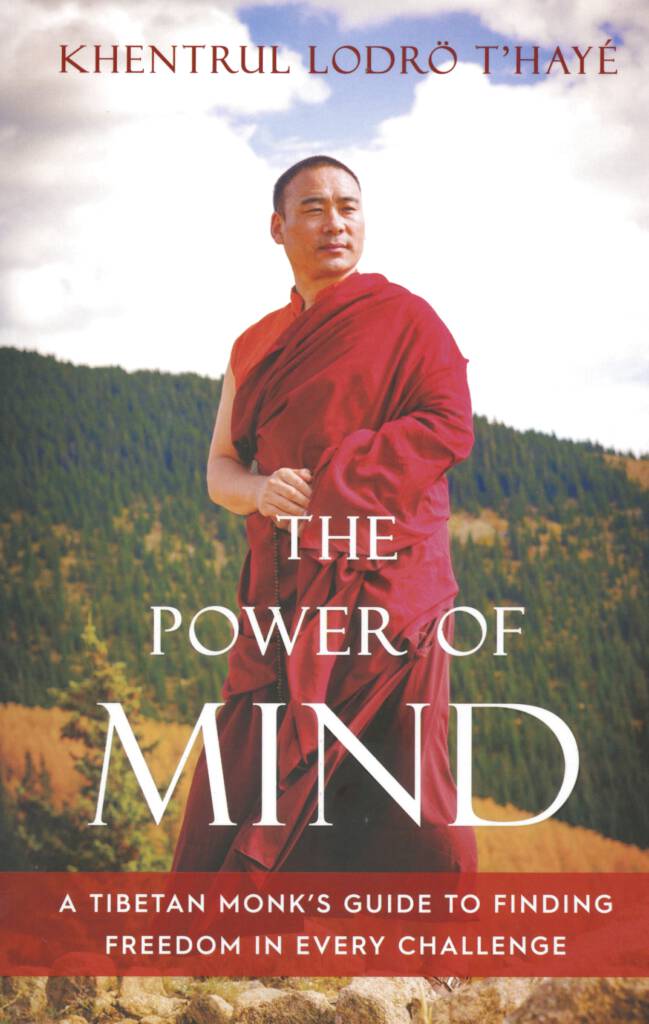
The Power of Mind: A Tibetan Monk's Guide to Finding Freedom in Every Challenge
Book
Please note that many items in our library are simply pages that represent a detailed library catalog entry and citation of someone else's work, presentation, or performance. Read our General Disclaimer for more information.

Description
A modern guidebook based on ancient Buddhist techniques for transforming emotional pain, anxiety, and stress into complete mental well-being that benefits us and the people around us.
We’ve all heard platitudes about cultivating love and compassion, but how can we really develop these qualities in ourselves and—crucially—share them in our world? The Power of Mind provides a proven path.
Khentrul Rinpoche teaches that regardless of what’s unfolding in our lives, our route to freedom lies in our minds—and how we work with them. A thousand years ago, the Indian saint Atisha endured great hardship to bring the Buddha’s teachings to Tibet, where they flourished. This book introduces a primary text that emerged—the Seven Key Points of Mind Training. (Source: Shambhala Publications)
Citation
T'hayé, Khentrul Lodrö. The Power of Mind: A Tibetan Monk's Guide to Finding Freedom in Every Challenge. Translated by Paloma Lopez Landry. Edited by Paloma Lopez Landry, Ibby Caputo, and Paul Gustafson. Boulder, CO: Shambhala Publications, 2022.
Table of contents
- Foreword by Tsultrim Lodro xi
- Translator's Guide for How to Read This Book xiii
- Introduction: Why Tame the Mind? 1
- PART ONE
- BUILDING A FOUNDATION FOR FREEDOM: THE PRELIMINARIES 11
- 1. This Precious Human Life: The Power of Being Human 13
- 2. Impermanence: No One Lives Forever 23
- 3. Karma, Cause, and Result: Actions Have Consequences 34
- 4. Suffering: The Unsatisfying Nature of All Things 41
- PART TWO
- MIND FREEING MIND: THE PRACTICE 51
- 5. Ultimate Bodhichitta: The True Nature of Reality 53
- 6. Relative Bodhichitta: The Awakened Heart 74
- PART THREE
- TRANSFORMING ADVERSITY: TURNING HARDSHIPS INTO OPPORTUNITIES117
- 7. Using Relative Reality for Transformation 119
- 8. Using Ultimate Reality for Transformation 132
- 9. Using Creative Methods for Transformation 139
- PART FOUR
- TRAINING IN LIVING AND DYING: APPLYING THE PRACTICE IN ALL CIRCUMSTANCES153
- 10. How to Train During This Life 155
- 11. How to Train While Dying164
- PART FIVE
- ASSESSING PROFICIENCY: RECOGNIZING THE SIGNS OF PROGRESS 171
- 12. Four Ways to Measure Your Growth173
- PART SIX
- LIVING IN HARMONY WITH PRACTICE: COMMITMENTS OF THE PATH 181
- 13. Sixteen Actions to Avoid That Contradict Mind Training 183
- PART SEVEN
- SUPPORT FOR TAMING THE MIND: KEY ADVICE203
- 14. Twenty-One Actions to Adopt That Support Mind Training 205
- 15. The Excellent Conclusion 227
- Acknowledgments 231
- Appendix 1: Atisha's Life Story and the Lineage of Mind Training233
- Appendix 2: The Root Text of the Seven Points of Mind Training 239
- Appendix 3: The Six Classes of Beings 243
- Appendix 4: Tonglen Meditation 246
- Extracted from Practice Instructions given by Kamyang Khyentse Wangpo
- Appendix 5: Dedication and Aspiration Prayers248
- Dedication Prayer extracted from the Kagyur
- Glossary 250
- Notes 256
- Index 265
- About the Author 277
Interconnections
1 Full translation of

Blo sbyong don bdun ma. (Lojong Döndünma). In Tibetan, "Seven Points of Mind Training"; an influential Tibetan work in the blo sbyong ("mind training") genre. The work was composed by the Bka' gdams scholar 'Chad ka ba ye shes rdo rje, often known as Dge bshes Mchad kha ba, based on the tradition of generating bodhicitta known as "mind training" transmitted by the Bengali master Atiśa Dīpaṃkaraśrījñāna. It also follows the system laid out previously by Glang ri thang pa (Langri Tangpa) in his Blo sbyong tshig brgyad ma ("Eight Verses on Mind Training"). Comprised of a series of pithy instructions and meditative techniques, the Blo sbyong don bdun ma became influential in Tibet, with scholars from numerous traditions writing commentaries to it. According to the commentary of the nineteenth-century Tibetan polymath 'Jam mgon kong sprul, the seven points covered in the treatise are: (1) the preliminaries to mind training, which include the contemplations on the preciousness of human rebirth, the reality of death and impermanence, the shortcomings of saṃsāra, and the effects of karman; (2) the actual practice of training in bodhicitta; (3) transforming adverse conditions into the path of awakening; (4) utilizing the practice in one's entire life; (5) the evaluation of mind training; (6) the commitments of mind training; and (7) guidelines for mind training. (Source: "Blo sbyong don bdun ma." In The Princeton Dictionary of Buddhism, 126–27. Princeton University Press, 2014. http://www.jstor.org/stable/j.ctt46n41q.27.)
1 Teaching on
Blo sbyong don bdun ma. (Lojong Döndünma). In Tibetan, "Seven Points of Mind Training"; an influential Tibetan work in the blo sbyong ("mind training") genre. The work was composed by the Bka' gdams scholar 'Chad ka ba ye shes rdo rje, often known as Dge bshes Mchad kha ba, based on the tradition of generating bodhicitta known as "mind training" transmitted by the Bengali master Atiśa Dīpaṃkaraśrījñāna. It also follows the system laid out previously by Glang ri thang pa (Langri Tangpa) in his Blo sbyong tshig brgyad ma ("Eight Verses on Mind Training"). Comprised of a series of pithy instructions and meditative techniques, the Blo sbyong don bdun ma became influential in Tibet, with scholars from numerous traditions writing commentaries to it. According to the commentary of the nineteenth-century Tibetan polymath 'Jam mgon kong sprul, the seven points covered in the treatise are: (1) the preliminaries to mind training, which include the contemplations on the preciousness of human rebirth, the reality of death and impermanence, the shortcomings of saṃsāra, and the effects of karman; (2) the actual practice of training in bodhicitta; (3) transforming adverse conditions into the path of awakening; (4) utilizing the practice in one's entire life; (5) the evaluation of mind training; (6) the commitments of mind training; and (7) guidelines for mind training. (Source: "Blo sbyong don bdun ma." In The Princeton Dictionary of Buddhism, 126–27. Princeton University Press, 2014. http://www.jstor.org/stable/j.ctt46n41q.27.)