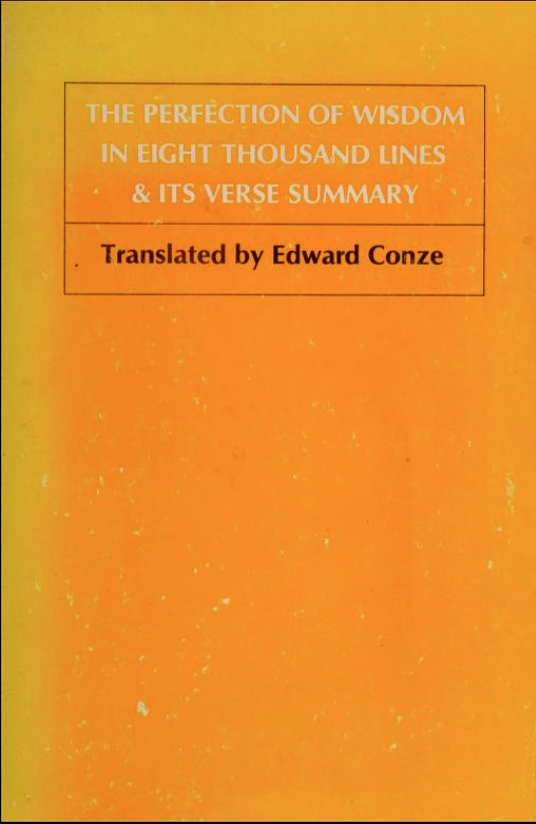
The Perfection of Wisdom in Eight Thousand Lines (1994) (Sri Satguru Publications)
From Bodhicitta
< Books(Redirected from The Perfection of Wisdom in Eight Thousand Lines and Its Verse Summary)
Books/The Perfection of Wisdom in Eight Thousand Lines (1994) (Sri Satguru Publications)
Books/The Perfection of Wisdom in Eight Thousand Lines (1994) (Sri Satguru Publications)
| 🤓 Admin Zone 🛠️ hidden to non-admins | |
The Perfection of Wisdom in Eight Thousand Lines and Its Verse Summary
Book
- A Few Good Men
- A New Translation of the Sanskrit Bhadracarī with Introduction and Notes
- Affirmation in Negation: A Study of the Tathāgatagarbha Theory in the Light of the Bodhisattva Practices
- Annotated Translation of the Daśabhūmika-sūtra
- Caturdharmikasūtra (Tseng, V.)
- Saddharma-Puṇḍarīka or the Lotus of the True Law (1963)
- Sarvadharmāpravṛttinirdeśa (Braarvig, J.)
- Saṅgharakṣita-avadāna (Hiraoka)
- Scripture of the Lotus Blossom of the Fine Dharma
- Siṃhaparipṛcchāsūtra (Tseng, V.)
- The Bhaiṣajyaguru-Sūtra and the Buddhism of Gilgit
- The Diamond Sutra (Conze)
- The Diamond Sutra: The Perfection of Wisdom
- The Diamond Sutra: Transforming the Way We Perceive the World
- The Final Leaves of the Pravrajyāvastu Portion of the Vinayavastu Manuscript Found Near Gilgit: Part 1 Saṃgharakṣitāvadāna
- The Hymn of the Life and Vows of Samantabhadra
- The Khotanese Bhadracaryādeśanā
- The Khotanese Śūraṅgamasamādhisūtra
- The Lalita-Vistara, or Memoirs of the Early Life of Śákya Siñha (English)
- The Lankavatara Sutra (1966)
- The Laṅkāvatāra Sūtra (1978)
- The Laṅkāvatāra Sūtra (2003)
- The Manuscript of the Vajracchedikā Found at Gilgit
- The Perfection of Wisdom (Jamieson)
- The Perfection of Wisdom in Eight Thousand Lines (1994) (South Asia Books)
- The Perfection of Wisdom in Eight Thousand Lines (1994) (Sri Satguru Publications)
- The Perfection of Wisdom in Eight Thousand Lines (Four Seasons Foundation)
- The Skill in Means (Upāyakauśalya) Sūtra
- The Story of Saṅgharakṣita (Stories 23–25)
- The Story of a Wretched Pig: Sūkarika-avadāna
- The Sūtra of the Golden Light
- The Sūtra of the Young Rice Plant (Śālistambasūtra)
- The Ten Grounds Sutra
- Vajracchedikā Prajñāpāramitā (Conze)
- Vajracchedikā Prajñāpāramitā (English)
- Vimalakīrtinirdeśasūtra (Joshi and Prāsādika)
Please note that many items in our library are simply pages that represent a detailed library catalog entry and citation of someone else's work, presentation, or performance. Read our General Disclaimer for more information.

Description
After the Torah, the Koran and the Gospels, the Indian literature of the Perfection of Wisdom has had the greatest impact on the religious consciousness of mankind. Its composition extended for over seven hundred years, and here we offer the reader the first two works which were composed in South India between 100 B.C. and A.D. 100. These documents are not only indispensable to those who wish to understand the mentality of the East, they still carry a potent spiritual message; and those who desire to diminish their personal worries y the disciplined contemplation of spiritual; thought could make no better choice. (Source Accessed June 25, 2021)
Citation
Conze, Edward, trans. The Perfection of Wisdom in Eight Thousand Lines and Its Verse Summary. Bibliotheca Indo-Buddhica Series 132 Delhi: Sri Satguru Publications, 1994.
Table of contents
- Prefaceix
- Verses on the Perfection of Wisdom1
- Chapter I9
- 1. Preliminary Admonition
- 2-4. The Source of Subhuti's Authority
- 5-15. The Basic Teachings
- 16-21. Three Key Terms Defined
- 22-28. The Transcendental Nature of Bodhisattvas
- Chapter I9
- Chapter II13
- 1-3. Where Bodhisattvas Stand
- 4-8. Wherein Bodhisattvas Train
- 9-12. The Facts of Existence
- 13. Conclusion
- Chapter II13
- Chapter III15
- 1-4. The Merit Derived from Perfect Wisdom
- 5-6. Perfect Wisdom a Great Lore
- 7-8. Perfect Wisdom and the Other Five Perfections
- Chapter III15
- Chapter IV17
- 1-2. Relative Value of Relics and Perfect Wisdom
- 3-4. Simile of the Wishing Jewel
- 5. Perfect Wisdom and the Other Five Perfections
- 6-7. Simile of the Shadows
- Chapter IV17
- Chapter V19
- 1-2. The Counterfeit and the True Perfection of Wisdom
- 3-4. Perfect Wisdom Greater Than Any Other Spiritual Gift
- 5-8. Importance of the Thought of Enlightenment
- 9. The Sun and the Firefly
- Chapter V19
- Chapter VI21
- 1. Supreme merit of Dedication and Jubilation
- 2-4. The Range of J ubilation
- 5-9 True and False Turning-over
- Chapter VI21
- Chapter VII23
- 1-2. Perfect Wisdom Guides the Other Perfections
- 3-4. The Attitude to Dharmas and to the Self
- 5-7. Faith in the Perfection of Wisdom
- Chapter VII23
- Chapter VlII25
- 1-4. The Meaning of Purity
- Chapter VlII25
- Chapter IX26
- 1-2. All-round Purity
- Chapter IX26
- Chapter X27
- 1-2. Qualifications for Perfect Wisdom
- 3-4. The Simile of a Village
- 5-6. The Simile of the Ocean
- 7. The Simile of Spring
- 8. The Simile of the Pregnant Woman
- 9-10. How to Dwell in Perfect Wisdom
- Chapter X27
- Chapter XI29
- 1. The Theme
- 2-3. Various Obstacles
- 4-5. The Bodhisattva-path and the Disciple-path
- 6-7. More Obstacles
- 8-10. Mara's Deeds and the Buddha's Help
- Chapter XI29
- Chapter XII31
- 1-2. Perfect Wisdom the Mother of the Buddhas
- 3-5. How the Tathagata Knows the World
- 6-7. Similes about the Buddha
- 8-9. The Tathagata's Vision of Dharma
- Chapter XII31
- Chapter XIII33
- 1-2. Simile of the King and His Ministers
- Chapter XIII33
- Chapter XIV34
- 1. The Bodhisattva and Enlightenment
- 2-4. The Simile of the Ship
- 5-6. The Simile of the Jar
- 7-8. The Simile of the Two Ships
- 9-10. The Simile of the Aged Man
- Chapter XIV34
- Chapter XV36
- 1-2. The Beginner and the Good Friends
- 3-6. How a Bodhisattva Helps Beings
- 7-8. Perfect Wisdom and Its Conflict with the World
- Chapter XV36
- Chapter XVI38
- 1-2. On Suchness
- 3.5. Wisdom and Skill in Means
- 6. The Desirable Attitude to Other Beings
- Chapter XVI38
- Chapter XVll39
- 1. The Theme '
- 2-7. Qualities of l rreversible Bodhisattvas
- Chapter XVll39
- Chapter XVlll41
- 1-2. Deep Stations
- 3. The Simile of the Woman
- 4-6. Considerations of Merit
- 7-8. No Growth or Diminution
- Chapter XVlll41
- Chapter XIX43
- 1-2. Conditioned Coproduction and the Simile of the Lamp
- 3-4. The Simile of the Seed and the Fruit
- 5. The Simile of the Water Drops
- 6-7. The Meaning of Emptiness
- 8. The Attitude to Places Which Might Inspire Fear
- Chapter XIX43
- Chapter XX45
- 1. The Three Doors to Deliverance and the Buddhadharmas
- 2-4. The Simile of the Hero
- 5-7. The Simile of the Cosmos
- 8. The Simile of the Flying Bird
- 9-10. The Simile of the Archer
- 11-12. The Simile of the Twin Miracle
- 13-14. The Simile of the Parachutes
- 15-16. The Simile of the Merchatlt and the Jewel Island
- 17-18. The Simile of the Merchant and W is Journey
- 19-20. The Bodhisattva Undefinable
- 21. The Doors to Deliverance and the Irreversible Stage
- 22-24. Tokens of Irreversibility
- Chapter XX45
- Chapter XXI49
- 1-3. Pride and Other Deeds of Mara
- 4-8. Faults in Connection with Detachment
- Chapter XXI49
- Chapter XXll51
- 1-4. The Good Friends and the Perfections
- 5-7. Defilement and Purification
- 8-9. The Supreme Merit of Perfect Wisdom
- 10-11. Compassion and Perfect Wisdom
- 12-13. The Simile of the Pearl of Great Price
- Chapter XXll51
- Chapter XXIII53
- 1-2. The Superior Position of Bodhisattvas
- 3-4. The Simile of the King and the Crown Prince
- Chapter XXIII53
- Chapter XXlV54
- 1-2. How Mara Is Discomfited and Defeated '
- 3-4. What Makes Mara Contented
- 5-6. The Bodhisattva's Pride and Repentance
- Chapter XXlV54
- Chapter XXV56
- 1-3. How a Bodhisattva Is Trained
- 4-5. Perfect Wisdom Comprehends All the Perfections
- 6. Bodhisattvas and Disciples
- Chapter XXV56
- Chapter XXVI57
- 1-3. Rejoicing and Perfect Wisdom
- 4. The Simile of Space and the Firmament
- 5-6. The Simile of the People Created by Magic
- 7. The Simile of the Buddha's Magical Creations
- 8. The Simile of the Machine
- Chapter XXVI57
- Chapter XXVII59
- 1. The Bodhisattva Worthy of Homage
- 2-3. Mara I s Powerless against Certain Bodhisattvas
- 4-5. The True Attitude to Suchness , ,
- 6-7. The Bodhisattva Dwells Supreme
- 8-9. How and Why One Should Dwell in Emptiness
- Chapter XXVII59
- Chapter XXVllI61
- 1. Who Trains in Perfect Wisdom Trains in Buddhahood
- 2-6. Inexhaustibility of Perfect Wisdom
- 7. Conditioned Co-production
- Chapter XXVllI61
- Chapter XXlX63
- 1-10. The Perfection of Concentration
- 11-14. The Perfection of Vigour
- Chapter XXlX63
- Chapter XXX66
- 11-7. The Perfection of Vigour, continued
- 18-14. The Perfection of Patience
- Chapter XXX66
- Chapter XXXl68
- 11-8. The Perfection of Morality
- 19-18. The Perfection of Giving
- Chapter XXXl68
- Chapter XXXll71
- 11-5. Rewards of the Six Perfections
- 16. Conclusion
- Chapter XXXll71
- The Perfection of Wisdom in Eight Thousand Lines75
- Chapter I. The Practice of the Knowledge of All Modes83
- 1. Introduction
- 2. The Extinction of Self
- 3. The Meaning of 'Bodhisattva'
- 4. The Meaning of 'Great Being'
- 5. The Meaning of 'Great Vehicle'
- 6. Attainment
- Chapter I. The Practice of the Knowledge of All Modes83
- Chapter II, Sakra96
- 1. Preamble
- 2. How to Stand in Emptiness, or the Perfection of Wisdom
- 3. The Saints and Their Goal Are Illusions
- 4. Sakra's Flowers
- 5. Training in Perfect Wisdom
- 6. The Infinitude of Perfect Wisdom
- 7. Confirmation
- Chapter II, Sakra96
- Chapter III. Reverence for the Receptacle of the Perfections, Which Holds Immeasurable Good Qualities103
- 1. Worldly Advantages of Perfect Wisdom
- 2. The Cult of Perfect Wisdom Compared with the Cult of the Buddhas
- 3. Perfect Wisdom, a Great Spell
- 4. Perfect Wisdom, and the Other Perfections
- 5. Further Advantages from Perfect Wisdom
- Chapter III. Reverence for the Receptacle of the Perfections, Which Holds Immeasurable Good Qualities103
- Chapter IV. The Proclamation of Qualities116
- 1. Relative Value of Tathagata-Relics and of Perfect Wisdom
- 2. Simile of the Wishing Jewel
- 3. Supreme Value of the Perfection of Wisdom
- Chapter IV. The Proclamation of Qualities116
- Chapter V. The Revolution of Merit120
- 1. The Perfection of Wisdom a Source of Great Merit
- 2. The Counterfeit Perfection of Wisdom
- 3. The Perfection of Wisdom Greater Than Any Other Spiritual Gift
- Chapter V. The Revolution of Merit120
- Chapter VI. Dedication and Jubilation124
- 1. Supreme Merit of Dedication and J ubilation
- 2. The Range of Jubilation
- 3. A Metaphysical Problem
- 4. How Perverted Views Can Be Avoided
- 5. Considerations of Merit
- Chapter VI. Dedication and Jubilation124
- Chapter VII. Hell135
- 1. Hymn to the Perfection of Wisdom
- 2. Predominance of Perfect Wisdom over the Other Perfections
- 3. Nothing Procured by Perfect Wisdom
- 4. Why the Perfection of Wisdom Is Great
- 5. Causes of Belief in the Perfection of Wisdom
- 6. Causes and Consequences of Disbelief
- Chapter VII. Hell135
- Chapter VIII. Purity142
- 1. Depth and Purity of Perfect Wisdom
- 2. Attachments
- 3. Non-attachment
- 4. Like Space or an Echo
- 5. Conclusion v'
- Chapter VIII. Purity142
- Chapter IX. Praise149
- 1. Perfect Wisdom Perfectly Pure
- 2. Effects of Perfect Wisdom
- 3. The Second Turning of the Wheel of Dharma
- 4. Modes and Qualities of Perfect Wisdom
- Chapter IX. Praise149
- Chapter X. Proclamation of the Qualities of Bearing in Mind153
- 1. Past Deeds, and the Present Attitude to Perfect Wisdom
- 2. Qualifications of a Bodhisattva Who Obtains Perfect Wisdom
- 3. Five Similes to Illustrate Nearness to Full Enlightenment
- 4. Why Bodhisattvas Are Well Favoured by the Buddhas
- 5. Right Attitude to Perfect Wisdom
- 6. Obstacles to Perfect Wisdom
- 7. The Bodhisattva Sustained by the Buddhas
- 8. Prediction about Spread of Perfect Wisdom
- 9. Description of Bodhisattvas Who Will Study Perfect Wisdom
- Chapter X. Proclamation of the Qualities of Bearing in Mind153
- Chapter XI. Mara's Deeds162
- 1. Various Deeds of Mara
- 2. The Perfection of Wisdom and the Sutras of the Disciples
- 3. Various Deeds of Mara
- 4. Sources of Discord between Teacher and Pupil
- 5. Misdirection of Aim
- 6. More Discord between Teacher and Pupil
- 7. Mara Dissuades from Perfect Wisdom
- 8. Antagonism between Mara and Buddha
- Chapter XI. Mara's Deeds162
- Chapter XII. Showing the World172
- 1. Perfect Wisdom the Mother of the Buddhas . .
- 2. How the Tathagata Knows the World
- 3. How the Tathagata Knows the Thoughts of Beings
- 4. Deep Marks, and How They Are Fastened
- 5. The World Shown as Empty
- Chapter XII. Showing the World172
- Chapter XIII. Unthinkable180
- 1. Five Attributes of Perfect Wisdom
- 2. Spiritual Rebirth Resulting from This Knowledge
- 3. Nothing to Take Hold of
- 4. Reaction of the Gods
- Chapter XIII. Unthinkable180
- Chapter XIV. Similes184
- 1. Future and Past Rebirths
- 2. Past Deeds of a Bodhisattva Who Fails in Perfect Wisdom
- 3. Four Similes
- Chapter XIV. Similes184
- Chapter XV. Gods188
- 1. The Beginner's Task
- 2. How a Bodhisattva Helps Beings
- 3. Description of Perfect Wisdom
- Chapter XV. Gods188
- Chapter XVI. Suchness193
- 1. Tathagata-Suchness
- 2. The Earth Shakes, and Many Are Saved
- 3. Perfect Wisdom and Skill in Means
- 4. Enlightenment and Emptiness
- 5. Requisites of Going Forth to Enlightenment
- Chapter XVI. Suchness193
- Chapter XVII. Attributes, Tokens and Signs of lrreversibility200
- 1. Various Tokens of lrreversibility
- 2. Mara's Deeds
- 3. More Tokens of lrreversibility
- Chapter XVII. Attributes, Tokens and Signs of lrreversibility200
- Chapter XVIII. Emptiness209
- 1. Deep Stations
- 2. How to Attend to Perfect Wisdom
- 3. Merit
- 4. Immeasurable, Empty and Talk
- 5. No Growth or Diminution
- Chapter XVIII. Emptiness209
- Chapter XIX. The Goddess of the Ganges213
- 1. Conditioned Coproduction
- 2. No Development
- 3. No Objective Supports and No Own-being
- 4. Five Places Which Inspire Fear
- 5. Prediction of the Goddess of the Ganges
- Chapter XIX. The Goddess of the Ganges213
- Chapter XX. Discussion of Skill in Means222
- 1. Emptiness and Reality-limit
- 2. Three Similes
- 3. Doors to Deliverance and Vows about Beings
- 4. lrreversibility
- 5. Dream Experiences and the Mark of lrreversibility
- 6. Irreversibility and the Magical Power of Veracity
- Chapter XX. Discussion of Skill in Means222
- Chapter XXI. Mara's Deeds230
- 1. Pride and the Magical Power of Veracity
- 2. Pride in Connection with the Annunciation of the Name
- 3. Faults in Connection with Detachment
- Chapter XXI. Mara's Deeds230
- Chapter XXII. The Good Friend236
- 1. The Good Friends
- 2. Emptiness, Defilements and Purification
- 3. Attentions to Perfect Wisdom, and the Pearl of Great Price
- 4. Emptiness and Growth in Enlightenment
- Chapter XXII. The Good Friend236
- Chapter XXIII. Sakra242
- 1. The Superior Position of Bodhisattvas
- 2. Rewards of Perfect Wisdom
- Chapter XXIII. Sakra242
- Chapter XXIV. Conceit245
- 1. Conditions Which Open a Bodhisattva to Mara's Influence
- 2. The Bodhisattva's Right Attitude to Other Bodhisattvas
- Chapter XXIV. Conceit245
- Chapter XXV. Training249
- 1. How a Bodhisattva is Trained in All Knowledge
- 2. Fewness of Bodhisattvm
- 3. The Perfection of Wisdom Comprehends All Perfections
- 4. Merit from Perfect Wisdom
- 5. Bodhisattvas and Disciples
- Chapter XXV. Training249
- Chapter XXVI. Like Illusion254
- 1. Sakra Praises the Bodhisattvas
- 2. Jubilation, Turning over and Merit
- 3. The Nature of Illusion
- Chapter XXVI. Like Illusion254
- Chapter XXVII. The Core259
- 1. The Bodhisattva's Courage in Difficulties
- 2. The Bodhisattva Protected by the Gods, and against Mara
- 3. The Buddhas Praise the Bodhisattva
- 4. Enlightenment and Suchness
- 5. Emptiness and Dwelling in Perfect Wisdom
- Chapter XXVII. The Core259
- Chapter XXVIII. Avakirnakusuma265
- 1. Prediction of Avakirnakusuma
- 2. Praise of Perfect Wisdom
- 3. Transmission of the Sutra to Ananda
- 4. Akshobhya's Buddha-field
- 5. Extinction, Non-extinction and Perfect Wisdom6. Advantages Derived from Perfect Wisdom
- Chapter XXVIII. Avakirnakusuma265
- Chapter XXIX. Approaches274
- Chapter XXX. Sadaprarudita277
- 1. Sadaprarudita Sets out to Find Perfect Wisdom
- 2. Description of Gandhavati, and of Dharmodgata's Life
- 3. List and Significance of Concentrations
- 4. Sadaprarudita and the Merchant's Daughter
- 5. The Meeting with Dharmodgata
- Chapter XXX. Sadaprarudita277
- Chapter XXXI. Dharmodgata291
- 1. The Coming and Going of the Tathagatas
- 2. Sadaprarudita's Self-sacrifice
- 3. Dharmodgata's Demonstration of Dharma
- Chapter XXXI. Dharmodgata291
- Chapter XXXII. Entrusting299
- 1. End of the Story of Sadaprarudita
- 2. The Perfection of Wisdom Entrusted to Ananda
- Chapter XXXII. Entrusting299
- Appendix:
- List of Topics303
- Glossary311
- Corrections327
Interconnections
2 Full translation of

The Perfection of Wisdom in Eight Thousand Lines, like other sūtras on the Perfection of Wisdom, deals with the topic of emptiness and the understanding of the ultimate truth or the way things are. Modern scholars date the sūtra roughly to the 2nd and 1st century BC and consider it to be the earliest sūtra on which other Perfection of Wisdom sūtras are based. Its adherents claim the sūtra to be a part of the words of the Buddha. It is believed to have been taken to the subterranean world and brought back to the human world by Nāgārjuna. It is sometimes known as the Condensed Mother (ཡུམ་བསྡུས་པ་), the term Mother referring to the Perfection of Wisdom which gives rise to all buddhas and bodhisattvas. It is said to be the condensed version of the long version in one hundred thousand lines and the middle version in twenty-five thousand lines. Having spread across Asia and beyond and having been translated into many languages, it is one of the most common books to be found in the Buddhist Himalayas.
The sūtra takes the form of a series of dialogues between the Buddha Śākyamuni, Subhūti, Śāriputra, and others, such as Indra, the king of gods, and a goddess of the Ganges. In the final chapters, the sūtra contains the inspirational narratives of Sadāprarudita and his quest for the teachings on the Perfection of Wisdom from the Bodhisattva Dharmodgata. The sūtra is also one of the earliest Mahāyāna sources proclaiming the luminous nature of the mind.

Rattnaguṇasaṃcayagāthā. (T. Yon tan rin po che sdud pa tshigs su bcad pa; C. Fomu baodezang bore boluomi jing; J. Butsumo hōtokuzō hannya haramitsukyō; K. Pulmo podǒkchang panya paramil kyǒng 佛母寶德藏般若波羅蜜經. In Sanskrit, "Verses on the Collection of Precious Qualities," the longer title is Prajñāpāramitāratnaguṇasaṃcayagāthā, or "Verses on the Collection of the Precious Qualities of the Perfection of Wisdom." The Ratnaguṇasaṃcayagāthā epitomizes the early Mahāyāna in its emphasis on the emptiness (śūnyatā) of the aggregates (skandha) and its praise of the path of the bodhisattva over that of the arhat. The text is considered to be of particular importance in the history of the Mahāyāna because many of its verses, particularly those that appear early in the text, may represent some of the earliest expressions of Mahāyāna philosophy and may date as far back as 100 BCE. Another indication of the text’s antiquity is that it was translated into Chinese as early as the second century CE. The only extant Sanskrit version is that edited in the eighth century by Haribhadra to conform to the structure of the Abhisamayālaṃkāra, making the precise order of the original verses difficult to determine. Many Mahāyāna sūtras are composed of alternating verse and prose. The verses of the Ratnaguṇasaṃcayagāthā are written in an ancient meter, suggesting to some that they constitute part of an original sūtra, with the Aṣṭasāhasrikāprajñāpāramitā ("Perfection of Wisdom in Eight Thousand Lines") supplying the prose section. However, because the verses that appear in the Ratnaguṇasaṃcayagāthā are not in all cases identical to those in the Aṣṭasāhasrikā, the Ratnaguṇasaṃcayagāthā may have originally been a separate work. It appears as the verse recapitulations in the Chinese translation of the Aṣṭasāhasrikā and as the eighty-fourth chapter of the Aṣṭadaśasāhasrikāprajñāpāramitā ("Perfection of Wisdom in Eighteen Thousand Lines") in its Tibetan translation. (Source: "Ratnaguṇasaṃcayagāthā." In The Princeton Dictionary of Buddhism, 702. Princeton University Press, 2014. http://www.jstor.org/stable/j.ctt46n41q.27.)
1 Other editions

After the Torah, the Koran and the Gospels, the Indian literature of the Perfection of Wisdom has had the greatest impact on the religious consciousness of mankind. Its composition extended for over seven hundred years, and here we offer the reader the first two works which were composed in South India between 100 B.C. and A.D. 100. These documents are not only indispensable to those who wish to understand the mentality of the East, they still carry a potent spiritual message; and those who desire to diminish their personal worries y the disciplined contemplation of spiritual; thought could make no better choice. (Source Accessed June 25, 2021)