The Mongolian Tanǰur Version of the Bodhicaryāvatāra
From Bodhicitta
< Books
(Redirected from The Mongolian Tanǰur Version of the Bodhicaryāvatāra)Books/The Mongolian Tanǰur Version of the Bodhicaryāvatāra
| 🤓 Admin Zone 🛠️ hidden to non-admins | |
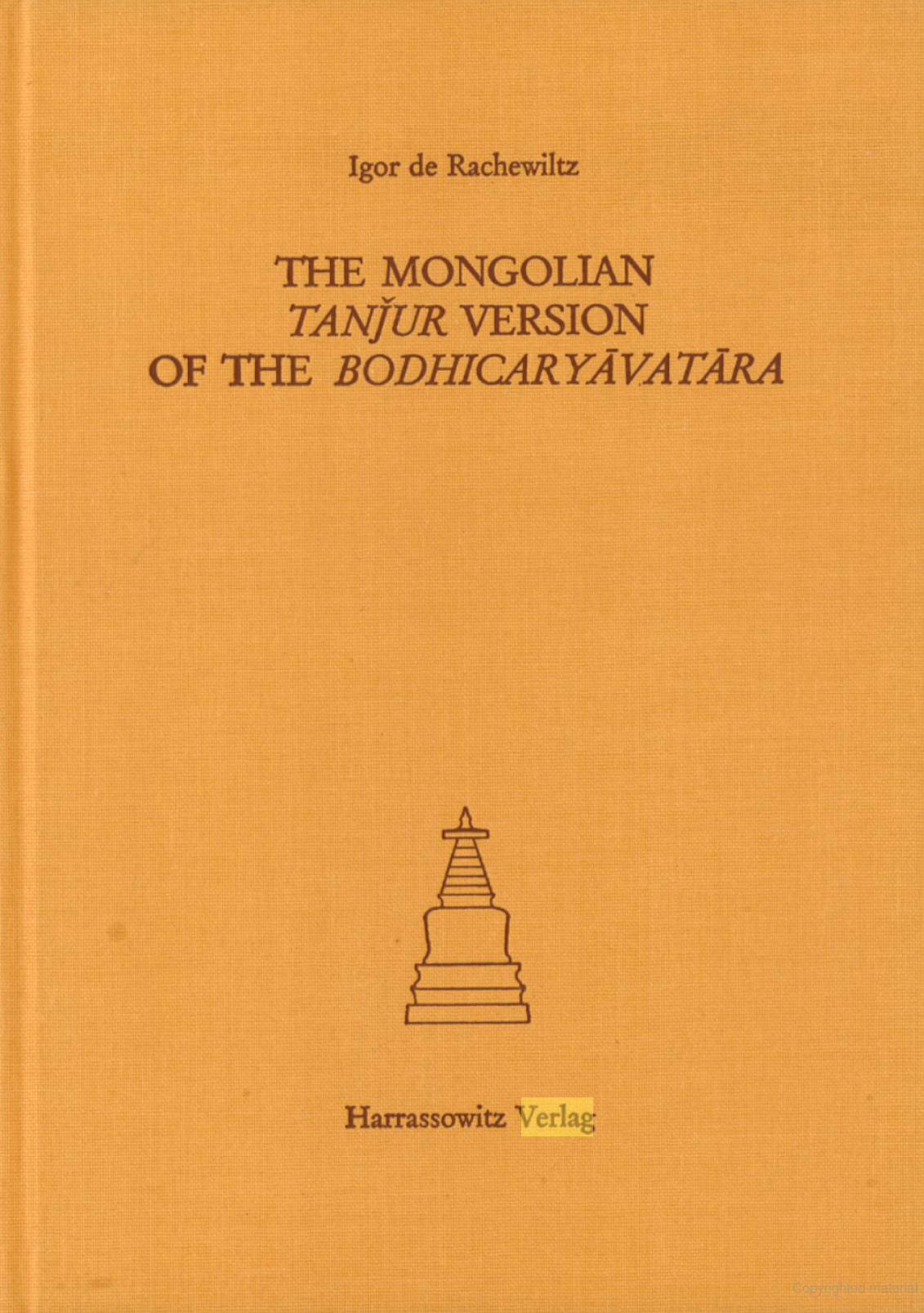
The Mongolian Tanǰur Version of the Bodhicaryāvatāra: Edited and Transcribed, with a Word-Index and a Photo-Reproduction of the Original Text (1748)
Book
- A Comparative of Sanskrit, Tibetan and Mongolian on Prajñāpāramitā Chapter of Śāntideva's Bodhicaryāvatāra (2) (The Commemoration Number Published on the Occasion of the Seventieth Birthday of Professor Ryojun Fuyo)
- A Fragment of the Bodhicaryāvatāra from Olon Süme
- A Mongolian Printed Fragment of Bodhicaryavatara from Dunhuang
- Another Chinese Source for a Biography of Čhos-kyi 'Od-zer
- Characteristics of the Buddhist Mongolian Texts: The Lineage of the Bodhicaryāvatāra
- Nachlese zum Mongolischen Turfanfragment des Bodhicaryāvatāra
- On the Duplicated Chapter of the Mongolian Bodhicaryāvatāra
- Regional Characteristics of Mongolian Buddhism: A Study on the Basis of the Bodhicaryāvatāra
- The Bodistw-a Čari-a Awatar-un Tayilbur of 1312 by Čosgi Odsir
- The Mongolian Tanǰur Version of the Bodhicaryāvatāra
- The Mongolian Tanǰur Version of the Bodhicaryāvatāra-Review by Kara
- The Third Chapter of Chos-kyi 'od-zer's Translation of the Bodhicaryāvatāra: A Tentative Reconstruction
- The Transmission of the Bodhicaryāvatāra: The History, Diffusion, and Influence of a Mahāyāna Buddhist Text
- Zum Blockdruckfragmente des mongolischen Bodhicaryāvatāra der Berliner Turfansammlung
- Über den Quellenbezug eines mongolischen Tanjurtextes
Please note that many items in our library are simply pages that represent a detailed library catalog entry and citation of someone else's work, presentation, or performance. Read our General Disclaimer for more information.

Description
The present work was originally conceived as a plain word-index to Professor L. Ligeti's text edition of the Tanǰur version of the Bodhicaryāvatāra which appeared in Budapest in 1966 as Volume VII of Mongol Nyelvemléktár. However, after a careful comparison of Ligeti's transcription with a photocopy of the original 1748 blockprint I came to the conclusion that a new transcription of the text was called for.
The work was carried out over a period of several years, mostly between other projects and, indeed, as a welcome change from those projects. I have greatly benefited from discussions with my friend and colleague Dr T. Rajapatirana of Canberra, whom I frequently consulted on matters relating to the Sanskrit and Tibetan versions of the Bodhicaryāvatāra. I owe to him many improvements and corrections.
For the word-processing of the entire text I am greatly indebted to Mrs H.O. Collins of the Division of Pacific & Asian History, the Australian National University, whose reliability, forbearance and cheerfulness have made my task immensely easier.
For the preparation of the word-index by computer process I am as ever grateful to Miss Mary Rose, Senior Programmer, Computer Services RSSS & RSPacS of the same University, who completed her task in record time.
Special thanks are due to Professor Klaus Sagaster and the Seminar für Sprachund Kulturwissenschaft Zentralasiens of Bonn University for kindly supplying an excellent photocopy of the Mongolian text from the Tanǰur without which the present work could have never been undertaken. (de Rachewiltz, preface, ix)
The work was carried out over a period of several years, mostly between other projects and, indeed, as a welcome change from those projects. I have greatly benefited from discussions with my friend and colleague Dr T. Rajapatirana of Canberra, whom I frequently consulted on matters relating to the Sanskrit and Tibetan versions of the Bodhicaryāvatāra. I owe to him many improvements and corrections.
For the word-processing of the entire text I am greatly indebted to Mrs H.O. Collins of the Division of Pacific & Asian History, the Australian National University, whose reliability, forbearance and cheerfulness have made my task immensely easier.
For the preparation of the word-index by computer process I am as ever grateful to Miss Mary Rose, Senior Programmer, Computer Services RSSS & RSPacS of the same University, who completed her task in record time.
Special thanks are due to Professor Klaus Sagaster and the Seminar für Sprachund Kulturwissenschaft Zentralasiens of Bonn University for kindly supplying an excellent photocopy of the Mongolian text from the Tanǰur without which the present work could have never been undertaken. (de Rachewiltz, preface, ix)
Citation
Rachewiltz, Igor de, ed. The Mongolian Tanǰur Version of the Bodhicaryāvatāra: Edited and Transcribed, with a Word-Index and a Photo-Reproduction of the Original Text (1748). Asiatische Forschungen 129. Wiesbaden, Germany: Otto Harrassowitz, 1996.
Table of contents
- Prefaceix
- Introductionxi
- Notes to the Introductionxvi
- Abbreviationsxix
- Part One: Text in Transcription1
- Part Two: Word Index127
- Part Three: Appendix I219
- Appendix II229
- Part Four: Photo Reproduction of the Text233
Interconnections
1 Recension of

An "Introduction to Bodhisattva Practice," the Bodhisattvacaryāvatāra is a poem about the path of a bodhisattva, in ten chapters, written by the Indian Buddhist Śāntideva (fl. c. 685–763). One of the masterpieces of world literature, it is a core text of Mahāyāna Buddhism and continues to be taught, studied, and commented upon in many languages and by many traditions around the world. The main subject of the text is bodhicitta, the altruistic aspiration for enlightenment, and the path and practices of the bodhisattva, the six perfections (pāramitās). The text forms the basis of many contemporary discussions of Buddhist ethics and philosophy.
1 Reviews

This is György Kara's review of the book The Mongolian Tanǰur Version of the Bodhicaryāvatāra, edited and transcribed by Igor de Rachewiltz.
1 Scholarship on
An "Introduction to Bodhisattva Practice," the Bodhisattvacaryāvatāra is a poem about the path of a bodhisattva, in ten chapters, written by the Indian Buddhist Śāntideva (fl. c. 685–763). One of the masterpieces of world literature, it is a core text of Mahāyāna Buddhism and continues to be taught, studied, and commented upon in many languages and by many traditions around the world. The main subject of the text is bodhicitta, the altruistic aspiration for enlightenment, and the path and practices of the bodhisattva, the six perfections (pāramitās). The text forms the basis of many contemporary discussions of Buddhist ethics and philosophy.