| 🤓 Admin Zone 🛠️ hidden to non-admins | |
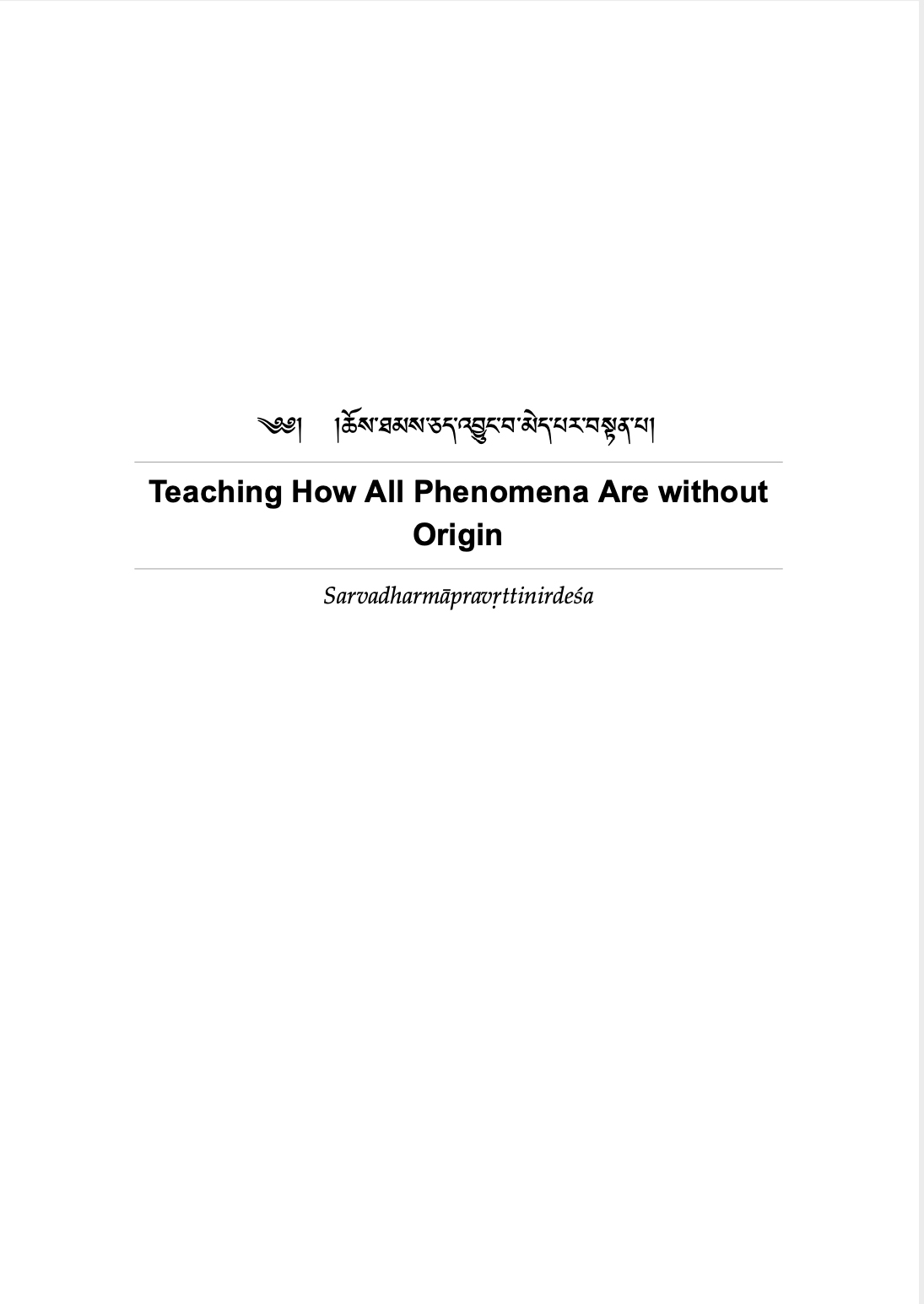
आर्यसर्वधर्माप्रवृत्तिनिर्देशनाममहायानसूत्र
Sarvadharmāpravṛttinirdeśasūtra
འཕགས་པ་ཆོས་ཐམས་ཅད་འབྱུང་བ་མེད་པར་བསྟན་པ་ཞེས་བྱ་བ་ཐེག་པ་ཆེན་པོའི་མདོ།
'phags pa chos thams cad 'byung ba med par bstan pa zhes bya ba theg pa chen po'i mdo
The Sūtra Teaching How All Phenomena are Without Any Origin (84000)
Text
Please note that many items in our library are simply pages that represent a detailed library catalog entry and citation of someone else's work, presentation, or performance. Read our General Disclaimer for more information.


Description
The Sarvadharmāpravṛttinirdeśa belongs to the great mass of literature representing the middle period of Mahāyāna sūtra literature. As such it is quite difficult to date with certainty, as it neither represents any outstanding or special doctrinal viewpoint, nor has been much employed as a canonical source in later scholastic literature. It is however still interesting for, among other things, its standpoints on the teachings and implications of emptiness, and its views on arrogance and judging others for their religious views. It also warns against the purely rhetorical use of Mahāyāna doctrines, such as the teaching on emptiness. The text is also itself a very typical example of what aptly can be called "Mahāyāna Rhetoric." (Source: Bibliotheca Polyglotta)
Quoted in the aligned translations
Reference
Sarvadharmāpravṛttinirdeśasūtra [आर्यसर्वधर्माप्रवृत्तिनिर्देशनाममहायानसूत्र]. 'phags pa chos thams cad 'byung ba med par bstan pa zhes bya ba theg pa chen po'i mdo [འཕགས་པ་ཆོས་ཐམས་ཅད་འབྱུང་བ་མེད་པར་བསྟན་པ་ཞེས་བྱ་བ་ཐེག་པ་ཆེན་པོའི་མདོ།]. [The Sūtra Teaching How All Phenomena are Without Any Origin (84000)]. Translated by Rin chen 'tsho, Kumārajīva, Jñānagupta. Kangyur, RKTSK 180 http://www.rkts.org/cat.php?id=180&typ=1.
Interconnections
2 Full translations

A multilingual translation (Tib., Ch., and Eng.) of the Sarvadharmāpravṛttinirdeśasūtra made by Jens Braarvig and published by Bibliotheca Polyglotta.

An English translation of the Sarvadharmāpravṛttinirdeśa from the Tibetan by Timothy Hinkle. Published by 84000: Translating the Words of the Buddha.
1 Scholarship

The Sanskrit text of the Sarvadharmāpravṛttinirdeśa-sūtra had for long time not been known till its manuscript, though not complete, was some twenty years ago found in the "Schøyen Collection" and studied and published by Prof. Braarvig, Norway. In the Sūtra, verses are found in three places separately, each group containing decades of them. Verses of the first group are almost complete; the second, fragmental; and the third, all lost.
Recently, I investigated the Sūtra, and specifically its verses, and found that there remain several important and serious problems unsolved, or rather, even unquestioned. In this paper, therefore, I would like to take up some problems in the first verse of the first group, especially its pāda a. The most important problem is actually that concerning its metre.
Pāda a of the first verse is as follows (with the other three pādas, as well):
Recently, I investigated the Sūtra, and specifically its verses, and found that there remain several important and serious problems unsolved, or rather, even unquestioned. In this paper, therefore, I would like to take up some problems in the first verse of the first group, especially its pāda a. The most important problem is actually that concerning its metre.
Pāda a of the first verse is as follows (with the other three pādas, as well):
- nirātma nirjīva niṣpudgala dharmā deśehi nāyaka anaṃtayaśāḥ /
śāntaḥ praśānta upaśāṃta satā ayam īdṛśa parṣa agravarā // 1 //
3 A topic of
The Sanskrit text of the Sarvadharmāpravṛttinirdeśa-sūtra had for long time not been known till its manuscript, though not complete, was some twenty years ago found in the "Schøyen Collection" and studied and published by Prof. Braarvig, Norway. In the Sūtra, verses are found in three places separately, each group containing decades of them. Verses of the first group are almost complete; the second, fragmental; and the third, all lost.
Recently, I investigated the Sūtra, and specifically its verses, and found that there remain several important and serious problems unsolved, or rather, even unquestioned. In this paper, therefore, I would like to take up some problems in the first verse of the first group, especially its pāda a. The most important problem is actually that concerning its metre.
Pāda a of the first verse is as follows (with the other three pādas, as well):
Recently, I investigated the Sūtra, and specifically its verses, and found that there remain several important and serious problems unsolved, or rather, even unquestioned. In this paper, therefore, I would like to take up some problems in the first verse of the first group, especially its pāda a. The most important problem is actually that concerning its metre.
Pāda a of the first verse is as follows (with the other three pādas, as well):
- nirātma nirjīva niṣpudgala dharmā deśehi nāyaka anaṃtayaśāḥ /
śāntaḥ praśānta upaśāṃta satā ayam īdṛśa parṣa agravarā // 1 //
A multilingual translation (Tib., Ch., and Eng.) of the Sarvadharmāpravṛttinirdeśasūtra made by Jens Braarvig and published by Bibliotheca Polyglotta.
An English translation of the Sarvadharmāpravṛttinirdeśa from the Tibetan by Timothy Hinkle. Published by 84000: Translating the Words of the Buddha.