| 🤓 Admin Zone 🛠️ hidden to non-admins | |
बोधिसंभार
Bodhisaṃbhāra
བྱང་ཆུབ་ཀྱི་ཚོགས།
byang chub kyi tshogs
Treatise on the Provisions for Enlightenment
Text
Please note that many items in our library are simply pages that represent a detailed library catalog entry and citation of someone else's work, presentation, or performance. Read our General Disclaimer for more information.

Description
In Sanskrit, "collection" of, or "equipment" (saṃbhāra) for,"enlightenment" (bodhi); the term refers to specific sets of spiritual requisites (also called "accumulations") necessary for the attainment of awakening. The bodhisattva becomes equipped with these factors during his progress along the path (mārga) leading to the attainment of buddhahood. In a buddha, the amount of this "enlightenment-collection" is understood to be infinite. These factors are often divided into two major groups: the collection of merit (puṇyasaṃbhāra) and the collection of knowledge (jñānasaṃbhāra). The collection of merit (puṇya) entails the strengthening of four perfections (pāramitā): generosity (dāna), morality (śīla), patience (kṣānti), and energy (vīrya). The collection of knowledge entails the cultivation of meditative states leading to the realization that emptiness (śūnyatā) is the ultimate nature of all things.
The bodhisaṃbhāra were expounded in the *Bodhisaṃbhāraka, attributed to the Madhyamaka exegete Nāgārjuna, which is now extant only in Dharmagupta's 609 CE Chinese translation, titled the Puti ziliang lun. In this treatise, Nāgārjuna explains that the acquisition, development, and fruition of these factors is an essentially interminable process: enlightenment will be achieved when these factors have been developed for as many eons as there are grains of sand in the Ganges River. The text also emphasizes the importance of compassion (karuṇā), calling it the mother of perfect wisdom (prajñāpāramitā). The perfection of wisdom sūtras stress that pariṇāmanā (turning over [merit]) and anumodana (rejoicing [in the good deeds of others]) are necessary to amass the collection necessary to reach the final goal. (Source: "bodhisaṃbhāra." In The Princeton Dictionary of Buddhism, 134. Princeton University Press, 2014. http://www.jstor.org/stable/j.ctt46n41q.27.)
Reference
bodhisaṃbhāra [बोधिसंभार]. byang chub kyi tshogs [བྱང་ཆུབ་ཀྱི་ཚོགས།]. [Treatise on the Provisions for Enlightenment].
Interconnections
2 Recensions

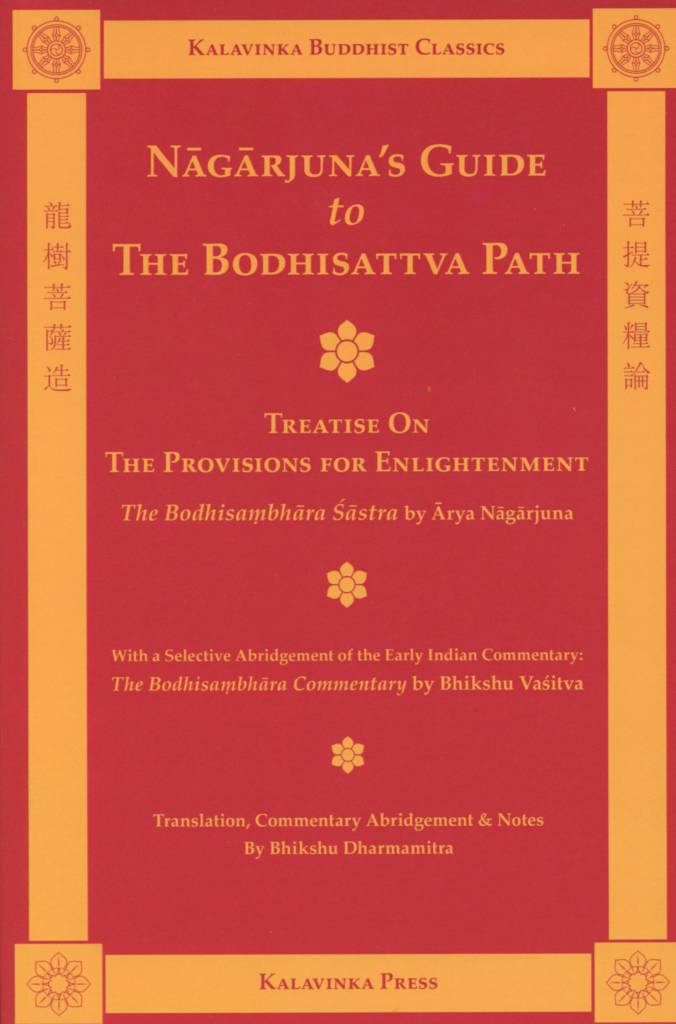
This is Nāgārjuna's Bodhisaṃbhāraśāstra (Treatise on the Provisions for Enlightenment). It describes the essential prerequisites for the complete enlightenment of a buddha. It is accompanied here by an abridged version of its only commentary, originally written by the early Indian Bhikshu Vasitva. Abridgement, notes, and translation by Bhikshu Dharmamitra. Includes facing-page source text for the stanzas in both traditional and simplified scripts.(Source: Kalavinka Press)
-front.jpg)
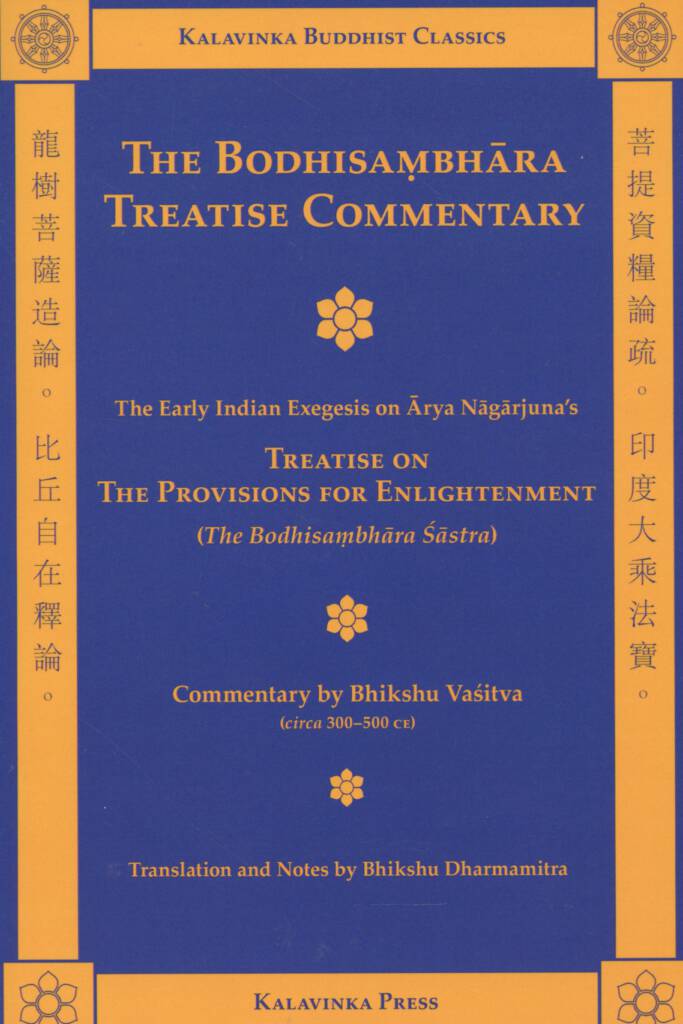
A detailed commentary on the meaning of each stanza comprising Ārya Nāgārjuna's Treatise on the Provisions for Enlightenment. It is the only extant commentary on this important work by Nāgārjuna. Commentary by Bhikshu Vaśitva. Translation and clarifying notes by Bhikshu Dharmamitra. Includes facing-page source text in both traditional and simplified scripts. (Source: Kalavinka Press)
3 Full translations

The author deals with the thirteen works attributed to Nāgārjuna. The first six are mainly dialectical works such as Mūlamadhyamakakārikā, Śūnyatāsaptati, Vigrahavyāvartanī, Vaidalyaprakaraṇa, Vyavahārasiddhi, Yuktiṣaṣṭikā followed by the remaining seven which are chiefly didactic texts - Catuḥstava, Ratnāvali, Pratītyasamutpādahṛdayakārikā, Sūtrasamuccaya, Bodhicittavivaraṇa, Suhṛllekha, and Bodhisaṃbhāra (ka). Thus he roughly follows the prescriptive distinction between Yukti and Agama.
This is Nāgārjuna's Bodhisaṃbhāraśāstra (Treatise on the Provisions for Enlightenment). It describes the essential prerequisites for the complete enlightenment of a buddha. It is accompanied here by an abridged version of its only commentary, originally written by the early Indian Bhikshu Vasitva. Abridgement, notes, and translation by Bhikshu Dharmamitra. Includes facing-page source text for the stanzas in both traditional and simplified scripts.(Source: Kalavinka Press)
A detailed commentary on the meaning of each stanza comprising Ārya Nāgārjuna's Treatise on the Provisions for Enlightenment. It is the only extant commentary on this important work by Nāgārjuna. Commentary by Bhikshu Vaśitva. Translation and clarifying notes by Bhikshu Dharmamitra. Includes facing-page source text in both traditional and simplified scripts. (Source: Kalavinka Press)
3 Scholarship
The author deals with the thirteen works attributed to Nāgārjuna. The first six are mainly dialectical works such as Mūlamadhyamakakārikā, Śūnyatāsaptati, Vigrahavyāvartanī, Vaidalyaprakaraṇa, Vyavahārasiddhi, Yuktiṣaṣṭikā followed by the remaining seven which are chiefly didactic texts - Catuḥstava, Ratnāvali, Pratītyasamutpādahṛdayakārikā, Sūtrasamuccaya, Bodhicittavivaraṇa, Suhṛllekha, and Bodhisaṃbhāra (ka). Thus he roughly follows the prescriptive distinction between Yukti and Agama.
This is Nāgārjuna's Bodhisaṃbhāraśāstra (Treatise on the Provisions for Enlightenment). It describes the essential prerequisites for the complete enlightenment of a buddha. It is accompanied here by an abridged version of its only commentary, originally written by the early Indian Bhikshu Vasitva. Abridgement, notes, and translation by Bhikshu Dharmamitra. Includes facing-page source text for the stanzas in both traditional and simplified scripts.(Source: Kalavinka Press)
A detailed commentary on the meaning of each stanza comprising Ārya Nāgārjuna's Treatise on the Provisions for Enlightenment. It is the only extant commentary on this important work by Nāgārjuna. Commentary by Bhikshu Vaśitva. Translation and clarifying notes by Bhikshu Dharmamitra. Includes facing-page source text in both traditional and simplified scripts. (Source: Kalavinka Press)
2 A topic of
This is Nāgārjuna's Bodhisaṃbhāraśāstra (Treatise on the Provisions for Enlightenment). It describes the essential prerequisites for the complete enlightenment of a buddha. It is accompanied here by an abridged version of its only commentary, originally written by the early Indian Bhikshu Vasitva. Abridgement, notes, and translation by Bhikshu Dharmamitra. Includes facing-page source text for the stanzas in both traditional and simplified scripts.(Source: Kalavinka Press)
A detailed commentary on the meaning of each stanza comprising Ārya Nāgārjuna's Treatise on the Provisions for Enlightenment. It is the only extant commentary on this important work by Nāgārjuna. Commentary by Bhikshu Vaśitva. Translation and clarifying notes by Bhikshu Dharmamitra. Includes facing-page source text in both traditional and simplified scripts. (Source: Kalavinka Press)