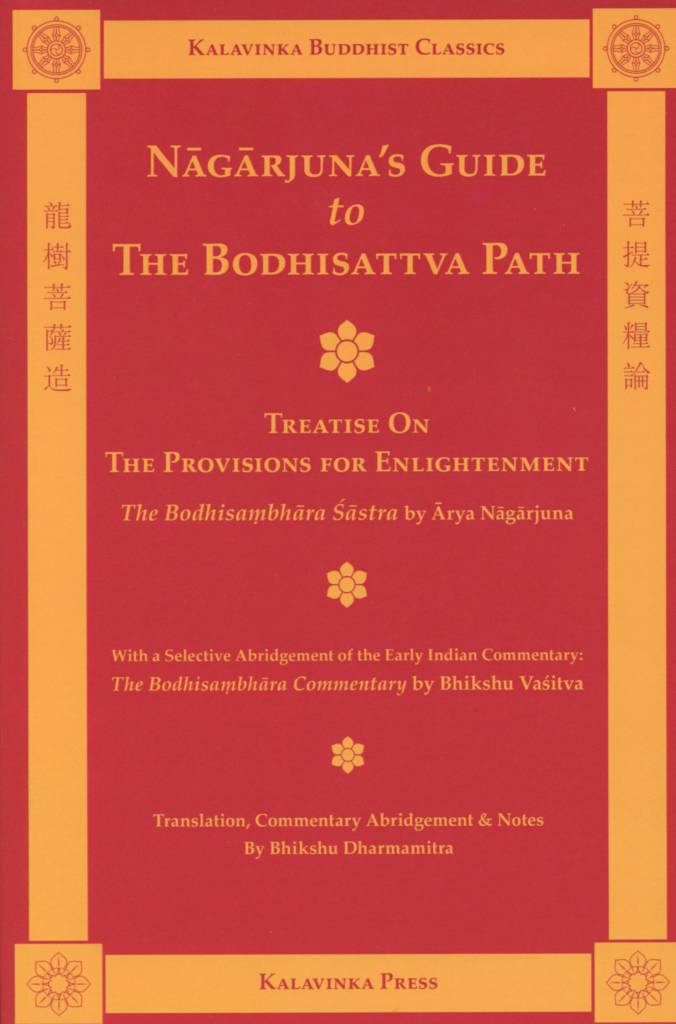
Nāgārjuna's Guide to The Bodhisattva Path
From Bodhicitta
< BooksBooks/Nāgārjuna's Guide to The Bodhisattva Path
| 🤓 Admin Zone 🛠️ hidden to non-admins | |
| | |
| Redirects needed | |
|---|---|
Nāgārjuna's Guide to The Bodhisattva Path: Ārya Nāgārjuna's Treatise on The Provisions for Enlightenment (Bodhisaṃbhāra Śāstra)
Book
Please note that many items in our library are simply pages that represent a detailed library catalog entry and citation of someone else's work, presentation, or performance. Read our General Disclaimer for more information.

Description
This is Nāgārjuna's Bodhisaṃbhāraśāstra (Treatise on the Provisions for Enlightenment). It describes the essential prerequisites for the complete enlightenment of a buddha. It is accompanied here by an abridged version of its only commentary, originally written by the early Indian Bhikshu Vasitva. Abridgement, notes, and translation by Bhikshu Dharmamitra. Includes facing-page source text for the stanzas in both traditional and simplified scripts.(Source: Kalavinka Press)
Citation
Dharmamitra, Bhikshu, trans. Nāgārjuna's Guide to The Bodhisattva Path: Ārya Nāgārjuna's Treatise on The Provisions for Enlightenment (Bodhisaṃbhāra Śāstra). Commentary by Bhikshu Vaśitva. Kalavinka Buddhist Classics. Seattle: Kalavinka Press, 2009.
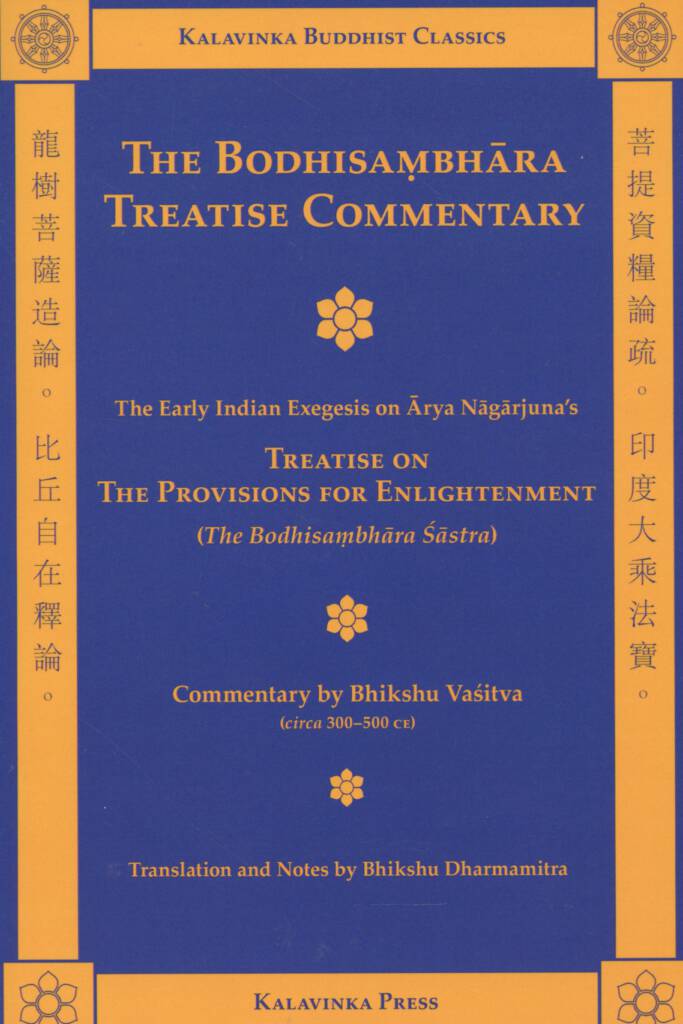
Table of contents
- Acknowledgements13
- Abbreviations, Citations & Romanization Protocols13
- The Chinese Text13
- Introduction15
- (Part One): The Treatise on the Provisions for Enlightenment21
- (Part Two): A Selective Abridgement of The Bodhisambhāra Commentary With Explanatory Notes by the Translator73
- About the Translator205
- 001 - The Homage to All Buddhas and the Declaration of Intent75
- 002 - The Impossibility of Completely Describing the Provisions76
- 003 - Since a Buddha's Qualities are Boundless, So Too Are the Provisions76
- 004 - Reverence to Buddhas and to Bodhisattvas, Those Also Worthy of Offerings77
- 005 - The Primary Provision: Prajñāpāramitā, Mother of Buddhas and Bodhisattvas78
- 006 - Prajñā Includes the Remaining Five Perfections and Their Retinue79
- THE SIX PERFECTIONS80
- THE PERFECTION OF GIVING80
- THE PERFECTION OF MORAL VIRTUE82
- THE PERFECTION OF PATIENCE84
- THE PERFECTION OF VIGOR85
- THE PERFECTION OF DHYĀNA MEDITATION87
- THE PERFECTION OF WISDOM91
- THE ADDITIONAL FOUR PERFECTIONS COMPRISING THE TEN PERFECTIONS92
- THE PERFECTION OF SKILLFUL MEANS92
- THE PERFECTION OF VOWS94
- THE PERFECTION OF POWERS96
- THE PERFECTION OF KNOWLEDGES98
- THE SIX PERFECTIONS80
- 007 - The Six Perfections, Like Space, Comprehensively Subsume Bodhi's Provisions100
- 008 - Another Exegete's Opinion: The Four Merit Bases Subsume All Provisions100
- 009 - The Great Compassion and the Great Kindness100
- 010 - The Great Sympathetic Joy101
- 011 - The Great Equanimity102
- 012 - The Role of Skillful Means102
- 013 - The Superior Merit Arising from Teaching the Great Vehicle102
- 014 - The Two Vehicles Are Taught Only to Those of Lesser Abilities103
- 015 - Teach Meritorious Deeds to Those Incapable of the Three Vehicles103
- 016 - Benefit and Slowly Draw in Those Unfit for Liberation or Celestial Rebirth104
- 017 - One Generates Kindness and Compassion for Those One Cannot Assist105
- 018 - The Means of Attraction105
- 019 - The Need for Tirelessness, Vows, Realization that Other-Benefit is Self-Benefit105
- 020 - Entering the Dharma Realm, Discriminations Cease, Equanimity Ensues106
- 021 - Equanimity as Remaining Unimpeded by the Eight Worldly Dharmas106
- 022 - The Need for Diligence So Long as Irreversibility Hasn't Been Gained107
- 023 - Bodhisattvas' Ceaseless Vigor in Seeking Bodhi Is Due to Heavy Responsibility108
- 024 - Prior to Compassion and Patience, the Bodhisattva Life Remains Imperiled108
- 025 - Falling onto the Śrāvaka or Pratyekabuddha Grounds is Fatal for a Bodhisattva110
- 026 - The Bodhisattva Fears the Two-Vehicles' Grounds More Than the Hells110
- 027 - Whereas Hells Don't Block Buddhahood, Two Vehicles' Grounds Do111
- 028 - The Bodhisattva Should Fear Two-Vehicles Grounds Like the Gallows111
- 029 - The Tetralemma-Transcending Contemplation of Dharmas112
- 030 - Unshakable Contemplation in the Unproduced-Dharmas Patience112
- 031 - The Prediction and Irreversibility Come with Unproduced-Dharmas Patience113
- 032 - Only This "Stage of Immovability" Guarantees Definite "Irreversibility"113
- 033 - No Negligence Can Be Indulged Prior to the "Direct Presence" Ground114
- 034 - Samādhis Are a Bodhisattva's Father, Compassion and Patience Are Mother115
- 035 - Wisdom as Mother and Means as Father is Due to Giving Birth and Support115
- 036 - Only Merit Greater Than a Hundred Sumerus Would Be Adequate for Bodhi115
- 037 - Through Skillful Means, a Minor Deed Generates Great Merit116
- 038 - How Could One Measure the Merit of Such Universally-Dedicated Deeds?116
- 039 - When Free of Attachments, When Not Coveting Even the Heavens—117
- 040 - Not Coveting Nirvāņa, Yet Caring for Others, Who Could Gauge Such Merit?117
- 041 - Rescuing and Protecting the Vulnerable, Who Could Measure Such Merit?118
- 042 - So It Is in a Moment Aligned with Wisdom. If Longer, Who Could Gauge It?118
- 043 - Recitation and Teaching of Profound Sutras Creates Massive Merit118
- 044 - Through Inspiring Bodhi Resolve, Superior Merit and Eighth Stage Are Assured119
- 045 - Turning the Dharma Wheel and Stilling Heterodoxies Makes a Merit Treasury119
- 046 - Where One Is Willing to Suffer the Hells for Beings, Bodhi Is at Hand120
- 047 - Where Actions Are Selfless, Altruistic, and Compassionate, Bodhi Is at Hand120
- 048 - Where Wisdom, Vigor, and Giving Are Transcendent, Bodhi Is at Hand120
- 049 - Where Meditation, Moral Virtue, and Patience Are Perfected, Bodhi Is at Hand121
- 050 - One Confesses All Bad Deeds in the Presence of All Buddhas121
- 051 - One Entreats the Buddhas to Turn the Dharma Wheel122
- 052 - One Beseeches the Buddhas to Remain in the World122
- 053 - All Merit Created by Beings Through Giving on Through to Meditation—122
- 054 - Whether Created by Aryas or Common People, I Rejoice in It All122
- 055 - I Dedicate All Merit to All Beings That They Might Realize Bodhi123
- 056 - To Repent, Entreat, Beseech, Rejoice, and Dedicate Accords with Buddhas' Acts124
- 057 - To Repent, Entreat, Beseech, Rejoice, and Dedicate Accords with Their Teachings124
- 058 - Thrice Daily, Thrice Nightly, Kneeling with Shoulder Bared, Palms Together124
- 059 - Merit From But a Single Instance of This Would Be Incalculably Immense125
- 060 - Revere and Cherish Minor Bodhisattvas As One Respects Guru and Parents125
- 061 - Don't Discuss a Bodhisattva's Faults; Utter Only Truth-Based Praise126
- 062 - To Prevent Retreat from Bodhi, Show the Way, Promote Vigor, Inspire Delight126
- 063 - Don't Claim Buddhas Didn't Utter the Profound Sutras; Retribution is Severe127
- 064 - Not Even the "Non-intermittent Offenses" Can Compare to These Two Offenses127
- 065 - One Should Cultivate the Three Gates to Liberation129
- 066 - Dharmas Are "Empty" of Inherent Existence, Hence Signless, Hence Wishless130
- 067 - As These Tend Toward Nirvāņa, Focus on the Causes Leading to Buddhahood130
- 068 - Resolve to Abstain from Nirvāņa; Rather Ripen the Perfection of Wisdom131
- 069 - The Great Bodhisattva Is Like the Skillful Archer Keeping His Arrows Aloft131
- 070 - Even in Realizing Emptiness, the Mind's Arrows Never Fall to Nirvāņa's Ground132
- 071 - One Makes the Altruistic Vow and Thenceforth Accords Therewith132
- 072 - Beings Abide in Attachment, Cherishing Inverted Views Caused by Delusion132
- 073 - Speak Dharma to Eliminate Attachments to Marks and Inverted Views133
- 074 - Bodhisattvas Help Beings, yet Perceive No Beings, and in This Are Inconceivable133
- 075 - Though Realizing Definite Stage and Gates to Liberation, One Avoids Nirvāņa134
- 076 - Prior to Definite Stage, As One Fulfills Vows, Skillful Means Restrain Nirvāņa136
- 077 - One Rejects Yet Faces Cyclic Existence, Has Faith in but Abstains From Nirvāņa137
- 078 - Dread But Don't End Afflictions; Block Them to Gather Good Karma137
- 079 - A Bodhisattva Is Better Served by Afflictions than by Nirvāņa138
- 080 - Predictions Such as in the Lotus Sutra Were Situation-Specific Expedients138
- 081 - Analogies for Incompatibility of Two-Vehicles Irreversibility and Buddhahood139
- 082 - To Benefit the World, Bring Forth Treatises, Skills, Sciences, Trades141
- 083 - Adapting to Various Beings, Per One's Vows, One Takes Birth Among Them142
- 084 - In the Midst of Evil, Don the Armor and Don't Yield to Either Loathing or Fear142
- 085 - Maintain Pure Intentions, Eschew Guile, Confess Wrongs, Conceal Good Deeds143
- 086 - Purify Three Karmas, Observe Moral Codes, Allow No Omissions or Slackening143
- 087 - Focus on the Object, Still Thoughts in Solitude, Eliminate Obstructive Thoughts144
- 088 - When Discriminating Thoughts Arise, Abandon the Bad, Cultivate the Good145
- 089 - When Scattered, Reestablish Focus, Return to the Object, Enforce Stillness145
- 090 - Refrain from Laxity and Wrong Attachment as They Prevent Concentration146
- 091 - Even Two-Vehicles' Men Focused on Self-Benefit Insist on Vigor in Meditation147
- 092 - How Much the Less Might a Bodhisattva Fail to Generate Infinite Vigor147
- 093 - Don't Pursue Other Practice Half-Time or Conjoint Practice of Other Paths147
- 094 - Covet Neither Body nor Life as the Body is Bound for Destruction148
- 095 - Never Coveting Offerings, Reverence, or Fame, Strive Urgently to Fulfill Vows148
- 096 - Resolutely Seize Victory, Not Waiting till Later as Survival Isn't Guaranteed148
- 097 - Established in Right Livelihood, Be Mindful and Free of Preferences in Eating149
- 098 - Review One's Monastic Deeds and Accordance with the Ten Dharmas Sutra149
- 099 - Contemplate Impermanence and Non-self, Abandoning Demonic Karma150
- 100 - Generate Vigor in the Thirty-Seven Wings of Enlightenment151
- 101 - Focus Analytic Contemplation on the Mind as Source of Good and Root of Evil153
- 102 - Contemplate With Great Concern Daily Increase and Decrease of Good Dharmas153
- 103 - Never Indulge Thoughts of Stinginess or Jealousy over Others' Good Fortune154
- 104 - Ignore Sense Realms as if Dull, Blind, Deaf, and Mute, Yet Roar the Lion's Roar154
- 105 - Welcome, Escort, and Revere the Venerable, Assisting All Dharma Endeavors155
- 106 - Liberate Beings and Cultivate Special Skills, Training Self and Teaching Others155
- 107 - Firmly Adopt Good Dharmas and Cultivate the Four Means of Attraction155
- 108 - Be Generous to Almsmen, Unite Kin and Clan, Give Dwellings and Possessions156
- 109 - Provide for Parents, Relatives, and Friends Appropriately and Deferentially157
- 110 - Servants Are Addressed with Kindness, Adopted, Esteemed, and Cared For157
- 111 - Be Foremost in Good Karma, Sublime and Right in Speech, and Generous to All157
- 112 - Avoid Harm or Disapproval; Regard Others with Kindness and as Good Friends158
- 113 - Act Straightaway in Conformity with Pronouncements, Thus Inspiring Faith159
- 114 - Be Protective of Dharma, Observant of Neglect, and Inclined to Adorn Stupas159
- 115 - Facilitate Marriages, Present the Bride, Praise the Buddha, and Give Mālās160
- 116 - Create Buddha Images and Cultivate the Six Dharmas of Community Harmony160
- 117 - Make Offerings to All and Never Slander the Buddha or Teachers of Dharma161
- 118 - Donate to Teaching Masters and Their Stupas, See to Preservation of Scripture162
- 119 - Let Reflection Precede Action; Have no Faith in Non-Buddhists, Gods, or Spirits163
- 120 - Make the Mind Penetratingly Sharp Like Vajra and as Immovable as a Mountain164
- 121 - Delight in Transcendent Words, Abandon Worldly Talk, Inspire Merit in Others164
- 122 - Cultivate Five Liberation Bases, Ten Impurity Reflections, Eight Realizations165
- 123 - Cultivate Purification in the Five Types of Spiritual Abilities168
- 124 - The Four Bases Are Their Root; the Four Immeasurables Govern Them169
- 125 - Regard Elements as Snakes, Senses as Empty Village, Aggregates as Assassins171
- 126 - Esteem Dharma and Its Teachers, Eschew Stinginess, Listen Closely to Dharma173
- 127 - Speak Dharma, Free of Arrogance or Hopes, Motivated Solely by Compassion174
- 128 - Be Insatiable in Learning, Don't Deceive the Venerables, Please Instructors174
- 129 - Don't Pay Visits for Gifts or Respect, Don't Study Worldly Texts for Debate175
- 130 - Don't Defame Bodhisattvas or Slander Dharmas Not Yet Understood175
- 131 - Sever Arrogance, Abide in the Lineage Bases, Avoid Disapproving, Halt Conceit175
- 132 - Don't Expose Others' Offenses or Find Fault, Be Aware of One's Own Errors176
- 133 - Avoid Criticism or Doubt Toward Buddha or Dharma, Keep Faith in the Abstruse176
- 134 - Even Though One May Be Put to Death, One Should Still Speak Only the Truth181
- 135 - Even if Beaten, Cursed, or Terrorized, Don't Hate or Condemn; See It as Karma181
- 136 - Support Parents Generously, Serve the Needs of Monastic Instructors as Well181
- 137 - Discoursing on Profound Dharmas for Two-Vehicles Practitioners Is an Error182
- 138 - Discoursing on Two-Vehicles Tenets to the Great-Vehicle Faithful is an Error183
- 139 - The Two Other Errors: Failing to Teach the Worthy, Trusting Wrongdoers183
- 140 - Abandon These Errors While Also Studying and Adopting the Dhūta Practices184
- 141 - Maintain Four Types of Uniformly Equal Bodhisattva Path Practices184
- 142 - One Works for Dharma Over Benefit, Good Over Fame, Beings Over Happiness186
- 143 - One Works in Secret for the Many and so Relinquishes Personal Concerns186
- 144 - Grow Close to the Four Types of Good Spiritual Friends187
- 145 - Lokāyatas, Wealth Obsessives, Pratyekabuddha and Śrāvaka Vehicles Advocates188
- 146 - Be Aware of Them As Unfit Spiritual Friends, Seek Out the Four Vast Treasuries188
- 147 - Meeting Buddhas, Perfections Teachings, Dharma Masters, Solitary Practice189
- 148 - Abide Like the Elements, Uniformly Equal in Benefiting All190
- 149 - Reflect on Meanings, Progress in Uses of Dhāraṇīs, Don't Block Dharma Study190
- 150 - Overcome Major Afflictions, Banish Subsidiary Afflictions, Cast off Indolence192
- 151 - Don't Covet What Is Not One's Lot, Reconcile the Estranged192
- 152 - Seeking to Get at Emptiness Itself Is Worse Than Viewing Body As Self193
- 153 - Maintain Stupas, Provide Adornments, and Make Offerings at the Stupas194
- 154 - Provide Lantern Wheels, Stupa Canopies, Sandals, Carriages, Sedan Chairs194
- 155 - Find Happiness in Listening to Dharma, in Faith in Buddha, in Serving Sangha195
- 156 - Dharmas Don't Arise in the Past, Abide in the Present, or Extend into the Future195
- 157 - Bestow What Is Best, Seek No Reward, Take on Sufferings, Do Not Covet Bliss196
- 158 - Don't Be Overjoyed at Karmic Rewards Nor Downcast at Karmic Misfortune196
- 159 - Esteem the Learned, Inspire the Untrained to Study Without Belittling Them197
- 160 - Revere Virtue, Inspire Purity, Draw Close to the Wise, Promote Wisdom in Fools197
- 161 - Don't Be Terrorized by Samsāra, Rather Subdue Demons and Evil Knowledge197
- 162 - Amass Merit in All Buddhalands, Make Vows That Others Will Reach Them Too199
- 163 - Never Seize on Dharmas, Abide in Equanimity, Take Up the Burden for Beings199
- 164 - Contemplate Dharmas as Non-Self, Don't Relinquish Compassion or Kindness199
- 165 - Making Offerings of Dharma Is Superior to Giving Every Gift to the Buddha200
- 166 - Upholding the Bodhisattva Canon Is the Foremost Dharma Offering200
- 167 - Rely on Meaning, Not Flavors; Enter the Profound Path, Avoiding Negligence202
- 168 - Buddhahood is Gained by Cultivating the Provisions in Countless Future Lives203
Interconnections
1 Recension of

In Sanskrit, "collection" of, or "equipment" (saṃbhāra) for,"enlightenment" (bodhi); the term refers to specific sets of spiritual requisites (also called "accumulations") necessary for the attainment of awakening. The bodhisattva becomes equipped with these factors during his progress along the path (mārga) leading to the attainment of buddhahood. In a buddha, the amount of this "enlightenment-collection" is understood to be infinite. These factors are often divided into two major groups: the collection of merit (puṇyasaṃbhāra) and the collection of knowledge (jñānasaṃbhāra). The collection of merit (puṇya) entails the strengthening of four perfections (pāramitā): generosity (dāna), morality (śīla), patience (kṣānti), and energy (vīrya). The collection of knowledge entails the cultivation of meditative states leading to the realization that emptiness (śūnyatā) is the ultimate nature of all things.
The bodhisaṃbhāra were expounded in the *Bodhisaṃbhāraka, attributed to the Madhyamaka exegete Nāgārjuna, which is now extant only in Dharmagupta's 609 CE Chinese translation, titled the Puti ziliang lun. In this treatise, Nāgārjuna explains that the acquisition, development, and fruition of these factors is an essentially interminable process: enlightenment will be achieved when these factors have been developed for as many eons as there are grains of sand in the Ganges River. The text also emphasizes the importance of compassion (karuṇā), calling it the mother of perfect wisdom (prajñāpāramitā). The perfection of wisdom sūtras stress that pariṇāmanā (turning over [merit]) and anumodana (rejoicing [in the good deeds of others]) are necessary to amass the collection necessary to reach the final goal. (Source: "bodhisaṃbhāra." In The Princeton Dictionary of Buddhism, 134. Princeton University Press, 2014. http://www.jstor.org/stable/j.ctt46n41q.27.)
1 Full translation of
In Sanskrit, "collection" of, or "equipment" (saṃbhāra) for,"enlightenment" (bodhi); the term refers to specific sets of spiritual requisites (also called "accumulations") necessary for the attainment of awakening. The bodhisattva becomes equipped with these factors during his progress along the path (mārga) leading to the attainment of buddhahood. In a buddha, the amount of this "enlightenment-collection" is understood to be infinite. These factors are often divided into two major groups: the collection of merit (puṇyasaṃbhāra) and the collection of knowledge (jñānasaṃbhāra). The collection of merit (puṇya) entails the strengthening of four perfections (pāramitā): generosity (dāna), morality (śīla), patience (kṣānti), and energy (vīrya). The collection of knowledge entails the cultivation of meditative states leading to the realization that emptiness (śūnyatā) is the ultimate nature of all things.
The bodhisaṃbhāra were expounded in the *Bodhisaṃbhāraka, attributed to the Madhyamaka exegete Nāgārjuna, which is now extant only in Dharmagupta's 609 CE Chinese translation, titled the Puti ziliang lun. In this treatise, Nāgārjuna explains that the acquisition, development, and fruition of these factors is an essentially interminable process: enlightenment will be achieved when these factors have been developed for as many eons as there are grains of sand in the Ganges River. The text also emphasizes the importance of compassion (karuṇā), calling it the mother of perfect wisdom (prajñāpāramitā). The perfection of wisdom sūtras stress that pariṇāmanā (turning over [merit]) and anumodana (rejoicing [in the good deeds of others]) are necessary to amass the collection necessary to reach the final goal. (Source: "bodhisaṃbhāra." In The Princeton Dictionary of Buddhism, 134. Princeton University Press, 2014. http://www.jstor.org/stable/j.ctt46n41q.27.)
1 Scholarship on
In Sanskrit, "collection" of, or "equipment" (saṃbhāra) for,"enlightenment" (bodhi); the term refers to specific sets of spiritual requisites (also called "accumulations") necessary for the attainment of awakening. The bodhisattva becomes equipped with these factors during his progress along the path (mārga) leading to the attainment of buddhahood. In a buddha, the amount of this "enlightenment-collection" is understood to be infinite. These factors are often divided into two major groups: the collection of merit (puṇyasaṃbhāra) and the collection of knowledge (jñānasaṃbhāra). The collection of merit (puṇya) entails the strengthening of four perfections (pāramitā): generosity (dāna), morality (śīla), patience (kṣānti), and energy (vīrya). The collection of knowledge entails the cultivation of meditative states leading to the realization that emptiness (śūnyatā) is the ultimate nature of all things.
The bodhisaṃbhāra were expounded in the *Bodhisaṃbhāraka, attributed to the Madhyamaka exegete Nāgārjuna, which is now extant only in Dharmagupta's 609 CE Chinese translation, titled the Puti ziliang lun. In this treatise, Nāgārjuna explains that the acquisition, development, and fruition of these factors is an essentially interminable process: enlightenment will be achieved when these factors have been developed for as many eons as there are grains of sand in the Ganges River. The text also emphasizes the importance of compassion (karuṇā), calling it the mother of perfect wisdom (prajñāpāramitā). The perfection of wisdom sūtras stress that pariṇāmanā (turning over [merit]) and anumodana (rejoicing [in the good deeds of others]) are necessary to amass the collection necessary to reach the final goal. (Source: "bodhisaṃbhāra." In The Princeton Dictionary of Buddhism, 134. Princeton University Press, 2014. http://www.jstor.org/stable/j.ctt46n41q.27.)
1 Related
-front.jpg)
A detailed commentary on the meaning of each stanza comprising Ārya Nāgārjuna's Treatise on the Provisions for Enlightenment. It is the only extant commentary on this important work by Nāgārjuna. Commentary by Bhikshu Vaśitva. Translation and clarifying notes by Bhikshu Dharmamitra. Includes facing-page source text in both traditional and simplified scripts. (Source: Kalavinka Press)