Suhṛllekha

From Bodhicitta
< Texts(Redirected from Suhṛllekha)
Texts/Suhṛllekha

🤓 Admin Zone 🛠️ hidden to non-admins
सुहृल्लेख
Suhṛllekha
བཤེས་པའི་སྤྲིང་ཡིག
bshes pa'i spring yig
Letter to a Friend (84000)
Text


Please note that many items in our library are simply pages that represent a detailed library catalog entry and citation of someone else's work, presentation, or performance. Read our General Disclaimer for more information.

Description

Letter to a Friend (Skt. Suhṛllekha; Tib. བཤེས་པའི་སྤྲིང་ཡིག་, shepé tring yik, Wyl. bshes pa'i spring yig) — a śāstra by Nāgārjuna, which belongs to his Collection of Advice.

Nāgārjuna (1st-2nd century A.D.) wrote this celebrated poem as a letter of advice to his friend King Gautamiputra/Satavahana.

This advice gives a concise and comprehensive introduction to the entire path and practice of Buddhism. It guides both householders and the ordained onto the path leading to liberation and enlightenment. The instructions are of special interest to those who wish to take up spiritual activity while continuing to live and work in society; they are meant to convey the whole meaning of the Dharma to the ordinary person in a language and style that are easy to understand.

Despite its short length (123 verses), it covers the whole Mahāyāna path with unusual clarity and memorable imagery; thus it is widely quoted by Tibet's great masters and scholars in the many commentaries they have written on the Buddhist path. (Source Accessed Feb 13, 2026)

Quoted in the aligned translations
Reference
Nāgārjuna. suhṛllekha [सुहृल्लेख]. bshes pa'i spring yig [བཤེས་པའི་སྤྲིང་ཡིག]. [Letter to a Friend (84000)]. Translated by Ska ba dpal brtsegs. Tengyur, RKTST 3520 http://www.rkts.org/cat.php?id=3520&typ=2.
Interconnections
2 Full translations
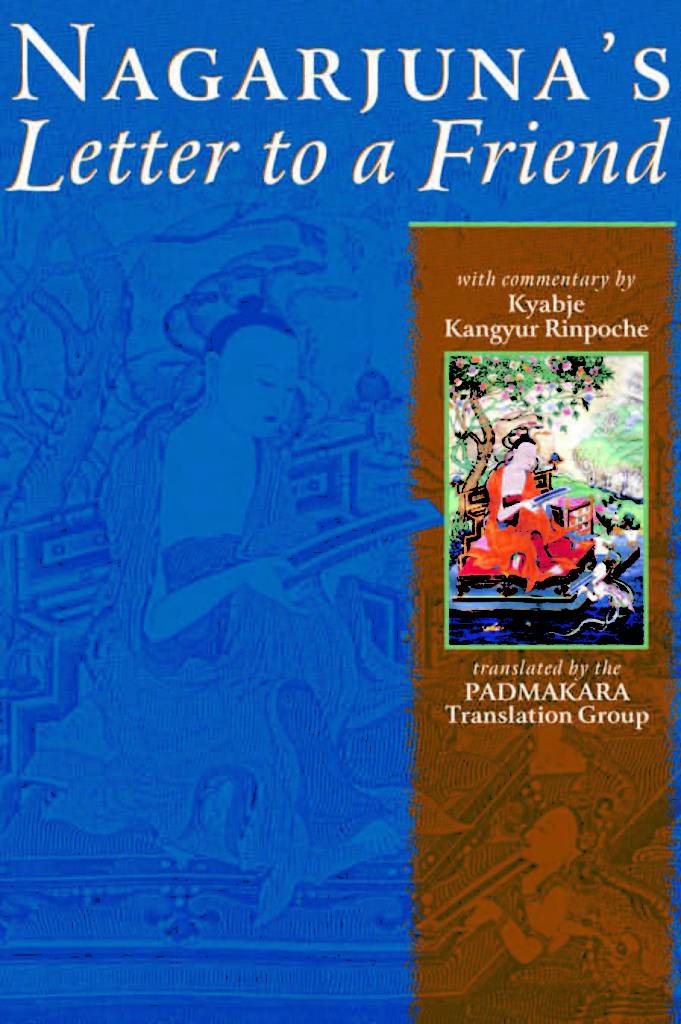
Nagarjuna's Letter to a Friend-front.jpg
Books2005About this item
The great Indian Buddhist master Nāgārjuna wrote his celebrated poem Letter to a Friend as a gift of advice to a South Indian king, and it has since become a monument in the Indian shastra tradition. Despite its short length (only 123 verses), it covers the entire Mahāyāna path, combining a practical approach to daily conduct with a theoretical exposition of the different stages leading to enlightenment. It has thus been an ideal source for many of Tibet's greatest scholars seeking a scriptural authority to enhance their own descriptions of the Buddhist path. (Source: Shambhala Publications)
1 Classical commentaries
Kangyur Rinpoche RigpaShedra.jpg
Classical WorksAbout this item
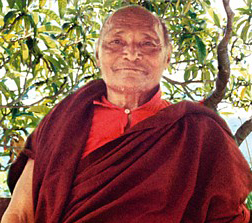
Kangyur Rinpoche's commentary broadly serves three purposes. First of all it provides a structural outline (sa bcad) for Nagarjuna’s text, furnishing appropriate headings with each change in topic; effectively this occurs almost with each new verse. On a casual reading of the root text, it is by no means easy to follow Nagarjuna’s argument and a structural outline is essential if readers are to have an overview of the entire work and keep their bearings as they read. Texts of this kind are open to more than a single interpretation and it is therefore possible to have more than one structural outline, which is indeed the case for Letter to a Friend. Jetsun

Rendawa's outline, for example, divides the text into three main sections: general advice concerning virtuous practices, developing aversion to samsara, and pursuing the path to nirvana. Sakya Pandita's outline views the Letter to a Friend more in terms of how it presents the Three Trainings, while the commentary by the Gelugpa Geshe Lobsang Jinba divides the text into practices for the three kinds of beings. Kangyur Rinpoche's outline puts the emphasis on the six transcendent perfections, and in this respect it is very similar to the outline that determines Lama Mipham's commentary.

Secondly, the commentary furnishes explanations on the more difficult points in Nagarjuna's poem by the insertion of notes between the words of the root text. These notes vary in their scope and purpose. Some constitute the simple insertion of synonyms to provide clarification of ambiguous words or modern equivalents for anachronistic expressions. Other notes explain what Nagarjuna means by particular terms. In some cases, Kangyur Rinpoche inserts quotations from the sutras and shastras, and for a number of topics he has written entire pages of detailed commentary.

The third purpose of Kangyur Rinpoche’s commentary is to render the original, sometimes cryptic, verse into relatively straightforward prose. (Source: Nagarjuna’s Letter to a Friend, 17–18)

1 Scholarship
Nagarjuniana-front.png
Books1982About this item
The author deals with the thirteen works attributed to Nāgārjuna. The first six are mainly dialectical works such as Mūlamadhyamakakārikā, Śūnyatāsaptati, Vigrahavyāvartanī, Vaidalyaprakaraṇa, Vyavahārasiddhi, Yuktiṣaṣṭikā followed by the remaining seven which are chiefly didactic texts - Catuḥstava, Ratnāvali, Pratītyasamutpādahṛdayakārikā, Sūtrasamuccaya, Bodhicittavivaraṇa, Suhṛllekha, and Bodhisaṃbhāra (ka). Thus he roughly follows the prescriptive distinction between Yukti and Agama.
4 A topic of
Kangyur Rinpoche RigpaShedra.jpg
Classical WorksAbout this item
Kangyur Rinpoche's commentary broadly serves three purposes. First of all it provides a structural outline (sa bcad) for Nagarjuna’s text, furnishing appropriate headings with each change in topic; effectively this occurs almost with each new verse. On a casual reading of the root text, it is by no means easy to follow Nagarjuna’s argument and a structural outline is essential if readers are to have an overview of the entire work and keep their bearings as they read. Texts of this kind are open to more than a single interpretation and it is therefore possible to have more than one structural outline, which is indeed the case for Letter to a Friend. Jetsun

Rendawa's outline, for example, divides the text into three main sections: general advice concerning virtuous practices, developing aversion to samsara, and pursuing the path to nirvana. Sakya Pandita's outline views the Letter to a Friend more in terms of how it presents the Three Trainings, while the commentary by the Gelugpa Geshe Lobsang Jinba divides the text into practices for the three kinds of beings. Kangyur Rinpoche's outline puts the emphasis on the six transcendent perfections, and in this respect it is very similar to the outline that determines Lama Mipham's commentary.

Secondly, the commentary furnishes explanations on the more difficult points in Nagarjuna's poem by the insertion of notes between the words of the root text. These notes vary in their scope and purpose. Some constitute the simple insertion of synonyms to provide clarification of ambiguous words or modern equivalents for anachronistic expressions. Other notes explain what Nagarjuna means by particular terms. In some cases, Kangyur Rinpoche inserts quotations from the sutras and shastras, and for a number of topics he has written entire pages of detailed commentary.

The third purpose of Kangyur Rinpoche’s commentary is to render the original, sometimes cryptic, verse into relatively straightforward prose. (Source: Nagarjuna’s Letter to a Friend, 17–18)

Nagarjuna's Letter to a Friend-front.jpg
Books2005About this item
The great Indian Buddhist master Nāgārjuna wrote his celebrated poem Letter to a Friend as a gift of advice to a South Indian king, and it has since become a monument in the Indian shastra tradition. Despite its short length (only 123 verses), it covers the entire Mahāyāna path, combining a practical approach to daily conduct with a theoretical exposition of the different stages leading to enlightenment. It has thus been an ideal source for many of Tibet's greatest scholars seeking a scriptural authority to enhance their own descriptions of the Buddhist path. (Source: Shambhala Publications)
Nagarjuniana-front.png
Books1982About this item
The author deals with the thirteen works attributed to Nāgārjuna. The first six are mainly dialectical works such as Mūlamadhyamakakārikā, Śūnyatāsaptati, Vigrahavyāvartanī, Vaidalyaprakaraṇa, Vyavahārasiddhi, Yuktiṣaṣṭikā followed by the remaining seven which are chiefly didactic texts - Catuḥstava, Ratnāvali, Pratītyasamutpādahṛdayakārikā, Sūtrasamuccaya, Bodhicittavivaraṇa, Suhṛllekha, and Bodhisaṃbhāra (ka). Thus he roughly follows the prescriptive distinction between Yukti and Agama.