- [[<span class="smw-highlighter" data-type="4" data-state="inline" data-title="Warning" title="Some use of "|]]
- "
- In your query was not closed by a matching "
- "
- [[.">Some use of "" in your query was not closed by a matching "".|]]
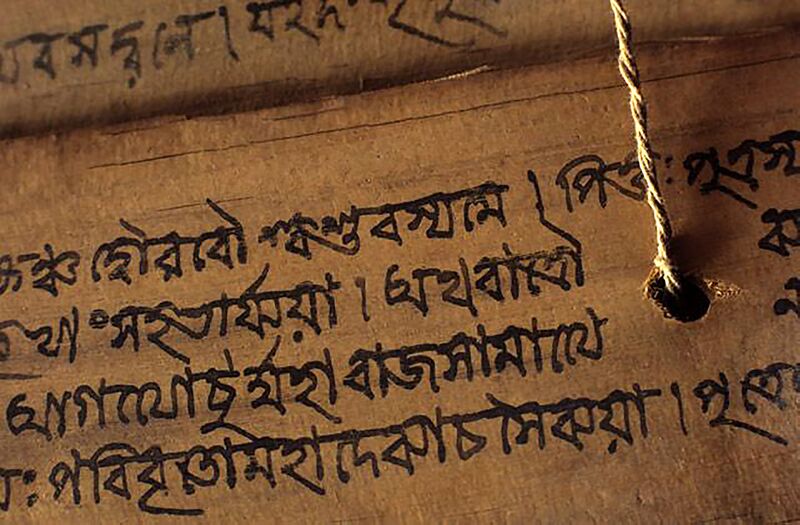
This article by Fredrik Liland provides a detailed overview of the Bodhicaryāvatāra's impact on Tibetan Buddhism. It traces the text's translation process from Sanskrit to Tibetan, detailing three major stages of translation and revision. The study highlights the text's influence on Tibetan Buddhist practices, particularly in the development of mental purification techniques and meditation manuals. It discusses the text's role in philosophical debates, especially regarding the interpretation of the ninth chapter on transcendental wisdom. The article also explores the Bodhicaryāvatāra's integration into monastic education and its continued relevance in contemporary Tibetan Buddhist practice.
This multifaceted analysis offers valuable insights into the text's historical, philosophical, and practical significance in Tibetan Buddhism. It illuminates the complex process of textual transmission and translation, demonstrating how a single text can shape religious thought and practice across centuries. The exploration of related philosophical debates showcases the importance of the Bodhicaryāvatāra in Tibetan Buddhism. By including contemporary examples showing how the text is used in education and daily practice, the article bridges historical analysis with current relevance, providing a comprehensive resource for understanding the enduring impact of this central Buddhist text in Tibetan culture and religious life.
The BCA has had a massive impact on Tibetan Buddhism. It is one of the most influential Indian Buddhist texts translated into Tibetan, held in awe by all the major sects, and has been the focus of heated philosophical debates, of meditational practices aimed at cultivating a compassionate mind, and chanted in devotional practices. To present anything that could resemble a comprehensive account of its history and impact in Tibet would be impossible within the limited space available to us here. Aspects of its role within Tibetan Buddhism today will also be treated in separate chapters below, such as in the presentation of a teaching on it given by the 14th Dalai Lama. There we will se an example of its practical usage as a manual to instruct aspiring bodhisattvas. What follows here will be a general survey of some of the important events of the BCA's career in Tibet. We will see how it was translated and received initially, examples of how it was used as a practical means of training in awakening, and how it arrived in the centre of heated sectarian debates. This will be but a mere overview of some of the research that has been done on the BCA's role in Tibet, and hopefully it will draw some general lines that can open up new avenues for future inquiries.
The Translation Process
In the canonical edition available to us in the Tg we find the following colophon describing the process of how the BCA was translated:
// byang chub sems dpa'i spyod pa la 'jug pa slob dpon sha nta (sic) de bas mdzad pa
rdzogs so // // rgya gar gyi mkhan po sa rba dzny'a de ba daṅ / zhu chen gyi lo ts'a ba
ban de dpal brtsegs kyis kha che'i dpe las zhus te gtan la phab pa las / slad kyis rgya
gar gyi mkhan po dha rma shr'i bha dra dang / zhu chen gyi lo ts'a ba ban de rin chen
bzang po dang / sh'a kya blo gros kyis yul dbus kyi dpe daṅ 'grel pa daṅ mthun par
bcos shing bsgyur te gtan la phab pa'o / / yang dus phyis rgya gar gyi mkhan po su ma
ti k'i rti dang / zhu chen gyi lo ts'a ba dge slong blo ldan shes rab kyis dag par bcos
shing bsgyur te legs par gtan la phab pa'o // //[1]
"Introduction to the Practice of a Bodhisattva by the master Śāntideva is concluded.
The Indian preceptor Sarvajñādeva and the great editor-translator venerable dPal
brtsegs established an edition of this based on a manuscript from Kashmir. Using this
[edition] the Indian preceptor Dharmaśrībhadra, the great editor-translator venerable
Rin chen bzang po and Śākya blo gros established a translation based on a manuscript,
and in accordance with a commentary, from Madhyadeśa (North-central India). Later,
the Indian preceptor Sumatikīrti and the great editor-translator monk Blo ldan shes rab
performed a detailed editing of this establishing the final translation."[2]
In a series of groundbreaking articles Akira Saito has illustrated some of the details of what this colophon outlines, and the process leading towards the canonical edition available today.[3] It is mainly from the work of Saito that the following results have been gathered.
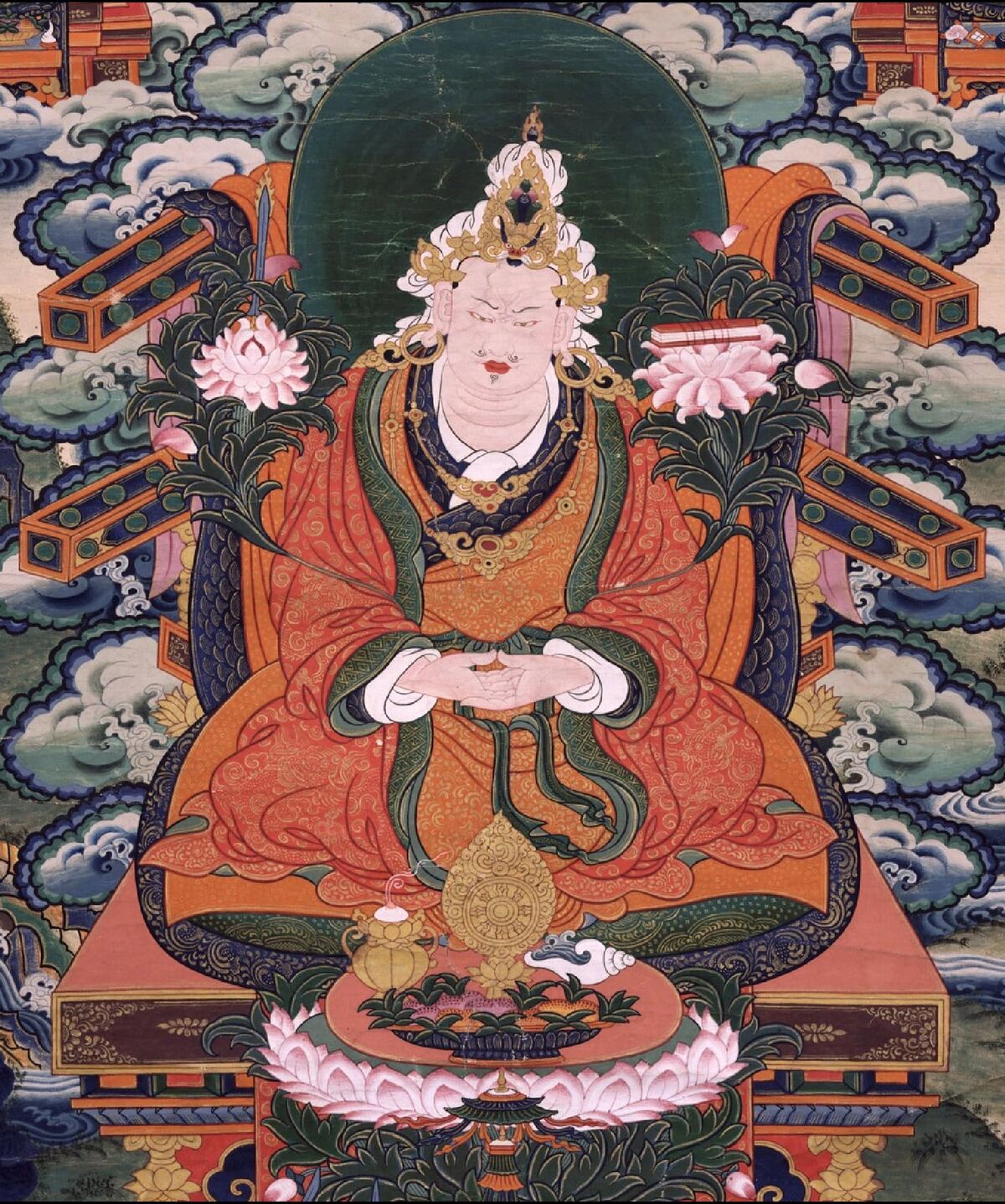
Source Himalayan Art Resources
As the colophon tells us the translation of the BCA went through three stages. The initial work (BCATib1) was done by sKa ba dPal brtseg (8th-9th Century) and Sarvajñādeva (8th-9th Century). According to Dudjom (1991: 515), a traditional account, Sarvajñādeva was invited to Tibet as one of several Indian Buddhist experts by king Khri Srong lde'u btsan (742-797; r. 755-797), the celebrated king accredited with having firmly established Buddhism in Tibet. Khri Srong lde'u btsan is said to have first invited the abbot of Nālanda Śāntarakṣita (8th Century) and the tantric master Padmasambhava (8th Century), the initiators of the first lineages of respectively the sūtra and tantra teachings in Tibet, and to have established the first Buddhist monastery, bSam yas, in the year 779. In order to commence the translation of the Buddhist canon several Indian experts were also invited, and in addition to Sarvajñādeva we hear of Jinamitra and Dānaśīla, among others. Tibetans were trained in the science of translation, and in addition to sKa ba dPal brtseg we hear of Ye shes sde, Klu'i rgyal mtshan, and Vairocana. These personas started the enormous and impressive translation process that would lead to the establishment of the Tibetan Buddhist canon. Precisely when the first translation of the BCA was established we can not say. It might have taken place under the rule of Khri Srong lde'u btsan, or it might have been during the rule of one of the subsequent kings. Most sources place the translations of sKa ba dPal brtseg aournd the year 800,[4] which could imply that it took place under a subsequent king, perhaps Mu ne btsan po (r. c. 797- 799?) or Khri lDe srong btsan (r. 804-815). The next king, Ral pa can (r. 815-838), is famed for having formalised the translation process by establishing fixed rules as laid out in for instance the Mahavyutpatti, a Sanskrit-Tibetan standardized word-list. The first translation of the BCA perhaps found its final form under this king.
What can be said with certainty is that the BCA was translated during the dynastic period, in the early dissemination of the docrtine (bstan pa'i snga dar) as it is traditionally called, since it is included in the lDan dkar ma, the earliest known catalogue of translations dating from this time.[5] This translation was based on the BCA1, and contained 701,5/202,5 verses. The only exemplars that have survived of this translation are four mss. that were found in the caves at Dūnhuáng, in the Gansu province, China, in the beginning of the 20th Century.[6] They were brought to London and Paris by the explorers Auriel Stein (1862-1943) and Paul Pelliot (1878-1945), and are today kept at the British Library in London and the Bibliothéque Nationale in Paris.[7] That these mss. are from the early dissemination is illustrated in part by the orthography, which demonstrates certain features of the language that had disappeared at the time of the later dissemination. These include such archaic attributes as ya (ya btags) subscribed to the root-letter ma,[8] and use of the later redundant post-suffix da,[9] to name two examples. Another proof of its age, and at least partial accuracy of the above quoted canonical colophon, is the colophon to the ms. Lon. IOL Tib. J 629 (folio 40b4-5) which indeed attributes its translation to mKhan po Sa ra ba da nya (sic) de va ("the preceptor Sarvajñādeva") and Zhu chen gyi lo tsa ba ban' de dPal brtseg ("chief editor-translator venerable dPal brtseg"). The canonical colophon also mentions that the Sanskrit ms. employed for BCATib1 was from Kashmir, and Saito (1999: 176) attributes this observation to the compiler of the Tg, Bu ston rin chen grub (1290-1364). The later Tibetan historian Tāranātha (1575-1608), however, says that the ms. was from East India.[10] Bu ston does not expand on his observation regarding the ms.'s origin, but Tāranātha, as we have seen before does. Tāranātha[11] is perhaps, for some as yet unknown reason, attempting to restore the Kasmiri masters' lineage as authentic when he observes that it was not them, but those from East India who transmitted the, to him incorrect, ms. that formed the base for the BCATib1. They both, however, agree that the later, and correct version of the BCATib came from North-central India.
The Revisions
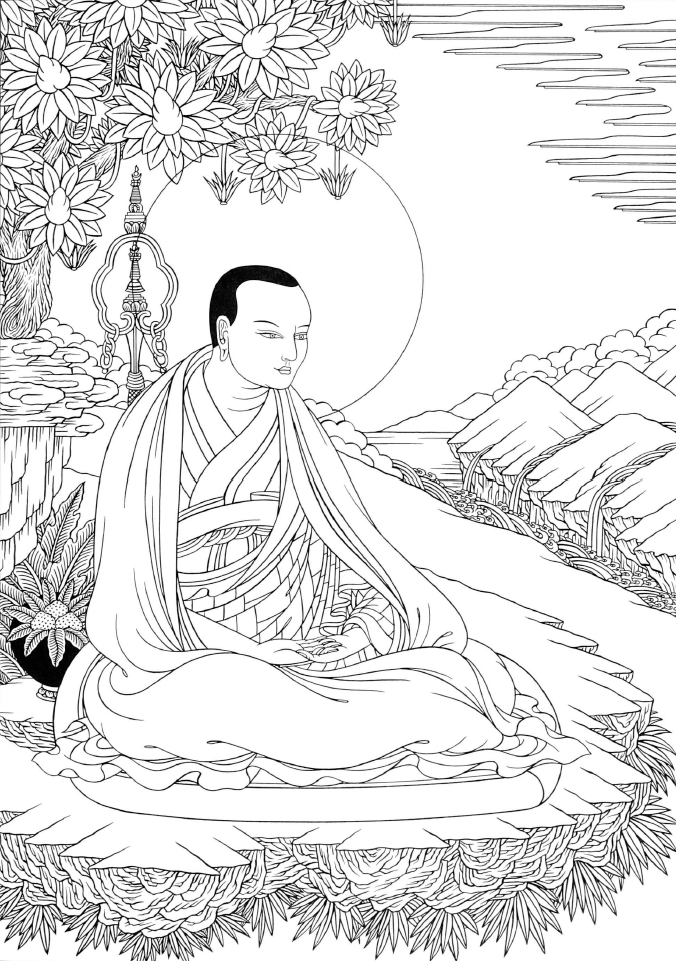
The revision of the BCATib1 was, according to our colophon, performed by the Indian master Dharmaśrībhadra (10th-11th Century?) and the Tibetan translators Rin chen bzang po (958-1055), and Śākya blo gros (10th-11th Century?). Concerning the last translator nothing is known for certain.[12] He is also not usually emphasized in connection with this work.[13] Rin chen bzang po is however well known.[14] He was connected to the kingdom of Gu ge in Western Tibet, a dynasty with family ties to the ancient royal line. The rulers of Gu ge wished to emulate the kings of old, and their support for Buddhism must at least in part be seen as politically motivated. Tradition tells us that Rin chen bzang po was among 21 youths sent to Kashmir by the Gu ge king Ye shes 'od (c. 956-1036) to be trained as translators and to reintroduce Buddhism to Tibet.[15] It seems, however, that he travelled to Kashmir on his own account, and only later became associated with the Gu ge kings. Dharmaśrībhadra was perhaps the master he studied under in Kashmir. Rin chen bzang po was a diverse scholar, involved in the translation of several yogatantras and medical works, as well as the development of the Tibetan traditions of painting and sculpturing.
The only ms. containing an edition of Rin chen bzang po's revision (BCATib2) has been found at Tabo monastery in the Indian state of Himachal Pradesh, established by Ye shes 'od about 996. This find, and its relationship with the BCATib1, has been dealt with in Saito (1999). The Tabo ms. is incomplete. It contains 12 folia, of a probable total of 37, and the last verse preserved is 5.97. It is a translation of BCA2, but contains verses from BCATib1. The translator must have had a version of the old translation of sKa ba dPal brtseg available, but had acquired a ms. of the expanded and later Sanskrit edition of the BCA, perhaps a ms. from North-central India (Madhyadeśa) as the colophon states. It is not known which commentary Rin chen bzang po consulted, as mentioned in the colophon. Saito found that Rin chen bzang po's translation was not free from careless omission of verses as well as unsuitable renderings of the BCA2, and that the copyist of the Tabo ms. must have consulted a Sanskrit edition while copying, and have tried to correct some of the mistakes. Only some of these corrections were later included in the third translation discussed below. Note should also be made of the fact that renderings from the Tabo ms. can be found in the translations of the BCAṢP and BCAPiṇ, the earlier mentioned abbreviated version of the BCA brought to Tibet by the Atiśa. Atiśa was invited to Gu ge and met Rin chen bzang po when the latter was already an old man in 1046. Atiśa's influence on the spread of the BCA in Tibet will be discussed below.
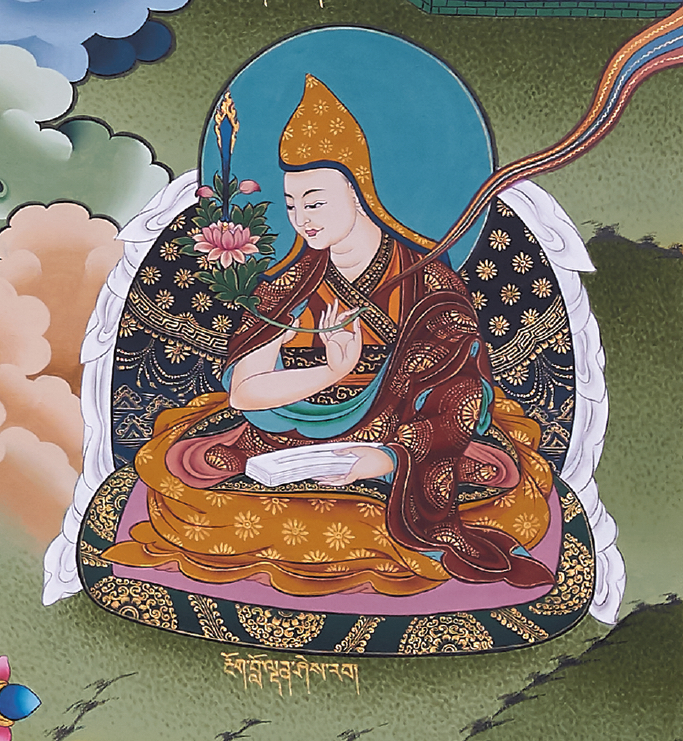
The third revision was done by Sumatikīrti (11th Century?) and Blo ldan shes rab (1059-1109)[16] (BCATib3). Sumatikīrti is referred to as an Indian preceptor (rgya gar gyi mkhan po) in our colophon. Cleaves (1954: 24) however reports that the Mongolian translation of the colophon describes him as "Nepali". Blo ldan shes rab is most famous for being one of the instigators of the "New Logic" (tshad ma gsar ma), the scholastic tradition that would later inspire the well known and still prosperous Tibetan tradition of monastic philosophical debate.[17] When Bu ston rin chen grub (1290-1364) was compiling the Tg at Zha lu monastery in 1334 he noted that it was Blo ldan shes rab's version of the BCATib that he was including in the collection.[18] This final edition contained 913 verses, over 200 more than the BCATib1. The ms. he used was not, however, one copied by Blo ldan shes rab himself, but by the bKa' gdams pa master gTsang nag pa Brtson 'grus seng ge (12-13th Century), and it appears that this ms. contained several corrections done by him. Bu ston, after himself having consulted a Sanskrit original as well as several commentaries, did not agree with many of these "corrections". He therefore tried to find a more reliable copy of Blo ldan shes rab's translation, but in vain. He therefore left the edition as it was, and it is this that has been handed down to us in the Tg.[19] Fortunately Bu ston also gives us the lineage of transmission of the BCA that he received.[20] This lineage seems to affirm the suggestion that Sumatikīrti was indeed Nepali, as his teacher, Kanakaśrī, was a Nepali.
Atiśa and the bKa' gdams pas

Thangka by Shawo Thar, 2003. View full painting on Himalayan Art Resources
The native Tibetan tradition of writing manuals aimed at mental purification (blo sbyong) is in large part inspired by the BCA and its promotion by the Indian master Atiśa Dīpaṃkaraśrījñāna (982-1054 CE).[21] As we have seen Atiśa arrived in Tibet in 1046, invited by the royal court of Gu ge. His planned return to India three years later was prevented by political turmoil in Nepal, and he instead accepted the invitation by some of his disciples to go to central Tibet. He taught for many years in that area and is considered the forefather of the dKa' gdams pa sect established by his disciple 'Brom ston rGyal ba'i 'byung gnas (1004-1057), the forerunner to the later dGe lugs pa sect established by Tsong kha pa Blo bzang grags pa (1357-1419). The dKa' gdams pas, the literal meaning of the name being "scripture and precepts", highlighted the texts of the Buddhist canon as the authoritative source, and the practical precepts of the Mahāyāna traditions as the appropriate basis for the religious life, as taught by Atiśa. This movement was in part a reaction to the conceived immorality prevalent in some of the esoteric tantric traditions stemming from the dynastic period, and one that highlighted the dire need for a proper monastic community as the main transmitter of the Buddhist teachings.
The tradition of mental purification is quite clear about the influence of the BCA, and accredits Śāntideva as one of the major figure in its transmission. It was mainly from the 8th chapter of the BCA, the perfection of contemplation (dhyānapāramitā), that this teaching drew its inspiration. In here we learn of the practice of exchanging oneself with others:
/ gang zhig bdag dang gzhan rnams ni / / myur du bskyab par 'dod pa des / / bdag dang gzhan du brje bya ba / / gsang ba'i dam pa spyad par bya /[22]
"Whoever wishes to quickly rescue oneself and others should practice the supreme mystery, exchanging oneself with others."
The verses that follow describe the reasoning behind this practice and the mental attitude one should engender. It is based on the observation that pride and self-centeredness leads to suffering, and that it is only through valuing others and wishing for their happiness, and not only one's own, that one's aims will be fulfilled. This practice became immensely popular, not only within the sKa' gdams pa sect, and the commentarial literature it instigated is found within all the four major sects of Tibetan Buddhism. As the main source for this practice, the BCA became regarded as one of the six main treatises of the bKa' gdams pa school.[23] We know of commentaries by many of the great bKa' gdams pa teachers, such as the already mentioned translator rNgog lo tsā ba Blo ldan shes rab, his disciple and famous logician Phywa pa Chos kyi seng ge (11th-12th Cent), Nyang bran Chos kyi ye shes (12th Century), Lha 'Bri sgang pa (12th Century), Gtsang Nag pa Brtson 'grus seng ge who was involved in the transmission of the final translation described above, Bu ston rin chen grub, Mtso sna ba Shes rab bzang po (14th century), dGa' ba gdong Mkhan po Chos dpal bzang po, Grub pa shes rab (14th Century), and rGyal sras Thogs med (1295-1369).[24] The commentary by rGyal sras Thogs med is by far the most influential of these, and was, as we shall see in a later chapter, used as a basis for the first translation into English of the BCATib.[25]
The BCA in a Meditation-Manual
The BCA also had a strong influence on the practice oriented bKa' brgyud sect. One of this sects main forebears was Gam po pa bSod nams rin chen (1079-1153), who prior to meeting his main teacher, the yogin Mi la ras pa (1052-1135), was a student of the bKa' gdams pa sect. As a scholastically trained monk, in a tradition mostly geared toward tantric meditational practices, he provided the school with a Mahāyāna theoretical basis,[26] at least partially inspired by his previous training. Although he did not himself write a commentary on the BCA, it is likely that some of the focus on the BCA within the bKa' brgyud sect is due to Gam po pa. The by far largest Tibetan commentary on the BCA was written by dPa' bo gtsug lag phreng ba (d. mid 16th Century), a disciple of the 8th Karma pa Mi bskyod rdo rje (1507–1554).[27] The next head of the Karma bKa' brgyud sect, the 9th Karma pa dBang phyug rdo rje (1556-1603), wrote a practice manual for meditation of the type known as a "preliminary practice" (sngon 'gro).[28] This manual leads the meditator through four practices: taking refuge and giving rise to bodhicitta, purification through meditation of the deity Vajrasattva, practicing generosity through maṇḍala-offering, and developing devotion to ones teacher through guruyoga. In the section concerned with bodhicitta there are several quotes from the BCA. The meditator is meant to recite these while actively trying to engender the altruistic mind of bodhicitta. The actual vow of bodhicitta is first recited three times, and part of this consists of verses 3.22-23:
/ ji ltar sngon gyi bde gshegs kyis / / byang chub thugs ni bskyed pa dang / / byang chub sems dpa’i bslab pa la / / de dag rim bzhin gnas pa ltar / / de bshin 'gro la phan don du / / byang chub sems ni bskyed bgyi zhing / / de bzhin du ni bslab pa la'ang / / rim pa bzhin du bslab par bgyi /[29]
"Just as the sugatas of old gave rise to bodhicitta and gradually trained in these practices of a bodhisattva, just so will I too, for the benefit of beings, give rise to bodhicitta, and train in these same practices, gradually traversing these stages."
This is followed, among other quotes, by verses 3.25, 26, 33, 10.32, and 49, which are used as verses of celebration, where the meditator rejoices in having taken up the bodhisattva's vow. This practice is meant to be recited daily, up to several hours a day by someone in retreat, and is formally finished when the vow has been repeated 100000 times. As part of this manual, and similar manuals that have been produced in abundance throughout the history of Buddhism in Tibet, verses of the BCA have been influential in the daily lives of many Tibetan Buddhists.
Philosophical Controversies
The 9th chapter of the BCA, the one concerned with the perfection of transcendental wisdom (prajñāpāramitā), has been at the centre of much heated debate in Tibet. From early times the Buddhist tradition employed critical analysis of the phenomena we experience as a means for working one's way towards the state of awakening. Typically the analysis dealt with phenomena such as one’s conceived self (ātman), which if related to with attachment is considered the main obstacle for realization. The philosophical branch of Buddhism the BCA is identified with is Mādhyamika,[30] often specified as Prāsaṅgika Mādhyamika in Tibet, the highest philosophical school in the hierarchy of Buddhist philosophical views that Tibetan Buddhism operates with.[31] A Mādhyamika type of analysis will typically start with a concept we hold true in everyday life and deconstruct it until it has been thoroughly shown to be exactly that, nothing more than a concept superimposed on our experiences, and not something that accurately describes the world. A particular approach of the Prāsaṅgika Mādhyamika is to deconstruct the philosophical approaches of other schools, Buddhist and non-Buddhist, and this is exactly what the 9th chapter of the BCA does. It takes the ideas of the, according to the Tibetan doxographical system, "lesser" schools, and shows the absurd consequences (prasaṅga) that holding such views will lead to.
This approach has a tendency to balance along the precipice of nihilism, and this accusation was often brought upon those Tibetan philosophers who were considered to go too far in their refutation of phenomena. The dGe lugs pa sect often found themselves on one side of such debates, taking the more sombre view of upholding a rigorous logic that should not be allowed to run amok, lest one should end up refuting everything and be left standing in the dark. The graded path (lam rim) introduced by Atiśa, leading the way gradually and safely towards awakening, must, according to the dGe lugs pas, be upheld. The instantaneous realization professed by some practitioners of rDzogs chen (the great perfection), a practice considered by the rNying ma pa sect to have been introduced to Tibet by Padmasambhava, was even accused of heresy by certain dGe lugs pas. The rDzogs chen yogis were, however, mostly content, as Smith (2001: 229) puts it, "to get about the task of emptying their mind of all conceptualization through the practice of higher esoteric methods." They were not so interested in formulating specific philosophical theories about how this actually took place. That is, they were, until the celebrated rNying ma pa scholar Mi pham rgya mtsho (1846-1912) came along and stirred up a debate concerning the 9th chapter of the BCA that would last for decades.[32]
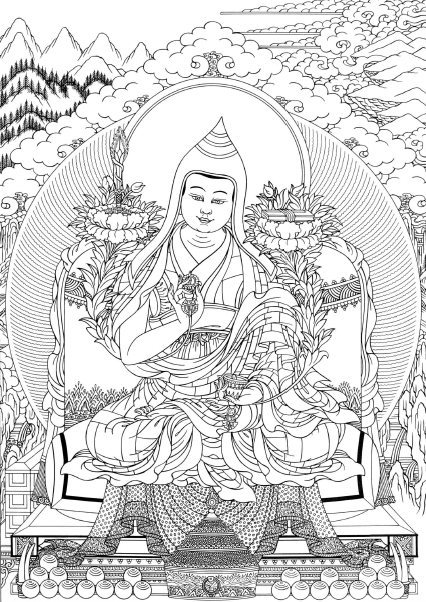
The exact contents of this debate will not be discussed here. As a brief example of the nature of the debate we can quote the BCA verse 9.2, where it says:
/ kun rdzob daṅ ni don dam ste / / 'di ni bden pa gñis su 'dod / / don dam blo yi spyod yul min / / blo ni kun rdzob yin par brjod /[33]
"The conventional and the ultimate, these are the two truths we profess.
The ultimate is not an object of the intellect; the intellect is within the scope of the conventional."
The debate that this verse caused is discussed in some detail by Sweet (1977: 20-32 and 1979). The disagreement is caused by the second line of the verse, and whether it should be understood literally or interpreted. The dGe lugs pas generally hold that it should be interpreted, and that when Śāntideva says that "the ultimate is not an object of the intellect", he is referring to a deluded intellect. Surely, the dGe lugs pa says, it must be possible to approach the ultimate nature of things by means of the intellect, for how else are we to become able to understand and realize awakening if not by means of rigorous logic? Representatives of the three other main schools, the rNying ma, bKa' brgyud, and Sa skya, were generally in favour of a more literal interpretation, and understood the verse as meaning that all conceptualization must in the end be eliminated in order to reach the realization of the ultimate.
A Contemporary Example
Due to a fortunate coincidence I have also been introduced to a contemporary example of the BCA's influence in Tibet. Puchung Tsering, a former graduate of Tibet University, has informed me of the fact that the BCA has experienced somewhat of a revival lately in the scholastic milieu of Lhasa.[34] In 1981, after the softening of Chinese politics in Tibet in the aftermath of the Cultural Revolution, The School for Tibetan Cadre (renamed Tibet University in 1985) was allowed to begin teaching a wider range of subjects, including Tibetan religion. There were however few educated scholars who could teach such a subject in Tibet at the time, and a quite original solution was devised to fill the new vacancies. During the Cultural Revolution all Tibetan Buddhist monks were forced to disrobe and take up a lay life. Many of these, especially from such prominent monastic institutions as dGa' ldan, 'Bras spung, and bKra shis lhun po near Lhasa, were highly educated scholars, experts in Tibetan Buddhist philosophy and history. Several of these were hired as teachers, and they were given relatively free reins when it came to the format and syllabus to be used. This resulted, quite as one could expect, in a religious studies program that was basically a duplicate of the program followed at the dGe lugs monastic institutions prior to the Cultural Revolution, with great emphasis laid on the art of debate, and, most interesting for our present study, a separate course devoted specifically to an in-depth study of the BCA. When Puchung attended the class during the period 1989-1991 the class was taught for four hours a week, and the teacher was a former teacher from bKra shis lhun po, Geshe Tsewang (dge shes tshe dbang; d. 2007). The text was taught in great detail, using the commentaries by for instance Tsong kha pa Blo bzang grags pa (1357-1419) and rGyal tshab Dar ma rin chen (1364-1432), and during the two years Puchung attended the class they were only able to cover the text up to the fifth chapter. It was expected of the students to memorize the text, and Puchung is still able today to recite most of the text up to this chapter. In 1997 there was an educational reform that resulted in restrictions on teaching religious subjects related to Tibetan Buddhism. There was no longer a separate class taught on the BCA from this time onwards, but the text was still taught under the headlines of more general subjects on the MA level. Puchung could also inform me that the 10th chapter of the BCA is found in prayer booklets found in many homes in Lhasa. It is therefore chanted regularly by many among the general populace, and is an important part of the daily life of the, again, flourishing Tibetan Buddhist religion.
Notes
- ↑ Tg la 40a5-7.
- ↑ Saito (1999: 176) suggests that this information must have been drawn from the observations made by Bu ston rin chen grub (1290-1364) in the catalogue attached to the Tg. Bu ston is famed for having collected the Tibetan canon in 1334.
- ↑ Saito (1993, 1997, and 1999).
- ↑ See for instance Ruegg (1981: 59 and 99).
- ↑ Saito (1993: 6-7).
- ↑ The Dūnhuáng cave-complex was sealed around 1000 CE, and contained a wide variety of mostly Buddhist literature in Tibetan, Sanskrit, and several other languages.
- ↑ See mss. Lon. IOL Tib J 628-630 and Par. Pt. 794 in the appendix; the International Dūnhuáng Project are in the process of making these mss. available on the internet, and two of them can already be accessed at http://idp.bl.uk.
- ↑ Myi for mi; myed for med; myig for mig.
- ↑ Gyurd for gyur; lend for len.
- ↑ Saito (1993: 7).
- ↑ Saito (1993: 10-11).
- ↑ He is perhaps the same Śākya blo gros mentioned in the lineage of the Sa skya sect by Smith (2001: 106). The general timeframe for such a connection would fit.
- ↑ See for instance Saito (1999) who does not mention his involvement at all.
- ↑ The life of Rin chen bzang po is dealt with in Kapstein (2006: 90-95).
- ↑ After the collapse of the Tibetan kingdom in the mid 9th Century the predicament of Buddhism worsened, and Tibetan historians refer to the period up to c. 1000 as the Dark Period.
- ↑ rNgog lo tsā ba Blo ldan shes rab.
- ↑ For a discussion of this tradition see for instance Dreyfus (2003.
- ↑ Saito (1997: 81).
- ↑ It should however be noted that the Peking (Q) and Narthang (N) editions differ from the Derge (Tg) edition in certain places, as illustrated by Saito (1999). These seem to have been corrected further based on a Sanskrit ms., and have also incorporated certain of Bu ston's corrections as found in his commentary on the BCA, the Byang chub sems dpa'i spyod pa la 'jug pa'i 'grel pa byang chub kyi sems gsal bar byed pa zla ba'i 'od zer.
- ↑ Saito (1997: 80); Śāntideva (7th Century) → Jitāri → Small Candrakīrti → Kunayaśrī → Nepalese Kanakaśrī → Sumatikīrti (11th Century) → rNgog Blo ldan shes rab (1059-1109) → Khyung Rin chen grags → sTod lung rGya dmar → [Gro lung pa Blo gros 'byung gnas →] Phya pa Chos kyi seng ge (1109-1169) → gTang dkar → [Kha che Paṇ chen Śākyaśrībhadra (1127-1225)/Paṇḍita Buddhaśrījñāna and Nepalese Paṇḍita Devaśrī →] Khro phu lo tsā ba Byams pa'i dpal (1172/73-1225) → bSod nams rgyal ba and gZhon nu rdo rje → Tshad ma'i skyes bu → Bu ston Rin chen grub (1290-1364) (Names in square brackets imply that these masters came from other lineages).
- ↑ For an introduction to the genre of texts on mental purification see Michael J. Sweet's article "Mental Purification (blo sbyong): A Native Tibetan Genre of Religious Literature" in Cabezón (1996), pp. 244-260.
- ↑ Tg la 28a2; verse 8.120.
- ↑ The other five treatises are the Mahāyānasūtrālaṅkāra by Maitreya/Asaṅga, the Bodhisattvabhūmi by Asaṅga, the Śīkṣāsamuccaya by Śāntideva, the Jātakamālā of Āryaśūra, and the Udānavarga.
- ↑ Smith (2001: 228).
- ↑ See Batchelor (1979).
- ↑ Such as in his Jewel Ornament of Liberation (Thar pa rin po che'i rgyan); see Konchog Gyaltsen (1998).
- ↑ The 9th chapter of this commentary is translated in Brunnhölzl (2004).
- ↑ The Chariot that Carries Us Along the Noble Way ('Phags lam bgrod pa'i shing rta); this text and its practice is treated in Hanson (2000).
- ↑ Tg la 7b2-3.
- ↑ For a treatment of the philosophy of the Mādhyamika, see Williams (1989).
- ↑ The four main philosophical schools are, from the lowest to the highest, the Vaibhāṣika (the Enumerators), Sautrāntika (the Followers of Scripture), Yogācāra (the Practitioners), and the Mādhyamika (the Middle Way). The Mādhyamika is again divided into the Svatantrika Mādhyamika (the Middle Way Autonomists) and the Prasaṅgika Mādhyamika (the Middle Way Consequentialists).
- ↑ Mi pham's text was entitled She rab kyi le'u'i tshig don go sla bar rnam par bshad pa nor bu ke ta ka (The Ketaka-jewel: a commentary to ease the understanding of the chapter on transcendental wisdom); for a discussion of this controversy see Smith (2001: 227-233); for a discussion of Mi pham and his philosophy see Pettit (1999a).
- ↑ Tg la 31a1.
- ↑ This information is based on an interview with Puchung Tsering, presenty working as a doctoral candidate at the University of Oslo, Norway, conducted at the University of Oslo on the 5th of March, 2009.
