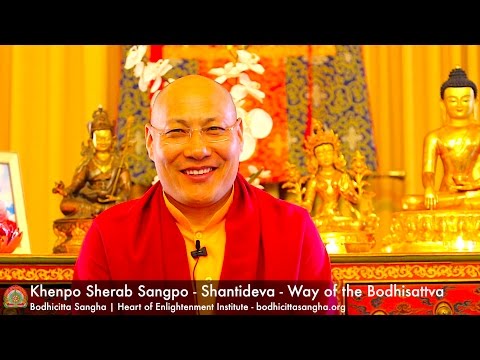
Shantideva - Way of the Bodhisattva: Teaching by Khenpo Sherab Sangpo

From Bodhicitta
LibraryMultimediaShantideva - Way of the Bodhisattva: Teaching by Khenpo Sherab Sangpo
< Media
(Redirected from Shantideva - Way of the Bodhisattva: Teaching by Khenpo Sherab Sangpo)
Media/Shantideva - Way of the Bodhisattva: Teaching by Khenpo Sherab Sangpo

Shantideva - Way of the Bodhisattva: Teaching by Khenpo Sherab Sangpo
Multimedia


Please note that many items in our library are simply pages that represent a detailed library catalog entry and citation of someone else's work, presentation, or performance. Read our General Disclaimer for more information.

Description

May supreme, precious bodhicitta

Take birth where it has not arisen.
Where it has arisen, may it never wane,
But continue to grow forevermore!

            -Shantideva

Khenpo Sherab Sangpo, a professor of Tibetan Buddhism in the Nyingma Lineage (bodhicittasangha.org), teaches on the 4-line bodhicitta prayer that is a summary of the “Bodhicaryāvatāra" by Shantideva. In "Introduction to the Bodhisattva's Way of Life,” Shantideva teaches how to give rise to, to cultivate, and to develop the kind heart of bodhicitta as one progresses along the Mahayana path toward enlightenment. Khenpo Sherab Sangpo received these teachings multiple times from his own root teacher, Khenchen Padma Tsewang. The teaching ends with a guided meditation on the heart of enlightenment—the bodhicitta mind—using the three channels and the breath as support. (Source Accessed Oct 13, 2021)


Citation
Sangpo, Khenpo Sherab. "Shantideva: Way of the Bodhisattva." Produced by the Bodhicitta Sangha: Heart of Enlightenment Institute May 7, 2017. Video, 55:08. https://www.youtube.com/watch?v=F6u6AOFUtGo.


Teaching on

 
An "Introduction to Bodhisattva Practice," the Bodhisattvacaryāvatāra is a poem about the path of a bodhisattva, in ten chapters, written by the Indian Buddhist Śāntideva (fl. c. 685–763). One of the masterpieces of world literature, it is a core text of Mahāyāna Buddhism and continues to be taught, studied, and commented upon in many languages and by many traditions around the world. The main subject of the text is bodhicitta, the altruistic aspiration for enlightenment, and the path and practices of the bodhisattva, the six perfections (pāramitās). The text forms the basis of many contemporary discussions of Buddhist ethics and philosophy.
Text