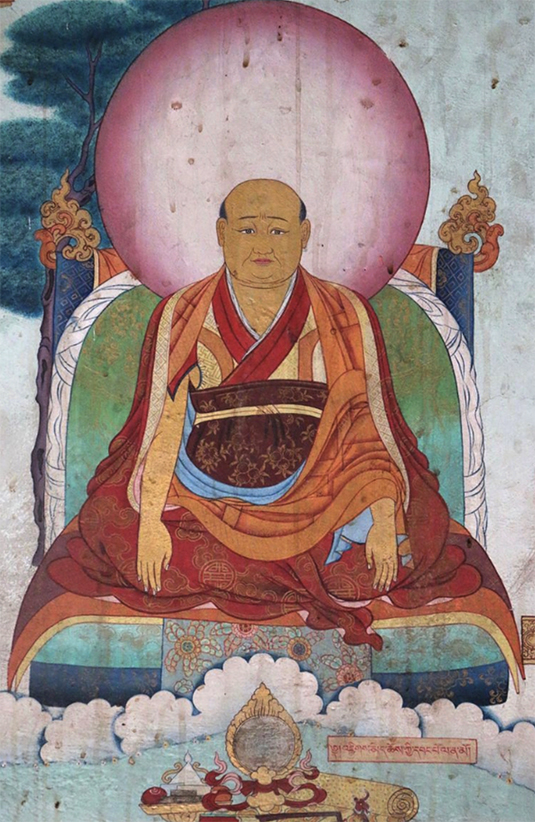
Sacred Words, Living Practice: Patrul Rinpoche and the Bodhicaryāvatāra
Articles/Sacred Words, Living Practice: Patrul Rinpoche and the Bodhicaryāvatāra (Forgues 2025)
| 🤓 Admin Zone 🛠️ hidden to non-admins | |
Patrul Rinpoche (1808-1887) transformed the transmission of Śāntideva's Bodhicaryāvatāra in eastern Tibet through his innovative practice-oriented approach, teaching the text over one hundred times and making it accessible to both monastic and lay audiences. Rather than composing a full commentary, he created three practical works: a step-by-step practice manual (Spyod 'jug sgom rim), structural outline (sa bcad), and lineage prayer (brgyud 'debs). His distinctive "three opportunities" method emphasized practical application through specific moments of intention refinement, focusing on bodhicitta as the foundation of all practice while integrating the Bodhicaryāvatāra with Dzogchen view and mind training traditions.
His influence extended through prominent disciples including Ju Mipham, whose Norbu Ketaka commentary sparked important philosophical debates, and Khenpo Kunpal, whose Drops of Nectar preserved Patrul's oral teaching tradition. This practice-oriented transmission established a network of study centers and democratized access to the text's teachings, making Patrul perhaps the most influential figure in popularizing the Bodhicaryāvatāra and ensuring its continued relevance as a living practice tradition rather than merely an object of scholarly study.Featured on
I. Historical Context and Early Life (1808–1887)
A. Early Life
In the early nineteenth century, during a period of significant religious revival in eastern Tibet (Kham), Patrul Rinpoche (Dpal sprul rin po che, aka Orgyen Jigme Chökyi Wangpo, 1808–1887) was born in Karchung Khormo Olu in the Dzachuka Valley. His birth into a family of high-ranking Derge court officials occurred at a time when the region was experiencing profound religious and institutional changes, particularly in the development of new scholastic traditions.[1]
Born in the first month of the Earth Dragon year (1808), his early life was marked by extraordinary signs as reported in traditional accounts. The infant reportedly recited the six-syllable mantra from his second night, with the Mani mantra visible on his wrists and a red Dhi syllable on his tongue. His mother, Drolma, daughter of the Dromza clan chief, kept these miraculous manifestations private to prevent potential obstacles. Rather than pushing him toward prominence, she fostered his genuine spiritual inclinations while maintaining a protective silence about his special qualities.[2]
From childhood, he displayed extraordinary compassion, particularly toward animals being led to slaughter. His presence was said to prevent successful hunting, even when his direct interventions were ignored. These early manifestations of compassion prefigured his later role as one of Tibet's most influential teachers of the Bodhicaryāvatāra, Śāntideva's classic text on the bodhisattva path.[3]
B. Recognition and Training
Patrul Rinpoche's formal recognition came from two key masters: initially from Dola Jigme Kalsang (Rdo bla 'jigs med skal bzang, b. 1789) as the reincarnation of Palge Lama Samten Phuntsok (Dpal dge bla ma bsam gtan phun tshogs), and subsequently from Dodrubchen Jigme Trinle Özer (Rdo grub chen 'Jigs med 'phrin las 'od zer, 1745–1821), who confirmed this recognition and gave him the name Orgyen Jigme Chökyi Wangpo while entrusting him with the Longchen Nyingtik lineage.[4] These early recognitions placed him within the complex network of religious authority in eastern Tibet during a time of significant development in Buddhist scholastic institutions.[5]
His training was remarkably comprehensive, centered around three principal teachers. First and foremost was Jigme Gyalwai Nyugu ('Jigs med rgyal ba'i myu gu, 1765–1843), under whom he completed the Longchen Nyingtik preliminary practices twenty-five times and received numerous cycles of teachings, including crucial instructions on tsa-lung (rtsa rlung) practice and Dzogchen. From Jigme Kalzang, he received transmissions of Longchenpa's Three Cycles on Being at Ease and the Guhyagarbha Tantra. Shechen Öntrul Thutob Namgyal (Zhe chen dbon sprul mthu stobs rnam rgyal, 1787–1854) provided him with the complete Kangyur reading transmission and extensive training in grammar and linguistics.[6]
A transformative moment occurred through his encounter with the unconventional master Do Khyentse Yeshe Dorje (Mdo mkhyen brtse ye shes rdo rje, 1800–1866). After being thrown to the ground by Do Khyentse, Patrul initially misinterpreted the master's apparent drunkenness, only to receive a profound introduction to the nature of mind. In a subsequent retreat focusing on Do Khyentse's chö instructions, he was said to have "completed the trials and upheavals all at once and defeated the four māras in a single retreat".[7]
Additionally, he trained extensively in the Longchen Nyingtik tsa-lung practices with the hidden yogi Rogza Sönam Palge (Rog bza' bsod nams dpal dge, 1800–1884?).[8] From Sengtruk Pema Tashi (Seng phrug pad+ma bkra shis, late 18th c.), he received full ordination with the name Jigme Gewai Jungne, along with comprehensive transmission of the Nyingma Kama teachings. His broad education enabled him to master any teaching upon a single hearing, developing what his biographer called "inexhaustible confidence" in explaining the Buddhist tradition.[9]
II. Teaching Style and Methods
A. Patrul’s Teachings on the Bodhicaryāvatāra
Patrul Rinpoche's approach to teaching Śāntideva's Bodhicaryāvatāra was remarkable for both its frequency and adaptability. He is credited with teaching the text more than one hundred times throughout eastern Tibet, making him perhaps the single most influential figure in popularizing the text in this region.[10] Before his time, except in major monastic institutions, even obtaining a copy of the text could prove difficult.[11] His teaching activity was so extensive that it led many of his contemporaries to regard him as an emanation of Śāntideva himself.[12]
What distinguished Patrul Rinpoche's pedagogical approach was his ability to adapt his teaching style according to his audience's sectarian background while maintaining the text's essential meaning. When teaching at Sakya institutions, he would explain the text according to the commentary by Sönam Tsemo (Bsod nams rtse mo, 1142–1182). For Geluk audiences, he relied on the commentary by Gyaltsap Darma Rinchen (Rgyal tshab rje dar ma rin chen, 1364–1432). When teaching at Kagyu monasteries, he would use the commentary by Pawo Tsuklak Trengwa (Dpa' bo gtsug lag phreng ba, 1504–1566) as his reference. For Nyingmapas, he taught according to the great commentary by Prajñākaramati (950–1030) and the works of Ngulchu Tokme Zangpo (Dngul chu Thogs med bzang po, 1295–1369),[13] which seems to have been the commentary he generally used when teaching the root text.[14]
Patrul Rinpoche emphasized practical application over mere scholarly understanding.[15] His teaching style focused on making the text immediately relevant to personal religious practice. This practice-oriented approach is evidenced in his annual three-month intensive study and practice periods on the Bodhicaryāvatāra at the "Saṃgha Garden Enclosure" near Dzogchen Monastery. During these sessions, participants would recite the entire text chapter by chapter throughout the day, incorporating extensive offerings, prostrations, prayers, and confessions at appropriate points, turning the whole text into a vast contemplative liturgy.[16]
In a way mirroring Tokme Zangpo's experiential approach, Patrul Rinpoche integrated the teachings of the Bodhicaryāvatāra with the broader Tibetan tradition of mind training (blo sbyong).[17] This synthesis is particularly evident in his emphasis on the cultivation of bodhicitta and his focus on the practical implementation of the text's teachings in daily life. His ability to make the text accessible to both monastic and lay audiences while maintaining its profound meaning was remarkable. When laypeople attended his teachings on the Bodhicaryāvatāra, they came to understand that bodhicitta was the very root of the Mahāyāna path. His influence was so profound that even in remote areas, young monks from the age of ten onwards could recite the entire text.[18]
B. Practice Instructions
Patrul Rinpoche developed distinctive methods for teaching the Bodhicaryāvatāra that emphasized direct practical application. His "three opportunities" method, which he taught at his practice encampment (Patrul Gar), provided students with three specific moments for practice and intention refinement: First, upon waking, practitioners were instructed not to rise hastily like animals but to take a moment while still in bed to relax their minds and examine their intentions. Second, while squeezing through a narrow passage past a stūpa on the way to teachings, practitioners were to use this moment as a reminder to cultivate bodhicitta and develop the wish to benefit others by avoiding evil actions and performing beneficial ones. Third, during the teaching sessions themselves, practitioners were taught to continually check their motivation and renew their commitment through reciting a verse that emphasized constant mindfulness:
Each instant, put your heart into it again. Each moment, remind yourself again. Each second, check yourself again. Night and day, make your resolve again. In the morning, commit yourself again. Each meditation session, examine mind minutely. Never be apart from dharma, not even accidentally. Continually, do not forget.[19]
At the heart of his instructional approach was an unwavering emphasis on bodhicitta as the foundation of all practice. He consistently taught that bodhicitta was "the sole path traversed by all the buddhas" and insisted that without proper training in the Mahāyāna tradition, practitioners could not genuinely understand supreme bodhicitta.[20] His teaching style was notably practice-oriented, making the text immediately relevant to personal religious practice rather than to one's purely scholastic knowledge.[21]
Throughout his life, Patrul Rinpoche skillfully integrated these teachings with the Dzogchen view. He would teach foundational practices along with the unique Dzogchen preliminaries of khorde rushen ('khor 'das ru shan),[22] and to some students trekchö (khregs chod)[23] and tögal (thod rgal)[24].[25]
III. Teaching Activities and Impact
A. Institutional Contributions
Patrul Rinpoche transformed the transmission of the Bodhicaryāvatāra in eastern Tibet through institutional innovations, pedagogical approaches, and personal examples. At Dzogchen Monastery, he established extensive study periods where monks would recite the entire text while incorporating offerings, prostrations, and contemplative practices.[26] But his institutional contributions extended beyond Dzogchen. He established similar programs at Dzagön (Rdza dgon) and Gegong (Dge gong), creating a network of practice centers focused on the text.[27] At Dza Monastery, he instituted an annual tradition of teaching the Bodhicaryāvatāra for three months each year, combining it with Amitābha empowerments and practice sessions.[28]
Patrul Rinpoche's most revolutionary contribution was democratizing access to these teachings. Prior to his efforts, the Bodhicaryāvatāra was primarily studied in major monastic centers. His approach made these teachings accessible to lay audiences, teaching extensively to large gatherings of ordinary men and women.[29] He emphasized practical application over scholarly analysis, focusing particularly on bodhicitta as the essential foundation of Mahāyāna practice.[30]
His influence extended to curriculum development in Buddhist colleges (bshad grwa), where this practice-oriented approach was integrated into formal study programs. Students at Dzogchen Monastery were required to memorize at minimum four chapters of the Bodhicaryāvatāra (the first, second, third, and tenth chapters).[31]
B. Personal Teaching Style
Throughout his teaching career, Patrul Rinpoche exemplified and emphasized renunciation and simplicity. He maintained only the barest necessities for survival and refused to accept material offerings for teachings.[32] His own practice of the Bodhicaryāvatāra was constant—he carried the text with him at all times along with the Mañjuśrīnāmasaṃgīti, using them as his daily prayers.[33]
What distinguished his teaching approach was its focus on practical application rather than scholarly exposition. Patrul Rinpoche's instruction methods often involved provocative or unconventional approaches to break through students' conceptual assumptions. His student Khenpo Kunzang Palden (Kun bzang dpal ldan, 1862–1943, aka Khenpo Kunpal) noted that his teaching style earned him such wide respect that even scholars from Lhasa's major monasteries would bow to him.[34] In his own writings, such as "An Explanation for Why I Chase My Students Away with Stones," he openly uses his personal experiences as teaching tools.[35]
IV. Patrul Rinpoche's Legacy
A. Direct Compositions on Śāntideva's Bodhicaryāvatāra
Patrul Rinpoche created several seminal works directly related to Śāntideva's Bodhicaryāvatāra, establishing a distinctive practice-oriented approach that transformed how this Indian classic was taught and practiced in eastern Tibet. While he did not write a full commentary himself, his three main pedagogical works on the text were Step-by-Step Practice Manual on the Bodhicaryāvatāra (Spyod 'jug sgom rim), Structural Outline (Spyod 'jug sa bcad), and Lineage Prayer (Spyod 'jug brud 'debs).[36]
The Step-by-Step Practice Manual on the Bodhicaryāvatāra represents Patrul's distinctive contribution to making the text accessible as a practice manual. This work summarizes the contents of the Bodhicaryāvatāra and gives an overview of key practices supported by the root text, demonstrating his emphasis on practical implementation rather than mere scholarly study. The manual reflects his broader teaching approach of focusing on religious practice rather than establishing a specific scholastic tradition. His structural outline (sa bcad) became particularly influential through its adoption by his disciples. His close student Khenpo Kunpal followed this outline almost exactly in his extensive commentary, diverging only in minor details.[37] The lineage prayer (brgyud 'debs) records the transmission lineage of the Bodhicaryāvatāra teachings, notably tracing it through both Nyingma scholars and the earlier translation period tradition. This prayer serves as an important historical document showing how Patrul positioned himself within the broader transmission history of the text.[38]
In addition to these works specifically focused on the Bodhicaryāvatāra, Patrul composed spiritual songs and practical instructions collected in his Melody of Simplicity (Mtshungs don man ngag rdo rje'i thol glu spros bral sgra dbyangs). These include three particularly relevant pieces: "An Explanation for Why I Chase My Students Away with Stones," "Heart Advice for Practitioners," and "Encouragement to Pursue the Path." These songs emphasize genuine renunciation, proper understanding of bodhicitta, and authentic practice.[39]
Notably, although Patrul Rinpoche taught the Bodhicaryāvatāra extensively, he chose not to write a full commentary, instead focusing on composing short texts for practical guidance. His oral teachings were later preserved through the notes and commentaries of his students, particularly Khenpo Kunpal and Minyak Kunzang Sönam (Mi nyag kun bzang bsod nams, 1823–1905).[40]
B. Key Disciples and Their Contributions
Patrul Rinpoche's impact manifested through a remarkable network of disciples who preserved and propagated his teachings on the Bodhicaryāvatāra. Among his most prominent students, Ju Mipham Rinpoche ('Ju mi pham rin po che, 1846–1912) considered the teachings he received from Patrul on the ninth chapter of the Bodhicaryāvatāra at Śrī Siṃha Philosophical College to be the most important instructions he ever received. When Mipham later composed his commentary, the Norbu Ketaka,[41] Patrul himself recognized it as an accurate reflection of his own teachings, remarking "O-ho! This is what I taught at Śrī Siṃha!"[42] As it is well-known, Mipham's commentary sparked important philosophical debates with Geluk scholars that helped establish a distinct Nyingma scholastic tradition.
Khenpo Kunpal, who served as Patrul's attendant during his final years, preserved his master's oral tradition with extraordinary devotion. Beyond receiving six months of teachings at Gegong, Kunpal also attended forty days of teachings twice from Ön Urgyen Tendzin Norbu (Dbon U rgyan Bstan 'dzin nor bu, 1841–1900), another close disciple of Patrul.[43] He composed a commentary on the Bodhicaryāvatāra called Drops of Nectar from the notes he took as Patrul's student.[44] This work closely follows his teacher's structural outline while incorporating Mipham's explanations of the ninth chapter, though carefully avoiding controversial doctrinal positions.
Minyak Kunzang Sönam was a Geluk scholar from Minyak who studied with Patrul for over twenty years. Patrul himself acknowledged Minyak's expertise, stating "Minyak Kunzang is more learned about the Bodhicaryāvatāra than myself."[45] His three commentaries on Śāntideva's root text, including detailed expositions of the ninth chapter, remained popular among Nyingmapas despite his Geluk affiliation.
Khenpo Shenga (Gzhan dga' Gzhan phan chos kyi snang ba, 1871–1927) composed influential "annotation commentaries" (mchan 'grel) on thirteen Indian texts, including the Bodhicaryāvatāra. His commentaries became foundational texts in the curricula of various shedras, particularly at Dzongsar, opened in 1918.[46] While aware of Mipham's interpretations, it is interesting to note that Shenga maintained a noncontroversial approach, relying primarily on Indian sources.[47] His commentaries on the thirteen great textbooks of Indian origin (gzhung chen bcu gsum), which include the Bodhicaryāvatāra, were based on the explanation lineage passed down through Ön Urgyen Tendzin Norbu from Patrul.[48]
C. Anecdotes about Patrul Rinpoche and the Bodhicaryāvatāra
One of the most intimate accounts comes from his time with Nyoshul Lungtok (Smyo shul lung rtogs bstan pa'i nyi ma, 1829–1901) in the forests of Dhichung and Ari. There, sustaining himself with only a single sack of tsampa, Patrul would teach the Bodhicaryāvatāra verse by verse. Wearing just a white woolen chuba, he would wander through the forest with a walking stick, occasionally breaking into spontaneous laughter. This forest retreat lasted several months.[49]
According to his direct disciple Kunzang Palden, a remarkable phenomenon occurred during Patrul’s teaching periods at Dzogchen Śrī Siṃha Shedra. Yellow flowers with thirty to fifty petals began blooming in areas where they had never grown before. These became known as the "Bodhicaryāvatāra flowers" (spyod 'jug me tog).[50]
One of the most striking stories involves Patrul Rinpoche again appearing incognito. While heading to Śrī Siṃha Philosophical College to teach the Bodhicaryāvatāra, he encountered a group of monks who were actually on their way to attend his teachings. Finding him by a meadow near the college making tea, dressed as a simple nomad in an old sheepskin chuba, they asked him if Patrul Rinpoche had arrived. He replied affirmatively but then proceeded to criticize "that Patrul" extensively, calling him "nothing but a loudmouth" and "a charlatan." The monks became furious at this apparent disrespect and threatened to beat him. The next day, these same monks arrived at the college for teachings, only to be mortified when they discovered that the "shabby nomad lama" was none other than Patrul Rinpoche himself ascending the teaching throne. Patrul then began his teaching by saying, "Last night, I met a bunch of furious monks. Where are they? I'd like them to come up here and sit in the very front row!"[51]
Once Patrul Rinpoche was teaching the Bodhicaryāvatāra in Dzakhok, and something quite wonderful happened. Two people who were known to be possessed by spirits met each other and showed great warmth and friendship. When asked why they were so happy to see each other, one explained that they had first met at Patrul's teachings in Upper Dzachukha. "You see, that area had been completely filled with spirits," as the possessed one said, "down to the tiniest pebble!" But when Patrul Rinpoche came to teach The Way of the Bodhisattva, every single being in the area came to listen—gods, demons, spirits, everyone. And through hearing these precious teachings, even harmful spirits were transformed into practitioners of the Dharma.[52]
Another time Patrul Rinpoche taught us about working with pride through his interaction with the great scholar Khenpo Rinchen Dargye (Mkhan po rin chen dar rgyas, 1835–?). The Khenpo was sent by none other than Chokgyur Lingpa (Mchog gyur gling pa, 1829–1870) himself to receive teachings from Patrul, particularly on the Bodhicaryāvatāra. Now, this Khenpo was renowned for his perfect observance of his monastic vows—he had never told a lie, never touched alcohol, never eaten meat, and never touched a woman. But it was precisely this pride in his pure conduct that became the obstacle Patrul needed to address. When the Khenpo arrived, carrying his monastic robes and begging bowl just so, Patrul immediately began to work with his mind. He called him "King of Ghosts" and wouldn't even let him make prostrations! For a month, he left this great scholar sitting in the freezing cold of Dzachukha without a single teaching. Then, when the Khenpo again requested teachings, or else he would leave, arguing he had pure samaya and strong faith, Patrul sent him away but just gave him exactly what Chokgyur Lingpa's letter requested—some robes for clothing, a leg of mutton for food, and a copy of the Bodhicaryāvatāra for Dharma. However, since the Khenpo insisted to stay despite all this, showing true dedication to receiving the teachings, Patrul then taught him extensively with great kindness for many months.[53]
V. Key Instructions for Practitioners of the Bodhicaryāvatāra
A. General Advice
In his "Heart Advice for Practitioners," Patrul specifically instructs that when approaching the Bodhicaryāvatāra and other texts:
- First understand both words and meaning
- Review that understanding thoroughly
- Blend the essential meaning with the mind
- Extract the crucial points for practice in meditation sessions[54]
Patrul's practice of the "Three Opportunities" can be summarized in the following way:
- Upon waking: Don't rush to get up, but take a moment while still in bed to relax the mind and check one's intention
- On the way to teachings: Use physical obstacles as reminders to cultivate bodhicitta
- During the teachings: Constantly refresh one's intention and goal[55]
With regard to this last point, Patrul exhort practitioners in the following way:
Each instant, put your heart into it again. Each moment, remind yourself again. Each second, check yourself again. Night and day, make your resolve again. In the morning, commit yourself again. Each meditation session, examine mind minutely. Never be apart from Dharma, not even accidentally. Continually, do not forget.[56]
B. Practice Instructions from Patrul's Step-by-Step Practice Manual on the Bodhicaryāvatāra
In this manual, Patrul gives detailed instructions on how to use Śāntideva's Bodhicaryāvatāra to practice the path of the bodhisattva. Here are a few key statements drawn from this work:[57]
The Practices: How to Follow the Training of a Bodhisattva
The practices of the bodhisattva are all included within the six pāramitās, and in essence they are defined as follows:
- An attitude of giving that is endowed with four special features.
- An attitude of restraint that is endowed with four special features.
- An attitude of imperturbability that is endowed with four special features.
- An enthusiastic attitude that is endowed with four special features.
- An undistracted state of attention that is endowed with four special features.
- A precise discernment of things and events that is endowed with four special features.
How These Pāramitās Are Brought into the Practice of Training the Mind
1. The Pāramitā of Generosity
Firstly, there is the training in generosity according to which we reflect on the faults of not giving away our own body, possessions and virtues from the past, present and future, and then on the benefits of actually giving them away, and also on the reasons why they must be given away, and so on.
2. The Pāramitā of Discipline
Secondly, in terms of discipline, there is an explanation of (1) the means of keeping discipline and then (2) how to keep discipline through these means.
- 1. The Means of Keeping Discipline
- The means of keeping discipline are:
- Conscientiousness (Tib. bag yod), which is a meticulous concern for what is to be adopted and what is to be avoided;
- Mindfulness (Tib. dran pa) , which means not forgetting what should be adopted and abandoned;
- And vigilance (Tib. shes bzhin), which involves continually checking the status of our body, speech and mind.
- 2. How to Keep Discipline Through These Means
- Firstly, through mindfulness, we do not lose sight of what should be adopted or abandoned. Then secondly, because we are checking the status of our body, speech and mind with vigilance, we recognize any occasions when we are tempted to avoid something virtuous or to do something negative. At that time, because of our conscientiousness, we recall the benefits of virtuous actions and undertake them, or remember the faults of negative conduct and unwholesome actions and avoid them. . . .
- There are many categories of discipline to be maintained, but the three principle things to avoid, which run contrary to bodhicitta in aspiration, are:
- mentally forsaking sentient beings;
- developing the attitude of a śrāvaka or pratyekabuddha;
- and the four impure practices[58]. . . .
3. The Pāramitā of Patience
. . . There are three reasons for accepting suffering:
- 1. Suffering can exhaust our negative actions, so we should accept it with the understanding that it is like a broom for sweeping away our misdeeds.
- 2. Through suffering we develop renunciation for saṃsāra, compassion for other sentient beings, and a wish to adopt wholesome actions and avoid unwholesome ones. So we should accept it in the knowledge that it spurs us on to virtue.
- 3. Suffering subdues our pride, takes away the sting of envy, overcomes the strength of desire and attachment, and leads us on towards accomplishment. So we should accept it with the view that it is an embellishment of the mind.
The patience of disregarding the harm done to us by others can be cultivated for the following three reasons:
- 1. By seeing those who harm us as objects for compassion: If we think how deluded sentient beings will inflict harm even on themselves through the influence of their disturbing emotions, is it any wonder that they do so to others?
- 2. By putting all the blame on ourselves: Consider how all the harm that is done to us now must come from our own past karma and how we are conducting ourselves in the immediate situation.
- 3. By thinking that it is only with the help of our enemies that we can gain the merit of practising patience, which in turn becomes a support for bodhisattva activity. In this way, we can consider enemies as friends who actually bring us benefit.
Patience can be cultivated by contemplating with certainty the profound teachings in the following three ways:
- 1. Considering the ultimate truth of emptiness, beyond any conceptual elaboration, we can cultivate patience by reflecting on how the harm that is done to us and the one who is doing the harm are both lacking in any true reality.
- 2. Considering the relative truth of magical dependent origination, we can cultivate patience by realizing how neither the harm-doer nor the suffering itself is independent.
- 3. Considering the inseparable unity of the nature of mind, we can cultivate patience by recognizing our anger to be pure and lacking any basis or origin.
4. The Pāramitā of Diligence
In this there are two sections: (i) overcoming factors incompatible with diligence, namely the three kinds of laziness, and (ii) cultivating conducive factors, i.e., the six forces.
- i. Overcoming Incompatible Factors
- Spurred on by the hook of impermanence, we can overcome the laziness of inactivity.
- The laziness of attachment to negative behaviour can be overcome by thinking about the joys of the sacred Dharma.
- The laziness of self-discouragement can be overcome by encouraging ourselves and bolstering our self-confidence.
- ii. Cultivating Conducive Factors
- [1] The preparation, which is the force of aspiration, is an aspiration to practise the Dharma that comes from reflecting on the benefits of virtue and the faults of harmful actions.
- [2] The main part, which is the force of self-confidence, is the stable commitment, born of strength of heart, ensuring that once a virtuous act is begun, it will reach completion. . . .
- [3] The force of special joy means practising virtue with joyful enthusiasm, but without any expectation of a positive result, celebrating all the good things that we do.
- [4] The force of moderation means to clear away hindrances by resting for a while whenever we are physically tired or disheartened, in order to continue with renewed vigour shortly thereafter.
- [5] The force of sincere application means to overcome what is to be abandoned, devoting ourselves to the vanquishing of the disturbing emotions by employing mindfulness and vigilance.
- [6] The force of mastery means to train ourselves in all disciplines, remembering the advice about conscientiousness, and maintaining control over our own body, speech and mind.
5. The Pāramitā of Meditative Concentration
This has two parts: (i) abandoning factors that are not conducive to concentration and (ii) working with the objects of śamatha meditation.
- i. Abandoning Adverse Factors
- In the first part, giving up adverse factors, there are two subsections: (a) giving up mundane concerns, and (b) letting go of discursive thought.
- (a) Giving up Mundane Concerns
- As regards renouncing mundane concerns, our mind will never settle into a state of one-pointed absorption as long as it is under the sway of attachment to parents, relatives and friends or attendants. So we must give up all our habitual preoccupations and busyness, and remain alone in an isolated place suitable for meditation. . . .
- (a) Giving up Mundane Concerns
- (b) Letting Go of Discursive Thought
- Even though we may be in an isolated place, not seeking possessions and such like to any great extent, if our mind falls under the power of desire, a genuine state of meditative concentration will not arise in our being, and our mind will be unable to rest in a state of absorption. Therefore thoughts of desire must be given up. To turn our thoughts away from attachment to desirable things is particularly important for gaining the special higher levels of concentration, so we should certainly turn the mind away from craving after members of the opposite sex by reflecting on the cause, the fact that they are not easy to obtain; their nature, which is impure; and the result, which involves a lot of harm, and so on. . . .
- (b) Letting Go of Discursive Thought
- ii. Focusing on the Objects of Practice
- As regards the main practice of meditative concentration, there are many methods for meditation, but here the practice is to cultivate bodhicitta. This has two aspects: (a) the meditation on equalizing oneself and others, and (b) the meditation on exchanging oneself for others.
- (a) Equalizing Oneself and Others
- We must recognize how unreasonable it is that we care only for ourselves and not for others, since we are the same as others in wanting happiness and not wanting suffering. Meditate therefore on the equality of oneself and others. . . .
- (a) Equalizing Oneself and Others
- Sentient beings are as infinite as space itself, and yet there is not a single one who has not been our own father or mother or dear friend. . . .
- Then whenever we experience happiness, we can cultivate this thought from the depths of our heart: "May all beings find such happiness and its causes!" And likewise, whenever we experience suffering, we can cultivate the following wish from the very core of our bones: "May I and all beings be free from suffering and its causes!"
- . . . In short, if there were no collaboration with everyone working for the sake of others, and instead everyone were only to operate in their own interest, then it would be extremely difficult for anything ever to be accomplished. Therefore, with this understanding, we should act for the benefit of sentient beings.
- (b) Exchanging Oneself and Others
- . . . In the first meditation, the 'other' is someone in a position lower than ourselves, for whom we are someone of higher status. From the point of view of this less privileged other, we practise feeling envious of our superior selves. When we have finished the meditation, the following feeling will arise:
- (b) Exchanging Oneself and Others
- "Look how even in a practice like this, if I am the superior one and others are inferior, to feel envious causes such distress! What is the point of envying others?" With this, our envy will subside.
- Similarly, there is a meditation of rivalry focusing on those of equal standing to ourselves. In this, we take the position of an 'other' of similar status to ourselves, and from their point of view consider ourselves as an opponent. Then, as the other, we cultivate an attitude of rivalry towards ourselves from every possible angle. When we let go of this meditation, the following feeling will arise:
- "If considering myself as an enemy and imagining the malicious and competitive attitude of others causes such distress, then what is the point of wishing harm upon others and feeling rivalry?" With this, our rivalry will naturally be pacified.
- Again, following the same principle, there is a practice of cultivating pride, in which we are in the position of an inferior, and the other is our superior. As the superior other, we cultivate feelings of pride based on our superior family, better education and so on. When we finish the meditation, we will think, "If considering the arrogance others feel towards me creates this much distress, then how can I feel arrogance towards others?" With this, our arrogance will be naturally pacified.
- We can practise these by following the detailed descriptions given in the Introduction to the Way of the Bodhisattva itself.
- If we are unable to do these meditations, and we would like to do a brief form of the practice, we can consider this quotation from the Precious Garland:
- May their misdeeds ripen on me,
- And all my virtues ripen on them.
- As long as any sentient being
- Anywhere has not been liberated,
- May I remain for the sake of that being
- Even if I have attained unsurpassed enlightenment.
- If the merit of saying this
- Had form, it could never be contained
- In worlds as vast in number
- As the sand grains of the Ganges.
- This was stated by the Buddha,
- And it is also apparent through reasoning.
- May their misdeeds ripen on me,
- If we are unable to do these meditations, and we would like to do a brief form of the practice, we can consider this quotation from the Precious Garland:
- And the Introduction to The Way of the Bodhisattva says:
- And the Introduction to The Way of the Bodhisattva says:
- May the pains of living beings
- All ripen wholly on myself.
- And may the bodhisattva sangha
- Bring about the happiness of all. (BCA 10.56). . . .
- May the pains of living beings
6. The Pāramitā of Wisdom
Wisdom is firstly identified and then it is applied to the topic of selflessness.
- i. Identifying Wisdom
- Firstly, wisdom is identified as the recognition during the formal meditation session that all phenomena are empty, and the knowledge during the post-meditation phase that all phenomena are unreal, like a magical illusion or a dream.
- ii. Applying Wisdom to Selflessness
- Secondly, this wisdom is applied to the topic of selflessness. In this there are two meditations: one on the selflessness of the individual, and one on the absence of 'self' in phenomena.
- Selflessness of the Individual
- In the first, we consider how foolish people label the one who accumulates karmic actions and experiences their results as a self, an individual, a person or a sentient being. We must ask ourselves whether such labels apply to the body, speech and mind or something different? To what is inanimate or animate? To what is permanent or impermanent? and so on.
- By investigating along these lines, we will come to the conclusion that although we cling to a "self" where there is no self and an "other" where there is no other, this is due to the power of mind's delusion, and in fact there is no such thing as a "self" or a "sentient being" that is established from the side of things themselves.
- The Absence of 'Self' in Phenomena
- Secondly, when it comes to the selflessness of phenomena, there are the four applications of mindfulness.
- (i) Application of Mindfulness to the Body
- All phenomena of appearance and existence—saṃsāra and nirvāṇa—are simply appearances arising in our own mind, and do not have the slightest existence apart from that which we attribute to them with our minds. This very mind also depends on the body, and so we should investigate the physical body by asking questions, such as:
- Is what we call the "body" the same as or different from the assembly of its parts?
- Where does the body originate?
- Where does it remain?
- Where does it go in the end?
- Finally, we should rest evenly in meditation on the theme of the body's unreality. . . .
- (ii) Application of Mindfulness to Feelings
- Feelings of pleasure and pain are the basis for negative states of mind such as craving and attachment, so we must investigate whether they are the same as or different from the mind and so on. Meditate on the unreality of feelings, and consider how all other [i.e., neutral] feelings are ultimately suffering, without essence and so on.
- (iii) Application of Mindfulness to the Mind
- Consider the mind that is made up of the 'six collections of consciousness', and investigate whether this stream of consciousness, appearing in various aspects—earlier and later moments, positive and negative states and so on—is a single thing or several different things. Consider whether all these various states of mind that appear—like and dislike, faith and lack of faith, states in accord with the Dharma and not in accord with the Dharma, happiness and sadness, attachment and aversion, and so on—are the same or different. If we decide that they are one, consider what the cause could be for a single mind appearing in several modes, such as happy, sad, desirous, angry and so on. If we think that these states arise due to temporary circumstances, then consider what mind is like in its essence, when it is not even slightly affected by conditions and not in contact with any object. Is it existent? Or is it non-existent? Is it permanent? Or impermanent? Analyze the mind again and again with thoughts such as these, and arrive at the certain conviction that mind is without basis or origin.
- (iv) Application of Mindfulness to Phenomena
- Recognize with certainty how all phenomena other than the body, feelings and the mind—everything included within the three categories of perceptions, formations and the unconditioned— also arise through the interdependence of causes and conditions, and are therefore lacking in true reality. Know them to be simply emptiness beyond every kind of conceptual elaboration.
The Result of Practising in That Way
By seeing the relative to be a mere display like a magical illusion or the experiences of a dream, we will train in vast enlightened activity in which the seven kinds of attachment are relinquished. And with the understanding that on the ultimate level all things and events lack even so much as an atom's worth of true existence, we will take this practice to heart without becoming attached to anything whatsoever.
Notes
- ↑ See Matthieu Ricard, Enlightened Vagabond: The Life and Teachings of Patrul Rinpoche, ed. Constance Wilkinson (Boulder, CO: Shambhala Publications, 2017), 1, and Lama Chönam and Timothy Hinkle (Light of Berotsana Translation Group), trans., A Vase of Nectar to Inspire the Faithful: A Biography of Patrul Rinpoche, Orgyen Jigme Chökyi Wangpo (Ashland, OR: Berotsana Publications, 2018), 24–25.
- ↑ Ricard, Enlightened Vagabond, 4–5; Chönam and Hinkle, Vase of Nectar, 24–25.
- ↑ Ricard, Enlightened Vagabond, 8.
- ↑ Chönam and Hinkle, Vase of Nectar, 25.
- ↑ See Andreas Kretschmar, trans., Drops of Nectar: Khenpo Kunpal's Commentary on Shantideva's Entering the Conduct of the Bodhisattvas, vol 1., ed. Judith S. Amtzis and John Deweese (Kathmandu: Padma Karpo Translation Committee, 2004), 31–33.
- ↑ Chönam and Hinkle, Vase of Nectar, 26.
- ↑ See Chönam and Hinkle, Vase of Nectar, 27–28.
- ↑ For the dating of Sönam Palge, see Adam Pearcey, "On the Dates of Rogza Sönam Palge," Adam S. Pearcey: Translator of Tibetan Texts, https://adamspearcey.com/2020/06/09/on-the-dates-of-rogza-sonam-palge/#more-5848.
- ↑ See Chönam and Hinkle, Vase of Nectar, 26–29.
- ↑ See Markus Viehbeck, "Performing Text as Practice: Rdza Dpal sprul's Practice Manual on the Bodhi(sattva)caryāvatāra," Journal of Research Institute: Historical Development of the Tibetan Languages 51 (2014): 554.
- ↑ See Helena Blankleder and Wulstan Fletcher (Padmakara Translation Group), trans., The Nectar of Manjushri's Speech: A Detailed Commentary on Shantideva's Way of the Bodhisattva, by Kunzang Pelden (Boston: Shambhala Publications, 2010), xiv.
- ↑ See Kretschmar, Drops of Nectar, 38.
- ↑ On specific commentarial traditions used for different schools, see Chönam and Hinkle, Vase of Nectar, 36.
- ↑ Markus Viehbeck, "An Indian Classic in 19th-Century Tibet and Beyond: Rdza Dpal sprul and the Dissemination of the Bodhi(sattva)caryāvatāra," Revue d’Etudes Tibétaines 36 (2016): 16. http://himalaya.socanth.cam.ac.uk/collections/journals/ret/pdf/ret_36.pdf.
- ↑ Viehbeck, "An Indian Classic," 24.
- ↑ Kretschmar, Drops of Nectar, 38.
- ↑ See Viehbeck, "Performing Text as Practice," 568–70.
- ↑ On accessibility and influence on both lay and monastic practitioners, see Kretschmar, Drops of Nectar, 39, and Chönam and Hinkle, Vase of Nectar, 44.
- ↑ Ricard, Enlightened Vagabond, 150–51.
- ↑ Chönam and Hinkle, Vase of Nectar, 86.
- ↑ Viehbeck, "An Indian Classic," 5; Kretschmar, Drops of Nectar, 56.
- ↑ Khorde rushen: A preliminary practice unique to Dzogchen that involves distinguishing/separating samsara (cyclic existence) from nirvana through specific exercises designed to identify the difference between confused perception and pure awareness.
- ↑ Trekchö: A main practice of Dzogchen meaning "cutting through" or "breaking through" solidity/rigidity, which aims at directly recognizing and remaining in the natural state of mind beyond conceptual elaboration.
- ↑ Tögal: An advanced Dzogchen practice meaning "direct crossing" or "leaping over," involving specific techniques for working with spontaneously arising visions/appearances to realize the unity of awareness and phenomena.
- ↑ Chönam and Hinkle, Vase of Nectar, 40–41.
- ↑ Kretschmar, Drops of Nectar, 38.
- ↑ Viehbeck, "An Indian Classic," 22.
- ↑ Chönam and Hinkle, Vase of Nectar, 36.
- ↑ Viehbeck, "Performing Text as Practice," 554.
- ↑ On Patrul's overall practice-oriented approach, see Viehbeck, "Performing Text as Practice."
- ↑ Kretschmar, Drops of Nectar, 39.
- ↑ Chönam and Hinkle, Vase of Nectar, 59–60; Ricard, Enlightened Vagabond, xxxv.
- ↑ Kretschmar, Drops of Nectar, 38.
- ↑ Viehbeck, "Performing Text as Practice," 555.
- ↑ Chönam and Hinkle, Vase of Nectar, 71–76.
- ↑ On these three works, see Viehbeck, "An Indian Classic," 10.
- ↑ See Viehbeck, "An Indian Classic," 13.
- ↑ See Adam Pearcey, trans., "Prayer to the Lineage of the Bodhicaryāvatāra," by Patrul Rinpoche (Lotsawa House, 2006. Revised 2019) Accessed Feb 9, 2023. http://www.lotsawahouse.org/tibetan-masters/patrul-rinpoche/bodhicharyavatara-lineage.
- ↑ See Chönam and Hinkle, Vase of Nectar, 71–94.
- ↑ See Helena Blankleder, Wulstan Fletcher, and Stephen Gethin (Padmakara Translation Group), trans., Wisdom: Two Buddhist Commentaries on the Ninth Chapter of Shantideva's Bodhicharyavatara, Khenchen Kunzang Palden's The Nectar of Mañjushri's Speech and Minyak Kunzang Sönam's The Brilliant Torch (Saint Léon sur Vézère, France: Editions Padmakara, 1999).
- ↑ Shes rab le'u'i tshig don go sla bar rnam par bshad pa nor bu ke ta ka.
- ↑ See Ricard, Enlightened Vagabond, 105.
- ↑ See Viehbeck, "An Indian Classic," 13.
- ↑ See Viehbeck, "Performing Text as Practice," 21–22.
- ↑ See Kretschmar, Drops of Nectar, 40n282.
- ↑ See Viehbeck, "An Indian Classic," 14.
- ↑ See Viehbeck, "An Indian Classic,"15n40.
- ↑ See Kretschmar, Drops of Nectar, 32.
- ↑ See Chönam and Hinkle, Vase of Nectar, 30.
- ↑ See Ricard, Enlightened Vagabond, 24–25, and Chönam and Hinkle, Vase of Nectar, 33.
- ↑ Ricard, Enlightened Vagabond, 42–43.
- ↑ Ricard, Enlightened Vagabond, 50.
- ↑ Ricard, Enlightened Vagabond, 86–88.
- ↑ See Chönam and Hinkle, Vase of Nectar, 77–94.
- ↑ See Ricard, Enlightened Vagabond, 150–51.
- ↑ Ricard, Enlightened Vagabond, 151.
- ↑ The following excerpts are from Adam Pearcey's translation. See Adam Pearcey, trans. The Brightly Shining Sun: A Step-by-Step Guide to Meditating on the Bodhicaryāvatāra, by Patrul Rinpoche (Lotsawa House, 2004, revised and updated August 2007 and 2019), http://www.lotsawahouse.org/tibetan-masters/patrul-rinpoche/bodhicharyavatara-brightly-shining-sun.
- ↑ The four impure practices are: "Deceiving those who merit veneration, regret that is misplaced, criticizing great beings, and cheating ordinary folk." See Pearcey, Brightly Shining Sun, http://www.lotsawahouse.org/tibetan-masters/patrul-rinpoche/bodhicharyavatara-brightly-shining-sun.