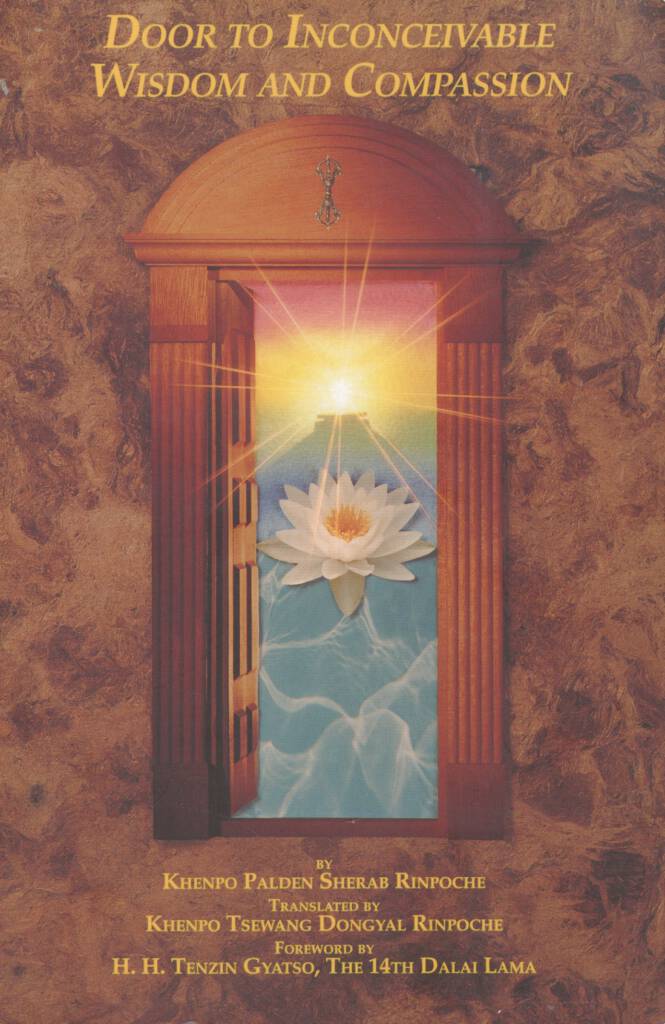
Door to Inconceivable Wisdom and Compassion (Sherab 1996)
From Bodhicitta
< Books(Redirected from Door to Inconceivable Wisdom and Compassion (Sherab 1996))
Books/Door to Inconceivable Wisdom and Compassion (Sherab 1996)
Books/Door to Inconceivable Wisdom and Compassion (Sherab 1996)
| 🤓 Admin Zone 🛠️ hidden to non-admins | |
Door to Inconceivable Wisdom and Compassion
Book
Please note that many items in our library are simply pages that represent a detailed library catalog entry and citation of someone else's work, presentation, or performance. Read our General Disclaimer for more information.
-front.jpg)
Description
Of all the Mahayana Buddhist teachings currently available in the Western hemisphere, none is as seminal as the instruction on Bodhicitta, a Sanskrit term symbolizing the union of loving-kindness, compassion, and the wisdom of ultimate reality.
Khenpo Palden Sherab Rinpoche opens wide The Door To Inconceivable Wisdom And Compassion by skillfully presenting a full spectrum of understandings and everyday applications regarding this most powerful, immediate and practical means of spiritual transformation and realization. (Source: Sky Dancer Press)
Citation
Sherab, Khenpo Palden. Door to Inconceivable Wisdom and Compassion. Translated by Khenpo Tsewang Dongyal Rinpoche. Boca Raton, Florida: Sky Dancer Press, 1996.
Table of contents
- Foreword by H.H. Tenzin Gyatso, The 14th Dalai Lama vii
- Introduction ix
- 1. The Three Minds of the Buddha 1
- 2. The Seven Treasures 19
- 3. Refuge 27
- 4. The Eightfold Path 35
- 5. The Way of the Bodhisattva 47
- 6. Meditation 131
- 7. Exchanging 141
- 8. The Five Paths 149
- Appendices
- The Lists 165
- The Bibliographies 172
Interconnections
1 Contains chapter or part

Khenpo Palden Sherab presents an introduction and commentary to Śāntideva's Bodhicaryāvatāra in the book Door to Inconceivable Wisdom and Compassion.
1 Teaching based on

An "Introduction to Bodhisattva Practice," the Bodhisattvacaryāvatāra is a poem about the path of a bodhisattva, in ten chapters, written by the Indian Buddhist Śāntideva (fl. c. 685–763). One of the masterpieces of world literature, it is a core text of Mahāyāna Buddhism and continues to be taught, studied, and commented upon in many languages and by many traditions around the world. The main subject of the text is bodhicitta, the altruistic aspiration for enlightenment, and the path and practices of the bodhisattva, the six perfections (pāramitās). The text forms the basis of many contemporary discussions of Buddhist ethics and philosophy.