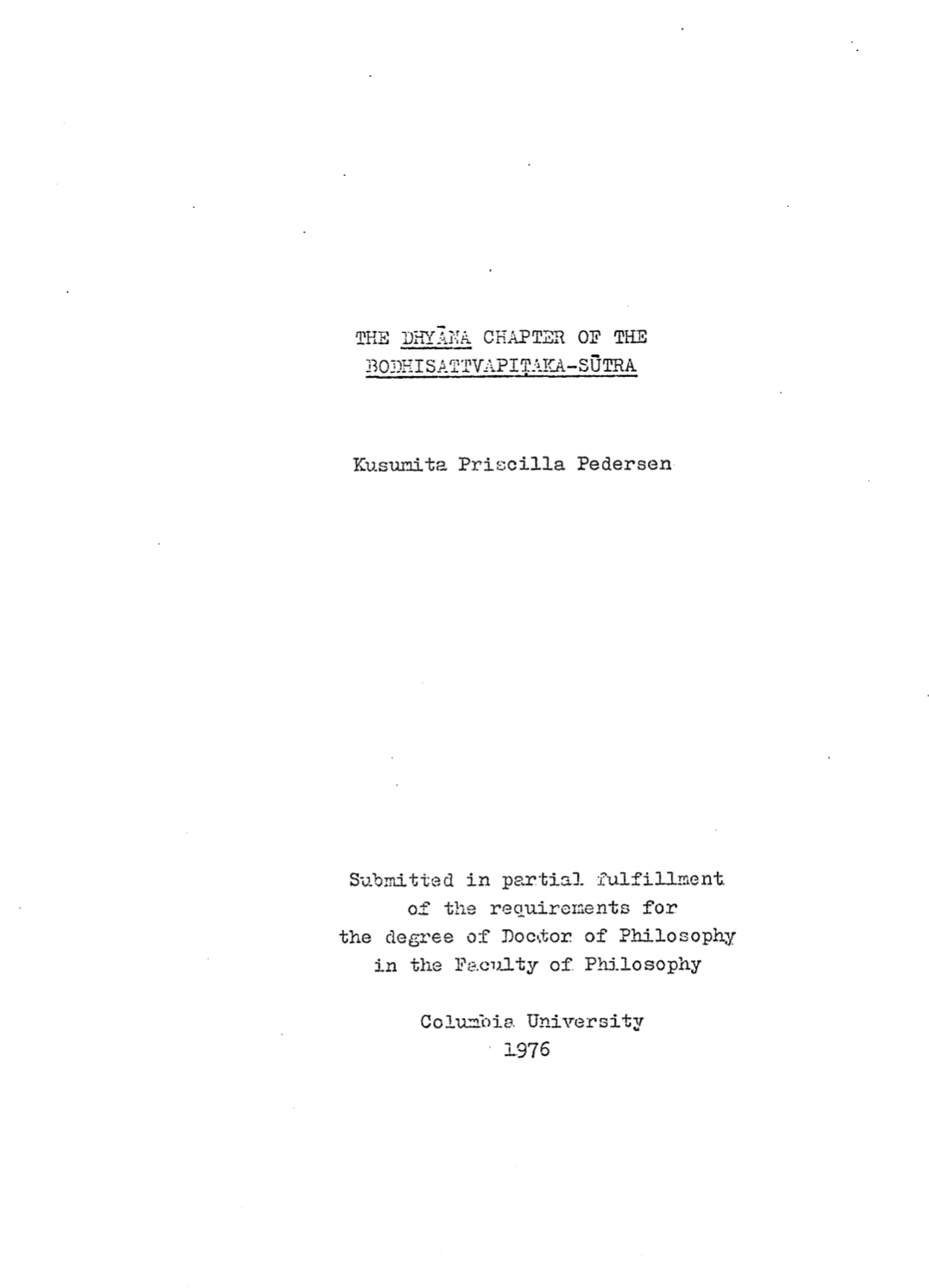
The Dhyāna Chapter of the Bodhisattvapiṭaka-Sūtra
| 🤓 Admin Zone 🛠️ hidden to non-admins | |

Description
The term "Bodhisattva-piṭaka" has a wide currency in Mahāyāna Buddhist literature, and is thought by some scholars to refer to a collection which actually existed in early Mahāyāna of works concerned with the Bodhisattva practice. There are instances of the term which support this view, but the term "Bodhisattva-piṭaka" is also often used simply to indicate scriptures of the Mahāyāna.
The dhyāna chapter of the Bodhisattvapiṭaka-sūtra begins with a formulaic passage on the four dhyānas and then deals at length with the five abhijñās or supernormal faculties. This description comprises about half of the chapter. The remainder praises the dhyāna of the Bodhisattva, his aid of sentient beings and his spiritual knowledge, and ends with a verse section. Translations of both versions of the chapter, with notes, form Part Three of the dissertation. The Chinese texts, reproduced from the Taisho Tripiṭaka, are furnished in an Appendix.
A number of texts on dhyāna were examined for purposes of comparison with the dhyāna chapter of the Bodhisattvapiṭaka-sūtra. These were Saṇgharakṣa's Yogacarabhūmi, Asaṅga's Śrāvakabhūmi, and Buddhaghosa's Visuddhimagga, as "Hinayana"-oriented treatments of dhyāna, and as works which included a treatment of dhyāna within that of the group of pāramitās, the verses on dhyāna of the Ratnaguṇasamcayagatha and the Dharmasamuccaya, the dhyāna chapters of Āsaṅga's Bodhisattvabhūmi, Śāntideva's Bodhicaryāvatāra, and Ārya-Śūra's Pāramitāsamāsa, and portions of Śāntideva's compendium, the Śikṣāsamuccaya.
This comparison showed a great variety in treatments of dhyāna in Buddhist literature, which we have roughly categorised as "Hinayana" and "Mahayana" in style. The "Hinayana" approach, is technical and expository, explaining methods of dhyāna for the practitioner, while the "Mahayana" approach emphasises the fact that the Bodhisattva practices dhyāna in order to aid sentient beings, and in extolling the Bodhisattva path may say relatively little about the practice of dhyāna as such. These two "phases" of the treatment of dhyāna occur together in certain works, and it seems that Buddhist writers did not feel them to be mutually inconsistent. The dhyāna chapter of the Bodhisattvapiṭaka-sūtra is almost entirely Mahayana in the style of its treatment of dhyāna. An assessment of its distinguishing qualities and its position in Buddhist tradition awaits further comparison with Mahayana sutra literature as well as commentarial and verse works such as those discussed here.