| 🤓 Admin Zone 🛠️ hidden to non-admins | |
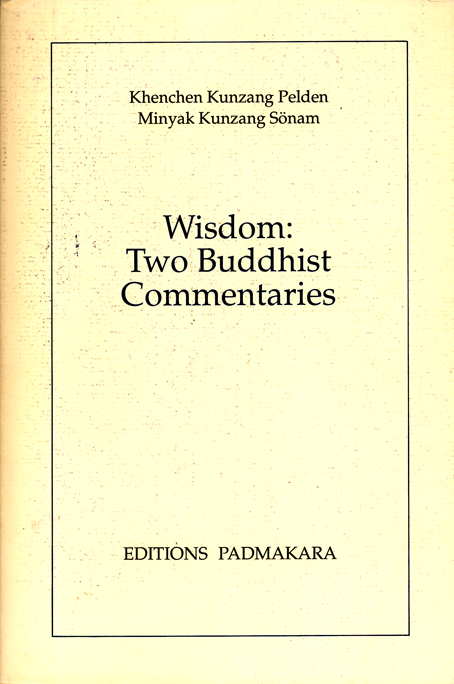
Wisdom: Two Buddhist Commentaries: On the Ninth Chapter of Shantideva's Bodhicharyavatara
Book
- A Commentary on Shantideva's Engaging in the Conduct of the Bodhisattvas
- A Few Good Men
- A Flash of Lightning in the Dark of Night
- A Great Commentary on Shantideva's Guide to the Bodhisattva's Way of Life, Vol. 1
- A Guide to the Bodhisattva Way of Life
- A Guide to the Bodhisattva's Way of Life (1985)
- A Guide to the Bodhisattva's Way of Life (1999)
- A Study of the Wisdom Chapter (Prajñāpāramitā Pariccheda) of the Bodhicaryāvatārapañjikā of Prajñākaramati
- Altruism and Reality (1998)
- An Intoxication of Mouse Venom: Reading the Guide, Chapter 9
- Appendix B: Excerpt from A Lamp Completely Illuminating the Profound Reality of Interdependence
- Becoming Bodhisattvas
- Bodhicaryāvatāra 9:2 as a Focus for Tibetan Interpretations of the Two Truths in the Prāsangika Mādhyamika
- Bodhicaryāvatāra with Commentary (O'Sullivan)
- Bodhicitta: Cultivating the Compassionate Mind of Enlightenment
- Bodhisattva e Prajñāpāramitā nel Bodhicaryāvatāra di Śāntideva
- Bodhisattvacaryāvatāra: Entering the Way of the Bodhisattvas (2022, Khenpo Gawang and Wiener)
- Can We Kill Illusory People? Some Philosophical Reflections on Bodhi(sattva)caryāvatāra 9:11-13ab
- Comprendre la vacuité
- Courageous Compassion
- Discourses on Bodhicharyāvatāra
- Drops of Nectar: Khenpo Kunpal's Commentary on Shantideva's Entering the Conduct of the Bodhisattvas
- Engaging in Bodhisattva Behavior
- Engaging in the Bodhisattva Deeds
- Engaging in the Conduct of the Bodhisattvas
- Entering the Way of the Bodhisattva: A New Translation and Contemporary Guide
- Epitome of the Bodhicaryāvatāra with Its Pañjikā, Chap. IX
- Following in the Buddha's Footsteps
- For the Benefit of All Beings
- Guide to the Bodhisattva's Way of Life (Bodhicaryavatara): A Commentary by Geshe Tenzin Zopa
- Guide to the Good Life
- Healing Anger
- How to Be a Bodhisattva: Introduction to the Practice of the Bodhisattva Path (The Bodhicaryāvatāra)
- In Praise of Great Compassion
- Indian Madhyamaka Buddhist Philosophy after Nagarjuna, Vol. 2
- Introduction to Gzhan gyis brtsad pa'i lan mdor bsdus pa rigs lam rab gsal de nyid snang byed: An Answer to Blo-bzang-rab-gsal's Refutation of the Author's 'Sher le nor bu ke ta ka' and Its Defence, the Brgal lan nyin byed snang ba
- L'opalescent joyau
- Le commentaire de Mi-pham au chapitre IX du Bodhicaryāvatāra de Śāntideva: Échos modernes d'une controverse du XVème siècle
- Mi pham and the Philosophical Controversies of the Nineteenth Century
- Mipham's Dialectics and the Debates on Emptiness
- No Time to Lose
- Patience: A Guide to Shantideva's Sixth Chapter (Zopa 2020)
- Peaceful Heart
- Perfecting Patience
- Perfecting Wisdom
- Polemics in Indo-Tibetan Scholasticism - A Late 19th-Century Debate Between 'Ju Mi pham and Dpa' ris Rab gsal
- Practicing Wisdom
- Readings of Śāntideva's Guide to Bodhisattva Practice
- Seeing from All Sides
- Shantideva and Friends
- Shantideva's Bodhicaryavatara: An Internal Pilgrimage to Universal Peace and Compassion
- Shantideva's Guide to the Bodhisattva's Way Of Life: An Oral Explanation of Chapter 4
- Shantideva's Guide to the Bodhisattva's Way Of Life: An Oral Explanation of Chapter 5
- Shantideva's Guide to the Bodhisattva's Way Of Life: An Oral Explanation of Chapter 6
- Shantideva's Guide to the Bodhisattva's Way Of Life: An Oral Explanation of Chapter 7
- Shantideva's Guide to the Bodhisattva's Way Of Life: An Oral Explanation of Chapter 8
- Shantideva's Guide to the Bodhisattva's Way of Life: An Oral Explanation of Chapter 1
- Shantideva's Guide to the Bodhisattva's Way of Life: An Oral Explanation of Chapter 2
- Shantideva's Guide to the Bodhisattva's Way of Life: An Oral Explanation of Chapter 3
- Studies in the Philosophy of the Bodhicaryāvatāra (2000)
- Sur l'océan du Mahayana
- Sāntideva, The Bodhicaryāvatāra, Chapter 8 (verses 89-140)
- Tant que durera l'espace
- The Beautiful Way of Life
- The Bodhisattva Guide
- The Buddhist Roots of Secular Compassion Training: A Comparative Study of Compassion Cultivation in Indian and Tibetan Mahāyāna Sources with the Contemporary Secular Program of Compassion Cultivation Training (CCT)
- The Case of 'Ju Mi pham (1846–1912) and Dpa' ris Rab gsal (1840–1912): A Study in Dgag lan Debate
- The Center of the Sunlit Sky
- The Entrance for the Children of the Conquerors
- The Middle Way of the Bodhisattva
- The Nectar of Manjushri's Speech
- The Profound Reality of Interdependence
- The Profound Reality of Interdependence-Review by Bouthillette
- The Reflexive Nature of Awareness (1998)
- The Way of Awakening
- The Way of the Bodhisattva (1997)
- The Way of the Bodhisattva (2006)
- The Wisdom Chapter
- Transcendent Wisdom (1988)
- Transcendent Wisdom (2009)
- Uncommon Happiness
- Vimalakīrtinirdeśa: The Teaching of Vimalakīrti (Gómez, L. and Harrison, P.)
- Wisdom: Two Buddhist Commentaries
- Śāntideva (Internet Encyclopedia of Philosophy)
- Śāntideva and the Mādhyamika: The Prajñāpāramitā-Pariccheda of the Bodhicaryāvatāra
Please note that many items in our library are simply pages that represent a detailed library catalog entry and citation of someone else's work, presentation, or performance. Read our General Disclaimer for more information.

Description
One of the most intriguing and challenging aspects of Buddhism is the idea of Emptiness. This is the subject of the ninth chapter of the Bodhicharyavatara (The Way of the Bodhisattva), one of the great classics of Mahayana Buddhist literature. The author, Shantideva, introduces the philosophical view of the Madhyamika school and describes the development of Transcendent Wisdom, the heart and life of Buddhist practice.
Numerous commentaries have been written by great Buddhist masters to explain Shantideva's somewhat cryptic poetry and subtle philosophical arguments. Two such commentaries, translated from Tibetan at the request of H.H the Dalai Lama, are presented in this book, along with a new translation of the original text. While both are highly respected within the explanatory tradition, their striking differences, in both emphasis and style, provide a rare depth of perspective on this essential subject. (Source: back cover)
Citation
Blankleder, Helena, Wulstan Fletcher, and Stephen Gethin (Padmakara Translation Group), trans. Wisdom: Two Buddhist Commentaries on the Ninth Chapter of Shantideva's Bodhicharyavatara. Khenchen Kunzang Palden's The Nectar of Mañjushri's Speech and Minyak Kunzang Sönam's The Brilliant Torch. Saint Léon sur Vézère, France: Editions Padmakara, 1999.
Table of contents
- Prefaceix
- Translators' Introductionxi
- Historical Notexv
- Bodhicharyavatara: The Wisdom Chapter1
- Book One: The Nectar of Mañjushri's Speech29
- Introduction31
- Wisdom established by means of the view35
- Wisdom experienced by means of meditation73
- Misconceptions dispelled through reasoning103
- The benefits of realising emptiness119
- Book Two: The Brilliant Torch127
- Brief Introduction129
- The Two Truths137
- The need to realise emptiness173
- Proofs of emptiness191
- Exhortation to develop wisdom249
- Colophon257
- The Nectar of Mañjushris Speech: Structural Outline260
- The Brilliant Torch: Structural Outline264
- The Philosophical Schools in Ancient India (chart)271
- Bibliography273
Interconnections
1 Full translation of

This commentary incorporates Gyaltsap Dharma Rinchen's explanations of the 9th chapter in his Spyod 'jug dar tik and his concise and extensive note-commentaries. It is summarized into three key points: the objective of cultivating the wisdom of realizing emptiness, the methods for cultivating it, and an appeal to endeavor to cultivate it.
2 Partial translation of

An "Introduction to Bodhisattva Practice," the Bodhisattvacaryāvatāra is a poem about the path of a bodhisattva, in ten chapters, written by the Indian Buddhist Śāntideva (fl. c. 685–763). One of the masterpieces of world literature, it is a core text of Mahāyāna Buddhism and continues to be taught, studied, and commented upon in many languages and by many traditions around the world. The main subject of the text is bodhicitta, the altruistic aspiration for enlightenment, and the path and practices of the bodhisattva, the six perfections (pāramitās). The text forms the basis of many contemporary discussions of Buddhist ethics and philosophy.

Khenpo Kunpal (1862-1943), student of Patrul Rinpoche and Mipham the Great, wrote this famous extensive word and meaning commentary (tshig don gyi 'grel pa) with a topical outline (sa bcad) to Śāntideva's Chonjuk (Bodhisattvacaryāvatāra).
1 Contains chapter or part

Blankleder, Helena, Wulstan Fletcher, and Stephen Gethin (Padmakara Translation Group), trans. "Historical Note." In Wisdom: Two Buddhist Commentaries on the Ninth Chapter of Shantideva's Bodhicharyavatara. Khenchen Kunzang Palden, The Nectar of Mañjushri's Speech, Minyak Kunzang Sönam, The Brilliant Torch, xv–xvi. Saint Léon sur Vézère, France: Editions Padmakara, 1999.