| 🤓 Admin Zone 🛠️ hidden to non-admins | |
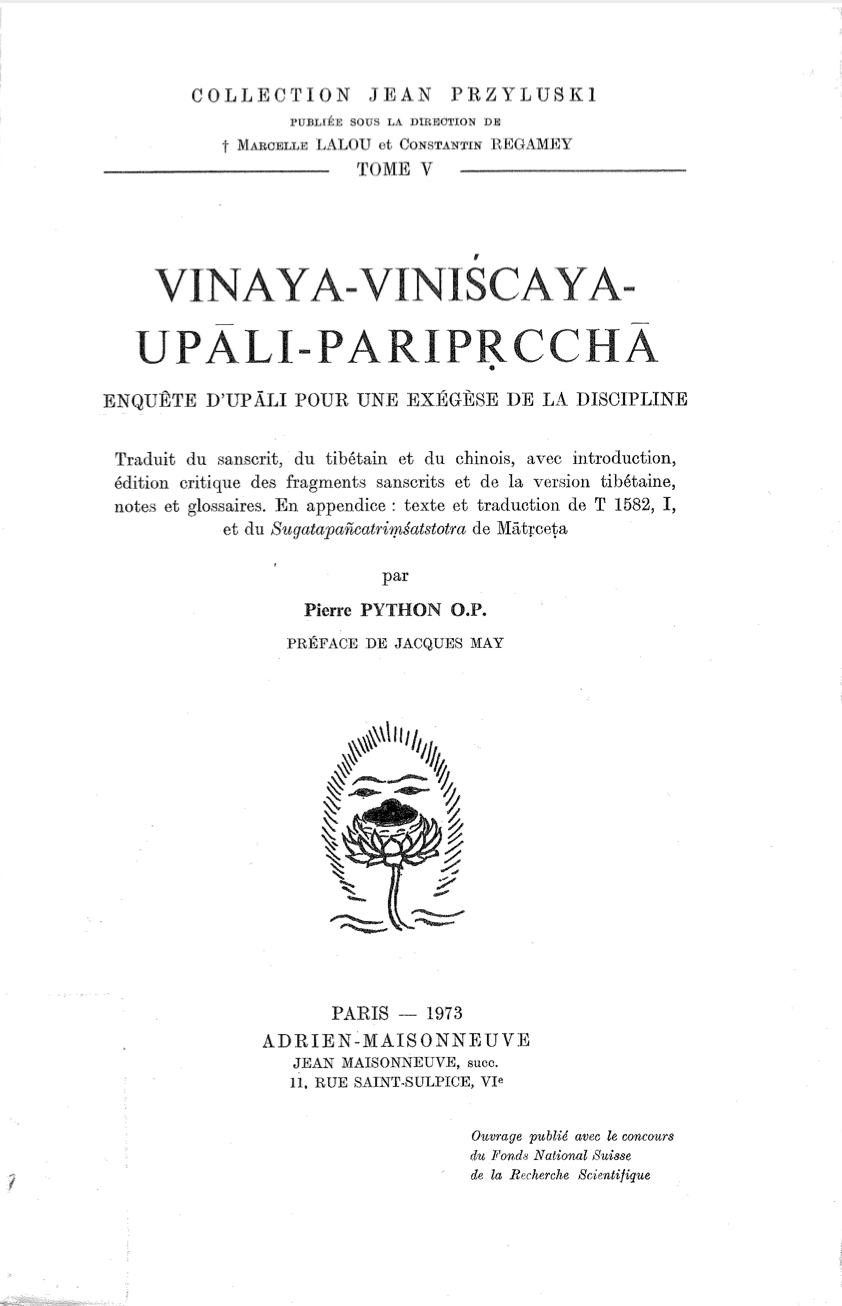
Vinaya-viniścaya-Upāli-paripṛcchā: Enquête d'Upāli pour une exégèse de la discipline
Book
Please note that many items in our library are simply pages that represent a detailed library catalog entry and citation of someone else's work, presentation, or performance. Read our General Disclaimer for more information.

Description
A French translation of the Vinayaviniścayopāliparipṛcchāsūtra by Pierre Python from the Sanskrit, Tibetan, and Chinese; with introduction, critical edition of Sanskrit fragments and the Tibetan version, notes and glossaries. In appendix: text and translation of T1582 (Bodhisattvabhūmi), I, and of the Sugatapañcatriṃśatstotra of Mātṛceṭa
Citation
Python, Pierre, trans. Vinaya-viniścaya-Upāli-paripṛcchā: Enquête d'Upāli pour une exégèse de la discipline. Collection Jean Przylusci 5. Paris: Adrien-Maisonneuve, 1973.
Table of contents
- PréfaceVII
- Avant-proposXI
- Ouvrages citésXV
- AbréviationsXIX
- Concordance des traductions chinoisesXX
- Introduction
- A. Les sources du texte1
- 1. Le texte sanscrit1
- 2. Les traductions tibétaine et chinoise2
- 3. La date4
- 4. Le titre4
- 5. L'unité et la composition5
- 6. Les personnages6
- B. La doctrine6
- 1. Le présupposé doctrinal7
- 2. Le code du Mahāyāna8
- 3. L'esprit de l'observance: altruisme, puissance de régénération, engagement à longue portée10
- 4. Un au-delà de Ia morale: doctrine des deux vérités, orgueil, morale de l'absurde13
- A. Les sources du texte1
- VERSION TIBÉTAlNE et FRAGMENTS SANSCRITS19
- VERSIONS CHINOISES65
- TRADUCTION FRANÇAISE
- Première Partie: Héroisme et moyens des Bodhisattva
- Introduction (§ 1-2)83
- 1. Le grand engagement des Bodhisabtva en vue du salut des êtres (§ 3-14)84
- 2. Admirable équipement des Bodhisattva et leur esprit de renoncement jusqu'au sacrifice
du corps (§ 15)90 - 3. L'art des Bodhisattva de convertir les êtres par conformité de vie sans se départir
du domaine de l'Absolu (§ 16-17)92 - 4. Le point d'aboutissement: le Tathāgata (§ 18-19)94
- 5. Générosité et patience des Bodhisattva (§ 20)95
- 6. Ce qui est péché pour les Bodhisattva (§ 21)96
- 7. Code de discipline et confession aux Trente-cinq Buddha (§ 22-28)97
- 8. Les recueillements actifs des Bodhisattva (§ 29-30)104
- Conclusion sur les privilèges et l'éminence des Bodhisattva (§ 31-32)106
- Première Partie: Héroisme et moyens des Bodhisattva
- Deuxième Partie: La discipline et son dépassement clans la perspective du Grand Véhicule
- Introduction: Question d'Upāli sur le règlement de discipline (§ 33-34)108
- 1. La pureté respective des moralités des deux Véhicules en fonction de l'acceptation ou
du refus des réincarnations (§ 35-36)110 - 2. Trois caractéristiques des deux Observances, déduites par mode d'opposition: altruisme
ou non-altruisme, immunité ou non-immunité, aboutissement lointain ou ordre sans relâche
(§ 37-40)111 - 3. Encouragement du Buddha aux Bodhisattva dans cette épreuye de force et de longue
haleine (§ 41)115 - 4. Gravité comparée des péchés selon l'optique des deux Observances (§ 42-43)116
- 5. Dépassement de la discipline: les êtres disciplinés par nature (§ 44-45)117
- 6. L'inconcevabilité, porte de la délivrance et remède a l'orgueil des Moines et des Bodhisattva
(§ 46-49)120 - 7. Bréviaire de l'inconcevabilité, donné par Buddha:122
- a) lnconcevabilité en épistémologie (§ 50-59)123
- b) Inconcevabilité en morale (§ 60-93)126
- Conclusion : Intitulation du traité (§ 94)135
- Deuxième Partie: La discipline et son dépassement clans la perspective du Grand Véhicule
- Appendice I: Texte chinoise du T 1582, I et traduction française137
- Appendice II: Texte tibétain et traduction française du Sugatapañcatrimśatstotra de Mātṛceṭa155
- Appendice III: Liste des Bodhisattva168
- Liste des Samādhi170
- Liste des Buddha172
- Index sanscrit-tibétain-chinois-français174
- Index tibétain-sanscrit204
- Table des matières221
- Hors-texte: Reproduction du manuscrit népalais de la Collection Bendall (Bibl. Univ. Cambridge)
Interconnections
1 Full translation of

Ascertaining the Vinaya: Upāli's Questions is a sūtra focused on the relationship between and integration of the prātimokṣa vows of monastic discipline and the conduct of a bodhisattva who follows the Mahāyāna tradition. The sūtra’s two main interlocuters, Śāriputra and Upāli, query the Buddha about the relationship between these two levels of commitments, eliciting a teaching on the different orientations held by the followers of different Buddhist vehicles and how their different views affect the application of their vows. Ascertaining the Vinaya is a particularly valuable sūtra for its inclusion of a unique form of the confessional "Three Sections" rite, making it one of the few extant canonical sources to describe it at length. (Source: 84000)